
The excellent article below, originally published by America Out Loud, draws on the work of two outstanding Canary contributors, Professor Henrik Svensmark and Professor Nir Shaviv (Chapters 4 and 5 of Canary in a Climate World).
Their research explores the fascinating relationship between solar activity, cosmic rays, cloud formation, and Earth’s climate—offering a perspective that challenges the idea that changes in atmospheric CO₂ alone drive our weather and climate.
Whether you are new to these concepts or have followed the climate debate for years, this article provides an accessible introduction to one of the most intriguing areas of climate science. It also helps explain why many of the distinguished contributors to Canary in a Climate World argue that the Earth’s climate system is far more complex than is often presented in the public debate.
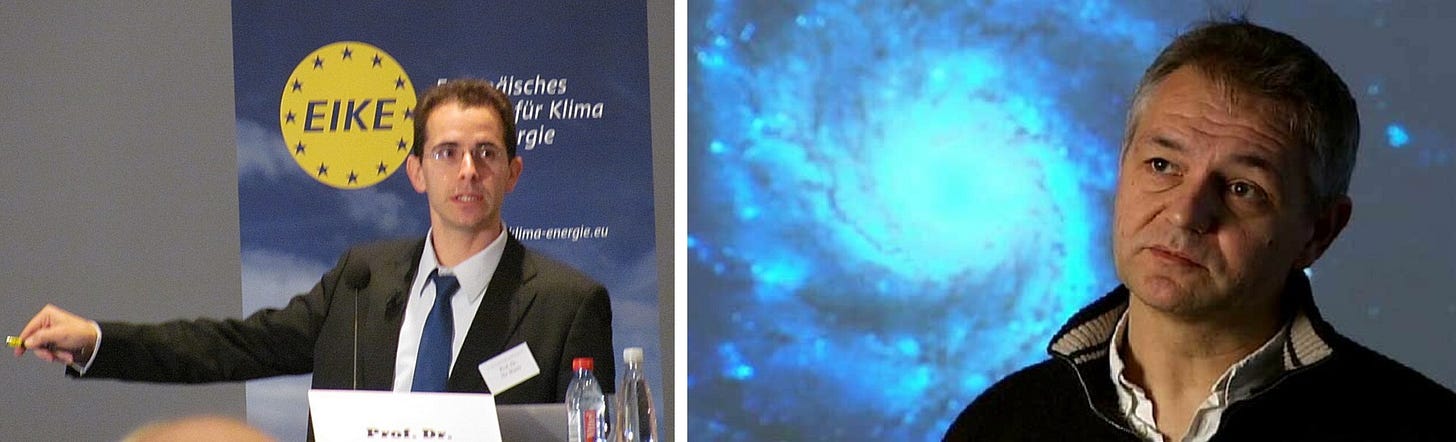
Nir Shaviv (left) Henrik Svensmark (right)
Do distant stars affect life on Earth? The answer may seem like an obvious “no,” but there is a striking connection between galactic cosmic rays and clouds that directly impacts biological life. In the newly released book Canary in a Climate World: Climate Realism vs. the Net Zero Myth, 38 experts have come together to write essays on the science of climate change, the fallacies of Net Zero, and the story the government and media are not telling us. One unusual but fascinating connection between the Earth’s climate and galactic cosmic rays (GCRs) is explored in Canary essays by physicist and climate researcher Dr. Henrik Svensmark (DTU Space, Technical University of Denmark) and astrophysicist Dr. Nir Shaviv (Hebrew University of Jerusalem).
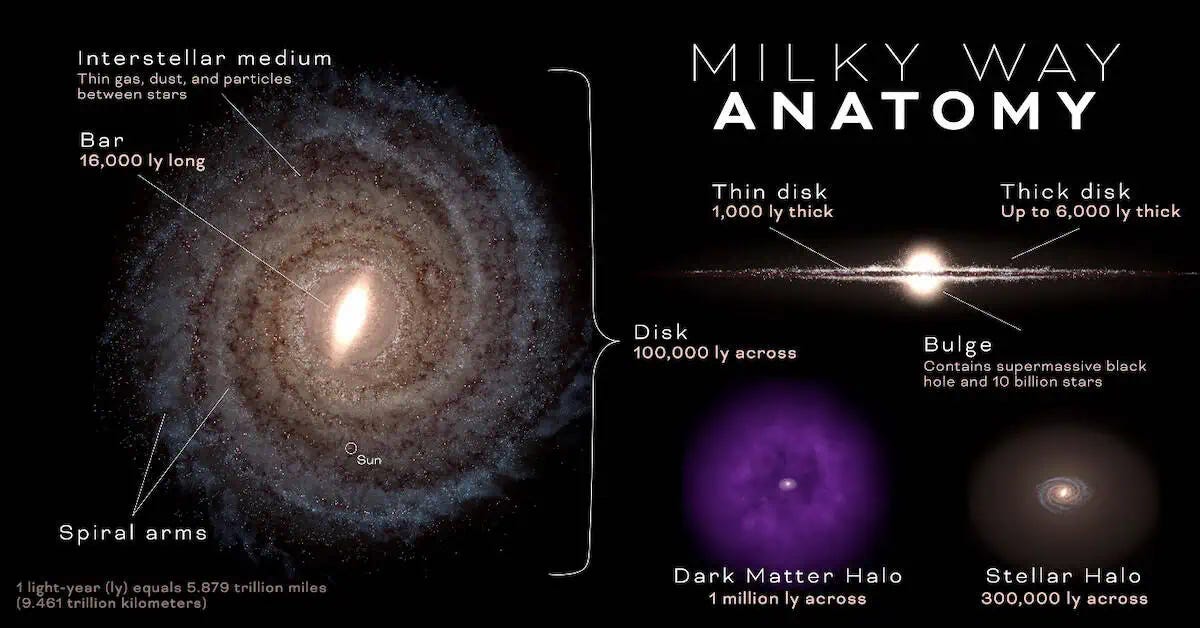
Dr. Svensmark has studied how changes in GCRs reaching the Earth affect cloud cover over time. GCRs are high-energy particles from outer space, created primarily from supernovae that accelerate particles at high speeds close to the speed of light. Using satellite observations, we can measure their abundance as they come streaming toward the Earth. The solar wind shields our planet from much of the GCRs, yet since the Sun’s output varies over time due to solar cycles, the number of GCR particles that reach the Earth likewise varies over time. This, in turn, affects atmospheric ionization, which forms clouds.
For a cloud droplet to form, there must be a surface for water vapor to condense onto that is larger than 50 nm (nanometers). If cosmic rays affect the number of cloud condensation nuclei that are formed, then they would also impact the cloud cover over Earth’s surface. The following graph from Dr. Svensmark’s Canary essay illustrates the process.
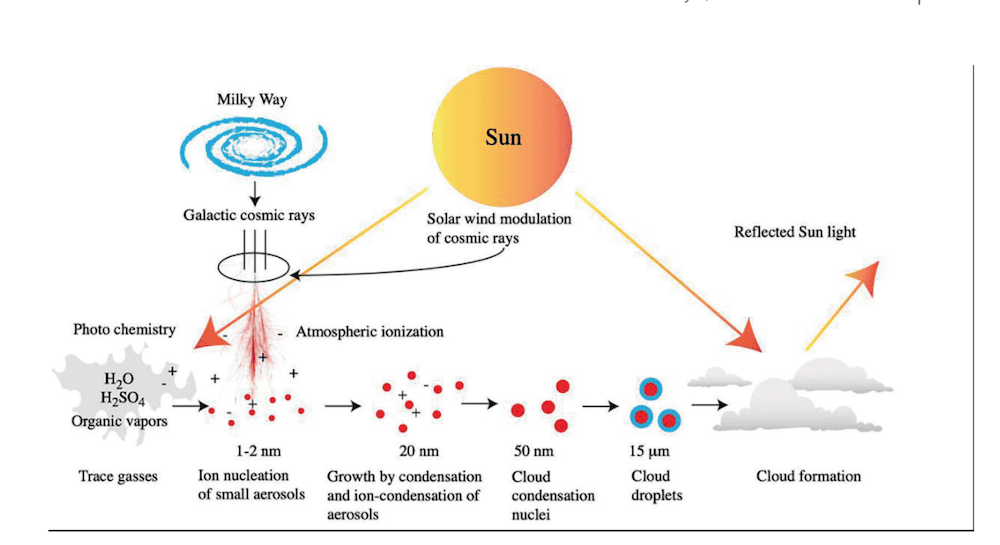
The formation of clouds through the interaction of solar wind and galactic cosmic rays.
(ref: Canary in a Climate World: Climate Realism vs. the Net Zero Myth, p. 61)
Clouds are obviously a major influence on the Earth’s climate. When there is more cloud cover, temperatures are generally cooler. It is thus not only that the increased and decreased solar output during different solar cycles result in a warmer or cooler planet, but it also affects the number of cosmic rays entering the atmosphere, and hence, the amount of cloud formation.
As explored by Dr. Nir Shaviv in his Canary in a Climate World: Climate Realism vs. the Net Zero Myth essay, the Sun undergoes an 11-year solar cycle that affects the strength of the solar wind and ultraviolet radiation. This has been observed throughout history by carbon-14 isotope dating. Carbon-14 is produced in the atmosphere when cosmic rays collide with atmospheric gases. It is then incorporated into plants and trees, leaving a trace in tree rings. Thus, in times when the Sun is less active, there are more cosmic rays, and so we expect to find more carbon-14 in tree rings. Conversely, when the sun is more active, there are fewer cosmic rays, so we expect to find less carbon-14. This is illustrated in the picture below from Canary.
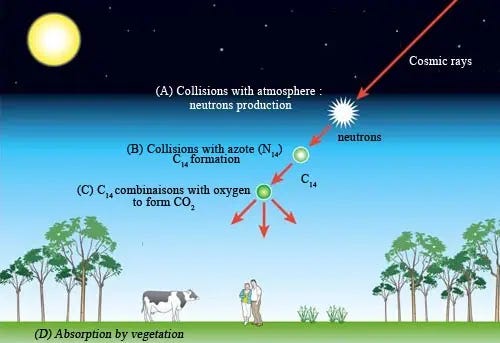
The formation of carbon-14 in the atmosphere by cosmic rays. (ref: Radioactivity.eu.com)
This reconstruction of solar activity by carbon-14 can then be compared to the temperature record, determined using oxygen isotopes in marine sediments and stalagmites. Scientists have found a clear correlation between these two indicators in various datasets from around the world.
In addition to the 11-year solar cycle, Dr. Shaviv explains that cosmic rays can vary on longer timescales. Solar activity controls how many GCRs enter Earth’s atmosphere, but our position in the Milky Way Galaxy itself also affects the number of cosmic rays that reach the Earth from supernovas. When our solar system passes through areas of intense star formation, we see more cosmic rays. Scientists have discovered that we go through a 145-million-year cycle as the Earth passes through the arms of the Milky Way, corresponding to icehouse periods (Ice Ages) and hothouse periods. Currently, we are in a warmer interglacial period within an icehouse period. Dr. Shaviv and geochemist Dr. Ján Veizer showed that about two-thirds of the temperature changes during the Phanerozoic Eon (the current eon in Earth’s geologic time scale, spanning from about 538.8 million years ago to the present) can be accounted for by cosmic ray variations. Dr. Shaviv states that “the evidence points to a strong solar-climate link, amplified by cosmic rays and cloud processes.”
The graph below from Dr. Svensmark illustrates the correlation between supernova activity and life on Earth, with the red line showing the proportion of organic material buried in oceanic sediments over the past 500 million years. This correlation is an astounding revelation in science: the activity of distant stars influences the climate and so all life on Earth. When there is more biological productivity in the oceans, there is a greater fraction of organic material buried in marine sediments, and so it is an indicator of the abundance of life on Earth.
In his 2022 paper, “Supernova Rates and Burial of Organic Matter,” Dr. Svensmark explains, “High levels of cosmic ray flux result in a colder climate with more extensive [ocean] circulation, which provides increased nutrient flux to the [marine] biological systems and may support larger biomass and increase the fraction of biological material buried in sediments.” Another fascinating implication is that biodiversity on Earth is also influenced by supernova activity. Dr. Svensmark has found that marine biodiversity over the past 500 million years can be explained by supernova frequency as well as the area of shallow seas.
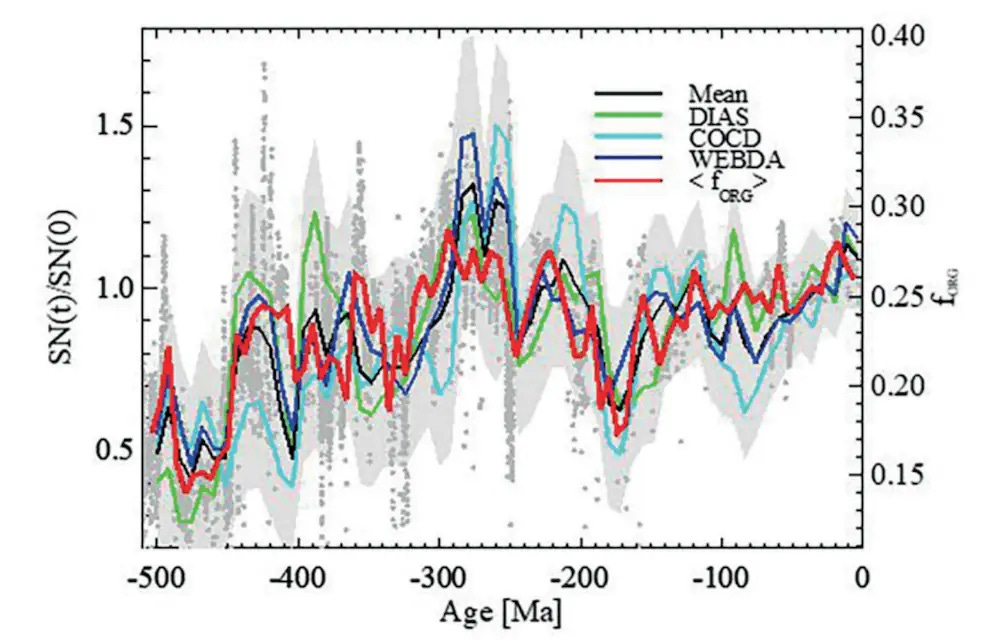
Supernova activity [left axis] is shown in green, blue, and teal, with the mean shown in black, over the past 500 million years. The fraction of carbon in sediments is shown in red [right axis], matching well with supernova activity.
(ref: Canary in a Climate World: Climate Realism vs. the Net Zero Myth, p. 67)
In experimental physicist Dr. John Clauser’s essay in the book, he emphasizes the importance of studying nature through careful observations. “Good science is always based on good experiments,” he tells us. Indeed, although computer models can often give us a good sense of what we can expect in the future on a smaller scale, for instance, when predicting the weather, when it comes to the climate, there are so many factors that come into play that accurate prediction is currently impossible. But science is now overrun with “techno-cons”—the application of scientific disinformation for opportunistic purposes. That could be by the government, businesses, lawyers, or any other organization that has a stake in the outcome. We see this en masse with environmental organizations. It is only through well-educated scientists such as Dr. Clauser, Dr. Shaviv, and Dr. Svensmark who honestly search for the truth that we can come to better understand our world, and hence, solve the world’s problems. We don’t want to just follow the “perception of truth,” but follow where the facts lead us, however inconvenient.
As we can see, the climate is a highly complex and nuanced system, and so it is more important than ever to continue studying it in all its complexities. Forces far outside our control, such as galactic cosmic rays, are one of the many keys to understanding the Earth’s climate, and with Dr. Svensmark’s and Dr. Shaviv’s advances, we are one step closer to grasping the incredible forces that shape our planet.
Mary-Jean Harris, BSc, MSc Physics, contributed to this article.
No posts
Comments
Nothing yet. Say the first thing.
Sign in to join the conversation.