
This article topic came from a subscriber request after my Long COVID piece, and I'm so glad it did, because these two topics are obviously, like obviously, related. This article is going to walk you through the virus most of us have already met (about 95% of us, if we're going by the numbers), the connection between Epstein-Barr Virus and autoimmunity, and why COVID is even part of this conversation at all (trust me, it's really interesting and kind of mindboggling).
Okay, first, let's get you familiar with the virus itself, and then we'll get into the fun stuff :) Well, its honestly all fun stuff in my opinion!
This was incredibly enlightening for me to research. All the dots seem to be there just STARING AT US, blinking in anticipation, but we’re just patiently waiting for science to find the lines to connect them all.
ALSO don’t forget to grab your notebooks and be prepared to come back to this a few times. It’s a bit dense, but I didn’t want to leave anything out. :)

If you’re an adult reading this, there’s a very good chance EBV is already living in your body right now (kind of a wild thing to sit with, honestly). It infects somewhere around 90 to 95% of adults worldwide (Shabnam and Khan, 2026), making it one of the most common viruses on the planet!
EBV is a member of the herpesvirus family, technically classified as a B-lymphotropic gammaherpesvirus, or human herpesvirus 4 (HHV-4) if you want the formal, fancy name (Shabnam and Khan, 2026). Most of us pick it up in early childhood, and childhood infection is usually so mild it comes and goes without anyone noticing. No fever, no drama, nothing. In adolescence, though, first exposure carries much higher odds of actually making you sick. Around 30 to 70% of teens and young adults infected for the first time develop infectious mononucleosis (Draborg et al., 2013), the “kissing disease” most of us have at least heard of by name (Shabnam and Khan, 2026).
EBV’s main route in is saliva, which is why infectious mononucleosis earned the “kissing disease” nickname. The virus enters through the oropharynx, the back of your throat, and works its way into the surrounding tissue before finding its real target: B cells, the immune system’s antibody factories (Draborg et al., 2013). Saliva isn’t the only way in, though. Sexual contact, organ transplantation, and blood transfusion can all transmit EBV as well (Shabnam and Khan, 2026), so this isn’t purely a childhood-cooties situation.
But once it reaches a B cell, EBV stops behaving like the virus you’d probably picture in your head.
dramatic pause for effect
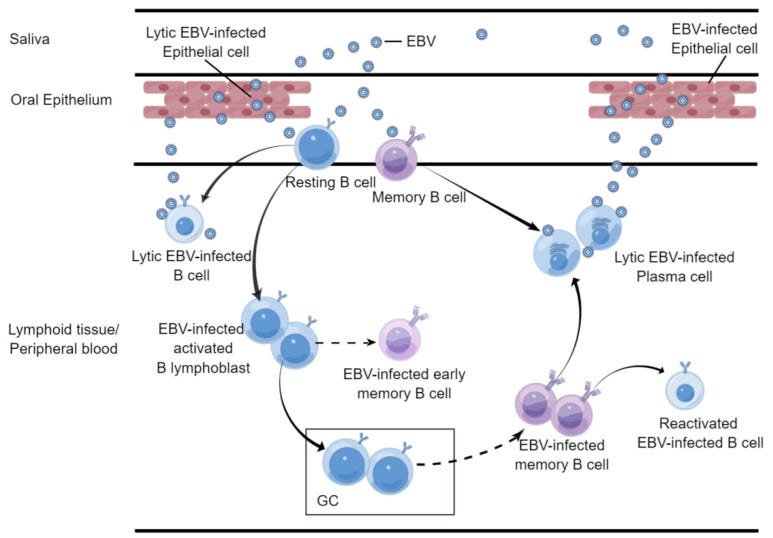
Model illustrating the infection of EBV in human.
Once inside of us, EBV has two very different ways it can behave. It can enter an active, or lytic, cycle, where it uses the infected cell to produce new copies of the virus that can go on to infect other cells. But EBV can also do something that explains how an infection you picked up as a kid can still be hanging around decades later: it can go latent.
During latency, the viral genome literally curls itself into a loop, forming a circular piece of DNA called an episome that sits inside the nucleus of the B cell, separate from your own chromosomes. Then EBV starts shutting things down. Depending on the stage of latency, most of its genes get switched off, and in resting memory B cells, viral protein production can become extremely limited or even undetectable (Draborg et al., 2013). SO! Now you’ve got a B cell carrying the entire EBV genome around inside of it while giving the immune system very little indication that anything unusual is happening. Sneaky.
But just hiding inside the cell isn’t enough. EBV also has to keep that cell alive.
B cells carry a protein called Bim, whose job is to trigger apoptosis, essentially cellular self-destruction, when something inside the cell has gone wrong. Very useful when the cell in question is carrying around an entire viral genome! EBV, naturally, would prefer that not happen. Through epigenetic changes, it can suppress the gene responsible for making Bim, turning down this self-destruct signal without actually changing the underlying DNA sequence (Paschos et al., 2009). Less Bim means less pressure for that infected B cell to undergo apoptosis, giving the cell, and the EBV genome sitting inside of it, a better chance of sticking around.
And it can stick around for a VERY long time. EBV establishes this reservoir inside the memory B-cell population, which is how a virus you may have picked up before you could even spell Epstein-Barr can still be sitting there decades later.
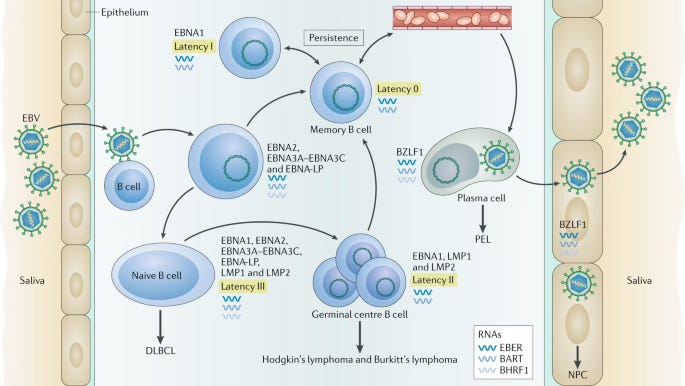
Latency in EBV
Of course, EBV isn’t getting away with all of this completely unopposed. A huge part of keeping the virus under control comes down to T cells, particularly CD8+ cytotoxic T cells, which can recognize and destroy infected cells (Draborg et al., 2013).
For those T cells to know what’s happening inside a cell, they need a way to actually see in there. That’s where MHC I comes in. Almost every nucleated cell in your body displays MHC I molecules on its surface, and those molecules hold up tiny pieces of proteins from inside the cell for CD8+ T cells to inspect (Wieczorek et al., 2017). If those pieces look normal, carry on. If one of them is viral? Now the immune system knows something is in there that absolutely shouldn’t be.
EBV, naturally, has found ways to interfere with this too. During active infection, it can disrupt the MHC I antigen-presentation pathway, reducing how effectively viral proteins get displayed to CD8+ T cells (Draborg et al., 2013). And during latency, EBV creates a different problem altogether by keeping its viral protein production extremely limited. Fewer viral proteins being made means fewer obvious signs of infection for the immune system to catch.
So, there’s this constant push and pull happening in the background. Your T cells are keeping watch over EBV-infected cells, while EBV is doing everything it can to give them as little to work with as possible. For most people, the immune system maintains that balance remarkably well, which is how you can carry EBV for the rest of your life without ever knowing it’s there.
One of EBV’s more interesting tricks involves molecular mimicry, where something made by the virus resembles something made by us. EBV takes advantage of that resemblance in a couple of different ways.
One is functional mimicry, where EBV makes its own version of a human protein that can do a very similar job. EBV actually carries the instructions for making a viral version of IL-10, one of our own anti-inflammatory cytokines (I know, what the heck). This viral IL-10 can suppress interferon-gamma production and dampen CD8+ cytotoxic T cell responses, the very cells we just talked about that help keep EBV-infected B cells under control (Draborg et al., 2013). IMPOSTER!
But there’s another kind of mimicry that becomes especially interesting when we start talking about autoimmune disease. Here, a viral protein resembles one of our own proteins closely enough that an immune response meant for the virus can cross-react with our own tissue. Your body builds an immune response against an EBV protein, completely correctly, but if part of that viral protein looks enough like something your own cells make, some of those antibodies or T cells may recognize both (Shabnam and Khan, 2026).
Your immune system is working off of bad information. :(
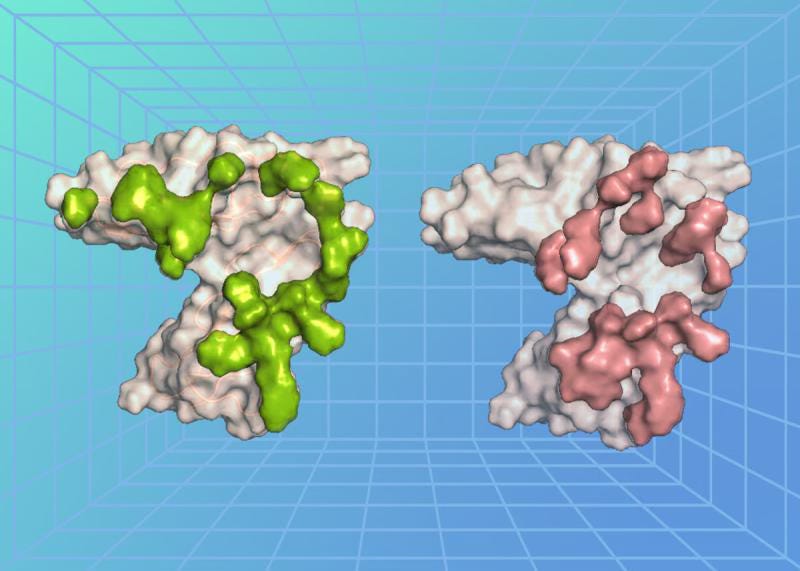
Side-by-side 3D models comparing how viral gp350 (green, left) and endogenous C3d (pink, right) map onto the B-cell receptor CR2 (gray).
And keep the concept of molecular mimicry in your back pocket during your immunology studies, because this is NOT just an EBV thing! Other pathogens are capable of doing this too.
Alright, now remember from earlier that when EBV goes dormant, it shuts down most of its genes and keeps only a small amount of viral activity going? One of the proteins that can stick around during latency is called EBNA1, or Epstein-Barr nuclear antigen 1. This one is especially interesting when we start looking at autoimmune disease (Shabnam and Khan, 2026).
In lupus, for example, parts of EBNA1 resemble Ro (SSA), one of the autoantigens targeted by the immune system in SLE. Antibodies produced against EBNA1 can cross-react with Ro, meaning the same antibody can recognize both the viral protein it was originally made to target and one of your own proteins (Draborg et al., 2013). From there, something called epitope spreading can happen, where an immune response that started against one small target gradually expands to recognize additional parts of the same protein, and eventually other proteins too (Fahlquist-Hagert et al., 2023). What started as a response against EBV has now widened into an autoimmune response against multiple targets.
EBNA1 doesn’t seem to have just one human look-alike. In MS, researchers have found cross-reactivity between EBNA1 and anoctamin-2, or ANO2, a protein expressed in the central nervous system. Antibodies against ANO2 are found more often in people with MS than in controls, and experiments have shown that antibodies recognizing ANO2 can also recognize a specific region of EBNA1 (Shabnam and Khan, 2026). Same viral protein, completely different human target.
So, what happens when EBV stops hiding?
Remember that latency isn’t permanent in the sense that EBV gets locked away inside a B cell and can never become active again. The virus can switch back into its lytic cycle, start producing new viral particles, and begin infecting other cells again. This is EBV reactivation!
Researchers still don’t have a complete picture of what makes that switch happen every time, but part of it comes down to the normal life cycle of the B cell itself. When a latently infected B cell differentiates into a plasma cell, the cellular changes involved in that process can activate EBV’s lytic program and push the virus back into active replication (Draborg et al., 2013). Reactivation can also happen spontaneously, during periods of acute or chronic stress, or alongside infection with another pathogen (Tarasco et al., 2025).
A lot of this comes back to the balance we talked about earlier between EBV and the immune system. If that balance gets disrupted, the conditions that were keeping a latent infection under control can change. Both immune suppression and an excessively inflammatory immune response have been associated with reactivation, which sounds a little backwards at first because those are opposite ends of the immune spectrum (Tarasco et al., 2025). But either one can interfere with the coordinated immune response that normally keeps EBV contained.
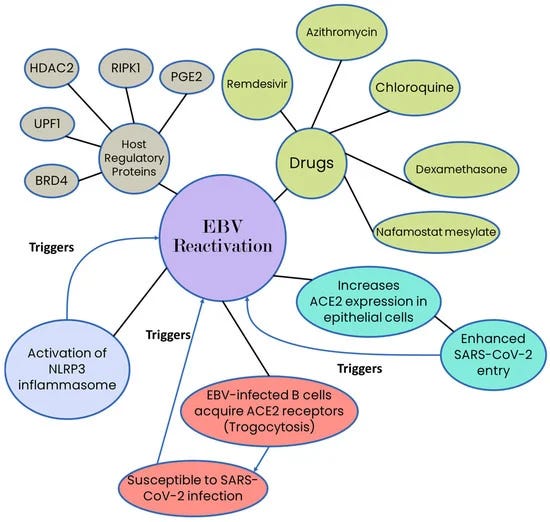
And we actually have a very big, very recent example of what that can look like: COVID-19.
Comments
Nothing yet. Say the first thing.
Sign in to join the conversation.