
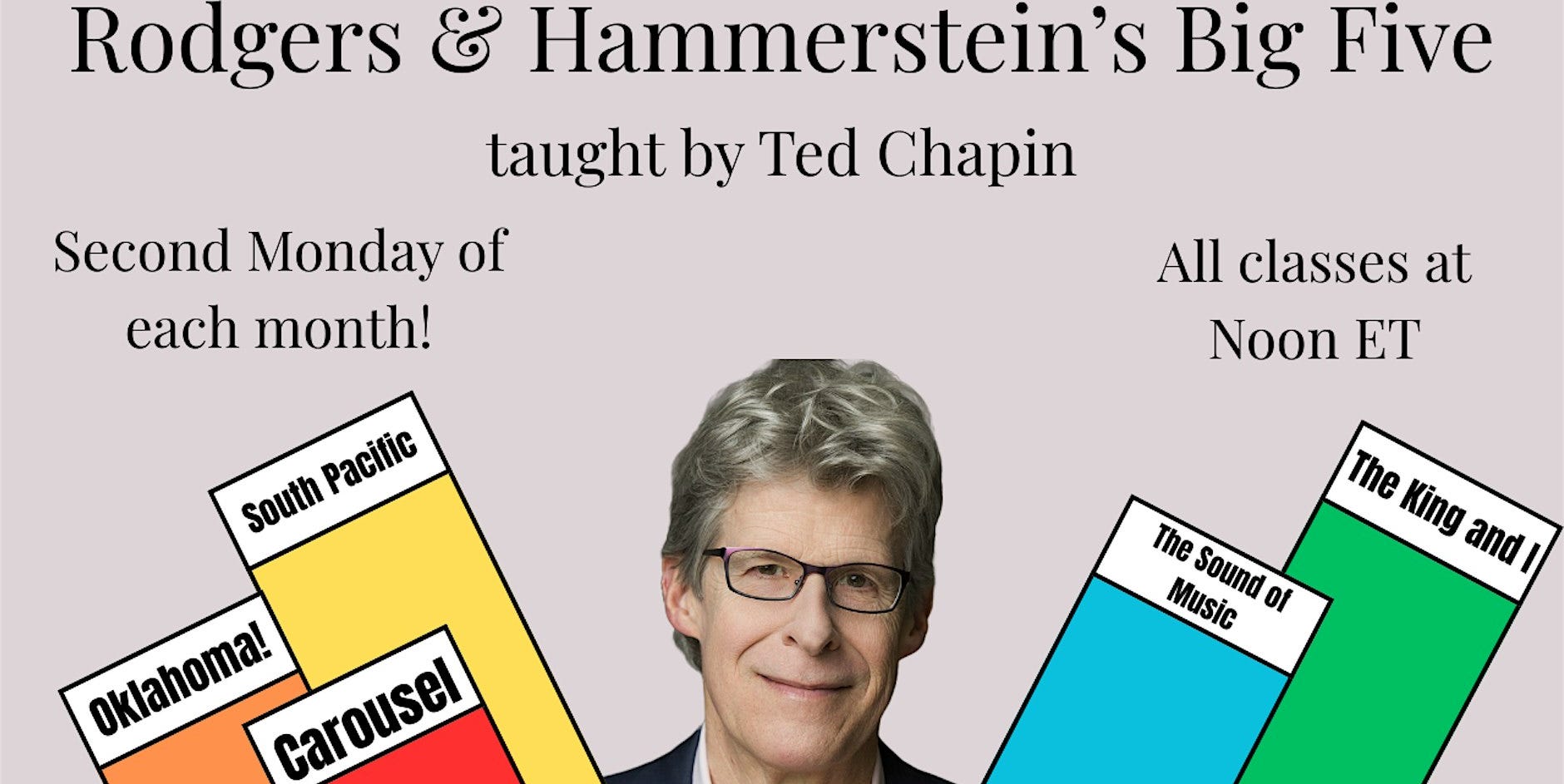
Join us for an exciting kickoff lecture to an in-depth 12-part series exploring the major accomplishments of Broadway’s Rodgers & Hammerstein. This series will be taught by Rodgers & Hammerstein expert Ted Chapin, who served as President of The Rodgers & Hammerstein Organization for more than 30 years. Ted is the world’s expert on Rodgers & Hammerstein and his knowledge of their canon is boundless. Tuition is $180, which you can later apply to a year’s Membership at The Broadway Maven.
Monday, August 10: Intro to Rodgers & Hammerstein
Monday, September 14 and Monday, October 12: Oklahoma!
Monday, November 9 and Monday, December 14: Carousel
Monday, January 11 and Monday, February 8: South Pacific
Monday, March 8 and Monday, April 12: The King and I
Monday, May 10 and Monday, June 14: The Sound of Music
Monday, July 12: The Legacy of Rodgers & Hammerstein
Register for Ted Chapin's class
On today’s marquee: A) An essay about Tevye’s relationship with God — and his daughters — in Fiddler on the Roof; B) a StageStreams about “For Forever” from Dear Evan Hansen; C) a quiz about show tunes with street names in them; and D) a Last Blast about My Fair Lady.

ESSAY: In Fiddler on the Roof, Tevye talks to God constantly. In these trademark one-sided conversations, the show’s patriarch complains, negotiates, jokes, pleads. Tevye addresses Heaven as if engaged in a lively dialogue, but God never responds.
Tevye never seems to interpret that silence as indifference. If anything, God’s refusal to answer reinforces His authority. Tevye may complain, bargain, even accuse Heaven of unfairness, but he never imagines that God’s silence strips God of the right to decide. The conversation is one-sided not because Tevye has stopped speaking, but because he accepts that ultimate authority need not explain itself.
That one-sided conversation quietly becomes the model for the way Tevye understands authority.
That strange dynamic—a conversation defined by faith and silence—also shapes Tevye’s relationships with his daughters. The household structure at the beginning of the musical resembles the same one-sided conversation Tevye imagines with God. Authority flows downward. Decisions are announced. Obedience is assumed. Tevye may debate with Heaven, but within his own family he sees his role as unquestioned authority.
When Tzeitel’s future comes under discussion, Tevye initially treats the matter exactly this way. The marriage arrangement with Lazar Wolf is announced as a fact of life. Tradition has already spoken. Yet something unexpected happens: Tzeitel argues back. She insists on marrying Motel instead. For the first time in Tevye’s household, a daughter refuses to accept the silent, hierarchical structure that has governed family life. Instead of obedience, Tevye receives dialogue.
Hodel’s story deepens this pattern. She looks not for her father’s permission to marry Perchik, just his blessing. When she pursues Perchik to Siberia, she again forces Tevye into a conversation he did not initiate. She explains herself, reasons with him, and appeals to his sense of justice. Tevye wrestles with the decision aloud, just as he wrestles with questions when speaking to God. But unlike Heaven, Hodel answers him. She explains her motives. She offers arguments. Tevye’s customary monologue of authority becomes something different when Hodel talks and he finds himself listening.
The story reaches its breaking point, though, with Chava. Her decision to marry Fyedka challenges not only Tevye’s authority but the boundary between Jewish and Christian worlds he believes must remain intact. For Tzeitel and Hodel, Tevye could weigh one claim against another: “On the other hand.” With Chava, he stops the argument itself. “There is no other hand,” he decides. He does not argue, negotiate, or plead. He simply withdraws. “Chava is dead to us,” he declares, ending the conversation before it can begin.
Even Tevye’s final, inaudible “God be with you”—in versions that emphasize it—does not reopen the conversation. Chava cannot hear him. Tevye speaks once more to or through God, but still not directly to his daughter.
The silence is devastating because it breaks the pattern Tzeitel and Hodel had established. Both daughters insisted on conversation, and Tevye ultimately answered them in kind. Chava reaches for that same dialogue, but this time Tevye refuses to participate. The conversations he has with God remain one-sided. Now, for the first time, so does a conversation with his daughter.
In that moment, the parallel that has quietly shaped the musical reveals itself. As Tzeitel and Hodel transform authority into dialogue, Tevye’s relationships with his daughters seem poised to break the hierarchy he has long accepted in his conversations with God. Yet Chava’s decision restores the older structure.
Tevye closes the conversation before it can begin, assuming the same silent posture that has long defined the highest authority in his own life.
This reversal reveals something profound about the musical’s understanding of tradition and authority. Fiddler on the Roof is often described as a story about balancing tradition and change. It is also a story about how authority is learned. Tevye has spent his life speaking to a silent God, accepting that silence as the shape of ultimate authority. His daughters teach him that authority need not end a conversation; it can survive one.
Throughout the musical, Tevye accepts that God will not answer him. He never accepts that his daughters should expect the same from him. Yet when Chava forces the greatest test of his authority, silence is the language he instinctively chooses. It is the one form of authority he has lived under all his life.
BROADWAY MAVEN StageStreams: In this portion of Mateo Chavez Lewis’s Dear Evan Hansen class from Monday, July 6, the accomplished composer and music educator dives into the orchestration and journey of Evan throughout one five-minute song, “For Forever.” Is the song one of Pasek and Paul’s best? Well, this musical breakdown argues it’s one of the best in musical theater history.
QUIZ: In which Broadway shows would you find these songs whose titles mention streets, roads, and avenues? Answers at the end of the issue, after the Last Blast. And no Googling!
“42nd Street”
“Christopher Street”
“Ease on Down the Road”
“Easy Street”
“Grant Avenue”
“On the Street Where You Live”
“The Road You Didn’t Take”
“Skid Row (Downtown)”
“Welcome to Our House on Maple Avenue”
“West End Avenue”
READER PANEL: MARQUEE is looking for subscribers willing to offer feedback on drafts of upcoming lead stories. It’s an easy and fun way to include your voice in the conversation! Write The Broadway Maven at DavidBenkof@gmail.com to be included.

Join The Broadway Maven! Nowhere else online brims with this much Broadway content, and certainly not for so little (Membership is $25 a month for 5-15 compelling classes). Purchase a monthly or an annual plan. Cancel at any time. Sign up here:
Broadway Maven Members get the Friday Blast once a week filled with Members-only goodies. It’s the easiest way to get links for upcoming classes. In this week’s Friday Blast: links to the upcoming classes on Intro to Rodgers & Hammerstein and Merrily We Roll Along; recordings of BOTH Sweeney Todd classes; a Broadway Blast on Flower Drum Song; a YouTube highlight about “On My Own” in American Sign Language; and the Archive clips reel of the week on Lynn Ahrens Beyond Ragtime.
SPECIAL OFFER: Through September 1, new Members who sign up for a year get one month FREE!
One month FREE Broadway Maven Membership

• Monday, August 10 Introduction to Rodgers & Hammerstein with Ted Chapin, Noon ET (12-part monthly course, $180, sign up HERE)
• Tuesday, August 11 Merrily We Roll Along with David Benkof and Asher Shectman, Noon and 7 pm ET, ($50 for a 16-part course, register HERE)
• Sunday, August 16 Sunday in the Park with George Watch Party, Noon ET (MEMBERS ONLY)
• Monday, August 17 Broadway in the 1970s with UW Prof. David Armstrong, Noon ET (MEMBERS ONLY)
• Tuesday, August 18 Sunday in the Park with George with David Benkof and Asher Shectman, Noon and 7 pm ET, ($50 for a 16-part course, register HERE)
• Tuesday, August 25 Into the Woods with David Benkof and Asher Shectman, Noon and 7 pm ET, ($50 for a 16-part course, register HERE)
• Monday, August 31 Jule Styne with Steve Bell, 7 pm ET (MEMBERS ONLY)
• Tuesday, September 1 Godspell, Noon and 7 pm ET (MEMBERS ONLY)

LAST BLAST: In My Fair Lady, Higgins insists he can transform Eliza through language, but he never fully acknowledges that he’s the one being reshaped. His world depends on fixed categories—proper/improper, refined/common—but Eliza’s presence destabilizes those distinctions. The more he trains her to navigate his system, the more she exposes its arbitrariness. By the end, Higgins hasn’t exactly lost control of Eliza—he’s lost control of the framework that made his control possible. Language doesn’t just elevate Eliza; it undermines him.
ANSWERS TO QUIZ: 42nd Street, Wonderful Town, The Wiz, Annie, Flower Drum Song, My Fair Lady, Follies, Little Shop of Horrors, Fun Home, The Magic Show
The Broadway Maven is a vibrant educational community that helps its members think more deeply about musical theater. We offer 5-15 classes a month for just $25. We also foster enthusiasm for Broadway through the FREE weekly Substack newsletter MARQUEE and host an expansive YouTube channel. It’s your home for Broadway appreciation. Contact The Broadway Maven at DavidBenkof@gmail.com.
Comments
Nothing yet. Say the first thing.
Sign in to join the conversation.