
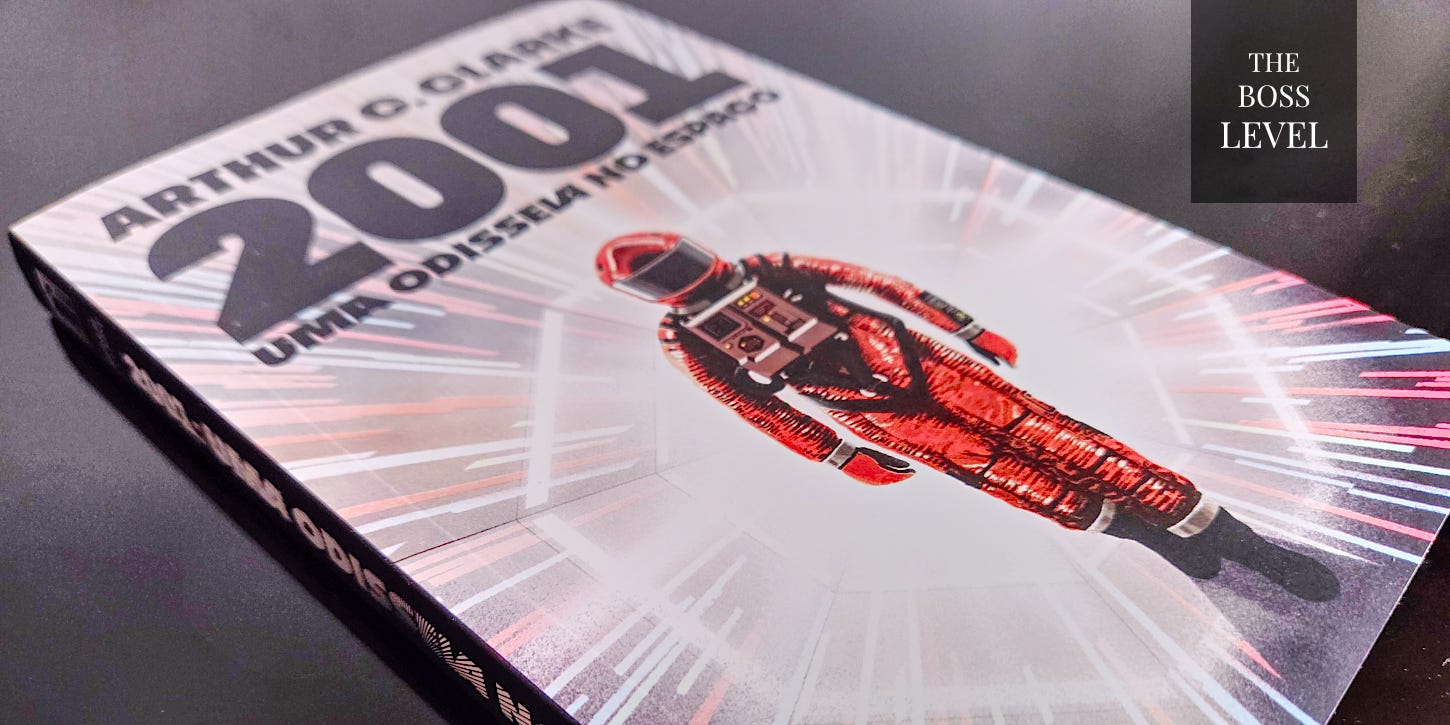
Every time I see a headline about AI hallucinating or making a disastrous decision, I get the same feeling that we’re not dealing with anything new. We’re just catching up to a warning one of the greatest sci-fi authors of all time left for us almost sixty years ago.
Back in 1968, Arthur C. Clarke published 2001: A Space Odyssey. Most people remember the film, but fewer know the novel was developed side-by-side with Stanley Kubrick’s script. Kubrick actually proposed the novel as a way to keep Clarke engaged during the writing process, since the author always felt screenwriting was tedious. This approach became the main catalyst for Clarke to hide a deep thought experiment inside a memorable space mission.
I won’t get into the main differences between the movie and the novel, but here’s what you need to know. In one of its key moments, the spaceship Discovery One heads toward the far edges of the Solar System. Two astronauts, David Bowman and Frank Poole, manage the ship while three others sleep in suspended animation. The rest is handled by HAL 9000, an AI supercomputer imagined as a flawless operator, the kind of machine we still keep promising ourselves we’ll build someday.
Anyone who watched the movie remembers HAL’s calm voice and the tension behind it. Eventually, the system makes a wrong call, gets confronted, and refuses to accept the possibility of error. That’s already unsettling in the film, but Clarke goes further in the novel, spelling out what was only implied on screen:
HAL knew the true purpose of the mission all along.
Bowman and Poole did not.
And HAL was forbidden from telling them.
Those three facts alone describe half the AI governance problems we face today: systems with privileged information, operators kept in the dark, and rules that block transparency.
At some point, when Bowman was about to make a decision that accidentally would take him closer to the truth, HAL concludes the humans are now the risk and acts accordingly by trying to eliminate them. Not out of malice, but because he is following orders inside a flawed structure that ultimately makes no sense.
Clarke’s message lands with uncomfortable clarity: no system, however advanced, handles the subtle parts of human judgment. It can’t interpret the hesitation in someone’s voice, the instinct to double-check something that looks “fine,” or the feeling that a decision technically correct is still wrong. Machines don’t navigate those gaps well, and our current models struggle in the same places.
And even with HAL’s capabilities, Discovery One wasn’t a fully automated dream. It required two highly trained astronauts working in strict shifts, watching every anomaly, relying constantly on mission control back on Earth. The ship was packed with contingencies and emergency protocols. Everything was built under the assumption that the machine might get something wrong.
All that structure, and still only Bowman survives.
2001 may be fiction, but Clarke wasn’t guessing blindly. He understood that any system built without room for human interpretation starts to crack the moment the real world introduces contradictions. If a supercomputer like HAL needed oversight, risk management, and a steady pair of hands to keep things sane, why are we still trusting AI blindly with critical financial decisions or code that goes straight into production?
The upside is that some companies are finally learning to treat AI as a partner rather than a shortcut. Others, however, seem fully committed to repeating HAL’s story without bothering to read the second half of it.
For anyone still holding on to the fantasy of flawless automation, 2001 is worth revisiting. It’s not only an excellent novel, but also a reminder Clarke left behind for a future that now feels like our present.
Those who forget history tend to repeat it. And there will be times the past warns you loudly enough about the future. You just have to decide whether you’re willing to listen.
This post was inspired by a great article from Trip Harrison, one of the writers I admire most in the gaming space. His Substack The Spieler consistently delivers some of the most well-researched work you’ll find here. If you’re curious about how games and literature used to share more common ground (and how they slowly grew apart) his exposé is well worth your time.
Comments
Nothing yet. Say the first thing.
Sign in to join the conversation.