
The Body Copy is weekly-ish newsletter where I try to keep my feminist marbles as I talk about AI, language, and design. For the most part I try to be calm and reflective, but other times I’ve had too much coffee and not enough snacks and I have THOUGHTS. Either way, I’m here to poke at things. If you like what you read, feel free to share. If you hate it, consider sharing it anyways. As always, thanks for being here.
Exclamation point (mark)
noun [ ex·cla·ma·tion, | \ ˌek-sklə-ˈmā-shən, ˈmärk \ ]
1: A mark ! used especially after an interjection or exclamation to indicate forceful utterance or strong feeling.
—Merriam Webster
I have at many points in my adult professional life gone back through an email or Slack message and re-read it multiple times before hitting send. In many of those moments, I have done one of two things: added an exclamation because oh god you sound like a troll ready to murder a bunch of puppies for jackets or removed one or all of them because oh god you sound hysterical no wonder people ask you what medications you take. Sometimes both.
So I’ll sit with either Sounds good! or Sounds good. for way too long and way too much effort.
(Where is the version of “sounds good” that just SOUNDS GOOD? )
What I’ve come to realize (and talked way too much about with my therapist, bless her heart) is that punctuation, specifically exclamation points, matter because somewhere along the way (thank you Mr. White, my fave high school English teacher) I just learned that they do.
I also learned they are gendered female. Exclamation points are girly, to be more precise and academic about it.
There are researchers who went out and explored this. Their research shows that yes, women use exclamation points more than men. Not because we’re inherently or biologically more enthusiastic about life (I am most definitely not), but because we often see a sentence and are like oh god this most definitely needs a party hat! Give it a party hat.
Linguist Debbie Cameron has a different read. She argues that women use exclamation points more because we’ve learned, through many many years of social feedback and training, that how we come across and present ourselves to the world matters to us. It’s the equivalent of smiling to seem non-threatening and approachable. It’s making sure you come off as friendly and warm instead of aggressive or rude. This is the game. Cool! Let’s go!
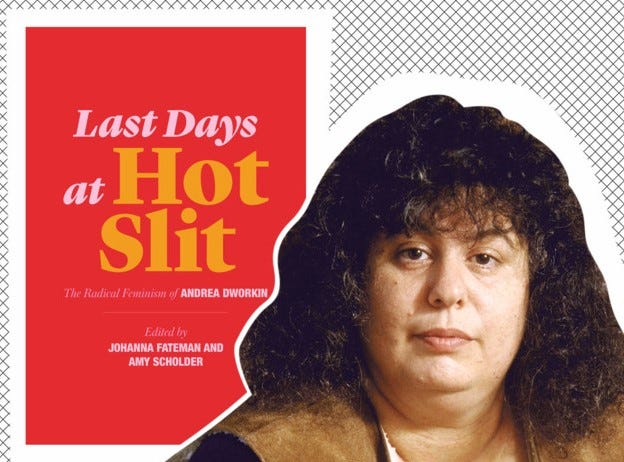
I’m going to pivot for a second to reference one of the most unhinged and polarizing writers out there among the feminist witch circles: Andrea Dworkin.
Dworkin is many things. She’s one of those writers people either want to high five or hurt badly by squeezing lemon juice in her eyeballs. She’s known mostly for being very anti-porn, very anti-sex work, and for influencing a lot of contemporary radical feminist thought.
Her problematic views aside, her writing style is definitely something else. It’s jagged and loud and sometimes feels like a scalpel coming for your throat. Her punctuation is also all over the place. I may be reading and then there’s no period or comma or apostrophe and I find myself instantly having some sort of judgment against her. There’s no order. IT IS NOT CORRECT.
She wrote about that judgment in a piece called The Great Punctuation Typography Struggle. In it, she writes acidically about her publisher wanting to correct her punctuation:
“Ive attacked the fundaments of culture, thats ok. Ive attacked male dominance, thats ok. Ive attacked every heterosexual notion of relation, thats ok. Ive in effect advocated the use of drugs, thats ok. (…) lower case letters are not. it does make one wonder.”
She didn’t change her punctuation. She also separately argued that male supremacy is a whole system of violence enforced (in part) by academic norms, including punctuation. It makes me wonder, if:
“Women must be beautiful, or at least attractive. Surrounded by mechanisms that enforce that beauty. (…) From the age 11 or 12, until she dies, a woman will spend a large part of her time, money, and energy on binding, plucking, painting, and deodorizing herself.” (Dworkin 2019, 57)
Could this then mean:
Punctuation rules (and who gets to enforce them) are analoguous to the beauty standards we are told to conform to? Just a thought.
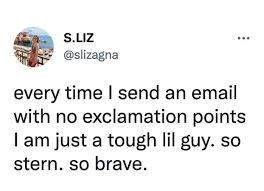
Back to exclamation points. The Internet has thoughts:
I work in UX writing and conversation design, which means I spend a good chunk of my waking life thinking about whether a button should say Get Started or Get Started! or whether or not the guideline I write to train the LLM should have a strict rule about when to be enthusiastic!!! and when to not.
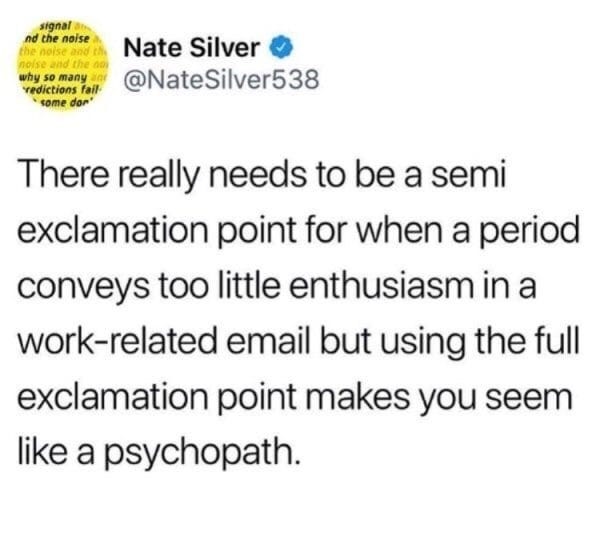
The wisdom I’ve received over the years in product writing is consistent: no exclamation points on buttons, use sparingly in notifications, never in your wildest dreams use in an error state.
The unofficial reason for that is that exclamation points are the written equivalent of goofy jazz hands and what we’re going for is confident and authoritative and a voice that isn’t wondering whether you find it annoying. But OK sure, you can use one or two exclamation points, but jesus christ make sure it’s in the right place at the right time for the right reason.
This is all tongue in cheek of course, I’m not an idiot. I understand brand, I understand style, and I understand that a brand or product wants to give off a certain impression. Totally fair.
What I’m poking at or questioning is: when we add or delete that exclamation point, do we thoughtfully consider why?
If the exclamation point is the mark that admits energetic, upbeat, potentially exaggerated feeling. If what it’s saying is I was not calm when I wrote this! Something in me moved!
If that were true, when we take that exclamation point out, how much are we then implying that being emotional or “too much” is undesirable?
None of this is to say the exclamation point is above critique. Use it for everything and it means nothing, just like that someone who chuckles at everything so you never really know when they’re actually happy (All the time?? That’s insane).
There’s also a difference between craft choice and tone policing, and the fact that anyone would self-edit their exclamation points or the fact that I do this almost on the daily could be about learning, very early on, how to police my own worry that I might be “too much.” It could be a way of managing my own image reputation.
Dworkin’s publisher corrected her punctuation and she lit him UP. She didn’t change a damn thing. She spat on his correction and left out the commas and apostrophes and wrote in whatever way she damn well pleased. The lack of punctuation was her revenge. It’s one of the many ways she released the bloodhounds guarding her feminist rage.
Very metal.
Maybe next time I catch myself editing my use of exclamation points, or listening to a gatekeeper explain what “correct” (read: obedient) is, maybe I can be a little bit more like Dworkin (but just a bit, I disagree with a lot of her ideas) and just walk right past it.
Maybe the next time I’m writing a guideline about what the appropriate use of exclamation points is, I go beyond the generic “avoid the use or overuse of exclamation points” and instead outline the moments when they’re actually a problem, and clearly state why. Or when enthusiast, upbeat, and energetic is the most fitting vibe for that moment. Maybe I can also specify when and why we’d want the punctuation to flatten the writing, or make it feel more/less alive.
I’m less interested in deciding how many exclamation points to use or not use. I’m way more interested in making sure I know WHY. No beef against the guideline itself. The unexamined guideline is what gets me going.
When we start questioning what’s correct, what counts as authoritative, what counts as appropriate…what changes?
Onward and upward,
Helena
Andrea Dworkin. Last Days at Hot Slit: The Radical Feminism of Andrea Dworkin. Edited by Amy Scholder and Johanna Fateman. New York: Semiotext(e), 2019.
Debbie Cameron. The Myth of Mars and Venus: Do Men and Women Really Speak Different Languages? Oxford: Oxford University Press, 2007.
Hélène Cixous. The Laugh of the Medusa. Translated by Keith Cohen and Paula Cohen. Signs 1, no. 4 (1976): 875–893.
Cixous has this argument where she explains that conventional sentence (subject + verb + object + period) mirrors a masculine, logical, linear, conclusive way of thinking. Which reminds me of Virginia Woolf, who uses run-ons, stream of consciousness, flowy style that’s untidy and messy and points to this idea that not everything needs to be crisp and clean and wrapped up all nicely in a bow.
No posts
Comments
Nothing yet. Say the first thing.
Sign in to join the conversation.