
Happy Friday, friends!
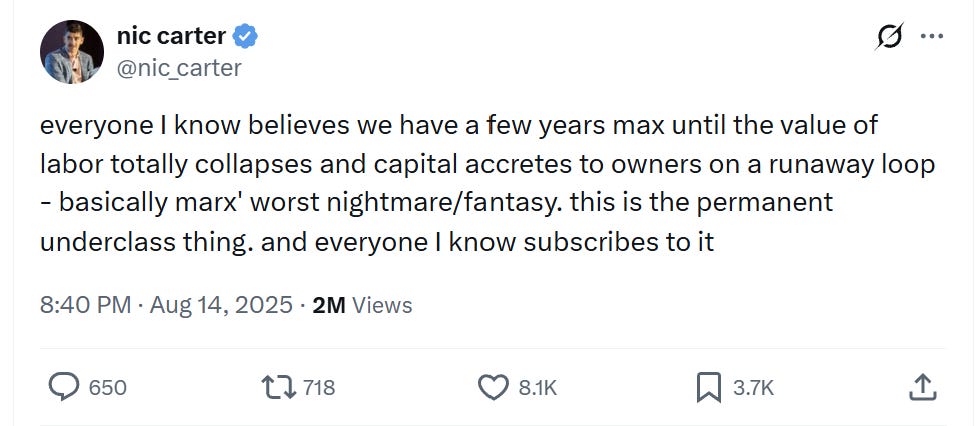
I think the next 5 years will be a lot harder for the average man. Without any edge or skills that make you stand out (specific knowledge) + fewer jobs than ever before due to the introduction of AI and robotics, why should they choose you for the job?
I am not saying this to make you feel bad, I am saying this so you can man the fuck the up. The only person who can change your life is you, so why not stop watching that comfy Netflix series and start doing some actual work on yourself? Prepare for what’s next. Don’t look at the demand today, try to use second-order thinking to see where we will be in 1 year, 3 years, and 5 years from now.
In this issue, I’ll explain why I think real estate won’t be a solid investment in the years to come. If you’re going to live there yourself, that’s different. But for an investment, I’d prefer different asset classes.
Let’s dive in.
Since the 1950s, property ownership has been the ultimate sign of safety. It built middle‑class wealth, beat inflation, and offered passive income through rent. But that playbook belongs to a world that looked nothing like today’s.
We’re entering a new environment with high debt, low birth rates, rising automation, and a digital economy where wealth moves faster than houses ever could. Real estate still feels safe because it’s familiar. Unfortunately, familiar doesn’t mean protected.
If the CEO of Anthropic is even directionally right and AI wipes out half of all entry-level white-collar jobs, the housing market is standing on the edge of a cliff.
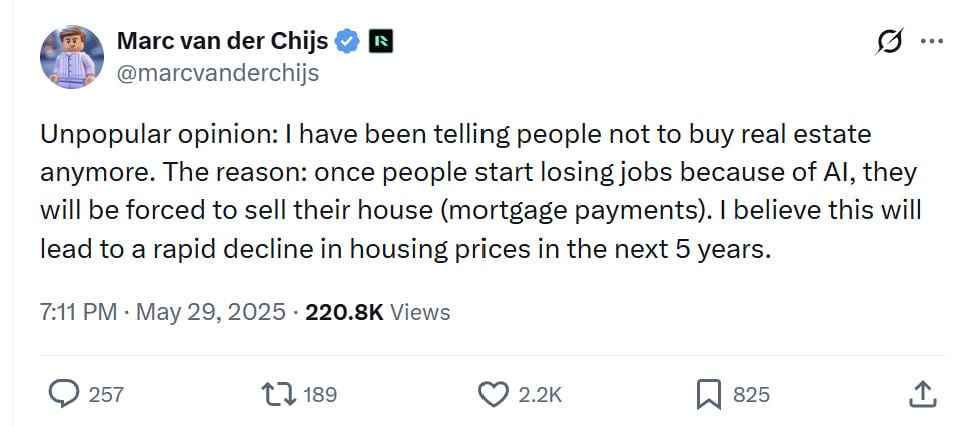
If artificial intelligence wipes out millions of jobs faster than society can react, real estate becomes the next casualty. Home values depend on stable incomes, cheap credit, and buyers confident enough to take on long‑term loans. Remove any of those, and the structure starts crumbling.
That’s where we’re heading. The next downturn in property won’t begin with rising interest rates, it’ll begin with people running out of payroll.
Now, let me explain.
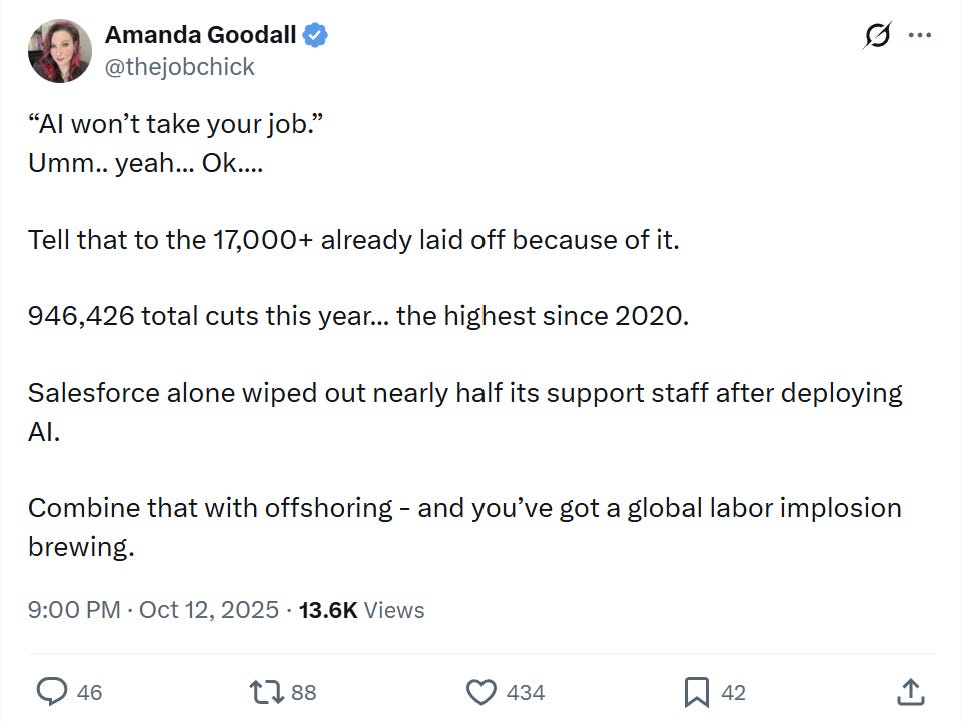
White‑collar jobs once looked safe: analysts, consultants, marketers, designers, even junior engineers. Yet these are the very roles AI can replace first.
If automation truly replaces half of all entry‑level knowledge jobs, something major AI founders publicly predict, the fallout is predictable:
Income shock. Families lose primary earners, and many new graduates won’t find similar roles (we’re already seeing this)
Confidence shock. Even those with jobs become cautious, avoiding 30‑year mortgages or luxury rentals (spending goes down)
Spending shock. Lower pay means weaker consumer demand, especially for high‑fixed‑cost living spaces.
Put together, that means fewer new buyers, less upgrade demand, and growing rent pressure across the board.
Most people think falling home demand will boost rental demand. But that only works if tenants still have cash flow. Once wages decline across the board, rent levels also reset lower.
Imagine it step by step:
When incomes fall, tenants start to reshuffle.
Some move in with relatives.
Some downsize to smaller places.
Some relocate to rural or cheaper regions.
Landlords then face an ugly choice:
Keep rents high and watch vacancies pile up.
Cut rents to keep units full, even if it barely covers costs.
Once enough owners lower rents, everyone else has to follow to stay competitive.
Rents can drop 10–20 percent in a year. Costs rarely move down at all.
Property taxes, insurance, maintenance, and mortgages are fixed or rising.
Example:
Monthly costs $3,400
New market rent = $2,500
Loss = $900 every month.
That’s before vacancies or repairs. Now scale that across investors who bought during the 2021–2024 buying frenzy with minimal down‑payments and high rates. Most can’t survive more than a few quarters like that.
Once cash runs dry, landlords list properties to stop the bleeding. Buyers, however, are missing. Banks have tightened lending, unemployment is high, and valuations have already turned.
That’s how the downward spiral starts:
More listings hit the market.
Prices drop further.
Appraisals fall, killing refinancing options.
Eventually, you get panic selling.
When people can’t afford rent, the government steps in. Rental assistance programs expand. At first, that looks supportive, but it quietly transforms housing into a subsidized industry.
Now, landlords depend on public payments. As budgets tighten, so does rent support.
If governments pull back or delay payments, landlords, and by extension banks, take the hit.
Once rent flows depend on politics, it’s no longer a free market. You’ve got a controlled economy propped up by temporary programs that can’t scale forever.
Even without AI, demographics are already working against housing.
Birth rates in most developed countries are below replacement. Each generation is smaller than the one before.
Immigration no longer offsets the gap fully, as living costs discourage relocation.
The baby boomer generation controls an enormous slice of the housing supply, which will flow back to the market over the next decade through inheritance and downsizing.
That means rising supply, falling demand, and weaker long‑term fundamentals. An aging population simply doesn’t buy homes at the same rate or take on new debt like younger households.
In the industrial age, wealth was built by owning heavy assets like land, machinery, and buildings. In the digital age, wealth moves through code, not concrete.
Real estate is slow. It takes 90 days to sell, and even longer to close. Your buyer pool shrinks whenever lending tightens. A property ties your wealth to one location, one currency, one tax system.
Digital assets are the opposite: liquid, global, mobile. Bitcoin, gold, or even solid equities like NVDA, AMZN++ can be moved or sold in seconds. In a world defined by volatility and automation shocks, that flexibility is priceless.
The new “safety” is speed and the ability to adapt instantly. In a digital economy, owning something that can’t move feels like owning a ship anchored in shallow water: secure until the tide goes out.
Job loss from AI will erode the income base that supports both rents and home prices.
Falling affordability will force rent reductions and kill investor cash flow.
Leverage and high rates will push landlords into forced sales and defaults.
Government dependency will distort the market and expose owners to policy risk.
Demographics will flood the market with old inventory and too few buyers.
Real estate isn’t doomed forever; it’s just losing its edge in a system moving faster than it can keep up with. The next generation won’t see housing as the sure path to wealth as the last one did.
The future is digital. Value flows where speed and liquidity live.
You don’t need to own more; you need to move faster than everyone else.
In this new reality, the wealthiest people won’t be those holding the most property; they’ll be those holding the most optionality.
Look at Pavel Durov (Telegram founder), he doesn’t own assets at all because he wants freedom, even though he is worth 15 billion. Check the clip below:
While this newsletter mostly focused on the US real estate, I think we will have the same issues in Europe as well.
Everything might look safe and sound for now, but the tech never lies.
AI will disrupt the world as we know it.
Again, real estate might give you okay returns if you want to retire in your 60’s.
Like 5% per year.
But you’re not reading this newsletter because you want to retire in 30-40 years, are you?
Take a risk. You will die anyway.
…
See you around, anon.
Comments
Nothing yet. Say the first thing.
Sign in to join the conversation.