
XRP just gave traders something to talk about. Payment activity on the XRP Ledger jumped more than 200% compared to recent lows, and the headline alone is enough to get any crypto watcher's attention. But headlines rarely tell the whole story, and this one deserves a proper breakdown. Let's walk through everything: the numbers, the context, the price action, what history tells us about moments like this, and what would actually need to happen for this to turn into something bigger

Daily payment volume on the XRP Ledger climbed to roughly 291 million XRP, more than tripling from the depressed levels seen earlier this month. That’s the core fact behind every headline you’re seeing right now.
To be clear about what “payment volume” means here: it’s a measure of how much XRP is actually moving between accounts on the ledger, not how much is being bought or sold on exchanges. This is a network usage metric, not a trading metric. It’s closer to measuring how many packages a shipping company delivered than how many shares of that company got traded on the stock market. Both can matter, but they’re telling you different things.
Here’s the piece that gets lost in most of the coverage. A 200% increase sounds dramatic, and technically it is. But percentages only tell you the size of the jump, not the size of what you jumped to.
Payment volume on the XRP Ledger had fallen sharply earlier in July, hitting some of its lowest levels in a while. Recovering from a deep low naturally creates big looking percentage gains, even if the actual level of activity is still modest in the bigger picture. Even after this rebound, total payment volume remains well below the highs recorded over the past year, including the sharp spike seen at the very beginning of this month.
This matters because it changes how you should interpret the news. A 200% jump from a near dead network would still leave that network fairly quiet. A 200% jump from an already busy network would be a completely different story. Right now, we’re closer to the first scenario than the second.
If a 200% activity spike were an obvious game changer, you’d expect price to already be reacting strongly. It isn’t, and that gap between the data and the chart is worth sitting with.
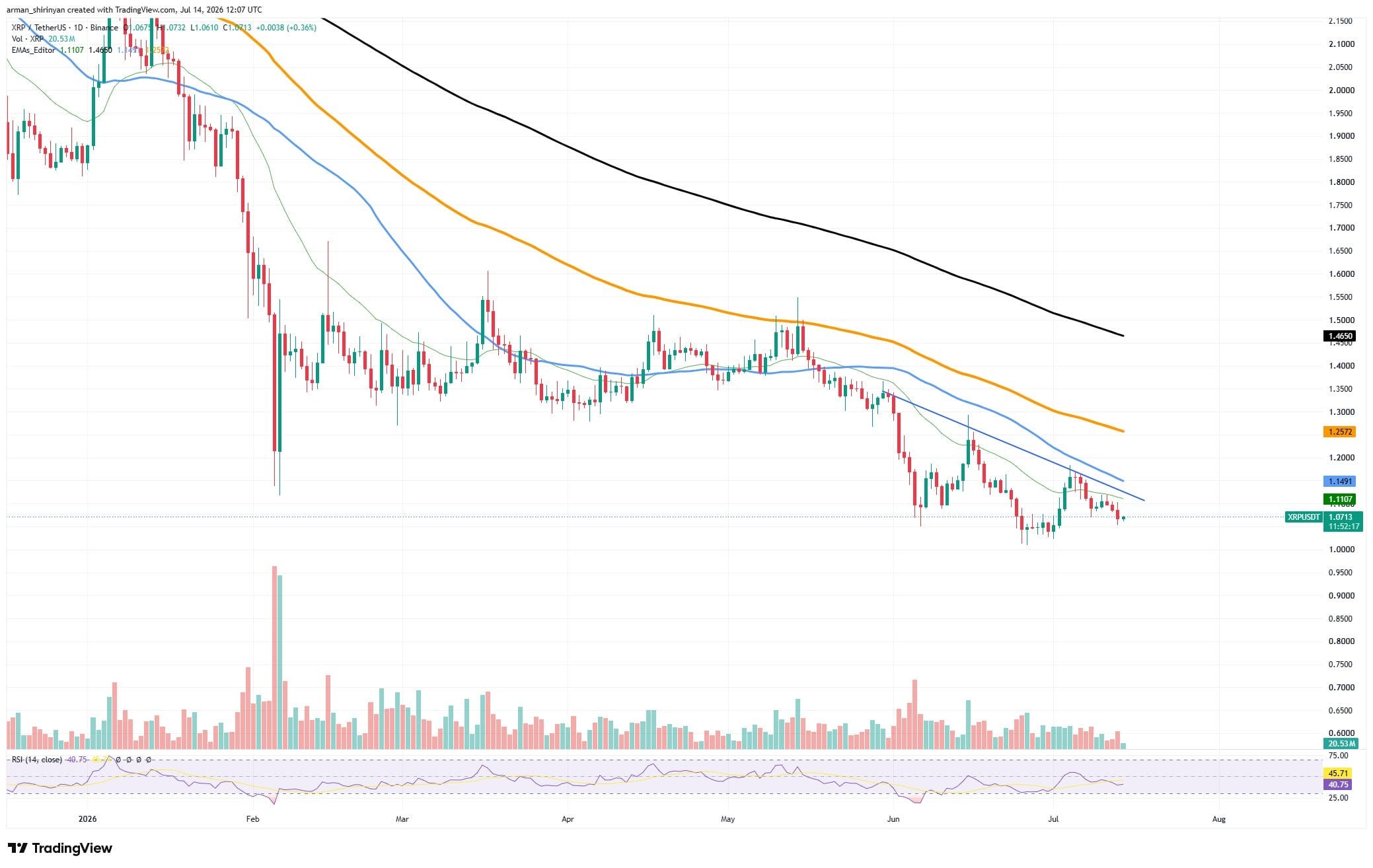
XRP is currently trading around $1.07. More importantly, it remains below its 50 day, 100 day, and 200 day moving averages. These three indicators track the average price over different timeframes, and when a coin sits below all three at once, it’s a textbook sign of a broader downtrend, not just short term noise. Every recent attempt at a bounce has been rejected by these levels.
Trading volume tells a similar story. It hasn’t meaningfully increased alongside the payment spike, which suggests traders haven’t yet decided this network data is a strong enough reason to start buying. When big money believes a shift is real, volume usually shows up early. Its absence here is a signal in itself, even if it’s a quiet one.
This disconnect between rising network usage and a still falling price isn’t unusual. It’s actually a well documented pattern across crypto markets.
Network activity, meaning the actual usage of a blockchain for transfers, payments, or transactions, tends to recover before price does. This makes sense if you think about who’s doing what. Builders, businesses, and long term holders often keep using a network quietly during downturns, since their activity isn’t driven by short term price swings. Traders, on the other hand, tend to wait for confirmation before committing money, especially after a period of heavy pessimism.
So when sentiment has swung too far negative, as it clearly has for XRP recently, it’s common to see usage data turn positive first while price lags behind, sometimes by weeks. That’s roughly where things stand right now.
One more data point worth mentioning is XRP’s Relative Strength Index, or RSI, a tool traders use to measure whether an asset is overbought or oversold. Right now, XRP’s RSI sits close to neutral, leaning slightly toward oversold territory.
This matters for two reasons. First, it means XRP isn’t overheated, so there’s no immediate risk of a “too far too fast” pullback the way there would be after a sharp rally. Second, combined with rising payment activity, it creates the kind of setup that has historically preceded recoveries, though it’s important to be clear this is a favorable condition, not a guarantee.
Here’s the balanced way to think about everything above. The payment spike is real, it’s meaningful, and it tells us the XRP Ledger is still actively being used rather than quietly dying off during a rough patch for the price. That’s genuinely good news for anyone tracking the network’s underlying health.
At the same time, this single data point isn’t strong enough on its own to call a trend reversal. One good day of payments after a slow stretch is a signal worth watching, not a signal worth acting on by itself. Markets are full of moments where good news shows up during a downtrend and gets ignored simply because it isn’t enough, yet, to change the bigger picture.
For this payment spike to evolve from an interesting data point into a genuine turning point, a few things would likely need to line up together over the coming weeks:
Payment volume would need to hold at these elevated levels instead of snapping right back down, since one strong day doesn’t confirm a lasting shift in usage patterns.
Trading volume would need to rise alongside the network activity, showing that traders are actually putting money behind the story rather than just watching from the sidelines.
Price would need to break back above the 50, 100, and 200 day moving averages, which would be the clearest technical confirmation that the broader downtrend has actually ended rather than just paused.
Until those three line up, the safest way to describe this moment is “encouraging, but unconfirmed.”
XRP Ledger just reminded everyone that the network is still very much alive, even during a stretch where price action has been discouraging. That’s worth acknowledging. But a 200% jump measured from a low base, unaccompanied by rising trading volume or a shift in the technical trend, isn’t enough on its own to call a turnaround.
The next week or two will matter more than today’s headline. If payment activity holds steady and price starts responding, this could end up looking like the early signal that started a shift. If it fades back down, it’ll be remembered as a brief bounce after an unusually quiet stretch. Either way, it’s a story worth watching closely rather than reacting to immediately.
Thanks for reading. If you like the post, please share with crypto lovers and make this viral.
Disclaimer: This article is for informational purposes only and does not constitute financial advice. Cryptocurrency markets are highly volatile; always do your own research before making investment decisions.
No posts
Comments
Nothing yet. Say the first thing.
Sign in to join the conversation.