
Let’s start with the basics. Anduril is a $61B defence tech company that builds autonomous systems, AI-powered software, and advanced hardware for military and security applications (Sourcery’s definition).
Anduril is the kind of company that thrives by redefining the rules of its industry. They launched in 2017, when Silicon Valley still treated defence tech as off-limits, and built the organisation as a countermodel of how legacy defence works. In under a decade, they shifted the sector’s perception and scaled from zero to $4B in revenue.
We wanted to dig into that journey from a talent angle. So, we mapped 643 current and former leaders, from Head to C-level, across every region and function. Then, we looked at how the funding-to-revenue history shaped its hiring cycles, the profiles brought in to lead, and where that talent went next.
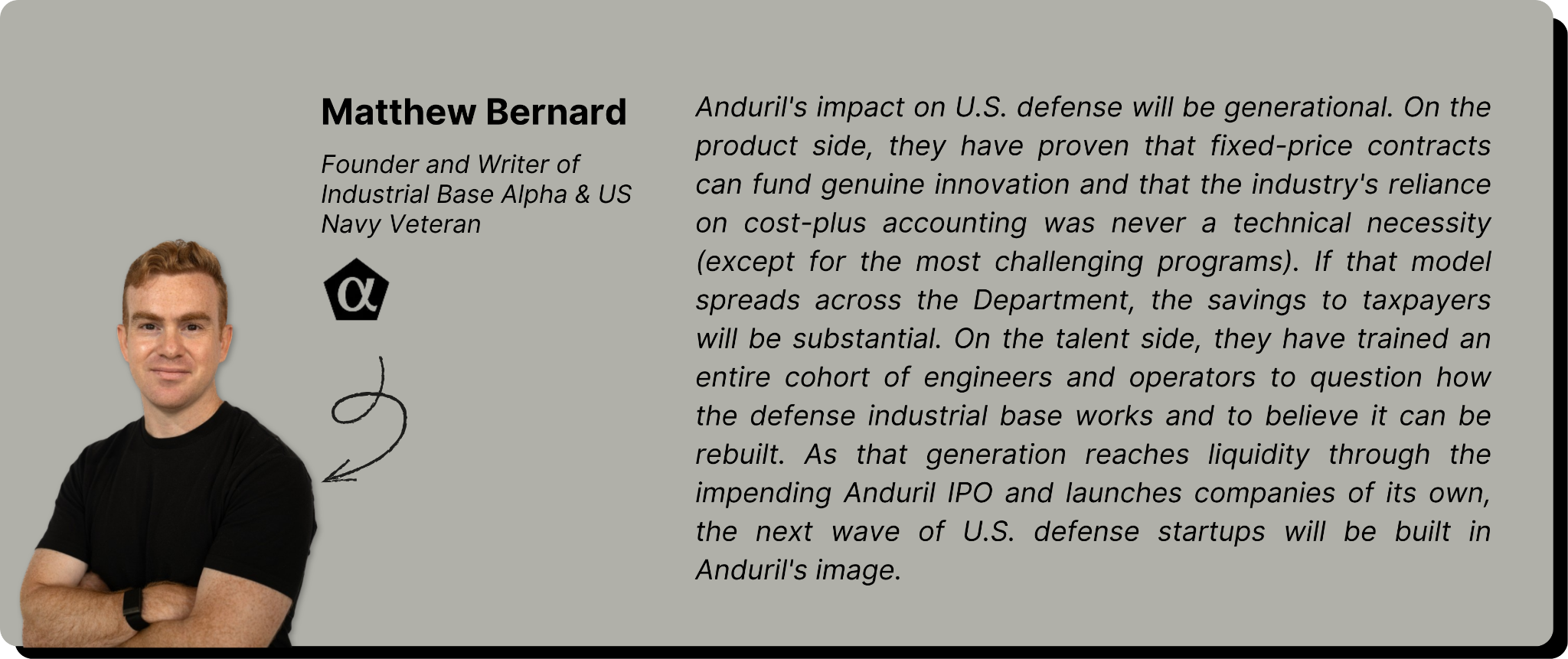
We also collaborated with Industrial Base Alpha, a defence tech Substack written by Matthew Bernard, a decade-long US Navy veteran who brought his expertise of the US defence tech sector to the piece.
Enjoy the read.
This article was compiled in collaboration with the DeepTech Practice at The Big Search. If you’re interested in leadership and talent trends, looking to hire a DeepTech leader, or simply want to discuss the findings, feel free to reach out: elena@thebigsearch.com or Elena Obukhova.
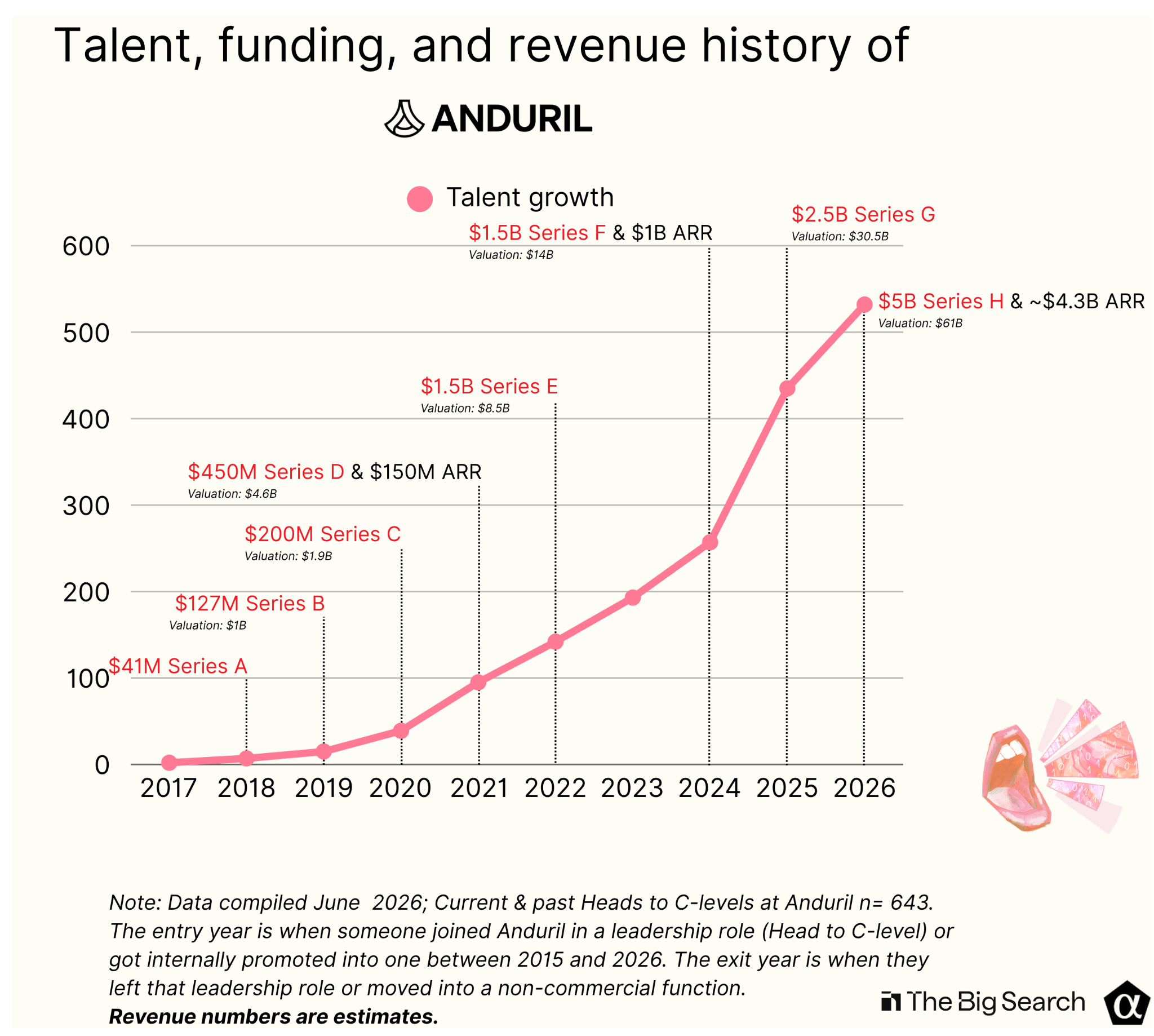
In the early days, defence wasn’t a popular sector to work in, and attracting talent wasn’t easy. So, Anduril’s first leadership hires, in 2018, came straight from defence industry roles. Three of the six were Palantir alumni (Matthew Steckman, Babak Siavoshy, and Kristi Radzieta), making the company the single biggest feeder of Anduril’s early years.
The pattern held through 2019 and 2020. 80% of new leaders came in with a defence or military/MoD background. For instance, Andrew Fijan joined as VP of Engineering straight from the US Army. If Silicon Valley talent wouldn’t work for Anduril, the company would source individuals from the defence/military sector.
Everything changed in 2022. Anduril raised $1.5B at Series E, and external events converged at the same time. Russia invaded Ukraine in February. Biden’s National Security Strategy named China the most consequential strategic competitor the US faces. A year later, the DoD announced the Replicator Program to counter China’s military mass in the Indo-Pacific. Global conflict stopped being abstract, and defence tech stopped being unfashionable. Anduril was positioned to capture both shifts. The leadership team grew 269% between 2022 and today.
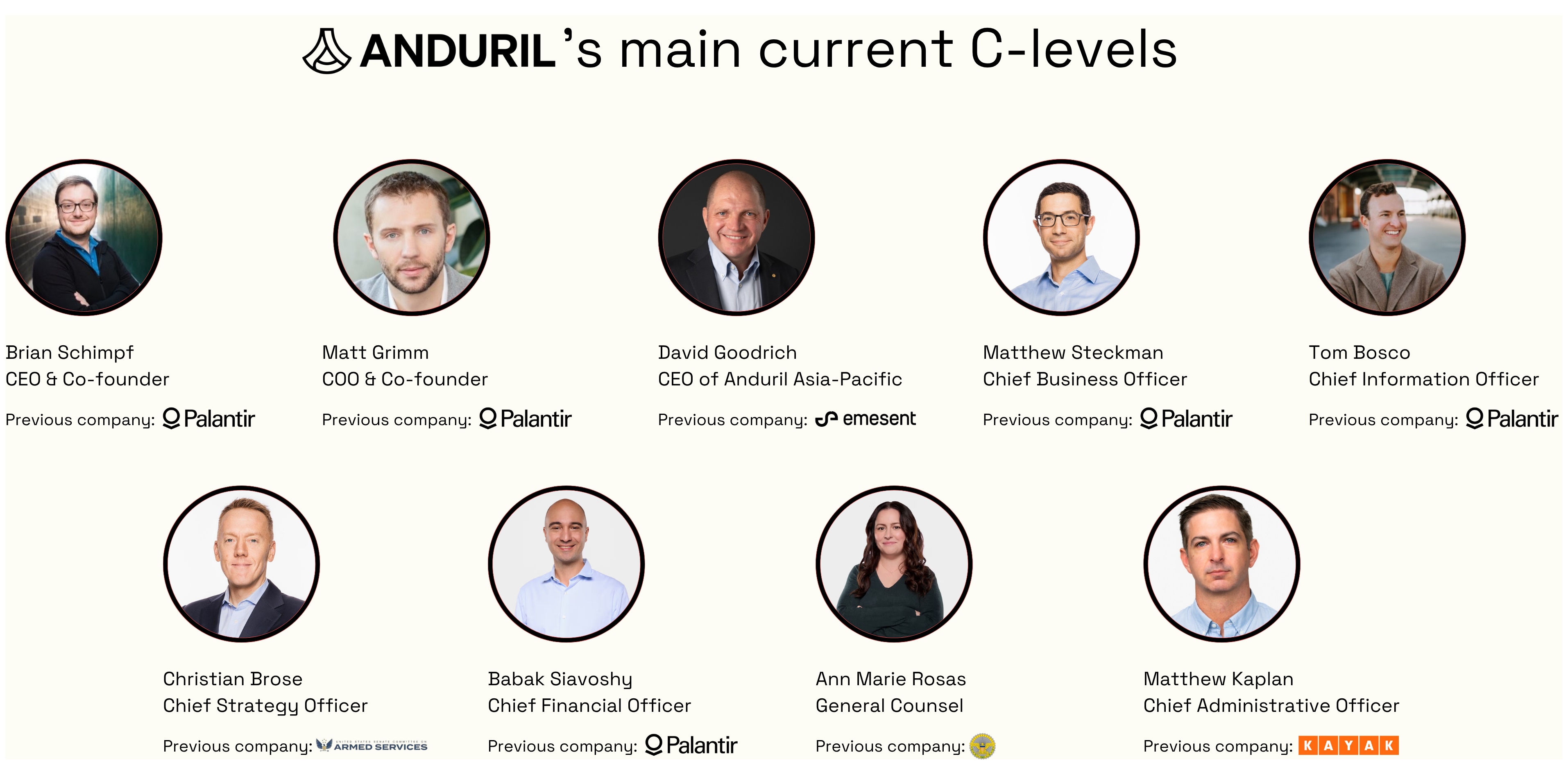
Three of Anduril’s co-founders came from Palantir, and they built the C-suite around people who could carry the same playbook: recruit brilliant operators with an entrepreneurial mindset and give them ownership. The Palantir alumni who joined Anduril had also experienced the company’s early hurdles, in particular the grind of selling to governments as a newcomer. They came in knowing what to repeat and what to avoid.
Babak Siavoshy, the current CFO, was previously CLO and stepped into the role with no prior finance experience after Michael Galvin left. Galvin had extensive CFO experience and had led multiple companies through acquisition, so the swap is notable. Tiffany Carpenter, SVP Finance, supports Siavoshy and brings operational finance depth.
Anduril doesn’t have a CTO. They have a Chief Scientist, Royce Beal, for Rocket Motor Systems, and previously had another in Scott Goldstein. The CTO role doesn’t exist, most likely because Palmer Luckey is the technical vision and drives new product ideas. EagleEye is a good example and traces back to Palmer’s earliest obsession with VR.
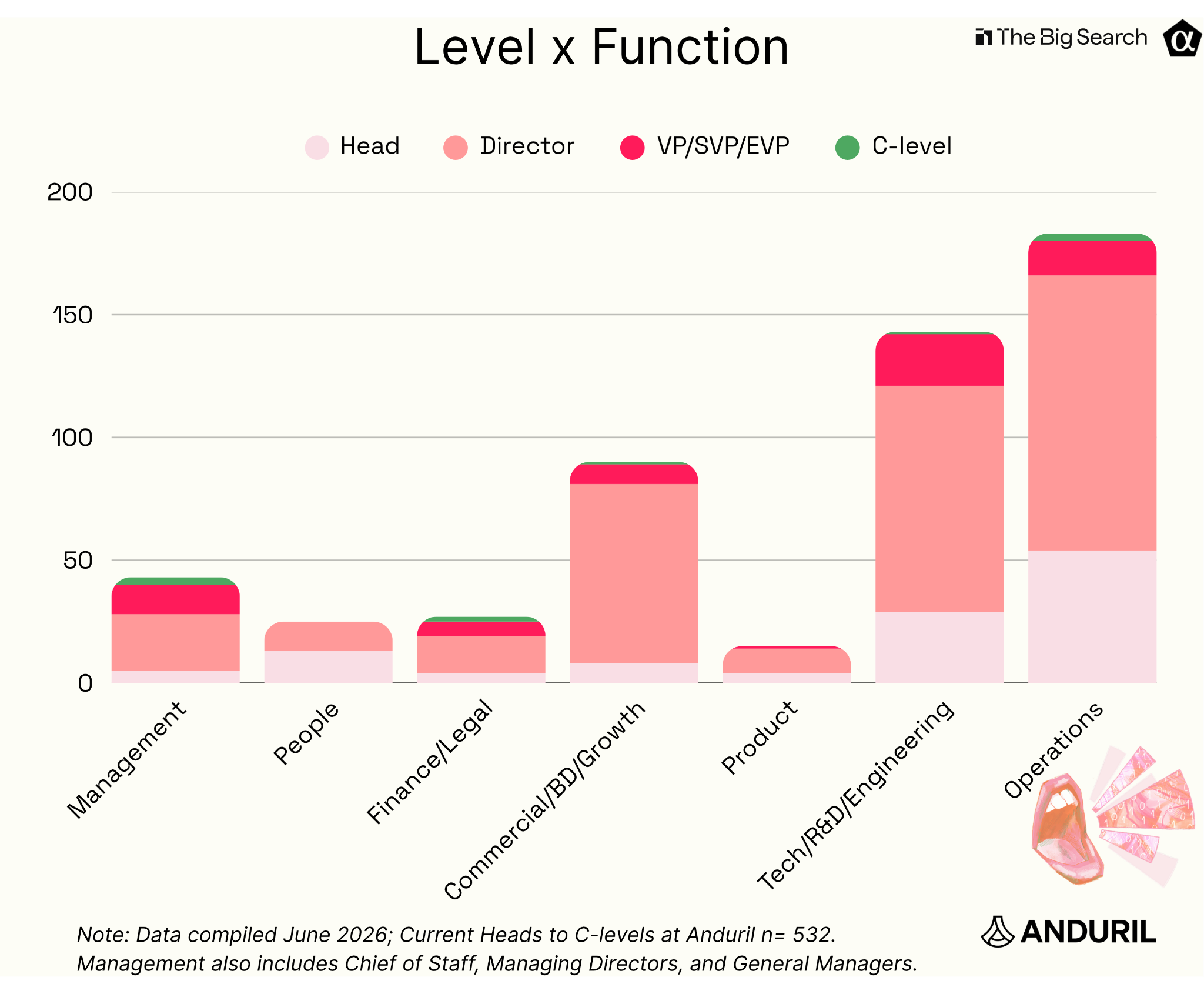
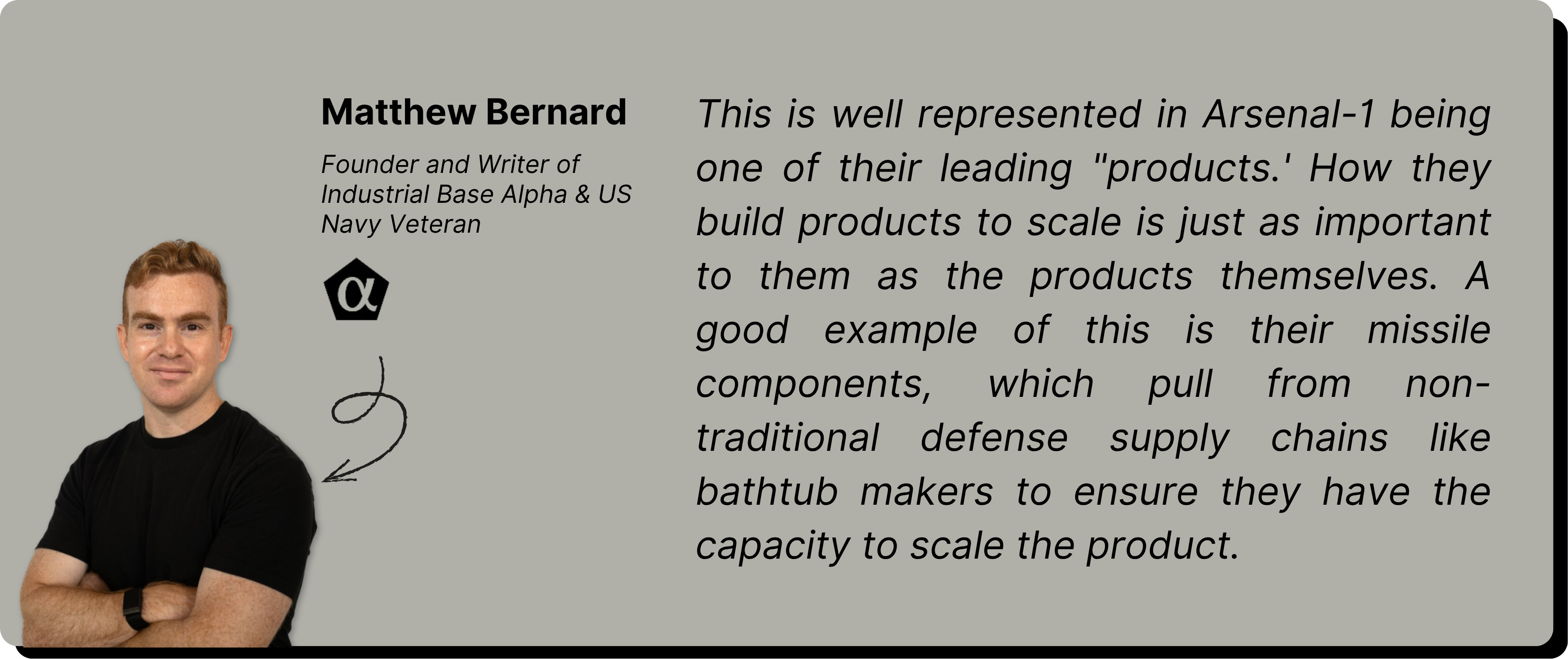
Success in defence tech usually comes from one of two things: edge technology or production at scale at a lower cost. Anduril’s thesis is “the factory is the weapon,” with hyper-scaled production as deterrence. How they build matters as much as what they build, which is why ops is the most represented function. And to fulfil manufacturing capabilities, Anduril hired outside the defence sector.
Just at the VP-level, talent running manufacturing, production, and supply chain came from industries with high-volume industrialisation hardware and vertically integrated supply chains: Kevin Kerr, VP Manufacturing, came from Ford and General Motors. Sameer K. (VP Supply Chain), Keith Flynn (SVP Production), and J. Eric Purcell (VP Quality) all worked at Tesla.
Defence is multi-domain, and Anduril’s strategy is to cover the whole gamut. The company has a portfolio of multiple capabilities, all plugged into its software-defined system, Lattice. Consequently, executives are divided across sub-product domains: Air Defense, Maneuver Dominance, Connected Warfare, Rocket Motor Systems, Space/Discovery, Mission Systems/Electromagnetic Warfare, and others. This reflects the company’s focus on a distributed, autonomous battlefield and the ability to field new capabilities fast.
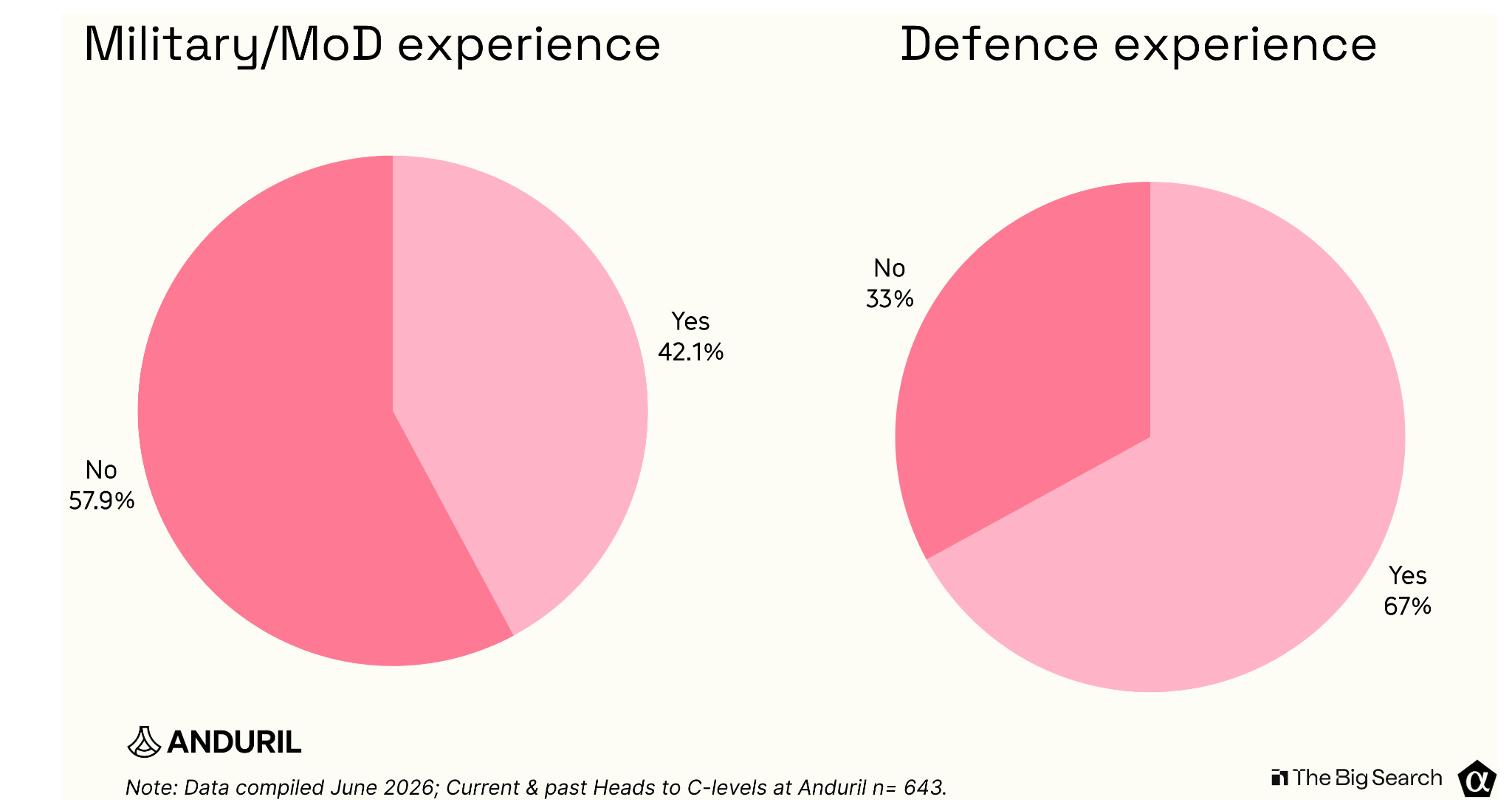
Most occupy ops and commercial/BD/growth roles, where strong government relations and an understanding of the sector are essential. We also checked whether Anduril’s scaling had diluted the share of military and MoD backgrounds by splitting the data pre- and post-2022. The drop is modest: 5 percentage points (45% before 2022 vs. 40% after), with 2025 hitting a low of 34% in the largest hiring wave. Despite hiring hundreds of leaders from adjacent sectors, the company has held its military DNA.
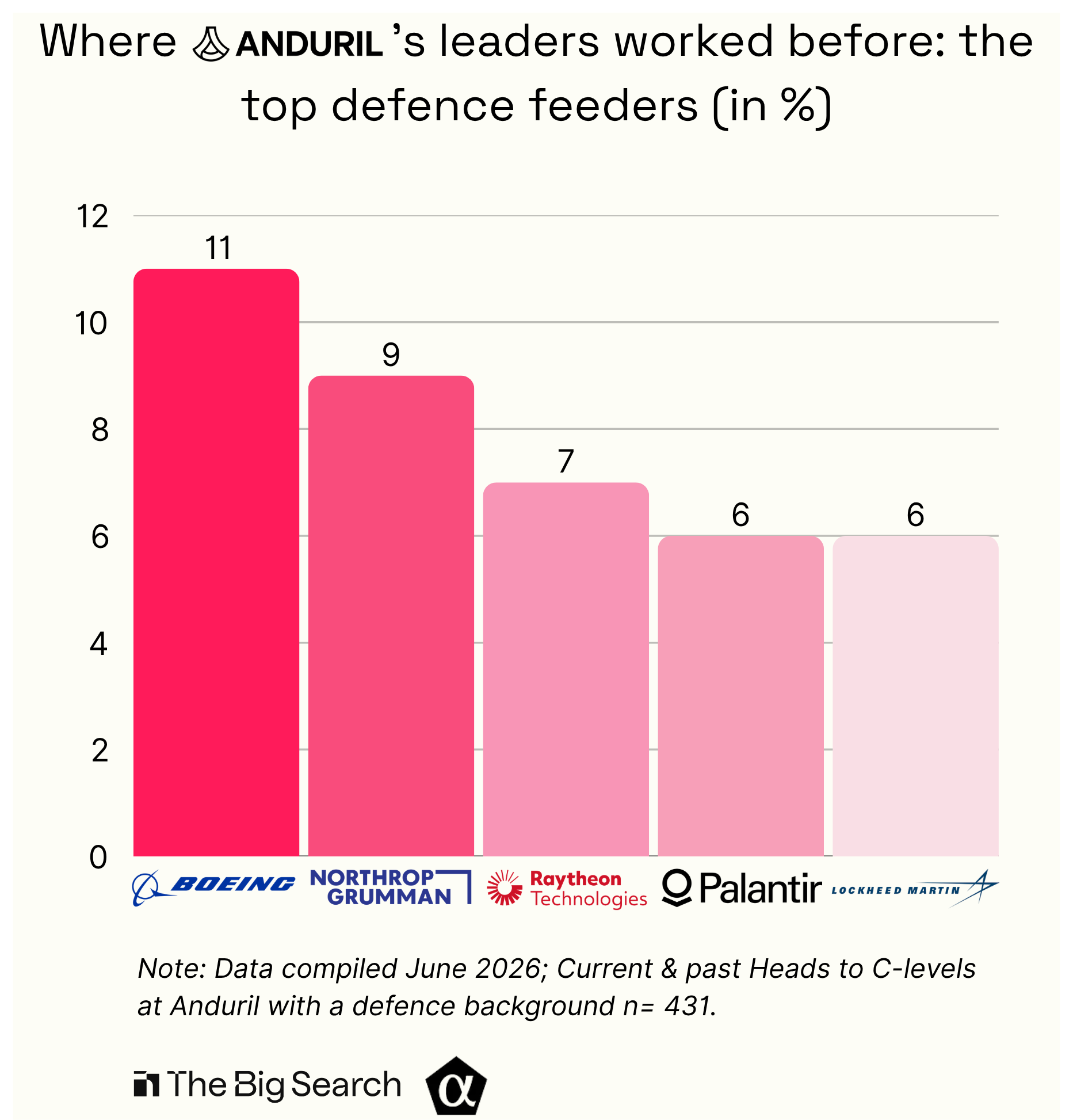
Of those, the US Navy is the main feeder, accounting for 25% of all military backgrounds. That aligns with Anduril’s maritime and undersea focus. The ocean is the highest-friction (and largest) environment to operate. It’s also where the data cables that underpin the global economy are, making undersea capability a strategic priority.
Allied military experience – Australia (2.9%) and the UK (4.4%) – points to AUKUS-aligned international hiring. Undersea capability is one of Australia’s highest defence priorities, and Anduril launched a production facility there to build Ghost Sharks.
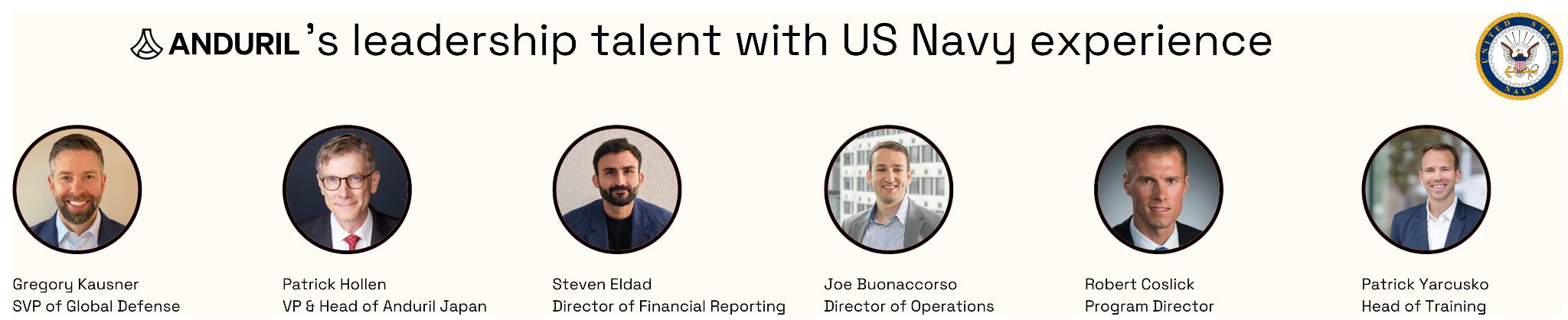
The bigger feeders are Boeing (11%), Northrop Grumman (9%), and Raytheon (7%), which is consistent with Anduril’s hiring strategy to attract defence talent who don’t fit in the purpose-built bureaucracy and slow iteration process of primes.
The rest of the defence background splits across four pipelines:
(1) Services firms: SAIC, Booz Allen, ManTech, Leidos
(2) Space tech: Sierra Space, SpaceX
(3) European and allied primes: Airbus, BAE, Babcock, QinetiQ
(4) Defence tech startups. For instance, Brett Darcey, VP of Engineering, came from Shield AI. Lauryn Fantano, Director of Product Management, came from Rebellion Defense.
And what about talent with no military/MoD or defence background?
Anduril is hiring (1) mission-driven engineers from Microsoft, Amazon/AWS, Meta, and Google; (2) high-volume hardware operators from Tesla or Rivian; and (3) marketing, design, and comms leaders from consumer businesses to make Anduril’s products recognisable as Anduril’s - e.g. Jeff Miller, VP Marketing, came from Snap.
Scaling at this pace creates two flows: people in and people out. Early employees are reaching liquidity events, and some are choosing to leave. That makes the question of where they go just as informative as where they came from.
Ex-Anduril employees overwhelmingly stay in the defence and aerospace ecosystem. They cluster at VC-backed defence tech startups rather than legacy primes or big tech. Think of companies like Saronic, True Anomaly, Hermeus, Gecko Robotics, Hadrian, and Shield AI.
They’re also influential: 28% have held C-level roles after leaving. Profiles like Quito Sáez, CEO at Skyeton, Paul Tilghman, CTO at Voyager Technologies, Declan Lynch, CRO at Privateer Space, or Amber Walker, CGO at Parry Labs. The company is producing exceptionally talented hardware product developers and is shaping who runs the next generation of US defence tech startups.
Anduril is becoming the Palantir of its own era.
Want to see how we can support your search? Visit our website to explore our services and learn what we can do for you.
Comments
Nothing yet. Say the first thing.
Sign in to join the conversation.