
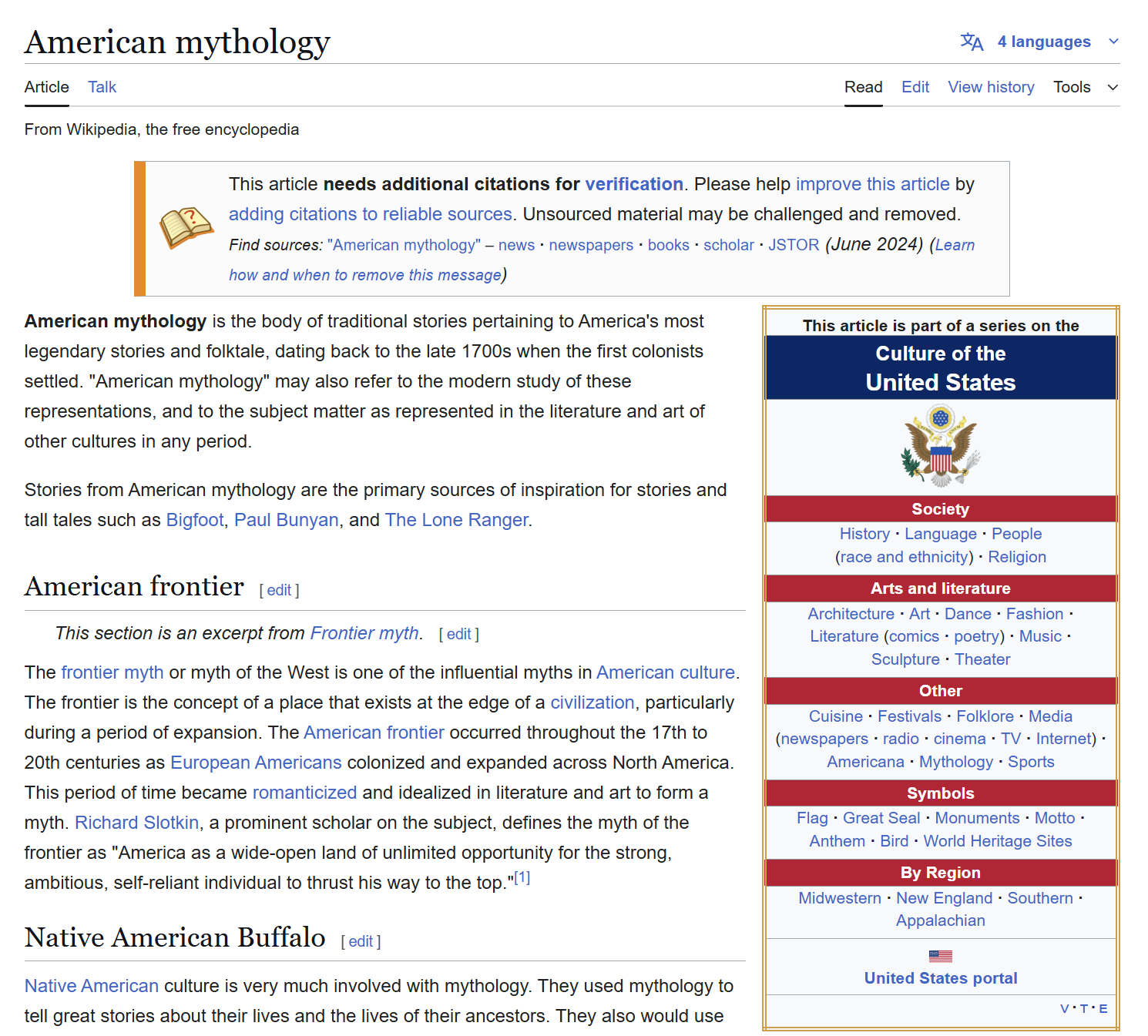
Wikipedia's article on American Mythology is surprising. It references the Western Frontier, Paul Bunyan--- alright, those two make sense--- along with... Bigfoot and Fearsome Critters? I wasn't even sure what the last one meant until I read the definition.
What I wanted was the George Washington cuts down the cherry tree, Johnny Appleseed, Honest Abe vibes. The kind of stories that shape history itself, and perpetuate societal values. The Folklore of the United States' page was more pertinent. It listed Jamestown, George Washington, Pocahontas, and Davey Crockett.
I noticed this new page had a penchant for a certain kind of American myth. All figures and stories mentioned were from the 19th century or earlier. It also seemed to focus on the figures that embodied the American Revolution or the Western Frontier while excluding some obviously noteworthy figures. I can understand omitting anyone from the 1900s or later, because culture lags behind reality. It can take hundreds of years to for a person to become larger than life. But where were the Edisons and the MLKs? Even Lincoln appears on the page only once- in a hyperlink to an article about his ghost allegedly haunting the White House. Moreover, every good mythology has its villains, and the American story is no exceptions. John Wilkes Booth, Benedict Arnold, and the Robber Barons, enter left.
With the exception of Martin Luther King, none of these figures can be disregarded because of recency. Nor do any of them feel irrelevant; Thomas Edison and Eli Whitney occupied a legendary status at least as large as that of Paul Bunyon in my own 21st century upbringing. Yet they don't make the cut for the Wikipedia page.
American mythology is not only built on the scaffolding of Christian and Greco-Roman tradition, but it is also based on the lives of real, extraordinary figures. The stories are embellished to the point where we can be fairly confident they did not occur, but the underlying character still existed. The bedrock of the new mythos is in real people who helped bring America to where it is today, and any additions must fit into this nicely. We couldn't, for example, add splice in L. Ron Hubbard's aliens.^1 This does not preclude reinterpretation-- just look at the evolving views on the Confederates, for example. I do not mean viewing them as villains versus well-meaning rebels--- the positive and negative views have evolved through Reconstruction, eugenics, the rebirth of the KKK, and even modern political discourse.
Okay, but Thomas Edison was a real person, and he seems to deserve a place at the table. Although there does seem to be a qualitative difference between him and the more canonical figures mentioned on Wikipedia. There are some early stories we can all agree on: George Washington can't tell a lie, so he cuts down the cherry tree. There are plenty of tidbits and quips from the Founding Fathers and how they convinced a hodgepodge of disgruntled colonists into thinking like a nation and eventually agreeing on a centralized system of government. But Edison, or Benjamin Franklin and the lightning, feel just as influential. Invention and innovation is such a strong part of the American psyche! It suffuses the speeches of politicians on both sides of the aisle, and powers the ethos of Silicon Valley. Elon Musk, the world's richest man, named his company Tesla. I doubt there is a convincing argument that America has not produced the real deal outside of revolutionaries and cowboys.
My example of Musk delineates a clearer boundary between the inclusions and outcasts. Musk is not without his controversy, and perhaps Nikola Tesla himself has absorbed some of the blame. Politicians on both sides of the aisle appeal to our Founding Fathers and their shared values--- but with Lincoln, the argument for which party has inherited his banner is contentious. Nonetheless, they both try to claim him.
Mythology is not static. The traditions that we directly associate with the word mythology are immobile and unable to evolve because their civilizations died out long ago. No one is coming out with new treatises on Jupiter's newest affairs; Rick Riordan's fan fiction doesn't have the same cultural weight because no one believes in those gods. However, this is only true from our unique 21st century vantage point. In Rome, Medieval England, and Ancient Judea, everything could be reinterpreted, if society would accept it. Greek gods like Athena were changed to be more warlike and justify the changes in Roman values from the original Greek ones. This was probably a complex process with many iterations between cultural sentiments and artists, but we have clear records of it.
To change a theology is to change how people interpret values. This is desirable if you are, say, an autocrat trying to centralize power. Pharaoh Akhenaten attempted this in ancient Egypt, by elevating the sun god Aten above all of the other deities worshipped in the Egyptian religion. By forcing everyone to worship one god, and then controlling the worship of that god, he monopolized religious authority. Not all changes need to be this drastic. Maybe you paint your god of war in a more positive light to so the public is more amenable to conquests of expansion.
Fortunately, our society is structured very differently than pre-industrial civilizations. Especially in Western countries, the majority of citizenry can participate in cultural progress through social media, writing, and general literacy. This makes it much harder, though not impossible, for any group of individuals to shape a shared story according to their will. There are simply too many people to convince. People on Twitter can barely agree how to interpret Sam Altman's latest tweet-- try going on there and convincing them that George Washington actually did lie about the cherry tree.
All of this means that any changes in mythology can't be bought, or at least it is very difficult to do so. There must be a real change in sentiment for mythology to adapt or expand.
There are at least two simultaneous effects confounding American mythology: more people can participate in its evolution, and it does not exert its power through literal belief. These factors explain why most canonical American myths are old, as skepticism and literacy skyrocketed as the United States' aged. However, I am still not giving up on my claim that Thomas Edison deserves a spot in the canon. If Franklin's genius can make it, why can't his?
To understand this question requires understanding what a genius is. The dictionary definition-- "a person who is exceptionally intelligent or creative, either generally or in some particular respect."-- is too broad an explanation to cast any light on our question. Additionally, this definition is too simplistic to incorporate the nuance that the term genius contains.
There are multiple archetypical genius types that are being entangled here. The first is the person of pure intellect--- someone who scores high on IQ tests or has a MENSA membership. These people need not be unsufferable, but citing your IQ score at a party is likely to get you only groans in response. No one cares about book-genius per se.
People do care about accomplishments, though. IQ is very loosely related with career advancement, though this effect flattens out in higher ranges which suggests that it functions more as an enabler than as a multiplier. However, there can be no doubt that in extreme cases, such as advanced mathematics and physics, a high level of processing ability and internal abstraction is necessary to make progress. Terence Tao, one of the greatest and most prolific contemporary mathematicians, owes a part-but certainly not all-- of his success to his IQ of over 175. He was caught reading a calculus textbook in class shortly before his eighth birthday, and has since made considerable contributions to number theory and other mathematical fields.
More people fit into this category of accomplished geniuses, and they are more important to civilization. People who are just smart and sit inside and do advanced logic puzzles are not advancing societal progress. Building in the real world is less "pure"-- it requires synergy between multiple areas and raw intelligence. Building an effective company requires picking the right people to delegate to, understanding your target industry, and combining both of those capabilities with intelligent analysis. Thomas Edison didn't just invent the a light bulb. He understood what made prior bulbs impractical, integrated chemistry, physics, and economics, and had the persistence to run hundreds of experiments. He was smart, but no one step in his process of invention was bottlenecked by intelligence. He was the inventor because he had the right skills at the right time and a personality that took advantage of the opportunity.
The third category of genius-- the genius persona--- is the carefully cultivated celebrity-like genius. These are the people who may or may not fit into the second category but do everything in their power to be perceived as accomplished people. Furthermore, they typically try to extend the bounds of their intelligence from their subfield to generalist intelligence that can be applied to any task. That's why billionaires such as Jeff Bezos or Bill Gates' are obsessed with saying how they could have done academic physics research, if only they wanted to.
These genius types are not mutually exclusive, and many historical individuals belong to multiple categories. Thomas Edison "has been accused of taking credit for inventions that were largely developed by others," largely to bolster his image as a scientist-inventor. It is the third category, though, that is relevant to American Mythology.
Before achieving this persona, these proto-geniuses want to be geniuses, and they understand the value of an image. If they are perceived in a certain light, their opinion is highly valued. It is what gives Alex Karp the cultural capita to appear on a host of podcasts and offer his view on any subject under the sun. This curious infirmity arguably afflicts most opinion journalists and influencers, to varying degrees of success. They are perceived as people whose opinions matter. Not just to a subset of people--- anyone can have professional expertise--- but to a large swathe of the public, perhaps to everyone.
Helen Lewis recently published "The Genius Myth," a book that attempts to unravel the idea of geniuses, how they are made, and the requirements for someone to be a genius. She claims that geniuses are viewed as tragic figures, people who were able move humanity through the force of their intellect while suffering from terrible personal flaws. Van Gogh killed himself, and Albert Einstein has numerous affairs.
But, as she points out, this lopsided personality type is artificial. Do people need to have some sort of deep personal flaw in order to be a genius? Of course, it is generally true that if someone obsesses over something, they will be able to spend more time in that area at the expense of others. Do the math. However, plenty of individuals have done important work and lived pleasant lives. Darwin was ill, but his marriage was successful and he died wealthy and with a good relationship to his community and children. Warren Buffett doesn't have any of the stigma that Steve Jobs or Jeff Bezos possess, and has said he finds fulfillment in a "simple lifestyle." There are countless Fortune 500 CEOs who you could find on Wikipedia, but are not household names.
Wanting to be good at everything and simultaneously disseminating a flawed genius personality seem like counterintuitive goals. Yet this is exactly the perception of savants that Lewis describes, and is true by inspection of most high-profile figures today.
One of the best ways to gain exposure is through notoriety. Scott Alexander wrote about this effect in his blog post "The Taxoplasma of Rage." When an activist group says something non-controversial and popular--- such as coming out against factory farming--- everyone agrees, but no one talks about it. You know what gets people to talk? Over the top stunts, such as when PETA agreed to pay the water bill for Flint, Michigan residents who became vegan. People were enraged by this, and it went viral online. But mission was not accomplished--- most people, including most vegans, reacted with disgust. Souperist stunts like this rarely widen a group's support base, and end up alienating most observers. This is why you know about Occupy Wall Street, but not United for a Fair Economy.
Maybe you can get that genius-sheen without taking controversial actions, but you certainly need to achieve a public persona somehow. But unlike most advocacy organizations, which are trading relatability for notoriety and must weigh that cost to convince the largest possible subset of the public, for geniuses that controversy is part of the package. PETA wants you to be vegan. Elon Musk may want your financial business, and he certainly wants a core group of supporters, but he mainly wants to stay relevant. Think of how much more news coverage he's received since his Twitter stunt as compared to his period as a normal billionaire in the 2010s. If you want influence, you need to part of the conversation. If you want to be part of the conversation, people need to talk about you.
Being good at everything is also difficult. Elon Musk doesn't actually have time to excel at the video game Path of Exile, so he cheated his way to a top-tier account. This is a win-win for him: if it had succeeded, his supporters would revere him as even more of a genius. If someone saw through the ploy, his supporters could laugh it off but everyone would be talking about it. I am not claiming this was a deliberate mastermind ploy by Musk. However, the end result of these performative stunts is a growing presence in mass culture. To build a genius persona is to alienate many people.
With the exception of Benjamin Franklin, none of the people mentioned on the Wikipedia page are celebrated as geniuses. George Washington and Lincoln celebrated for their political acumen and moral integrity, but seldom is the word "genius" used to describe them. This is particularly strange given that Washington was a brilliant military strategist with a sophisticated knowledge of British weaknesses. His strengths lied not in military tactics, where he would make frequent mistakes, but in discovering British weaknesses and making the war seem endless and expensive. Historians know this--- it is just rarely framed as genius. This breaks from a long tradition, from Sun Tzu to Napoleon, of recognizing military skill as a type of genius. Lincoln's debate skills are also legendary--- he stole the show at every speech and debate of his--- but the term genius, in popular usage, has evaded him.

Part of the reason why the myth of a genius is so compelling is because of the "rugged individualist" roots of America. The term, which originates in the frontier and cowboy era of the United States, refers to the ideal that one should be self sufficient and not rely on public infrastructure or government institutions to stabilize life. This was a pragmatic outlook when the cowboys went full manifest destiny and settled in places without public utilities or consistent municipal oversight.
In our interconnected societies, where being a true rugged individualist is impossible, a bona fide genius is the next best thing. Living off the grid is nearly impossible, but maybe someone can be philosophically self-sufficient and have the skills to do everything. Someone who can do everything does not need anyone else. This figure is reminiscent of Nietzche's Ubermensch, who has overcome societal norms and is able to shape their own existence as they see fit. Nietzche first wrote about the concept of Ubermensch, also known as the Superman, in his book "Thus Spoke Zarathustra." The American Ubermensch is a genius who is able to do anything and has chosen to focus on a specific area not because that is what they are most skilled or, but because of a deliberate decision. The world, or morality, or the United States needs them to build technology or a company, but they could have done physics research if they wanted to.
Capitalist's eminent place at the American table strengthens our reverence for genius. Capitalism works because it presupposes a hierarchy of ability. In principle, this hierarchy need not be genetic or intrinsic--- it can be a result of one's circumstances, luck, or hard work--- but it is so rarely viewed through a non-meritocratic vantage point. Charles Wright Mills, in his book "The Power Elite," frames this point succinctly:
Text within this block will maintain its original spacing when published
“People with advantages are loathe to believe that they just happen to be people with advantages. They come readily to define themselves as inherently worthy of what they possess; they come to believe themselves ‘naturally’ elite; and, in fact, to imagine their possessions and their privileges as natural extensions of their own elite selves.”
America and capitalism are enmeshed with each other. The country grew up as the Western World moved away from monarchical centralized economies, and grew to our greatest strength as the war against communism smoldered. In the brainstem of the American psyche is the idea that we live in a meritocratic society, and that the ultimate meritocrat should be able to do anything on their own.
In the 21st century, though, this is just not how the greatest meritocrats are perceived. In a capitalism system with a true meritocratic hierarchy, those with the most money are the most praiseworthy. But everyone hates billionaires--- politically and socially. The right views the deep state and shadow money with disdain, and the left questions the foundations of capitalism. Six in ten Americans blame the ultra‑rich for driving up inflation and favor higher taxes on them. A Reuters poll in 2025 found that 71% of Americans thought that billionaires have too much political clout.
American culture created a hierarchy that its own people are ambivalent about. The people at the top of ladder are geniuses ex officio of reaching the top, and have every incentive to create a persona that reflects that position and increases their power share. This totem pole isn't about speaking ability, or generosity, or cleverness, or military skill, or virtuousness--- the characteristics we prized in the revolutionary and frontier era--- it is about the genius of building. A social scale with the Grinch on top.
And modern capitalists beware: the cultural canon has not been kind to the robber barons, the ultimate capitalists. Rockefeller, Carnegie, and Vanderbilt were worshipped in their day as patrons and society-builders. They became the first billionaires and their companies still dominate American industries. Now, high school students reflect critically on the inequality they caused in American History.
Rugged individualism was a real American value, as was fearlessness before the British. Washington was unanimously elected as President and had the gall to warn a nation state in its infancy about the danger of political parties--- a luxury only afforded to those immensely popular in their own lifetime. But we shun the off-the-grid citizens, and the only British Empire equivalent in the world is the good ol' US of A. Those ladders rusted and fell long ago.
Benjamin Franklin's ingenuity was untainted by industrialism and exploitation--- in fact, the difference between him and Edison is right there in front of us: Franklin's experiment was in discovery, whereas Edison's was generative. That generation is what powers capitalism, and that heavy burden has tainted the myth.
Modern would-be American myths find themselves between a rock and hard place: they have made themselves personally unlikable for short-term gain, and the system they mastered is on shaky foundations. There must exist a period of time, however short, where there is a consensus about a particular figure being good in order for them to be mythologized. Perhaps Rockefeller has been mythologized as a villain, but he will never be an American hero.
It is not just political division that creates this dearth. In 2025, there is no way any mogul past or present could be invited to join the pantheon. Until American society finds a new ladder, we'll have to make due with Paul Revere.
No posts
Comments
Nothing yet. Say the first thing.
Sign in to join the conversation.