
The Berkeley Factory Incident refers to the rapid liquification of the Fourier Gear Plant (colloquially known as “the Factory”) on May 18th, 2029. The bodies of all eighteen factory workers, as well as the majority of supplies and machinery from the facility, were never found. The incident has been the subject of numerous conspiracy theories, films, and novels.
The Fourier Gear Plant was located in an industrial corridor just west of Interstate 80, on the narrow strip of reclaimed land between the Berkeley Marina and the Union Pacific rail line. The site had once been a shipyard and was later converted to a warehouse for imported machine tools. Fourier Technologies purchased the site in 2025.
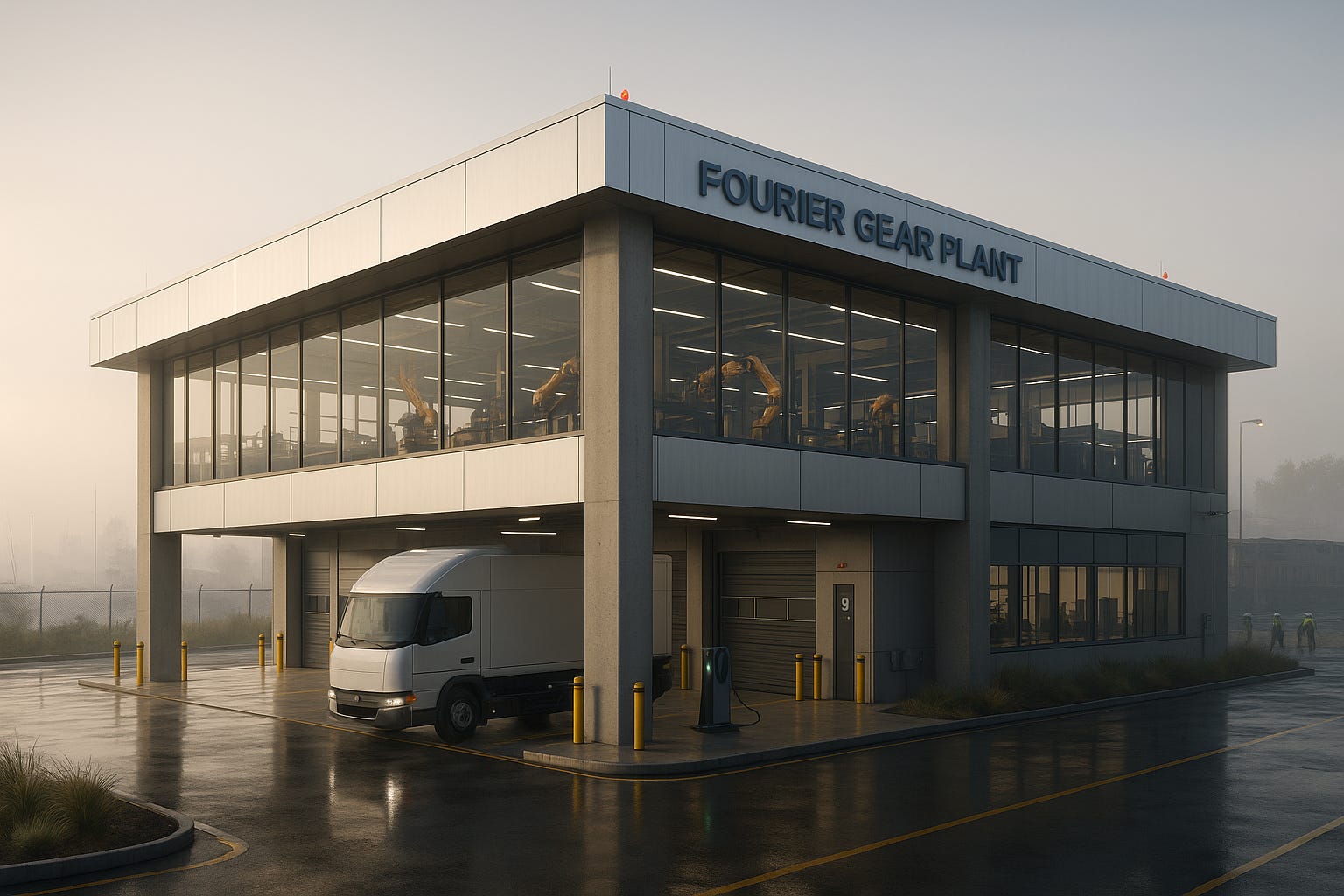
.
Fourier Technologies was founded by Matt Grace and Lillian Wachtel shortly after they graduated from Stanford University in 2025. It was originally designed as a rapid prototyping plant for Grace and Wachtel’s other startup, Beamer. In 2026, they spun off Fourier as its own company and raised a 100$ million investment round led by investor Pewter Talle.
As a private company, Fourier’s finances were notoriously secret. A congressional subpoena revealed that it had 120$ million in gross revenue in 2028. According to internal documents uncovered during the investigation of the incident, Fourier planned to open two more factories in early 2030, both in China.
Both founders had research backgrounds in artificial intelligence and robotics. Wachtel had developed an early blueprint for constitutional AI systems (models trained to strictly follow behavioral rules) while interning at Antrophic. Grace interned at Thezla on its robotic dexterity team.
The Fourier plant was designed to reduce the prototype iteration cycle time from weeks to just days or hours. Older facilities required precise specifications and blueprints to produce a working prototype, and often needed custom hardware for each project. However, the Fourier Plant accepted a wide variety of specifications, from very high level instructions— such as a picture of a mobile phone accompanied by the text “make this phone thinner”— to detailed 3D models. For shorter or underspecified prompts, the robots relied on their own judgement and common sense to convert it into a detailed plan.
Trucks left the facilities every two hours to deliver the products to startups around the Bay Area. Simple prototypes could be delivered in as little as eight hours, and the company had a thirty hour guarantee for all orders.
The robots in the facility would receive the instructions and spend approximately thirty minutes planning, followed by four to sixteen hours of experiments. Though the facility was outfitted with a variety of state-of-the-art machines, some jobs required creative use of existing machines in the absence of task-specific hardware. For example, if a job needed a blender, a robot would bolt a mixing paddle onto a CNC mill, clamp a sealed steel bucket under the spindle, and spin the contents at high speed until smooth.
It is generally accepted that the facility used only Class A-C robots (the lower-capability tiers as would later be defined by FEDRA guidelines). Many conspiracy theorists contest this point.
Prior to the passage of the Protect Our Limits Act, there was limited federal oversight regarding the intelligence levels and instruction sets of embodied robotic agents. Earlier executive orders issued during the Trump administration required only minimal hardcoded safety parameters for robots above a certain intelligence threshold. This included geographically confining the robots to a specific area (“geofencing.”) These intelligence classifications were not formally defined until 2035, though a preliminary classification system was detailed by the subsequent congressional investigation.
According to company statements, all robots at the Fourier Gear Plant—regardless of whether they fell under the scope of the Protect Our Limits Act and Lucy Segal Act—were programmed with strict geographic restrictions and would automatically power down if removed from the facility.
The extent of the robots’ internet connectivity remains unclear. Wachtel testified to Congress that every model on site, both embodied and virtual, could access the internet only through two monitored links. Internal emails further indicate that the robots were programmed with “constitutional prerogatives” that demanded they keep to certain guidelines, including not to create or seek unauthorized internet connections.
The company’s annual Artificial Intelligence Safety seminar was scheduled for June 20th, 2029.
Workers generally described the plant as a safe workplace. Between 2026 and April 2029, only two recorded accidents occurred, both resulting in minor injuries. In one case, employee Bella Shakhar suffered a mild acid burn to her knee after a brief power outage caused a humanoid robot to stumble. In December 2028, a chandelier collapsed on the second floor, but a robot intervened, pushing a worker out of harm’s way. Fourier reached confidential settlements with both employees.
Aside from these accidents, most workers said the atmosphere was cordial, calm, and fun. Joseph Sracwyz said this in a CNN interview following the incident in December 2030:
“I never felt like anything dangerous could happen, not more than any other factory, no… it was a laid-back atmosphere, for the most part. We called the talking robots Standers, the ones who would ask our opinion if they needed something. We would joke with them sometimes— put the hot iron in the fire, something like that. They never, ever took the jokes seriously— the robots were literal, but not that literal. It was rare we had to interfere, but we did our job when we needed to. Matt— may he rest in peace— probably had to do the most of any of us. He would check for any new chemical interactions that the robot books didn’t have, and he probablyonly had to do that twice a week.”
Damage to robotic systems and automation hardware was relatively common, owing to the experimental nature of the work. In December 2027, Fourier collected a $50 million insurance payout after two robots fell apart during operation; both were later found to be missing the same screws.
On May 14th, the factory started rejecting overnight orders due to lack of demand. This marked the first week in which the facility implemented its new startup and shutdown protocol, as it had been operating continuously since January 2nd.
The morning crew of six employees arrived at the plant between 5:45 a.m. and 6:15 a.m. There is no surviving evidence that any of them observed unusual activity at that time. The only visual record from the day is a 15-second video sent by one worker to his spouse; though blurry, the background appears to show the plant operating normally.
By 9:00 a.m., all 18 employees scheduled for the day shift were on site. At 9:30 a.m., company co-founders Matt Grace and Lillian Wachtel participated in a video stand-up meeting with the factory manager and two staff scientists. The meeting, which was not recorded, was later described by Grace as “tense” due to upcoming performance reviews but containing “nothing unusual.” Under oath before Congress, Grace stated that no suspicious or irregular activity in the facility was reported during the call.
Because of Fourier’s military contracts, the full list of manufacturing orders processed that morning has never been released. A subsequent congressional investigation, led by Representative Tom Kraut, determined that between 7:00 a.m. and 10:00 a.m. the plant fulfilled approximately 450 orders, of which all but 12 had been received the previous night. Of the twelve orders, six have been released to the public. The infamous “soup order” has received the most attention.
Fourier’s logistics fleet relied primarily on autonomous electric delivery vehicles. At the time, California law still required a human driver for any vehicle exceeding ten tons in gross weight. The last confirmed departure from the plant occurred at 10:05 a.m., when driver José Kamura collected a large delivery for transport to San Francisco.
Data from two cell towers near the site showed that the last outgoing internet requests occurred at 10:43 a.m. to YouTube.com. No calls were placed from the site from the time that the delivery truck left at 10:05 until this time. At 10:43, there were still five devices actively sending internet requests through nearby cell towers. By 10:44, there were no outgoing requests. This has led investigators to conclude that the incident occurred extremely quickly.
When Kamura returned shortly after 12:00 p.m., he found the site almost entirely destroyed. Much of the surrounding ground was coated with a viscous brown fluid. Kamura later described the odor as “so strong and nauseating I had to cover my face.” The main structure of the plant had collapsed or disintegrated, leaving only two reinforced concrete support pillars and the partial frame of a single humanoid robot partially submerged.
Subsequent forensic analysis of samples taken from the scene tested positive for human DNA along with unusually high concentrations of heavy metals.
The Berkeley Fire Department and Alameda County hazardous-materials teams secured the site on the afternoon of May 18, 2029, following a 9-1-1 call from driver José Kamura. Access roads around the Berkeley Marina frontage and portions of Interstate 80’s on-and off-ramps were briefly closed while air monitoring was conducted.
Within the first hour, responders reported a humanoid robot visible within the collapse zone, intermittently upright and apparently moving. Given the unknown hazard, unaccounted personnel, and the possibility of secondary events, the Berkeley Police Department requested tactical support. A joint team—BPD SWAT, the county bomb squad, and a robotics/explosives unit—arrived with an armored rescue vehicle and deployed drones and loudspeaker hails. By the time a remote camera approached the object, the robot showed no heat signature or motion. Entry teams subsequently found it inert.
Heavy equipment operations were initially deferred; responders used drones and thermal imaging to access the debris and collect samples. On May 27th, the Alameda County Coroner issued presumptive death certificates for the 18 employees after the fluid tested positive for human DNA. The scene was then released to environmental and industrial investigators once life-safety operations concluded.
Search and recovery continued for roughly one month under a unified command. Crews conducted grid searches of the slab and loading bays, screened runoff channels leading toward the marina, and sifted debris for biological and mechanical traces. Forensic sampling of the brown slurry was a positive match for two of the workers who were in the factory at the time. It also contained extremely high levels of heavy metal residue— including cobalt and iridium— at approximately the same ratios as the storage system tabulated were present in the warehouse facility. No additional remains, personal effects, or intact data recorders attributable to the missing personnel were ever recovered.

In response to this incident and the explosion at the Thezla factory a month prior, the President convened a special congressional session. Eighteen days after the incident, the House Committee on Science, Space, and Technology opened hearings chaired by Representative Tom Kraut. Subpoenas covered Fourier’s telemetry archives, former personnel, and vendor logs for the plant’s autonomous machining cells. Portions of the proceedings were classified because of Fourier’s defense contracts; a redacted interim report was released on June 21, 2029. Much of the uncovered materials are scheduled for declassification in 2090.
The Protect Our Limits Act passed the House on September 27 by a vote of 322–98 and cleared the Senate on September 29 by 72–26. The President signed it on October 2, 2029. The statute formally defined federal capability classes for industrial robots and required stronger geofencing requirements. It also established a pathway for one way black-box communications for all embodied agents above a specific intelligence level, and established a committee to classify embodied robots by intelligence level. These requirements were stricter for internet-enabled models. The act also appropriated $3.2 billion to invest in technical safeguards for agents who were capable of physically harming humans.
Fourier was fined 1.1$ billion for gross negligence. The company filed for bankruptcy in October of 2030. No company personnel were ever charged in relation to this incident.
Most theories center on the so-called “soup order.” One of the last prototype orders the plant received was for a device to be used in a Stanford psychological research lab. It ended with the following non sequitur, presumably unrelated to the actual request:
“Chicken (3 drumsticks), parsley (2), broth. Put EVERYTHING in the soup, Henry- all of it. Don’t forget like last time”
A joint analysis by the CIA and researchers at MIT, CMU, and Princeton concluded that a component of the specification-processing pipeline amplified this instruction and suppressed the instructions for the device itself. The request somehow bypassed all safety guardrails and then propagated through to the robotic machinery on the factory floor.
On August 11, 2029, Anita Liao, deputy head of the CIA investigation team, announced the official cause of death as “traumatic exsanguination due to machinery malfunction.” Later independent analysis by the FEDRA research team agreed with this finding, albeit with less certainty:
"It will be impossible to know for certain what occurred during the May 18th incident. However, initial reports that civilian robotics were incapable of liquefaction is patently false. Researchers at MIT were able to reproduce the liquefication of biological matter at a much smaller scale…
The two larger questions are how a maligned request was able to get past the company’s safeguards, and why the request itself was misinterpreted. Fourier itself has proposed the safety drill theory, whereby some of the safeguards were purposefully disabled by the human operator. As the plant was destroyed and company policy dictated that the drills were randomized, there is no evidence for or against this explanation… However, there is a strong incentive for the factory owners to attribute the meltdown to human error.
Through some hole in the security system, a catastrophically unsafe version of the so-called ‘soup request’ made it through the systems and overrode most of the safety constraints. The machines on the floor took the request literally, in a way that should never have been possible. They turned everything into soup as they best interpreted the instructions… The charred remains of a single robot support the assertion that a single robot cannibalized the plant and all of its machinery, and then slurried its own material until it too ceased operation."
A minority of commentators advance a “secret-weapon malfunction” hypothesis, alleging that the U.S. government (described as the Department of Defense, CIA, or a defense contractor) was covertly testing a material-processing system at the plant and that the device catastrophically failed. Versions of the claim typically assert that a classified project—often given codenames such as “Project MERCURY GATE” or “ANVIL”— was the cause behind the observed slurry of biological material. Other commentators claim that the government was beta testing a Class D robot (as defined by the FEDRA guidelines of 2035). An embodied robot of this intelligence class was not released onto the market until 2034.
Proponents of this theory point to (1) redactions in the House committee’s interim report; (2) the brief perimeter lockdown and multi-agency response on May 18; (3) the presence of a single, partially intact robot frame; and (4) the retire-out of certain commercial robot models in the months after the incident.
Critics counter that each point is easily explainable. Portions of the hearings were classified because of unrelated defense contracts, as is standard practice. Perimeter control and drone overflights were consistent with existing HazMat guidelines for severe biological hazards.
No documentation demonstrating the existence of a government “programmable disassembly” device at the Factory has been released, and all relevant agencies have denied the allegations.
This theory was first proposed by Alec Joan immediately after the incident on The Alec Joan Show. It focuses on Chai Zhongxun, a worker at the Factory at the time of the incident. Zhongxun was the second cousin of former Chinese premier Xi Jinping. Proponents argue that Zhongxun’s presence, combined with what they describe as a delayed official response from the People’s Republic of China (PRC), supports the hypothesis of a covert Chinese operation against the plant. Supporters also note that Zhongxun’s body was never recovered, and no forensic samples from the site matched his DNA.
Both United States and PRC government representatives have categorically denied the theory. Analysts generally attribute the PRC’s limited public engagement on the incident to unrelated geopolitical factors, particularly the onset of the Sino-Japanese Freeze.
The theory was later featured, alongside claims related to the Skillman Fifteen hostage incident, in the documentary Operation Pond & Pound: The Attack We All Ignored.
The incident has been dramatized and analyzed across film, television, theater, and audio:
Forty-Four Minutes (2033), an independent feature by director Rhea Ocampo, stages the morning of May 18, 2029 in real time.
The Factory: Unredacted (2032) is a six-part documentary series from Bannerline Studios of the incident and the subsequent investigations
Everything in the Soup (novel, 2033) by Jacob Sheltz provides a fictionalized version of the incident in which the plant workers fight against the robotic workers over the course of twenty four hours.
Brown Noise (podcast, Season 2: “The Factory,” 2030) presents a serialized investigation with archival reconstructions of the 10:43 a.m. network activity and interviews with safety researchers.
Operation Pond & Pound: The Attack We All Ignored (documentary, 2032) devotes one episode to the Chai Zhongxun and his plot to sabotage the plant and flee the country.
No posts
Comments
Nothing yet. Say the first thing.
Sign in to join the conversation.