
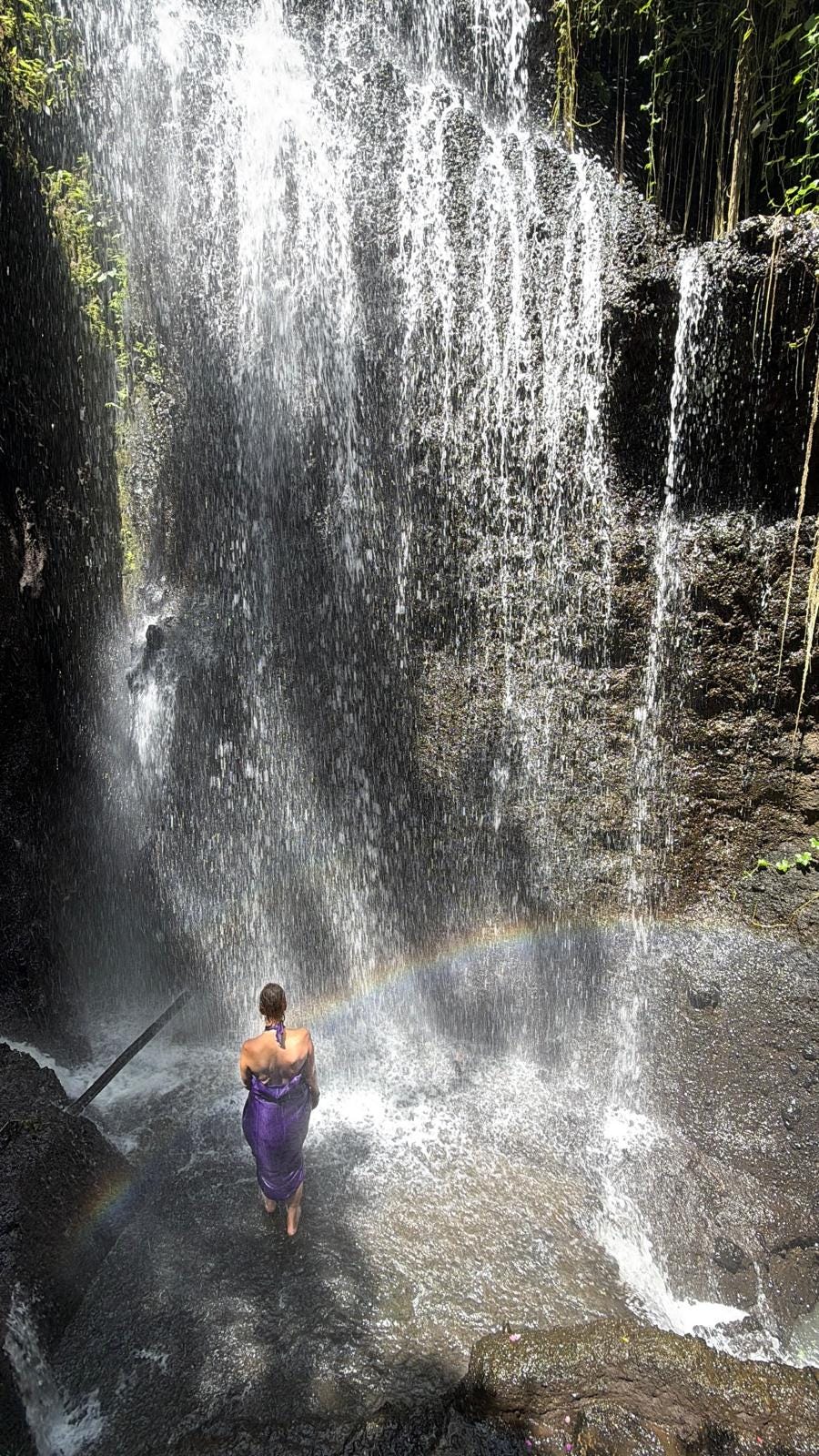
Long before we reached the waterfall itself, we could hear people screaming somewhere deep in the jungle.
Not terrified screaming, though. Release.
At least that’s how our guide explained it while leading us barefoot through the temple grounds carrying baskets of offerings and incense. “We’ll cross that bridge later,” he said casually, as if screaming beneath a waterfall was a perfectly ordinary thing to build into the middle of a Tuesday.
At the time, I still assumed I’d probably feel self-conscious about the entire experience.
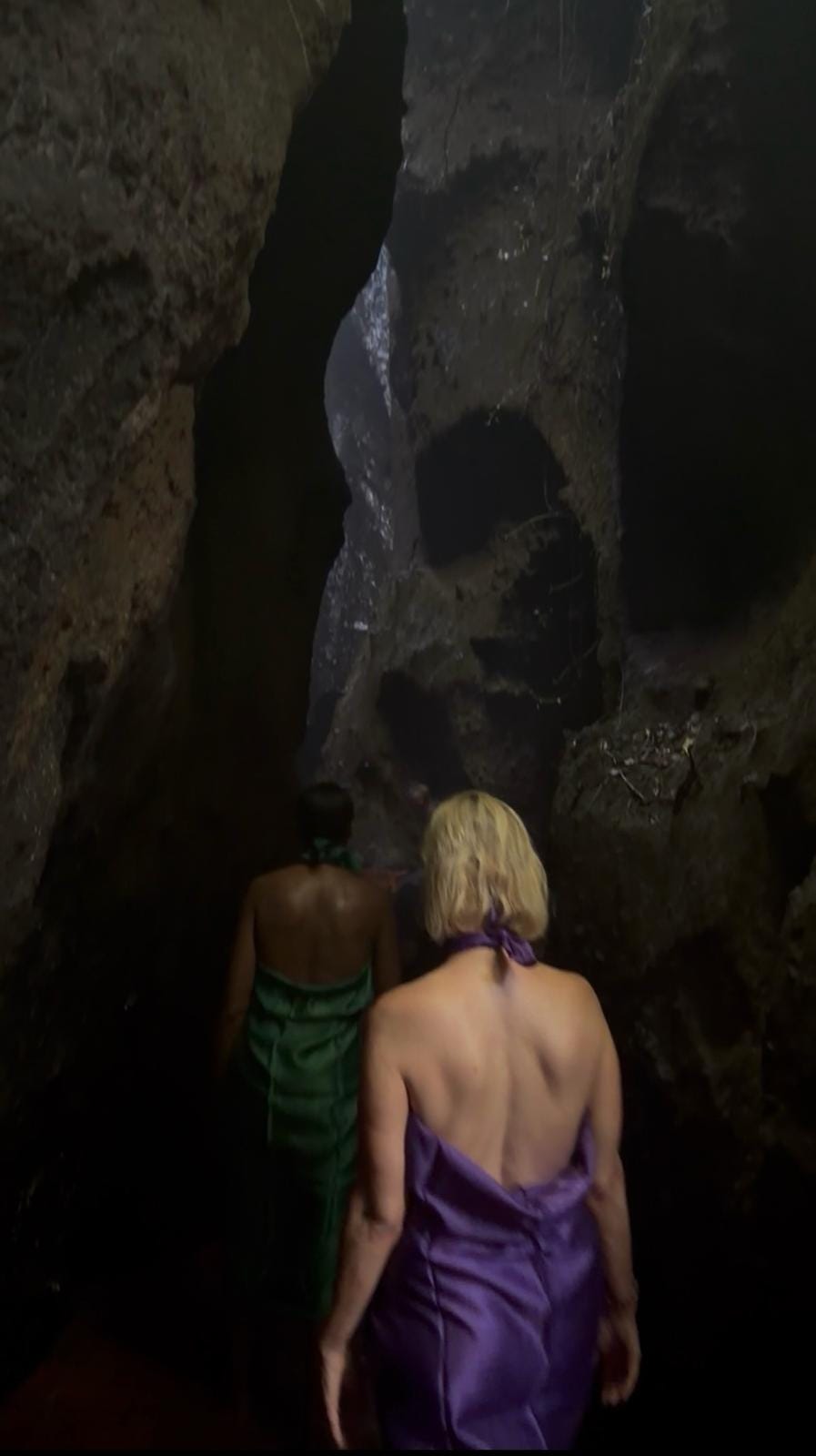
Krystal and I had already navigated the first uncomfortable layer earlier that morning — changing into sarongs and sashes, trying to move respectfully through ritual space while also quietly wondering whether we fully understood what we were stepping into. Krystal deals with vertigo, so when we finally reached the waterfall area, Nigel stayed beside her helping her navigate the slippery rocks.
I climbed underneath the waterfall alone, which surprised me too.
Usually I’m highly aware of everyone else around me — monitoring, adjusting, paying attention to whether everyone is okay and whether I’m behaving correctly. But standing underneath that pounding water with my sarong whipping around my body in the gusts, briefly worried about accidentally offending someone because I was naked underneath it, I stopped thinking about anyone else entirely.
The water crashed so hard onto my head and shoulders that it erased thought.
So I screamed.
Three times.
And afterward, we were apparently supposed to laugh three times too, but fake laughing felt impossible somehow. Screaming from somewhere real felt completely different than manufacturing joy on command.
By the time I walked back toward Nigel and Krystal, I was soaked, silent, and crying without fully understanding why.
That stayed with me, not because the experience suddenly felt spiritual or mystical, but because it felt physically true in a way I wasn’t expecting. Like something locked inside the nervous system had finally found a way out.
And afterward, I felt strangely serene. Powerful. Empty in a good way. The kind of calm that arrives after release instead of control.
Honestly, I remember thinking: I should probably do this regularly.
What surprised me afterward wasn’t the ritual itself.
It was realizing how many of the periods in my life that felt most vivid seemed to contain similar underlying conditions — awareness, stretch, openness, recovery, environment, participation.
Not as productivity tools, but as ways of staying connected to life over time.
I’ve spent years thinking about how to build a life with less friction — fewer unnecessary decisions, better environments, more walkable cities, simpler routines, less constant cognitive drag. And honestly, I still think most of that matters tremendously.
But somewhere in Bali, I started realizing something else too: depth doesn’t sustain itself automatically.
The more time we spent there, the harder it became to ignore how much our surroundings, relationships, nervous systems, and willingness to engage shape what remains emotionally reachable over time.
Awareness came first, particularly the ability to notice when something was expanding me versus quietly depleting me.
When we left Ubud one afternoon, I’d developed a fever. Earlier versions of me probably would have pushed through anyway, finished the itinerary, and forced the experience to continue because I’d already committed to the plan.
Instead, I remember stepping barefoot onto the cool wet stone outside the villa after we returned to Sanur, watching kites fly and bats circle in search of insects, while the evening stayed quiet around us. I sat still, left the doors open, and felt relief arrive faster than guilt for once.
That mattered more than I realized.
I’ve started wondering whether awareness is sometimes the thing that interrupts self-abandonment before it disguises itself as discipline.
Stretch looked different too. Sometimes it arrived disguised as discomfort, like the day Alit unexpectedly pulled us into an all-day Uluwatu adventure before we’d even mentally adjusted to Bali.
At first I resisted almost every part of it — the heat, the lack of a plan, the feeling that I’d lost control of the day entirely. But somewhere between the chaos, the temple monkeys stealing my sunglasses, and a sunset seafood dinner beside the ocean, I realized how quickly involvement can completely transform an experience we initially try to manage or resist.
Environment mattered more than I expected too.
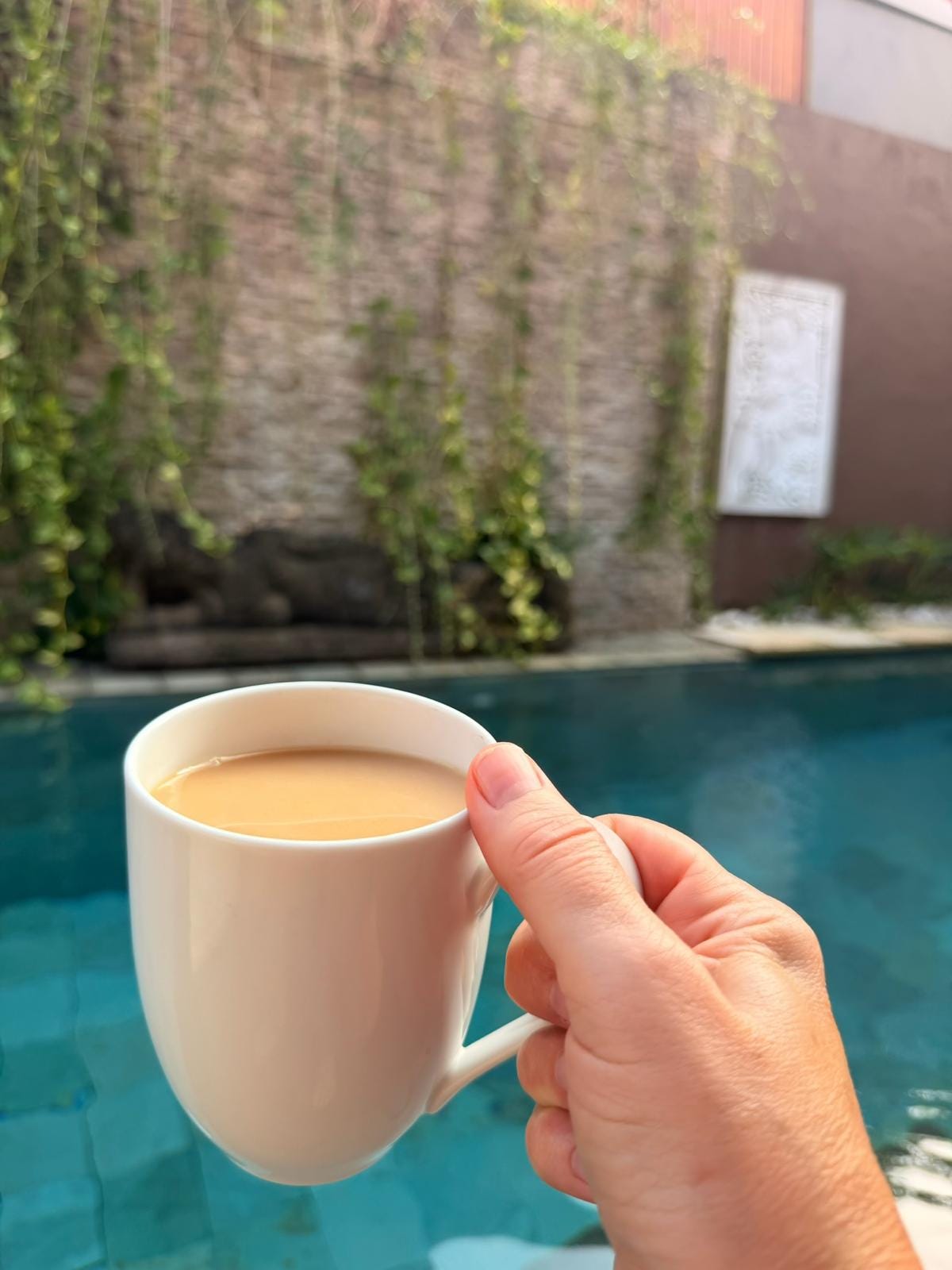
The open-air villa. Humid night air moving through the curtains, music drifting between rooms, incense smoke in the mornings before the scooters started. Wet stone under bare feet. Pool reflections moving across the ceiling at night.
Eventually, I realized the environment itself was changing what felt accessible internally.
Certain environments narrow us. Others soften us before we consciously realize it’s happening.
I noticed similar shifts physically as well.
After alternating between sauna heat and freezing plunge pools one afternoon, I woke up the next morning feeling like my entire body was vibrating internally — electric, awake, like I’d briefly stepped outside my normal operating range and my nervous system hadn’t fully recalibrated yet.
It felt strange, but also deeply alive.
Connection may have been the biggest realization of all.
Not observing life beautifully from a distance, but actually joining it.
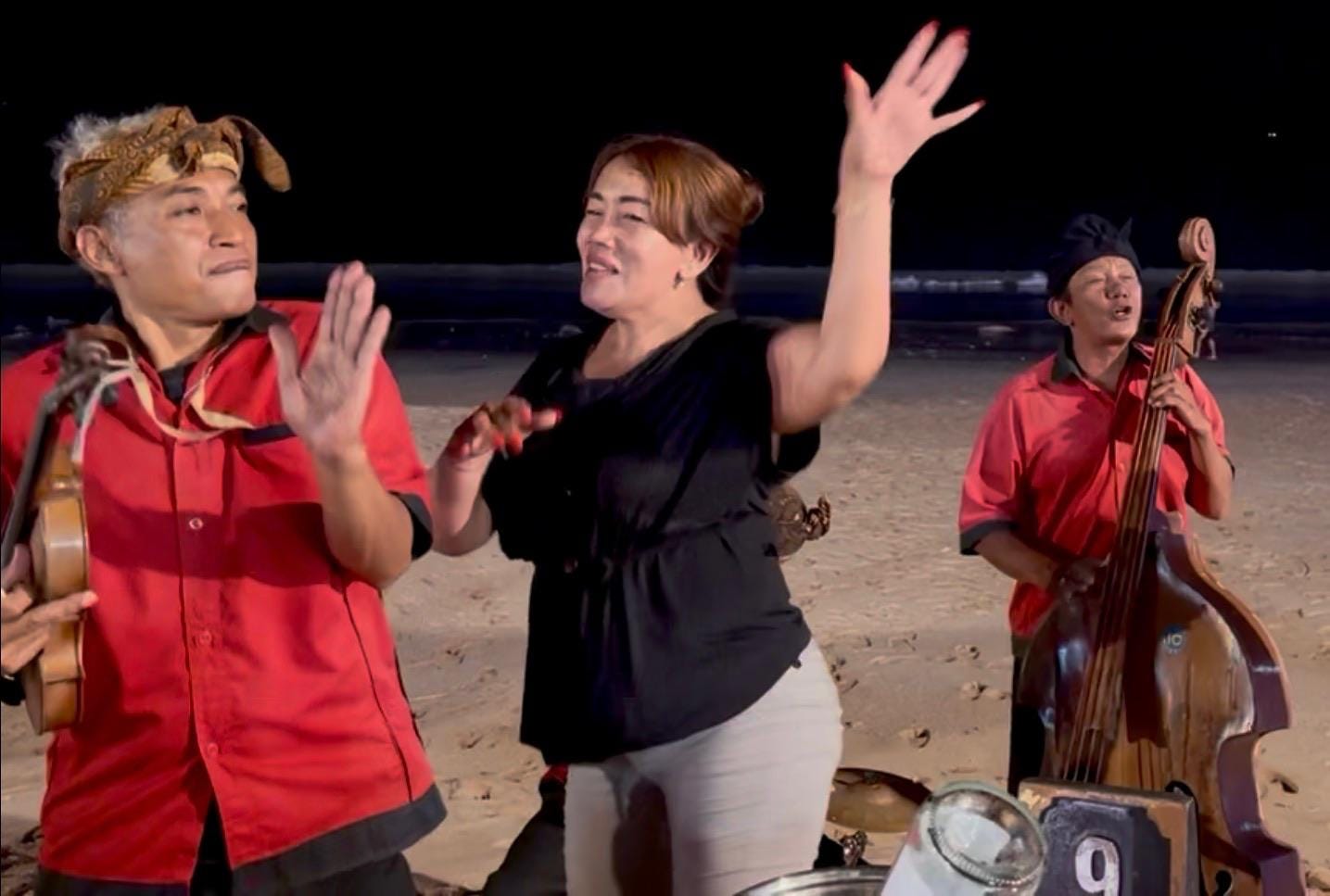
The dance parties with Krystal. Champagne rituals. Singing too loudly in the kitchen. Letting old friendships overlap with new ones instead of keeping different parts of my life carefully separated from each other.
I started noticing how quickly being connected changed my experience of a place. Not because every moment suddenly became extraordinary, but because involvement created a kind of emotional permeability that observation alone never quite could.
I think many adults slowly lose access to that without fully realizing it as we become optimized, functional, highly competent versions of ourselves. Good at managing schedules, responsibilities, relationships, and identities. Careful about how we appear, how much discomfort we tolerate, how foolish we might look.
And somewhere inside all that carefulness, life can slowly become more logistical than dimensional. That certainly happened to me somewhere along the way, in the life I left behind.
Nothing was necessarily wrong on the surface, but my openness to experience had quietly narrowed as self-protection slowly took over.
Increasingly, I think the nervous system expands less through perfection than through participation.
That may be part of why certain experiences change us so quickly — not because they’re objectively extraordinary, but because they temporarily interrupt the systems we normally use to manage ourselves.
We remain in the arena — where we allow ourselves to be affected, to look foolish sometimes, to stop managing every experience so tightly that nothing unpredictable can reach us anymore.
Because over time, many adults become highly skilled at protecting themselves from discomfort while accidentally protecting themselves from aliveness too.
That’s the part I understand differently now.
Participation creates emotional access faster than perfection.
The older I get, the more I realize how easy it is to build a life that functions beautifully while quietly losing contact with parts of yourself inside it. I think that’s part of what I’ve been feeling underneath this entire Bali season. Not the desire to escape my life, but the desire to re-enter it differently.
And increasingly, I’m not sure most people need reinvention as much as they need enough safety, openness, and capacity to re-enter the lives they already have more fully again.
💛 Kelly
🚪 Opening the Door
Some essays begin in the paid space because the ideas are still taking shape.
Others stay with me long enough that they become part of the foundation of this publication.
This is one of those essays.
I’m opening the door because I think this idea belongs in the larger conversation.
Going forward, many of the essays that define the philosophy of Benthall Slow Travel will eventually become part of the public archive. The paid space is becoming something a little different: the workshop where new frameworks, experiments, and ideas are developed before they’re fully formed.
If these are the kinds of conversations you want to be part of while they’re still unfolding, I’d love to have you there.
Comments
Nothing yet. Say the first thing.
Sign in to join the conversation.