
When I was five years old, my kindergarten teacher left the room and put me in charge of the class. When she returned a few minutes later, I was sitting in her chair reading a picture book while my classmates sat cross-legged on the rug around me. Every few pages I turned the book toward them so they could see the illustrations, exactly the way she’d done.
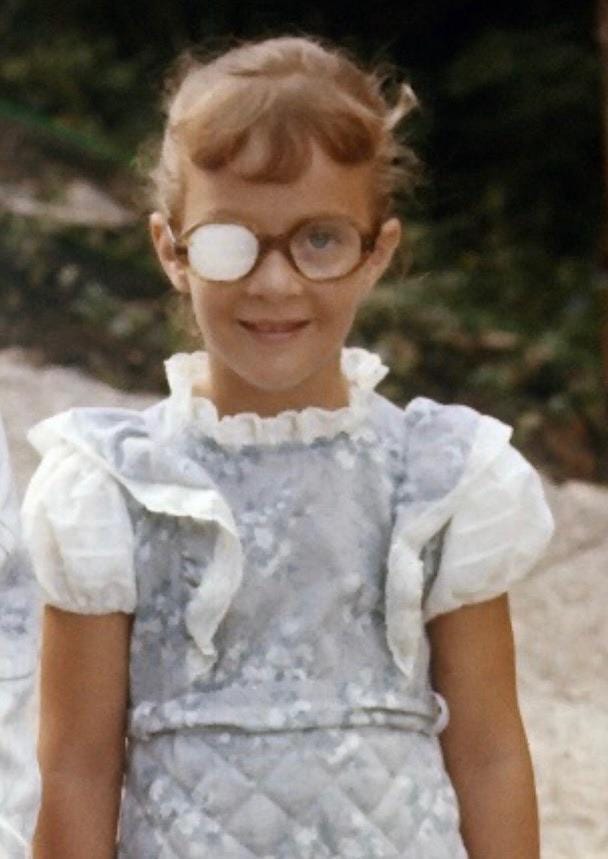
Apparently I played teacher convincingly enough that the school decided I should skip the rest of kindergarten and move straight into first grade. My mother wasn’t convinced I was ready, but the school believed I was. So one morning I put on a green jumper with a flower embroidered on the front, a green-and-white checked shirt my mom had sewn, taped a fresh eye patch over my oversized tortoiseshell glasses, picked up my little backpack, and walked into a classroom full of children who were one, and in some cases almost two, years older than I was.
I can still picture that moment as though someone took a photograph. The teacher paused just inside the doorway with her hand lightly resting on my shoulder while I looked over it into the room. Everything seemed white: the walls, the shelves, the fluorescent lights reflecting off the desks. There was a little workstation just inside the door where she left me standing while she introduced me. No one looked up. The other children were too busy working.
They were decorating large block numbers with drawings of their houses and families. They chatted quietly while they worked, using words I didn’t understand. I remember hearing the phrase zip code for the first time and realizing I had no idea what anyone was talking about.
It wasn’t that I didn’t know the answer. It was realizing everyone else seemed to.
The teacher found me a seat near the back wall and handed me a math worksheet. I’ve never been naturally gifted at math, but this wasn’t really about numbers. It was about who I thought I was. Twenty-four hours earlier I had been the little girl reading to the class. Suddenly I was the child staring at a page she couldn’t complete while everyone around her worked with an ease I couldn’t imagine.
As the room grew quieter, I turned slightly in my chair so no one could see my paper. One by one, the children finished, carried their worksheets to the front of the room, and returned to their desks. Mine remained blank. Looking back, I probably knew more than I thought I did. But that wasn't the comparison I was making. I wasn't comparing myself to anyone else in the room. I was comparing myself to the little girl I'd been the day before.
When the last few students stood to hand in their work, I waited until no one was paying attention. Because my desk sat against the back wall, I could reach the shelf behind me without anyone noticing. I quietly slid the worksheet behind a row of little figurines lined neatly along the edge and sat back down as though I’d turned it in with everyone else. I don’t remember whether the teacher ever found it. I only remember deciding, at five years old, that if I didn’t know the answer, I’d better learn to look like I did.
The eye patch eventually came off. I think I just kept wearing it in my mind. I still instinctively choose the seat against the back wall, even in a café. It's funny how old adaptations can outlive the reasons we needed them.
Something shifted after that first year. Not overnight. I eventually caught up academically. By fifth grade I was making straight A’s again, and from the outside it probably looked as though the school’s decision had been the right one all along. My teacher that year had a way of explaining things that made sense to me. We had moved again, so I was the new kid again, which somehow made it easier to reinvent myself. I became “the smart one” once more.
Only now I knew how quickly that identity could disappear, so I paid attention to everything. I listened carefully when teachers spoke. I memorized what mattered. I watched the students who always seemed to understand before I did and quietly copied the parts that worked. If I didn’t know something, I became very good at making sure no one noticed.
The teasing never completely stopped. I was younger than almost everyone else. The boys made fun of my glasses, my teeth, my nose. Later I became a cheerleader, not because I was one of the popular girls but because I could tumble. I won a spot someone else expected to have, which didn’t exactly make me any more welcome. Looking back, it’s strange that my parents remember me as confident. They had no idea how much of my day was spent trying not to attract the wrong kind of attention.
College didn’t change that. I was still younger than my classmates and hiding had simply become more sophisticated. I knew how to produce good work. Most of the time I did. But every now and then, if I felt unprepared or convinced I couldn’t meet my own expectations, that same old panic would return. It wasn’t really about the assignment anymore. It was about the possibility of being exposed as someone who wasn’t as capable as everyone believed. Even now, it’s uncomfortable to admit how much energy I spent protecting that version of myself.
That strategy served me well for a very long time. It served me so well that I mistook it for my personality. I built a career I genuinely loved because I'd become remarkably good at finding answers before anyone realized I hadn't started there. People eventually introduced me as someone who could figure things out, and after hearing it often enough, I believed it too.
On my first day at American General, the CEO came to welcome our new employee class. He walked around the room asking each of us to introduce ourselves and share a little about our background. Part of my previous job had involved writing speeches for a local politician. When I mentioned it during introductions, the CEO walked over afterward, shook my hand, and asked if I'd write speeches for him.
I was twenty-something years old with a degree in industrial and organizational psychology. I’d never imagined writing speeches for the CEO of a Fortune 500 company. I smiled and said, "Absolutely," while thinking something entirely different: Can I actually do this? Then I did what I'd been practicing since I was five years old. I stayed late, overprepared, and learned everything I possibly could before anyone had the chance to discover what I didn't know.
The speeches went well. He kept asking me back. We met one-on-one for the next three years. He trusted my judgment. He asked for my advice. From the outside, it probably looked like confidence. In the rearview mirror, I think it was something slightly different.
Retirement quietly removed the structures that had made those habits look like strengths. There were no quarterly reviews to prepare for, no executives waiting for recommendations, no meetings where someone expected me to have already done the homework. For the first time since I was five years old, life wasn’t asking me to arrive with answers. It was asking me questions instead. At first I responded the only way I knew how.
I researched where we should live, where we should travel, visa requirements, neighborhoods, weather, healthcare, grocery stores, internet speeds. I called it planning, and some of it certainly was. Looking back, though, I can see that some of it was still the little girl with the blank worksheet trying very hard not to get caught again.
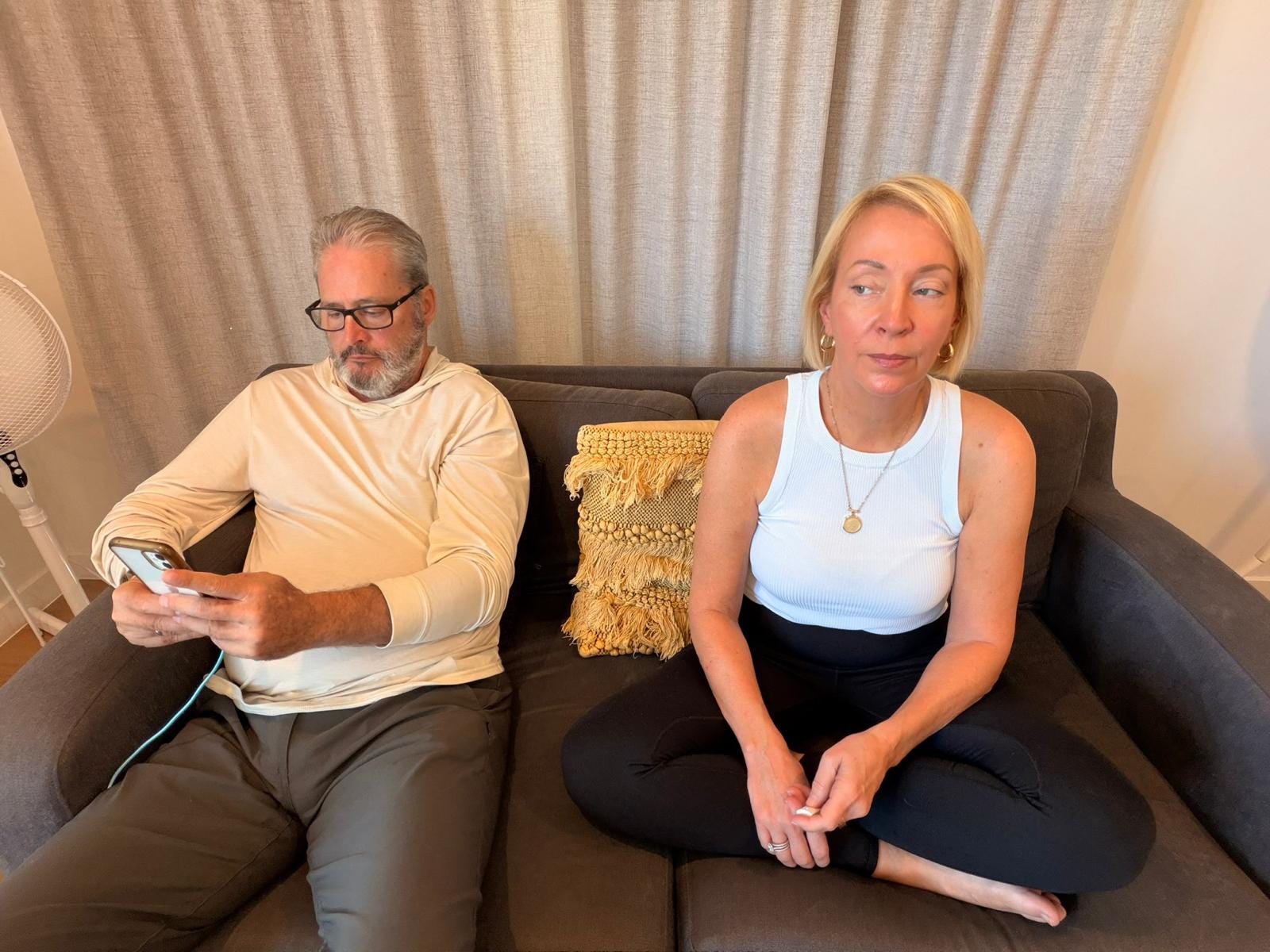
One Sunday afternoon Nigel and I were sitting on the couch during our weekly business meeting, talking about where we should travel next, when I remembered an article I’d read recently. “We should go to Oceania,” I said confidently. He looked up from his laptop and asked the simplest question imaginable. “What’s Oceania?” I opened my mouth to answer and realized I had absolutely no idea. I’d studied geography at university. I’d memorized mountain ranges, capitals, rivers and coastlines well enough to pass every exam, but like so much crammed knowledge, most of it had quietly leaked away over the years. I knew the word Oceania. I just didn’t know what it actually meant.
For a split second I felt that familiar tightening in my stomach. Fifty years of instinct suggested I should recover quickly, change the subject, buy myself a few seconds, somehow make it sound as though I knew more than I did. Instead I heard myself laugh. “Good question, actually. I don’t really know. I guess I shouldn’t throw out random destinations expecting you to supply the context so I can pretend I knew what I was talking about.” Nigel laughed immediately, and then we carried on planning our trip. The conversation didn’t become awkward. He didn’t think less of me. Nothing bad happened at all.
I’ve thought about that moment more times than I’d like to admit. Not because I didn’t know where Oceania was, but because I realized it was one of the first times in my life that saying “I don’t know” hadn’t felt like failure. It felt like the beginning of curiosity instead.
For most of my life, I thought confidence meant arriving with answers. I thought grown-ups were people who already knew what they were doing. Looking back, I can see how many decisions I made from that assumption. Careers. Relationships. Even retirement. I kept waiting until I felt certain before allowing myself to move forward, never realizing that certainty wasn’t confidence at all.
It was camouflage.
The strange thing about slow travel wasn't that it changed me. It was that it placed me in environments where I wasn't supposed to know everything. Every new country expected me to be a beginner. For the first time in my life, being new wasn't something to hide. It was expected. I wasn't expected to understand the language, the customs, the unwritten rules, or even which grocery store sold milk. Somewhere along the way I realized that curiosity worked better than certainty ever had.
Retirement didn’t change me as much as it revealed me.
It gave me enough space to notice that what I’d always called my personality might actually have been an adaptation. That little girl who walked into first grade before she was ready wasn’t weak. She was resourceful. She found a way to survive an environment that expected more from her than she could yet give. The problem wasn’t the adaptation. The problem was that I carried it with me for another fifty years, long after I needed it.
Sometimes I think about that little girl standing just inside the doorway of her first-grade classroom, clutching her backpack and trying very hard to look as though she belonged. If I could say anything to her now, it wouldn’t be the answers to the worksheet. It wouldn’t be the zip codes or the math problems or the words she hadn’t learned yet.
I’d kneel down beside her and tell her something she couldn’t possibly believe yet.
You don’t have to already know to belong.
Then I’d ask her to do the one thing she was too frightened to do that day.
Raise your hand.
💛 Kelly
Have you ever realized that something you called your personality was actually an adaptation?
I’d love to hear about it in the comments. Sometimes the habits that helped us survive become so familiar we stop noticing they’re there at all.
If these essays are resonating with you, paid subscriptions help me keep writing them. They also give you early access to new essays, behind-the-scenes drafts, and the conversations, experiments, and frameworks that eventually become essays like this one.
Comments
Nothing yet. Say the first thing.
Sign in to join the conversation.