
On Saturday, Cardinals rookie Joshua Báez became the first player in major league history to hit a home run in each of his first three career at-bats. Moments like that tend to live forever as trivia and nowhere else, a single unforgettable afternoon attached to an otherwise ordinary career. Sixty years earlier, a 22-year-old Cuban shortstop pulled off something almost as improbable in his own first game, and then spent the next two decades proving it wasn’t a fluke at all.
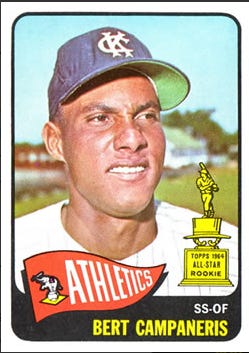
Dagoberto “Bert” Campaneris grew up near Matanzas, Cuba, playing the game whenever he could and working as a groundskeeper on the side just to stay close to the game. A Kansas City A’s scout spotted him at the 1961 Amateur World Series and signed him to a contract that guaranteed $1,000, but only if he stayed with the organization for at least sixty days. Campaneris left Cuba for the United States just before the Cuban Revolution made that kind of emigration nearly impossible. He didn’t speak much English and knew almost no one in the country. “I had no one in the United States,” he said later. “I was so lonely.”
Campaneris spent parts of three seasons developing in the minors before Kansas City’s starting shortstop went down with an elbow injury in July 1964. Campaneris got the call from Double-A Birmingham, flew through the night, and landed with barely enough time to reach the ballpark. On the very first pitch he saw in the major leagues, from Twins ace Jim Kaat, he hit a home run. He went deep again later in the game, added a single, a walk, and a stolen base. He’s one of only six players in major league history to hit two home runs in his major league debut, a list that includes just one other player before him, Bob Nieman in 1951, and future additions like Trevor Story decades later.
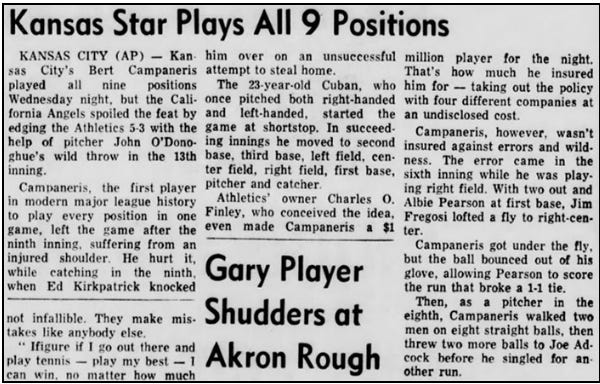
The rookie burst turned into a real career almost immediately. Campaneris led the American League in stolen bases in 1965, the first of six stolen-base titles, breaking a nine-year run atop the league held by Luis Aparicio. That September, A’s owner Charlie Finley built an entire promotional night around him, having Campaneris play all nine positions in a single game against the Angels, the first player in major league history to do it. He worked his way around the diamond position by position and even pitched an inning, throwing left-handed to left-handed batters and switching back for right-handers. The night nearly ended in real injury, as a home-plate collision left him with a shoulder injury that briefly sidelined him. The stunt was memorable enough that in 2015, actor Will Ferrell recreated it across nine separate spring training games specifically to honor what Campaneris had done fifty years earlier.
By the early 1970s, Campaneris had become the everyday engine of the “Swingin’ A’s,” a defensively gifted shortstop who set the table for Reggie Jackson, Catfish Hunter, and Sal Bando as Oakland won three straight World Series titles from 1972 through 1974. It wasn’t always graceful. In the 1972 ALCS, after being hit by a pitch from Detroit’s Lerrin LaGrow, Campaneris flung his bat toward the mound, sparking a bench-clearing brawl and drawing a suspension that cost him the rest of that series. He played through the aftermath anyway, delivering a leadoff home run and a game-winning eleventh-inning homer against Baltimore the following October. In Game 7 of the 1973 World Series, he and Reggie Jackson both hit two-run homers in the same inning, the only two home runs Oakland managed that entire series, and Campaneris caught the final out of the championship himself.
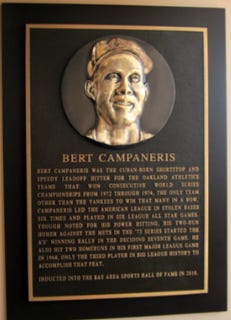
Campaneris’s skills faded gradually rather than all at once. He bounced from Texas to California to a brief, improbable return with the Yankees at 41 years old, batting a career-high .322 in a part-time role before retiring. He finished with 649 career stolen bases, still the franchise leader in games played, at-bats, and several defensive categories at shortstop decades later, with only Rickey Henderson eventually surpassing his Oakland records for stolen bases and triples. The Athletics inducted him into their team Hall of Fame in 2019.
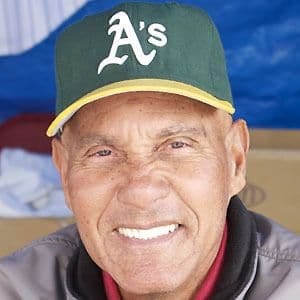
Most players who hit multiple home runs in their debut don’t come close to what Campaneris built afterward. History’s actual lesson isn’t that a great debut promises a great career. Most of the time it doesn’t. But every once in a long while, the player behind the highlight reel turns out to be built for the long run too, and there’s no way to know which version you’re watching on day one. Nobody in Minneapolis in 1964 could have guessed they were watching the start of a two-decade run toward three championships with a fiercely competitive native of Pueblo Nuevo, Cuba.
Sunday Stories · Timeless baseball stories, delivered weekly
Comments
Nothing yet. Say the first thing.
Sign in to join the conversation.