
On July 4, 1914, the Boston Braves were in last place, fresh off getting swept in a doubleheader by Brooklyn. Three months later they were world champions, in the most complete upset the sport had produced to that point. The man who did more than anyone to make it happen wasn’t a star. He was a career backup catcher hitting .243 that season, and within three years he’d sign up to become the first active major leaguer to enlist for World War I.
Losing to a Minor League Team
The Braves hadn’t come close to contending in years, finishing fourth in 1913, more than a dozen games back. 1914 looked like more of the same, and worse. By early July they were more than 20 games out of first place. To underline how far they’d fallen, they traveled to Buffalo for an exhibition game against the local minor league club and lost, 10-2, to a team of nobodies. Under manager George Stallings, something changed almost immediately after. The Braves caught fire, overtook the three-time defending champion Giants, and finished the season having won the National League pennant by 10.5 games. Their home ballpark couldn’t handle the crowds this new version of the team was drawing, so for a decisive late-season series against New York, they rented Fenway Park from the Red Sox.
A .243 Hitter Nobody Expected Anything From
Hank Gowdy had bounced from the Giants to Boston without much fanfare. He was a big, capable defensive catcher who spent much of his early career in the minor leagues learning the position. He wasn’t the gut int he lineup that the favorite Philadelphia Athletics worried about. Connie Mack’s Philadelphia Athletics, the defending champions with one of the most feared rotations in baseball, was going to make this an unfair fight. The outcome of the series was not going to be close, but the games just needed to be played.
It wasn’t close, just not in the direction anyone expected. Boston swept Philadelphia in four games, the first sweep of the modern best-of-seven World Series. The Athletics dynasty never recovered in Philadelphia. Mack, stunned by the loss, broke up his own championship roster afterward, and Philadelphia collapsed into last place the very next season.
The Best Series Any Catcher Has Ever Had
Gowdy was the reason Boston’s pitching staff never had to be perfect. He went 3-for-3 in Game 1, then in Game 3, with Boston down two runs in the tenth inning, led off with the Series’ only home run to ignite the tying rally, later adding a double that started the winning rally in the 12th. He finished the Series batting .545, six hits and five walks in sixteen plate appearances. One contemporary account called him the biggest individual World Series hero the National League had produced since Christy Mathewson. Manager George Stallings later said flatly that his mild-mannered catcher had been the most valuable player of the entire miracle run.
A Rainout Gave Him the Opening He Was Looking For
In late spring of 1917, with the United States now involved in the war overseas, Cincinnati got rained out on June 1, and Gowdy used the unexpected free day to take a train home to Columbus and enlist in the Ohio National Guard, choosing to fight alongside men he’d grown up with rather than wait for the draft. He was 27, in the prime of his career, giving up his salary and a favorable contract to do it.
National League president John Tener later wrote that Gowdy was neither a fading veteran nor an untried rookie, but a player in his prime with everything to lose, and that he hadn’t hesitated. Gowdy played three more weeks with the Braves, his last game a win over the Giants on June 22, before reporting for duty in mid-July. Teammate Johnny Evers remembered Gowdy breezing out of the team hotel that night calling back, “So long boys, I’ll meet you in Paris,” as if he were headed to a party rather than a war.
Trench Fighting With the Rainbow Division
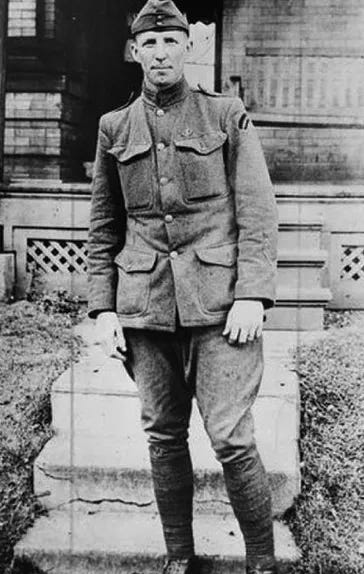
Gowdy served as a color sergeant with the 42nd 'Rainbow' Division, the soldier trusted to carry the regiment's flag into battle, one of the most exposed positions in the unit, seeing combat at Chateau-Thierry, Saint-Mihiel, and the Argonne. His regimental commander called him one of the best men in the outfit.
Fourteen of his 1917 Braves teammates eventually followed him into the service. Two of them didn’t come home: Willard McGraw died in the war, and Arthur Rico died shortly after his discharge.
He Turned Down $1,500 a Week to Get His Old Job Back
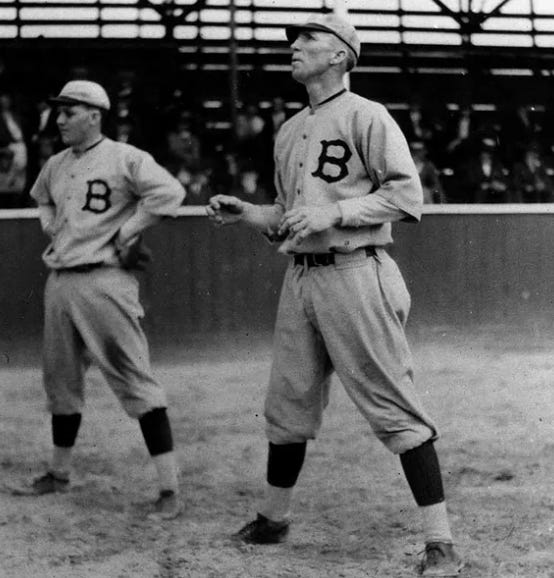
When Gowdy came home in 1919, promoters offered him $1,500 a week to tour the country giving speeches about his war record. In today’s dollars, that is about $30,000. He turned it down and asked for his catching job back instead.
On May 24, 1919, the Braves held a ceremony in his honor before more than 16,000 fans, with Boston’s mayor presenting him a gold watch, a cigar cutter, and $600 in Victory Bonds, while his own teammates gave him a trunk full of new clothes. The team unveiled a bronze tablet at the ballpark honoring all 14 Braves who’d served, including the two who never made it back. Gowdy stepped up for his first at-bat in nearly two years and lined a single to right field on the first pitch he saw.
The Hero Who Became Part of the Story a Decade Later
Gowdy’s story didn’t end on a clean note of redemption. Traded back to the Giants, he won a second championship with them in 1923. The following year, in the deciding Game 7 of the 1924 World Series against Washington, with two outs in the bottom of the 12th inning, Gowdy went to make a play on a foul popup and stepped directly into his own discarded catcher’s mask. “It held me like a bear trap,” he said afterward. The ball dropped, the batter got new life and doubled, and the Senators scored the winning run. It wasn’t the only costly miscue in that game, an 18-year-old Giants third baseman named Freddie Lindstrom had let a ball skip past him earlier that let Washington tie it in the first place, but Gowdy’s mistake is the one that’s been retold for a century, and the reason catchers today are taught to fling their masks well clear of the play rather than leave them underfoot.
A Second War, and a Record for Being Overlooked
Gowdy coached for three teams through the 1930s, then, at 53, sought to serve his country again when World War II broke out. The Army initially turned him down before commissioning him a major, making him the only former major leaguer to serve in uniform in both world wars. He ran athletic training at Fort Benning, Georgia, on a diamond that still bears his name. He appeared on the Hall of Fame ballot 17 times and was never elected, still the record for the most unsuccessful induction attempts in the sport’s history. He died in his hometown of Columbus in 1966, at 76.
Baseball remembers 1914 as a team miracle, a franchise-wide statistical anomaly cited whenever a bad team gets hot at the right time. The man most responsible for turning that miracle into an actual championship gave up the fame it bought him almost immediately, and the institution built to remember baseball’s greats never got around to remembering him either.
Sunday Stories · Timeless baseball stories, delivered weekly
Comments
Nothing yet. Say the first thing.
Sign in to join the conversation.