
Last weekend, our time in Buenos Aires came to a close as it began: with restless nights filled with the sounds of traffic-laden streets and construction, and a lovely steak dinner, accompanied, of course, with a fabulous bottle of Argentine red. The agony and the ecstasy of this beautiful city were on full display, and it was time to move on to the next stop of our sabbatical journey.
And so, on Sunday, we boarded a plane to traverse the hemispheres—from south to north, from west to east. The very long journey brought us (but not our bags) to Berlin, where we were to spend a week teaching some young professionals from around the world about atrocity prevention…and enjoy a beer garden or two along the way.
So many people love Berlin. I’ve heard countless friends and acquaintances speak of it with total delight. They land in this German capital and are enamored by its vibe, its modernity, its grit, and its nightlife. Alas, I am not and have never been one of these people.
My first visit to Berlin was in January 2007 during my first solo trip to Europe (to anywhere, actually). I started that journey in Paris, then took the train to a town in Southern Germany called Baden-Baden, where I met a director friend working on a play there, before heading onward to Berlin. I still remember the fear in my grandparents’ voices when I told them I was visiting Germany on my own. For them, their only association with the country was the Second World War—a prejudice that was certainly reinforced by the WWII documentaries my papa watched on an almost daily basis.
I laughed off their apprehension. I knew Germany was no longer the aggressor nation of decades past, of course. I was expecting all the joy and fulfillment that so many others discovered there, but ultimately found none of it. After the magic and romance of Paris, the plain stoicism of Berlin felt enervating. The frigid grayness of winter didn’t help. I don’t think I caught a single glimpse of the sun during my stay in Berlin, which makes sense given that the days only lasted a handful of hours. By four in the afternoon each day, daylight was already disappearing, and given that I was never one for the clubs, my nights there remained lonely and cold. I just longed to return to Paris.
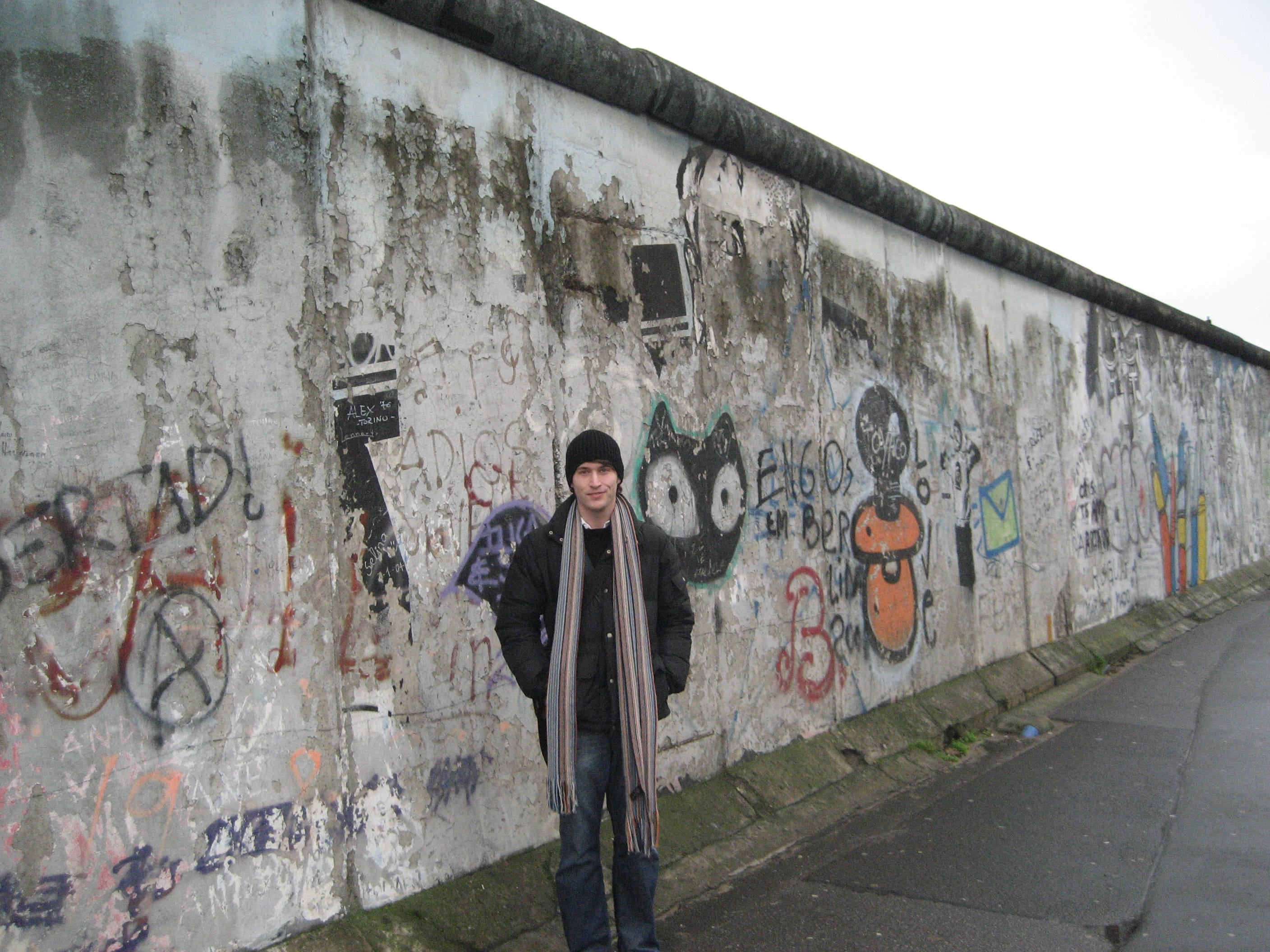
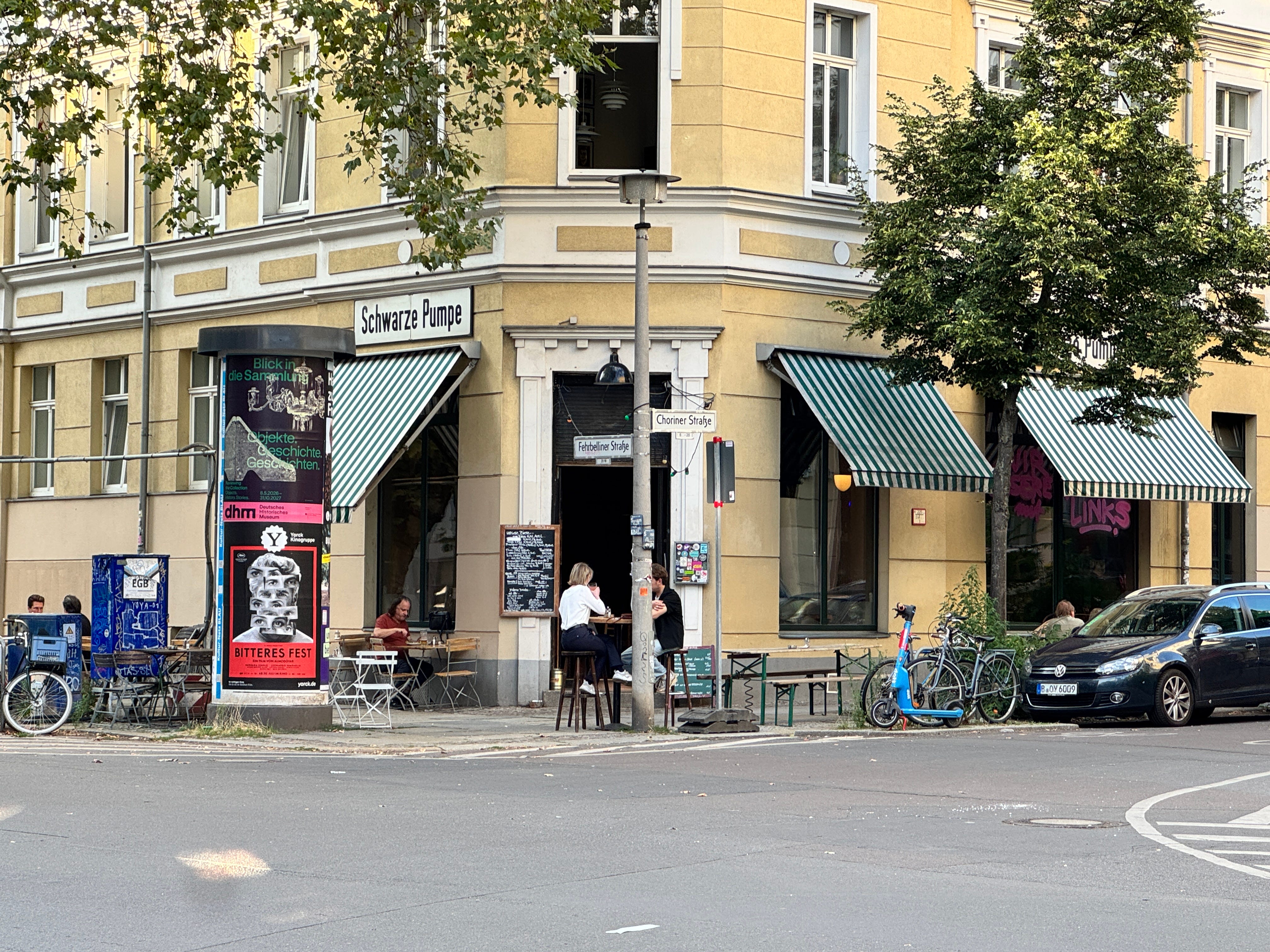
Despite not liking the city very much, Berlin was and remains a fascinating place, particularly for the kind of research I went on to do years after my first visit. And so it is perhaps unsurprising that I ended up there again some years later, in 2013, for a much longer stint, spending a semester as a doctoral student working out of NYU’s Berlin campus. I was there to study Germany’s culture of Holocaust memorialization, and it was an incredibly fruitful visit on that front. My site visits and interviews there led to several published articles, chapters, and a good section of my first book. Tibi and I also met some wonderful friends during this time who were also studying at NYU Berlin, some of whom we’re still quite close to. We’d stayed for those three months in a lovely apartment in Prenzlauer Berg—perhaps the bougiest of Berlin’s neighborhoods—where we found our rhythm and our local gems, the best of which was Schwarze Pumpe, the corner bar steps from our house, where we spent many an evening drinking German lager and eating their delicious käsespätzle.
But, even at the best of times, I only tolerated Berlin, never loved it. And the city certainly didn’t love me. In fact, I felt somewhat cursed during this trip to Berlin. I got robbed not once, but twice. The first time was in a coffee shop, where I was meeting someone for an interview. One minute, my bag was at my feet, and the next, it was gone, along with my passport. I hadn’t even noticed, and likely wouldn’t have for a while longer, had it not been for a police officer coming up to me with my bag in one hand and the thief in the other. (Come to think of it, in this case, maybe it was the thief who was cursed, rather than me!)
The second time was much worse. I had come home from a day of meetings to find that someone had broken into our apartment through the small crack of a window I had left tilted ajar. The apartment was trashed, with my clothes on the floor and all the drawers and cabinets opened. My computer was gone, along with my very nice Nikon camera and my entire sense of personal security. Tibi was out of town when it happened, and I didn’t feel safe staying in the apartment alone. Luckily, our Berliner friends Steffi and Frank took me in.
In addition to the robberies, about a week or so after arriving in Berlin, my left middle finger started aching with a pain that worsened each day. I was hoping it would just go away on its own, but the finger started to turn a bright red and the pain kept increasing, so I eventually accepted the inevitable and went to the emergency room. I always had the idea that most Germans speak English, but this is decidedly untrue. While many young Germans speak English, this was not the case for middle-aged and older Germans, at least in 2013, so negotiating a German hospital was more difficult that I expected. Eventually, I was taken into a back room where a doctor injected me with a numbing agent and then, almost immediately, without checking if my finger was actually numb, took out a scalpel and cut my finger open. I had never felt so much pain in my life. I didn’t want to be a difficult patient, however, so I just let this doctor operate on me without a working anesthetic. (This is one of those memories that makes me so embarrassed of my tendency to prioritize not making others uncomfortable, even if the cost is my own quite extreme discomfort.) She dug through my finger, extracting the pus that had formed over the previous few weeks, bandaged me up, and sent me home.
Two days later, the pain was exactly as bad as it had been before, and it became clear that my own private Dr. Mengele’s impromptu vivisection had not, in fact, fixed anything. Luckily, I was able to find a hand specialist who listened in horror to my story and promised this would never happen under his care. The scalpel was taken to my finger several more times during my stay in Berlin, but I’m happy to report that I couldn’t feel any of these subsequent surgeries, having received ample anesthetic for each. The doctor healed me, but for roughly six full weeks, I was forced to walk the streets with my left middle finger bandaged in a stint and elevated across my chest with a sling. The result: I spent a month and a half giving Berlin the finger, whether I wanted to or not, as my hand healed. The good news: thanks to Germany’s state-funded healthcare system, I did not pay a single cent for any of the medical care I received throughout this ordeal.
All these memories of Berlin left me somewhat reluctant to return last week. I was ready, instead, to venture onward to London or Spello, two places I knew would be founts of more joy than Berlin. For this reason, I was surprised by how much I enjoyed the city this time around. The biggest difference is that all my previous stints in Germany had been during the bleak winter months. In turns out that Berlin in the summer is absolutely delightful. The sun and blue skies transform the city from a drab, post-Communist landscape to a handsome and colorful urban playground. I’ve always loved cities with rivers or canals cutting through them—Paris, Venice, Bruges. The loveliest parts of summertime Berlin can be found along its central aquatic artery, the River Spree. Cafes, restaurants, beer gardens, and concrete urban beaches populate the riverbanks as long, shallow tour boats slip through the water’s gentle current. Willows weep from the embankments as friends laugh at benches and picnic tables, sipping beers and whiling away the hours.
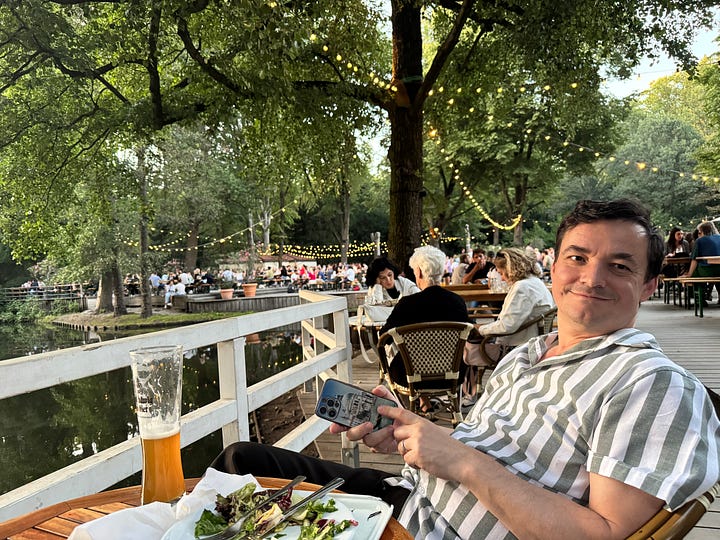
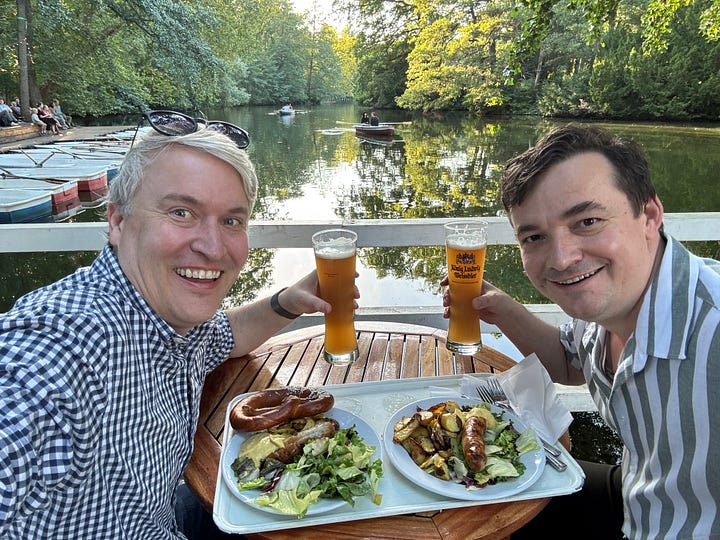
We spent two heavenly nights at Café am Neuen See, the platonic ideal of a beer garden located alongside a quaint lake in the Tiergarten, Berlin’s answer to Central Park. Dozens of wooden tables and benches populate the pebbled ground, which hundreds of people traverse with tall glasses of hefeweizen or lager, bottles of rosé, and cafeteria trays stacked tall with bratwurst and soft, salted pretzels. As the sun sets, fairy lights strung throughout the chestnut trees illuminate, giving the entire garden a magical aura. It was a scene straight out of A Midsummer Night’s Dream. Tibi and I lucked out with a table-for-two right by the lake. As we sipped our beers, we watched couples push off the docks in rustic, wooden row boats, struggling to coordinate their oar movements to propel their crafts forward. We chuckled as more than a few elected to row their boats backwards, with the pointy part of the boat to the back and the water pushing against the blunt rear.
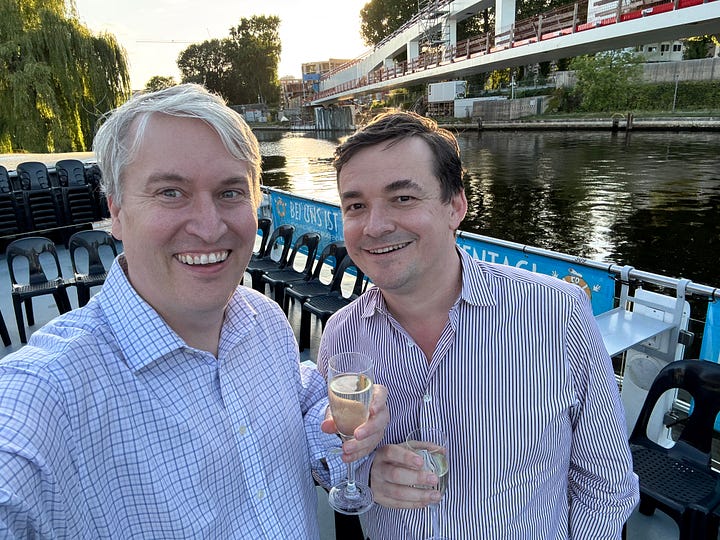
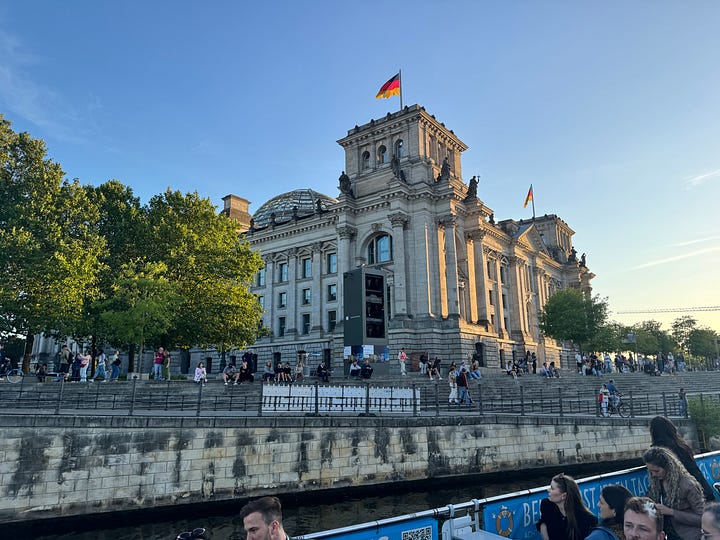
On another enchanted evening, the organizers of the seminar hired a dinner cruise for the seminar participants. A bright, German rosé in hand, we glided down the River Spree, standing atop the long, thin vessel. We passed the German Bundestag with its spectacular glass-domed roof—a reminder of the 1933 fire that triggered the start of the Nazi’s genocidal policies. The glass dome replaced the original stone one that topped the Bundestag before this incident, at once recalling the past and celebrating a brighter and more transparent future for German government. We passed under bridges and alongside weeping willows, at some points having to duck so as not to hit our heads. This version of Berlin, it turns out, I could get used to.
Despite these beautiful experiences, there is one aspect of German culture I will simply never understand, however, and that is the unwavering insistence to wait at street crossings until the light turns green, even if there are no cars within miles of the intersection. For a New Yorker, this phenomenon is truly remarkable. Obviously, in New York City, we have walk/don’t walk signs that tell us when it is safest to cross. But no New Yorker would dream of waiting to cross the street if there is no risk of being hit by a car or bike, with the possible exception of parents trying to teach their children to wait—a lesson that they will undoubtedly forget the moment they are old enough to walk the streets without their parents by their sides. Refusing to wait for a walk sign is such a constituent part of New Yorker-ness that, several years ago, jaywalking was basically decriminalized. The NYPD declared publicly that they would no longer issue tickets for this most common of “crimes.”
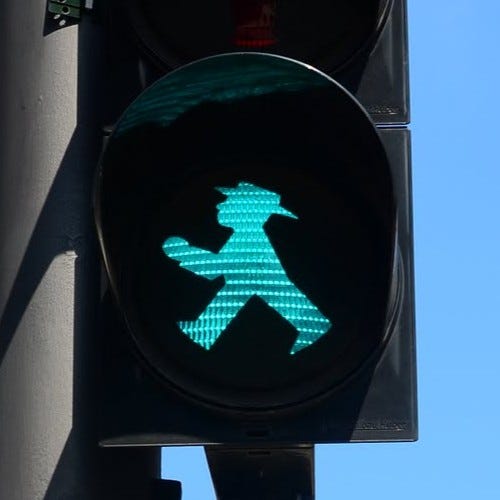
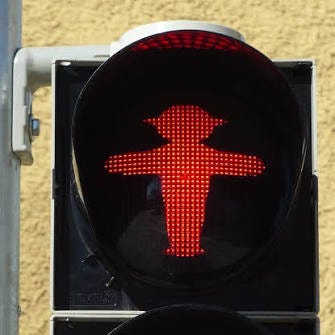
Germans, on the other hand, as history has unfortunately shown us, are fanatical rule followers, and this characteristic is on blatant display at every street crossing in Berlin. In fact, it is so central to life, apparently, that the little man who turns from red to green to show when one can cross the street has become a famous feature of Berlin’s identity. The Ampelmann—literally, “traffic light man”—turns a vibrant green and is shown in a walking position when it’s time to cross the street. In his “don’t walk” position, on the other hand, his bright red outline faces forward with his legs together and arms outstretched to the sides in the shape of a “T” or, more appropriately, like he’s been crucified on a cross—which is exactly what may happen to you if you dare to cross the street when the Ampelmann is red!
That’s right. Attempt to cross a completely empty street on red, and at least half the time, a local will start screaming at you in German that you’re doing something wrong. Michel Foucault famously described modernity as characterized by the internalization of Jeremy Bentham’s panopticon, the philosopher’s ingenious prison design in which the guards could view every prison cell, but the prisoners could never know whether they were being watched or not. The result: the prisoners always had to behave like they were being watched. For Foucault, the objective of modern governance was to discipline society in such a way that everyone behaves as if they are constantly being monitored.
The panopticon has succeeded in Germany, at least at the crosswalks.
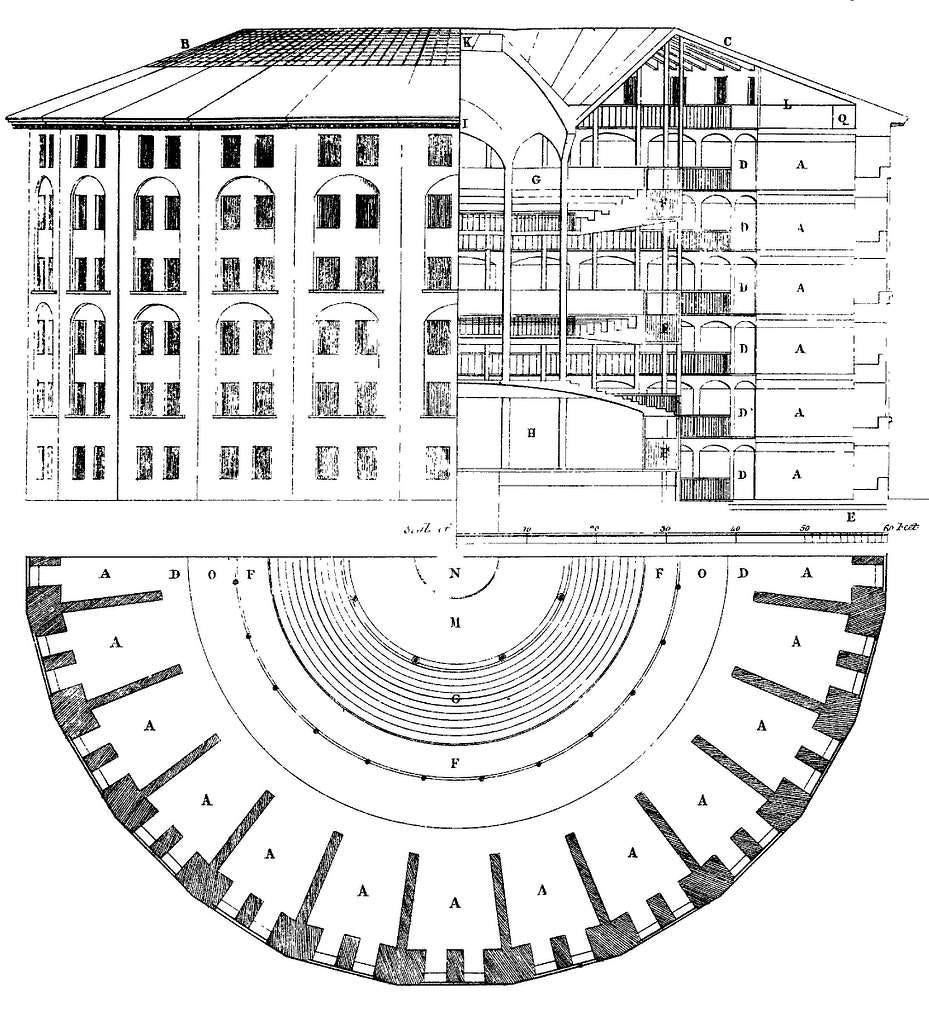
Of course, that doesn’t mean two New Yorkers are going to follow these rules.
Our final night in Berlin, we were walking home from a final nightcap at a swanky cocktail bar north of the Spree. We arrived at Unter din Linden, Berlin’s most famous boulevard, to find hoards of people waiting at a crossing and the closest cars about half a kilometer away, stopped at a traffic light. Tibi and I just kept walking, and within seconds of stepping off the curb, a wave of German invective was hurled in our direction. “Es ist rot!” they screamed. “It is red!” Tibi smiled a million-dollar smile and replied, “You can waste your own time, but don’t waste mine!” One of the yellers—who I am sure also ratted out her best friend in kindergarten for accidentally coloring outside the lines—replied, “This is Germany!” Tibi, ever the federalist, casually replied in his best Mancunian, “This is Europe, luv!”
We walked on toward our hotel, eventually making it to our room. I like to think that all those yellers were still waiting at that street crossing for the little green man to tell them it’s ok to walk. Rules are important sometimes, but so too are personal evaluation and judgment. The latter without the former would lead to anarchy, I know. But the former without the latter gives us Nazism. So, in Berlin, at least, I’m happy to exert my own little rebellion each time I come to the crosswalk.
Comments
Nothing yet. Say the first thing.
Sign in to join the conversation.