
This story is a continuation of our trip to Japan, which started in this post.
After our night of watered down cocktails and drag queens, we woke the next morning and decided to spend our New Year’s Day the way most Japanese people do: by going to a temple. Senso-ji Temple is perhaps the most famous in Tokyo, owing largely to the fact that it is the oldest. Originally founded in 645 AD, this temple is one of the enduring centers of Buddhist life in Tokyo, having survived much of the bombings of World War II that destroyed so many of the city’s other buildings and religious sites.
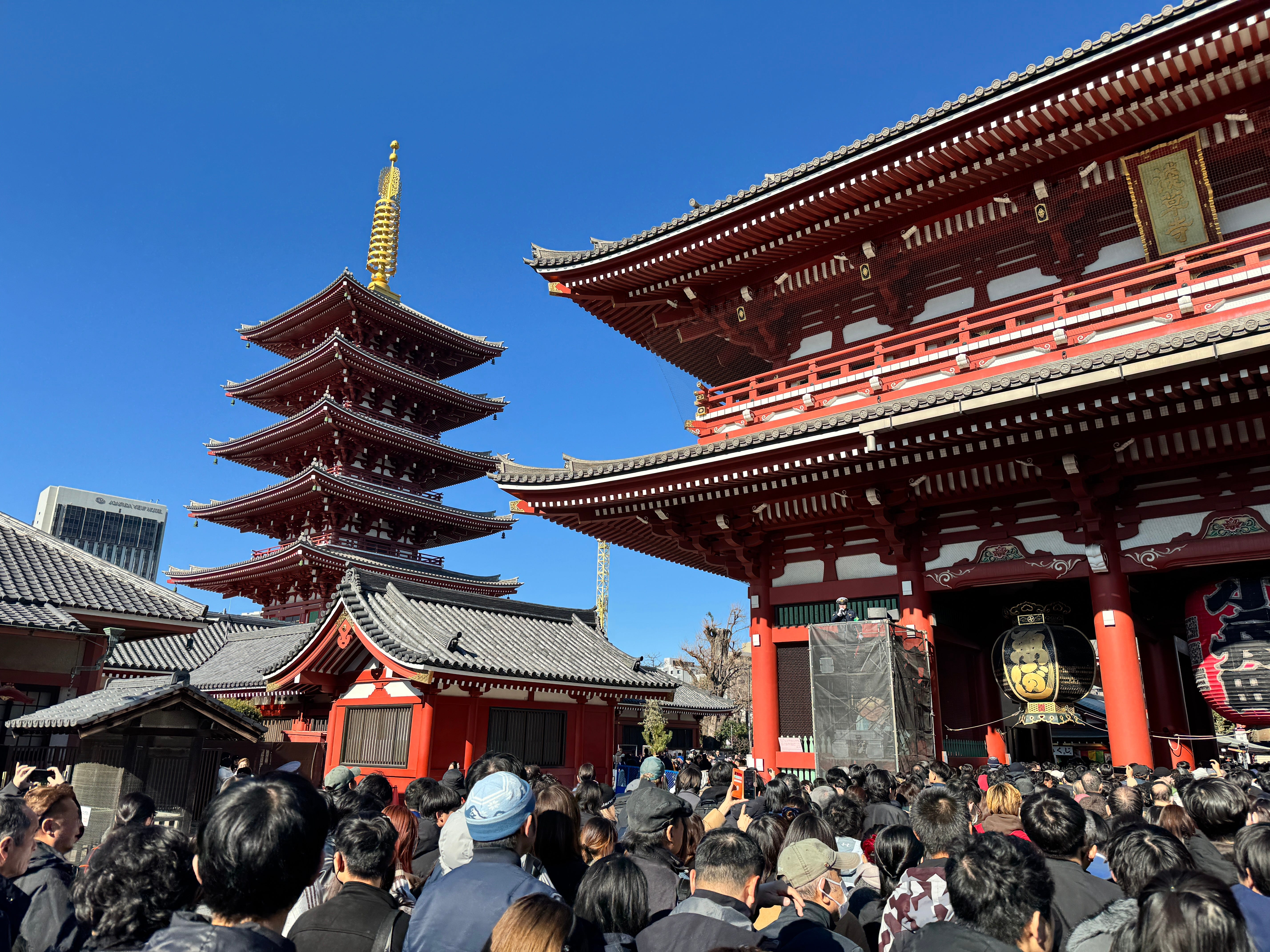
As I mentioned in my previous post, New Year’s Day is a sacred holiday in Japan. Rather than partying until dawn, the Japanese spend the holiday with family, starting the year off by visiting temples, where they say prayers and make offerings in hopes of a prosperous, healthy, and joyful new year. So when we decided to visit Tokyo’s most famous temple on New Year’s Day, needless to say, we were not the only ones. Tens of thousands of others had the same idea. We decided, however, to be energized rather than deterred by the crowds, and so joined the throngs of people waiting to pass beneath the famous Thunder Gate, reaching up to smack the sacred lantern before entering the temple grounds.
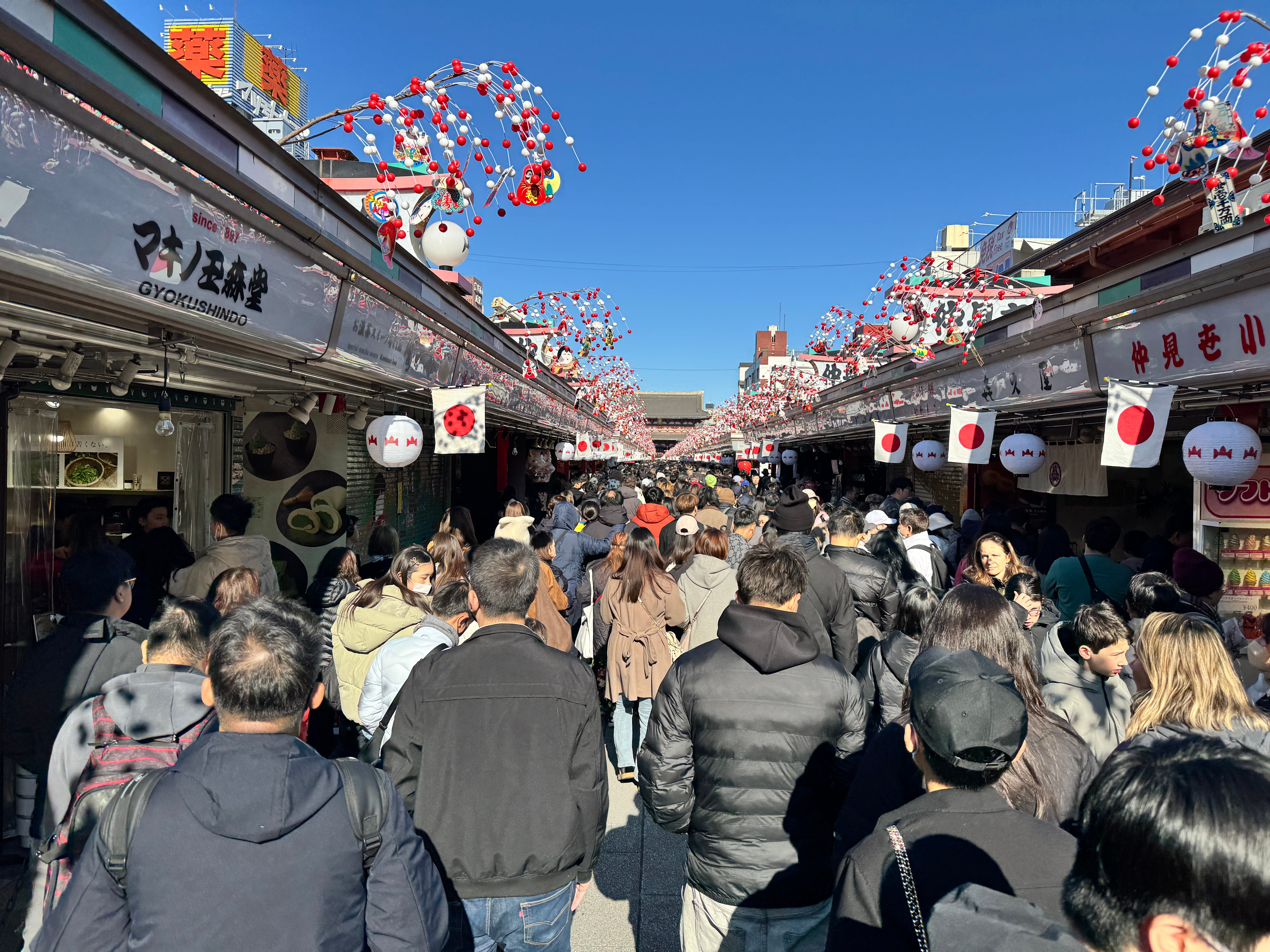
Speaking about Senso-ji Temple in the singular is incredibly misleading, as it is really more of a complex of many smaller temples, shrines, offices, and shops. Red and gold abounded. Pagodas towered over us with their gently sloping eaves, evoking some monumental conifer. Tranquil Buddha statues filled the space alongside an array of other Japanese gods and goddesses with visages that ranged from plaintive to enraged. Some of the temple bells were so large they could have been turned over and filled with water to serve as a hot tub for a small house party. Despite knowing that its meaning in Japan has nothing to do with its meaning in Europe or the United States, it remained jarring to see swastikas scattered throughout the temple grounds, lining the eaves of black-tiled roofs and etched into gold-plated charms promising good fortune. Mostly, however, the space was just majestic.
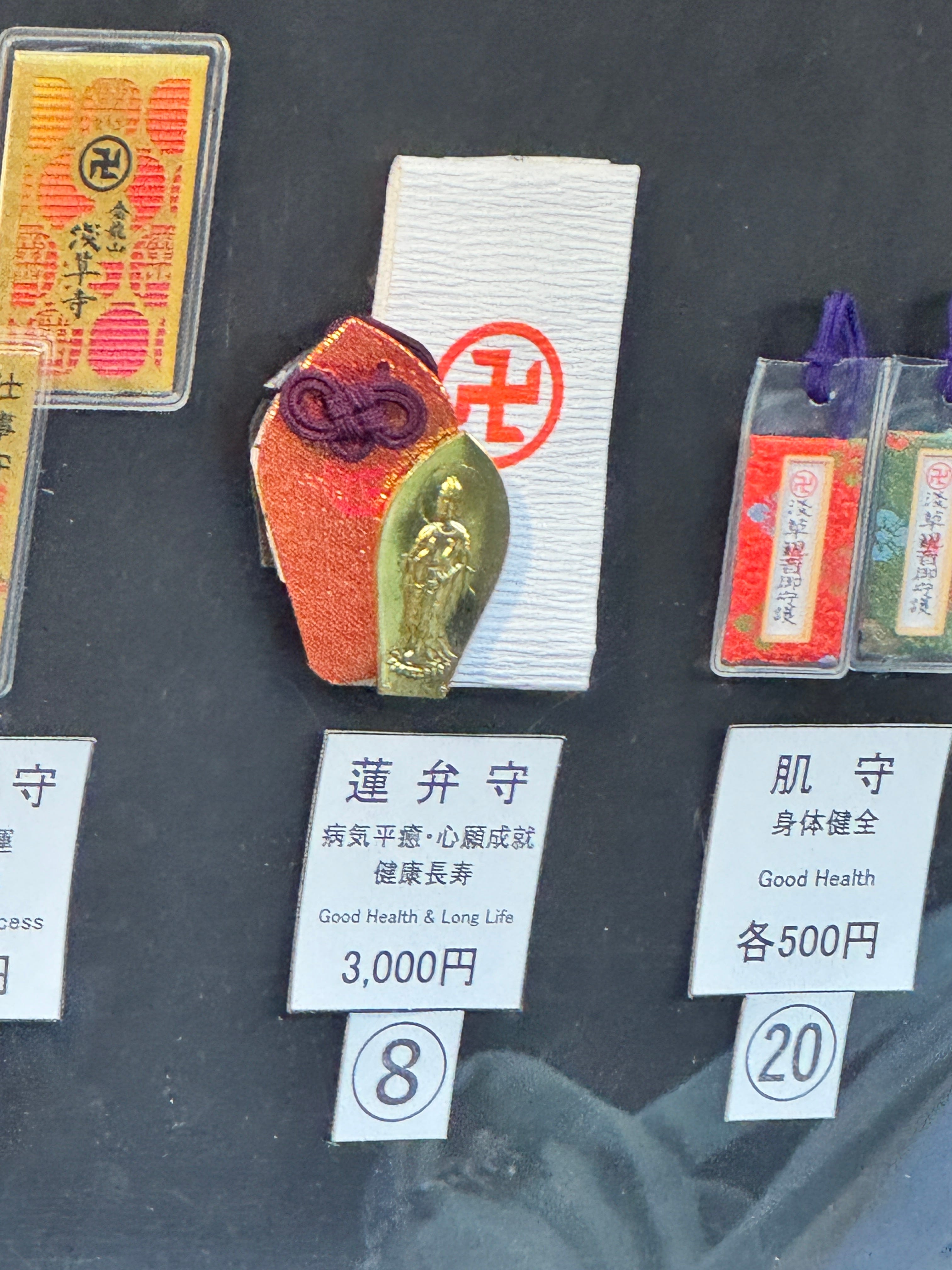
All along the pathway, vendors sold a variety of amulets, each with its own specific meaning, some promising good health, others success at work, and still others luck in love. Visitors bought the amulets and then almost immediately returned them to the priests in the temple in exchange for the promised fortune in the New Year. It was like the strangest gift shop I’d ever seen, where people acquired their souvenir tchotchkes only to immediately return them…but without any form of refund. I suppose they were returning them for “store credit,” only the credit came in the form of some promised auspiciousness in our next collective trip around the sun. Long lines of people waited to toss coins into grates or ring the sacred bells. At every corner, yen were being thrown into bins or passed to vendors. That part of my brain that still remembers all those years reading my Bible and going to church flashed to images of Jesus castigating the moneychangers in the temple, but the aroma of honey biscuits and sweet red bean paste just as easily dispelled that from my mind.
Instead, Tibi and I decided to join in, happily tossing coins into some grate in the floor. I’m not sure why the coins in the grate portended such prosperity, but everyone else was doing it, and it certainly couldn’t hurt. Around the corner, we saw hoards of visitors standing in line to receive their fortunes for the next year, and we certainly weren’t going to miss out on that! We approached a tiny hut with about a hundred tiny drawers in front of us, reminding me of a giant gold card catalogue from the libraries of my youth. In front of the drawers was a hexagonal silver container filled with handcarved wooden sticks, one for each of the drawers in front of us. We paid the price of 100 yen before shaking the container to shuffle the sticks. It sounded like a giant maraca. Then Tibi and I each pulled out a stick with a number at its end, opening the corresponding drawers to pull out our fortune for the coming year.
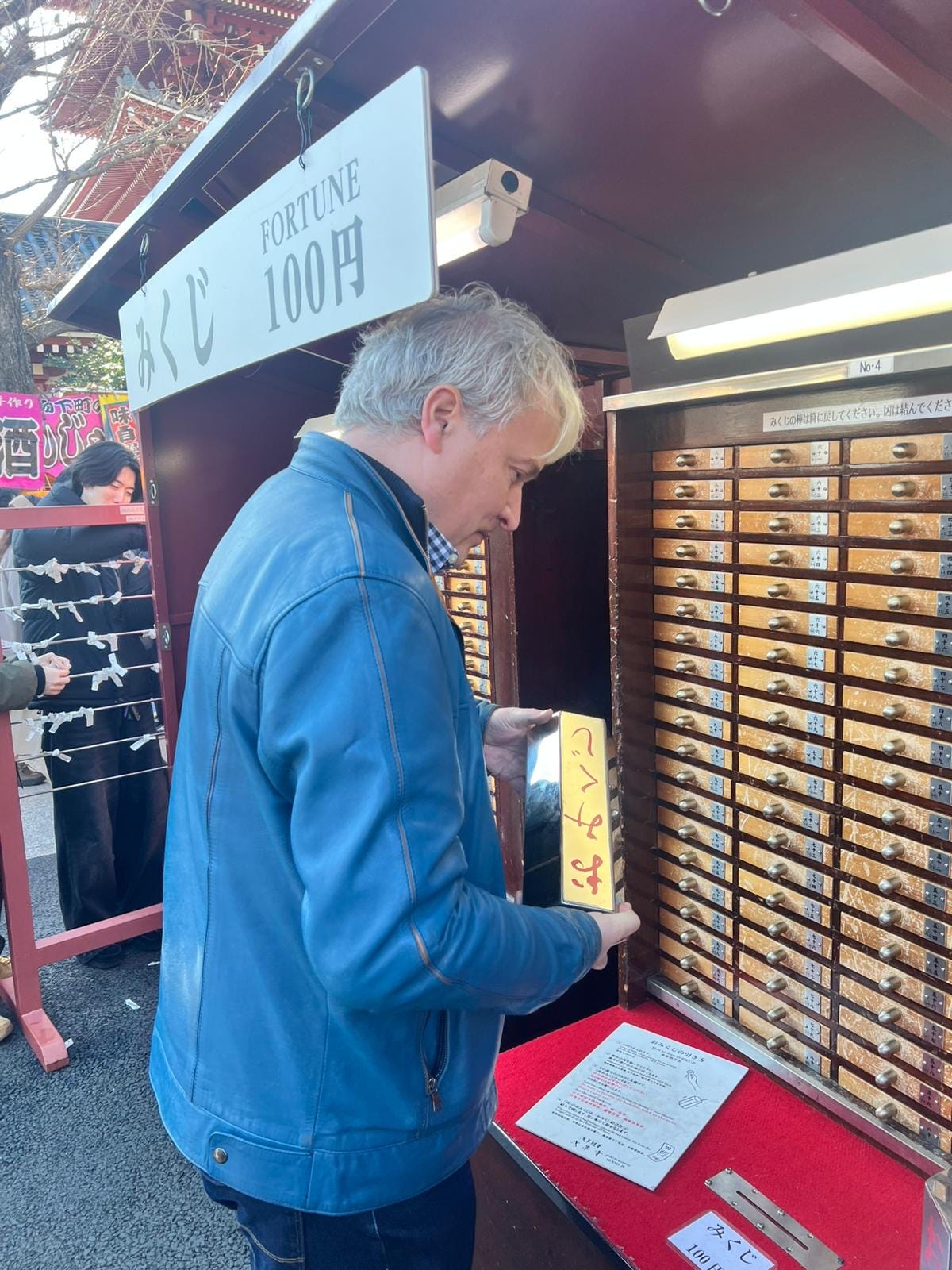
The fortune was mostly in Japanese, but it contained a helpful section that summarized the news in English. There were some characteristics that both our fortunes and, I imagine, all the others shared. After all, these fortunes needed to speak to the central concerns of most people. For this reason, they all offer guidance on some common themes. They all speak to professional success and travel. They talk about marriage or making a move. They all presume that you have someone in your family who is sick or could get sick—a byproduct, I suppose, of Japan’s infamously aging population, as well as the almost universal practice of children caring for their aging parents. And they all, interestingly, presume you’ve lost something that you’re simply desperate to find and that you’re waiting on someone to arrive. For what? That remains unclear. Where they vary, of course, is on the details of how your fortune relates to these things.
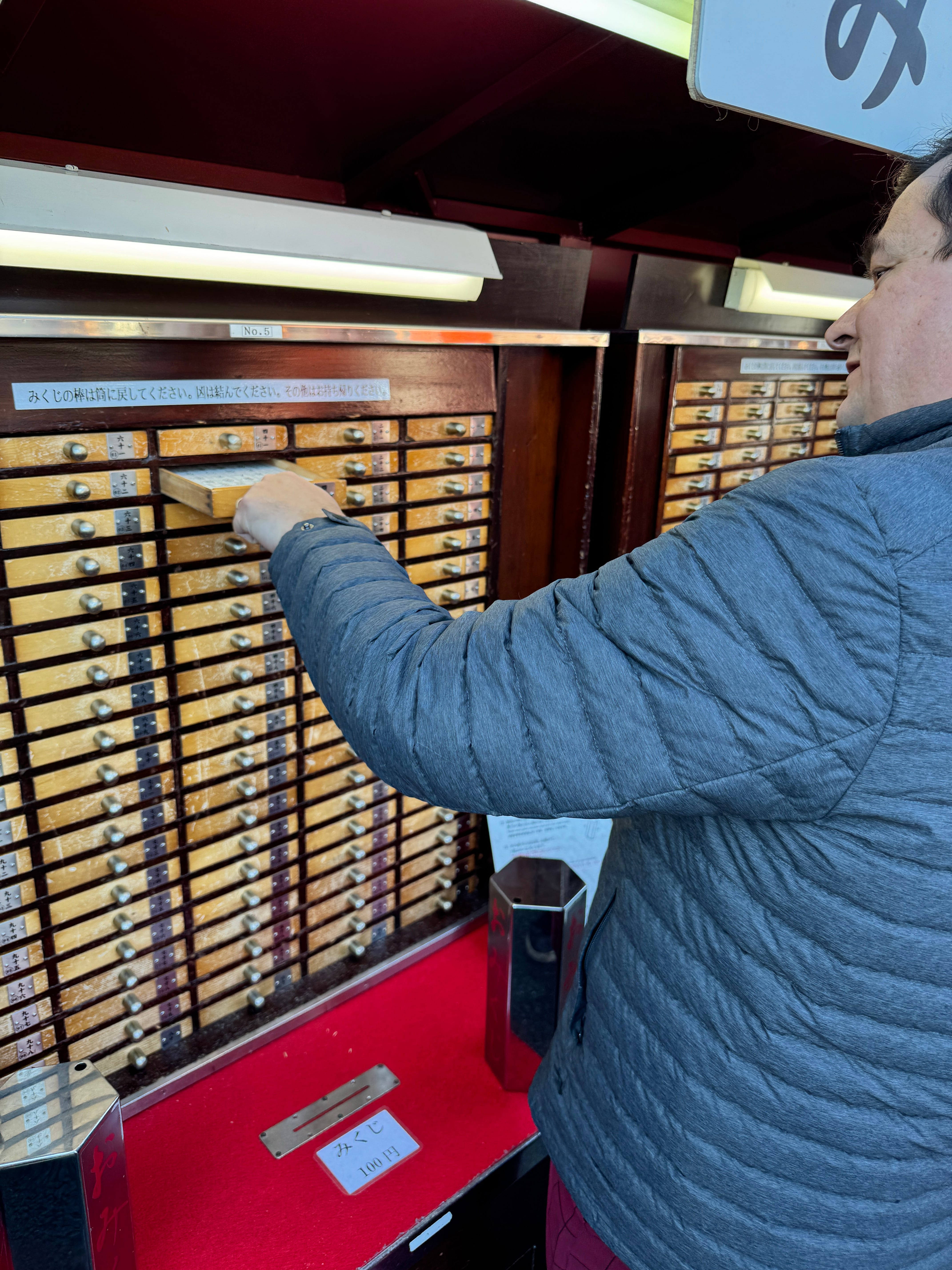
Tibi’s fortune was glorious. It told of success, love, and riches beyond his wildest dreams. He would travel the world. He would have amazing health. He would find everything he’s lost. The world was his oyster. For him, the next 365 days looked incredibly bright.
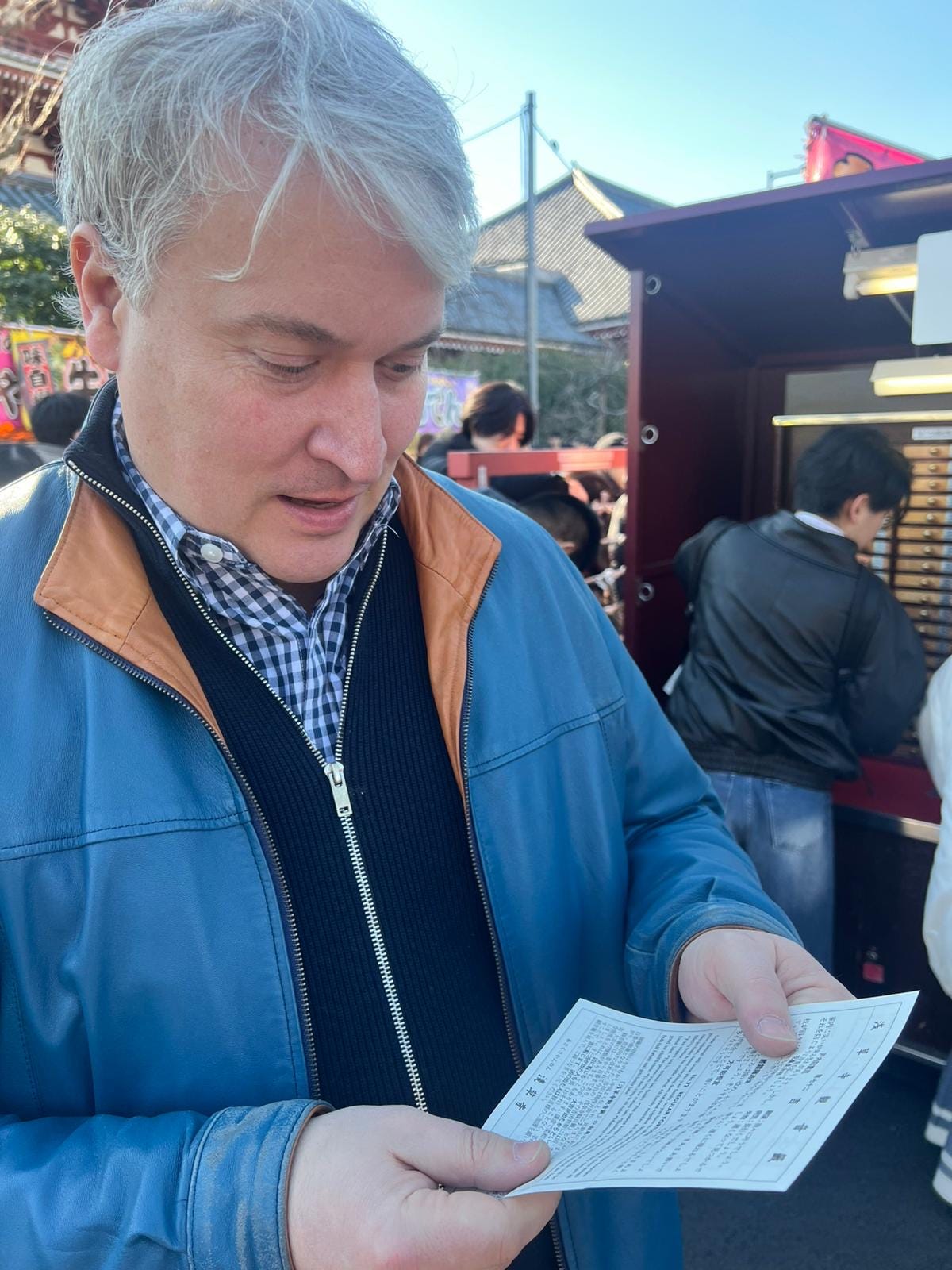
My fortune, on the other hand, was not quite so thrilling. I pulled number 97. In bold, capital letters next to my number, it read clearly and unmistakably: “BAD FORTUNE.” Here is what it predicted for my 2026:
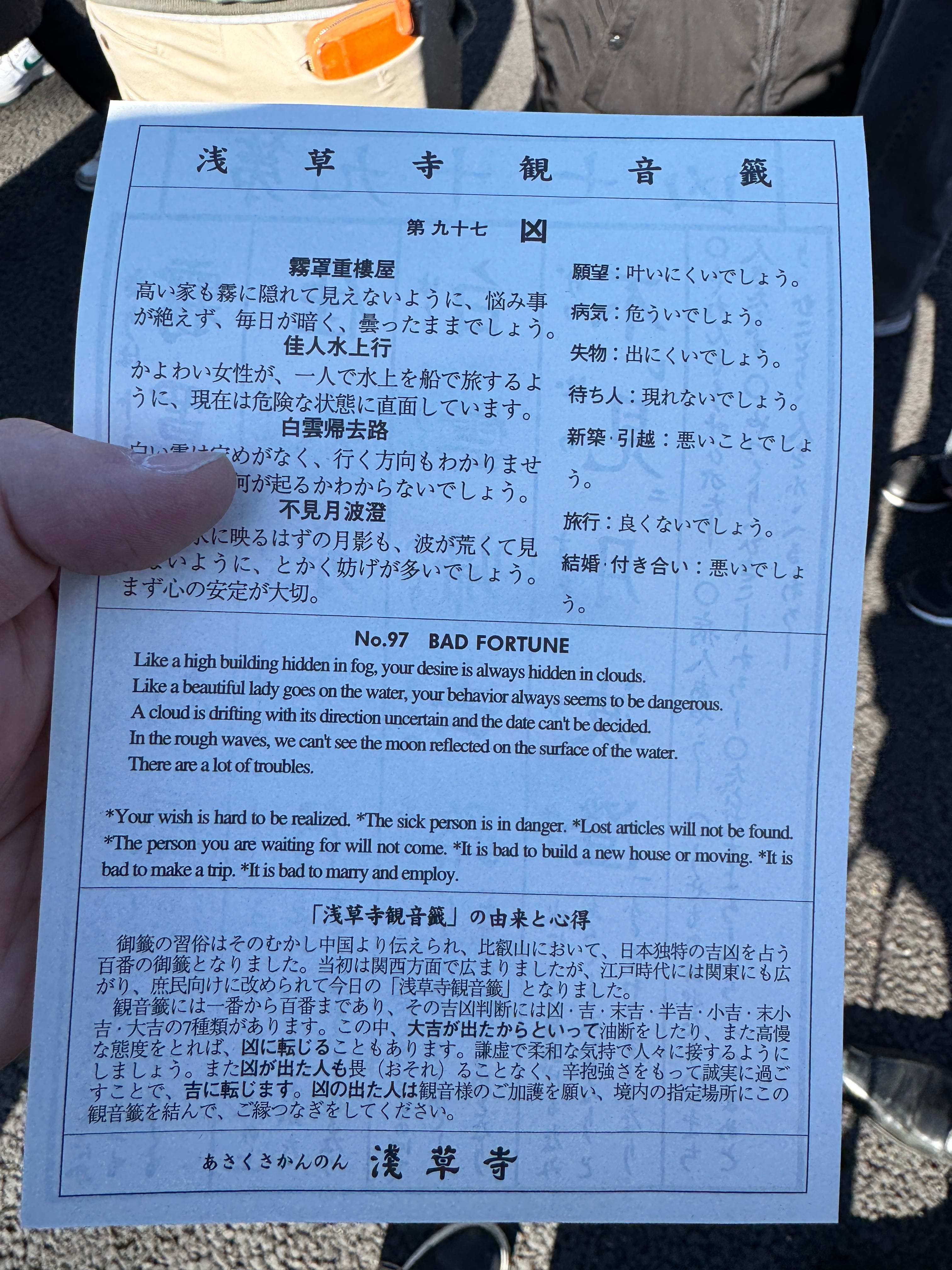
Like a high building hidden in fog, your desire is always hidden in clouds.
Like a beautiful lady goes on the water, your behavior always seems to be dangerous.
A cloud is drifting with its direction uncertain and the date can’t be decided.
In the rough waves, we can’t see the moon reflected on the surface of the water.
There are a lot of troubles.
This poetry was followed with some prose that reinforced just how much trouble I was in, in case I had missed it:
Your wish is hard to be realized. The sick person is in danger. Lost articles will not be found. The person you are waiting for will not come. It is bad to build a new house or moving. It is bad to make a trip. It is bad to marry and employ.
For a while, I couldn’t get past the line about the beautiful woman on the water and her apparent connection to dangerous behavior, but, even looking past that latent misogyny and the less than perfect translation, it seemed pretty clear that my future was bleak. Given that we were about to spend a year traveling the world, I was particularly concerned by the advice regarding how dangerous it was to make a trip. What was I to do? Was there some amulet I could buy to reverse this coming misfortune?
It turns out, at a Japanese temple, there is always an answer to this situation—and it involves making another offering to the temple. Just around the corner we noticed a stand with a series of horizontal metal rods that had a number of fortunes tied around them. Apparently, if you get a bad fortune, all you have to do is fold it up, tie it onto one of these rods, then pay to get a new one. You can just keep doing it until you get the fortune you want. Brilliant! The Buddhist monks had clearly learned a thing or two about capitalism along the way. Why settle for a bad future when you can buy a better one?
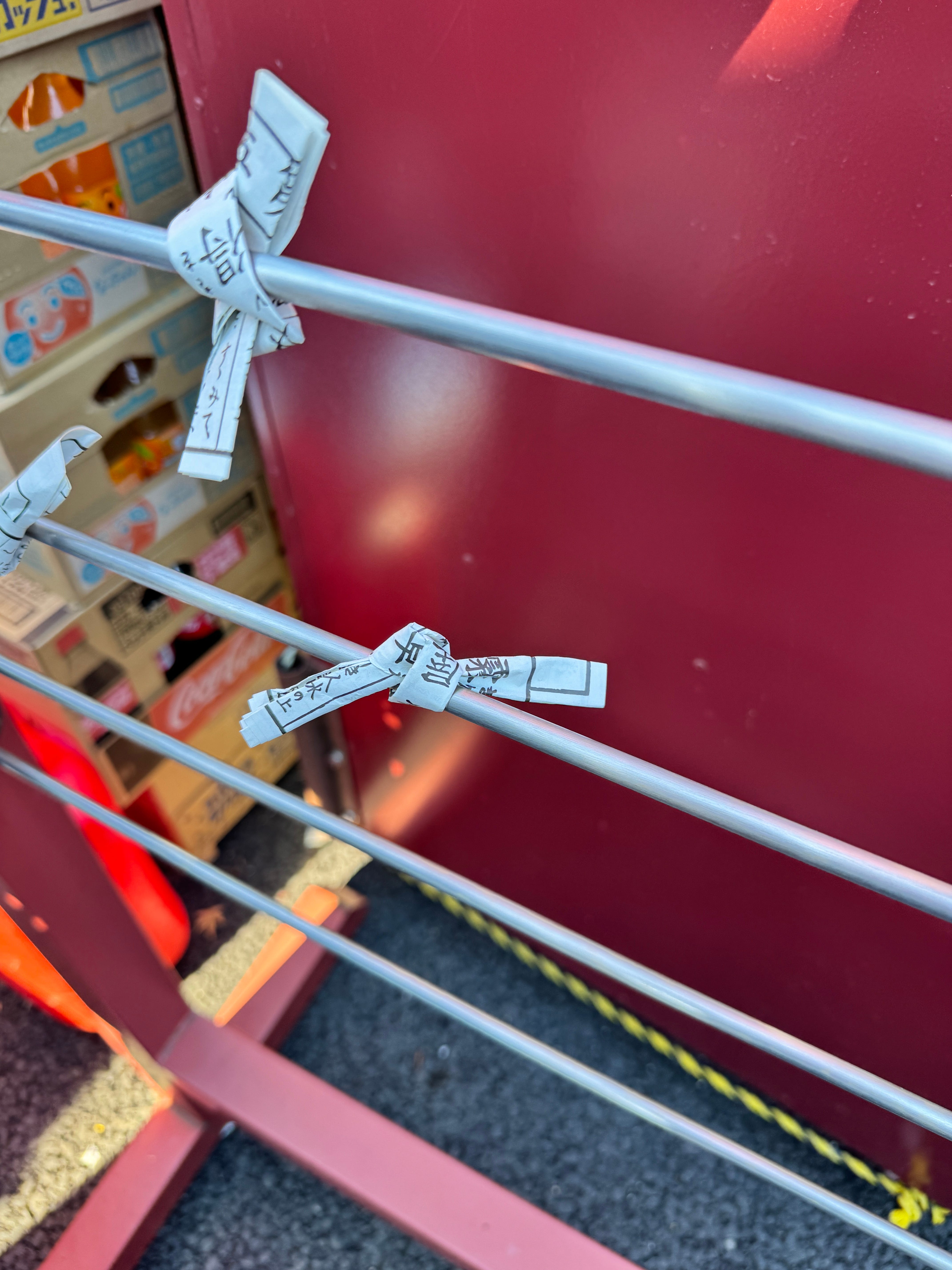
I folded my horrifying fortune tightly and tied it around the rod, leaving it with those hundreds of other bad fortunes that had been assessed, then rejected by those before me. (Were they all as desperate as mine? Or were some people just discontented until they had the perfect fortune?) Then I pulled another 100 yen coin out of my pocket, dropped it in the offering box, and shook the container for another stick. (Not number 97 again! Please not number 97!) I selected a new stick, which read 72 on its tip. Taking a deep breath, I pulled open the corresponding drawer and slowly extracted my new fortune.
I took a look, and exhaled in relief. Where my previous drawing had said “BAD FORTUNE,” this one read “REGULAR FORTUNE.” True, it wasn’t as good as Tibi’s, which, to the best of my memory said something like “LUCKIEST GODDAMN FORTUNE IN THE WORLD, YOU COOL COOL SONOFABITCH,” but under the circumstances, “REGULAR” was a huge improvement:
Some damage will come into your family, so you have to take care to defend it.
That branches grows separate, means everything does not meet together.
When hard winter is over, those things may get better in the middle spring.
All family members get along quite well, and they can get all filled by fortune.
Your request will be granted late finally. The patient keeps bed long. The lost article will be found later. The person you wait for comes late. Building a new house and removal are both good but a half fortune. To start a trip is all right. Marriage of any kind and new employment are both half fortune and gets better later.
It wasn’t perfect. It didn’t say my year would be without hardship. In fact, it seemed like things might start out roughly. But if I could just make it to middle spring, it seems like things were really going to turn around. And, after some thought, I was kind of ok with that. I guess I could have tried for another fortune, something even more auspicious. Don’t we all want a year like Tibi was promised?
But then I reconsidered. I had pushed my luck already and came out the better for it. And I didn’t want to risk going back to the bleak future I had just tied onto that silver rod. Life isn’t supposed to be perfect, after all. Sometimes you have to wait for the good stuff. And middle spring wasn’t that far away. I could make it until then, whatever the winter brought.
Anyways, I’d run out of coins to drop in the offering box.
To be continued…
Comments
Nothing yet. Say the first thing.
Sign in to join the conversation.