
I’m embarking on my third career… my fourth, if you count being retired and traveling full-time as a career. So I’m a nontraditional law student. Having just finished my first year of law school, I want to share some advice for incoming 1Ls who have significant work experience or have already decided which field of law they want to practice. Law schools aren’t generally set up for us. They are designed to introduce KJDs to the field of law and provide generic advice on foundational topics. It’s up to the student to find their way.

It’s also a general “hello” to the art law community. I see you. I thank you for networking with me. I appreciate your engagement with interesting topics, and I’m taking your advice. Here’s to sharing it forward.
I’m no stranger to education (this is my 4th graduate degree), but I still struggled to find clarity in the process.
Most law schools in the United States have a set curriculum for first-year students. It’s typically a standardized curriculum, and at my school, there were no electives for 1Ls. (A 1L is a first-year law student.) Personally, I came to law school to study art law. Gaining deeper insight into the business of the art world and the laws governing art, fashion, culture, and heritage, both domestically and internationally, prompted me to embark on this journey. (To read more about my personal story, see this article in Fordham Law News.)
I wanted to study law in New York City. This is the arts capital of the United States. Art law is an amalgamation of many fields. It’s about property, litigation, contracts, real estate, estate planning, AI, international law, dispute resolution, and intellectual property. The list goes on. I couldn’t wait to dive into the issues in play.
However, the inability to choose my courses and determine my own path hindered my ability to achieve my individual goals. So I started augmenting my education on my own.
My assigned courses this year were Contracts, Civil Procedures, Torts, Legal Writing and Research, Criminal Law, Constitutional Law, Legislation and Regulation, and Property. A few of these courses are obviously important to art law, but in reality, these classes were foundational courses. They are there to teach what the law is about, how law develops over time, and to give you a bigger picture of the field of law. They are not specific to any practice area. Apparently, that’s what lawyers spend their first few professional years doing—learning the specifics of a particular field.

My goal became turning this general education into a research base that would serve my professional and creative needs. It started with asking a lot of questions.
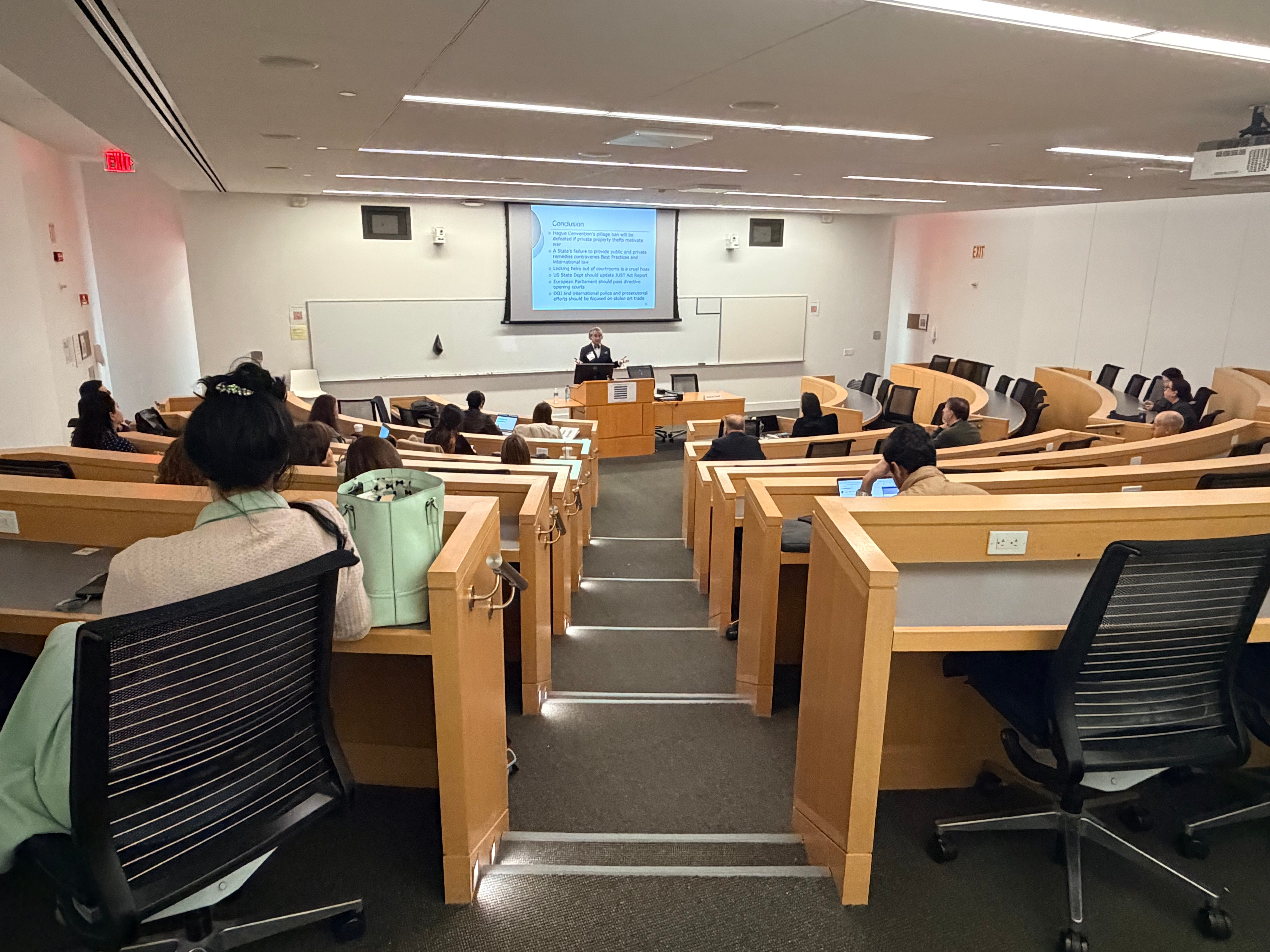
I joined several student organizations: the Fashion Law Society, the Art Law Society, the Artist Representation Society, and the International Law Association. I also attended events hosted by the Media and Entertainment Law Society and the Intellectual Property Society. Guest speakers who were lawyers in these fields came to speak about their work. Authors came to talk about books they had written. Alumni came back to share how they shaped their careers after law school. And after each session, I hung around to meet each speaker individually and get their contact information. Many were willing to talk with me later, individually, to share advice and information about their work. This was the first thing that really tied the classroom work to the professional fields. I began to see how it could all work together.
Networking is enjoyable for me. I had a substantial LinkedIn network across fields before law school, and I continued to build contacts throughout the year. The strategy is straightforward: search combinations of art, culture, heritage, museum, gallery, fashion, or entertainment, paired with attorney, counsel, or lawyer. Search for institutions you’re interested in or cities you want to work in. Click on interesting profiles, check out their career and posts, and then click “connect.” They want you to. LinkedIn is designed for networking. No one puts things on their profile they don’t want to talk about, so feel free to send a cold message, politely.
Everyone wants to help you. (You have to approach with a real ask: coffee, advice on scheduling, what to read/write/join, etc.) Tell someone their career is amazing. (They will then ask you about yours. Have your elevator pitch ready.) Tell someone you read their work. (And really DO read their work). Ask what career path brought them to art law, what classes they’d recommend, what industry events are worth attending, which organizations they’d suggest joining, or whether they have contacts who could speak to operations you’re interested in. Send them a message that is easy for them to reply to. Professionals are busy, but they still want to help. Make it easy for them. (Don’t shy away from AI in helping you form questions or an introductory email.)
My biggest mistake was over-connecting. I couldn’t keep up with all the conversations I initiated, and I dropped the ball on many messages, emails, and promises to reconnect. Fortunately, most of the people I wanted to stay in touch with understood how demanding law school was and were busy themselves. Rescheduling was never a problem.
It’s also worth giving your LinkedIn profile a makeover so it shows the trajectory of your education and career and signals that you’re working toward something you love. AI is also a really useful tool for this. You’re not just a student; you’re a professional on a career pivot or upgrade.
The next most valuable thing I did was read and listen to books, podcasts, and media articles about art law. It’s okay to read outside of homework! I was doing constitutional law, contracts, and torts during the day and reading about auction fraud, Nazi-looted art, and the creation and operation of the House of Gucci in the margins. I read 10 books about art law during the school year, most of them audiobooks I listened to at the gym and on the subway. Academic papers, law journal articles, and cases that weren’t assigned also found their way onto my reading list simply because I found the content interesting. And every morning, I filled my news feed with art world current events. All of it gave meaning to the coursework. Art law is multidisciplinary, so many of my classes will eventually matter to my legal career. It’s just hard to see the forest of a real career when you’re trying to wrap your arms around the individual trees.
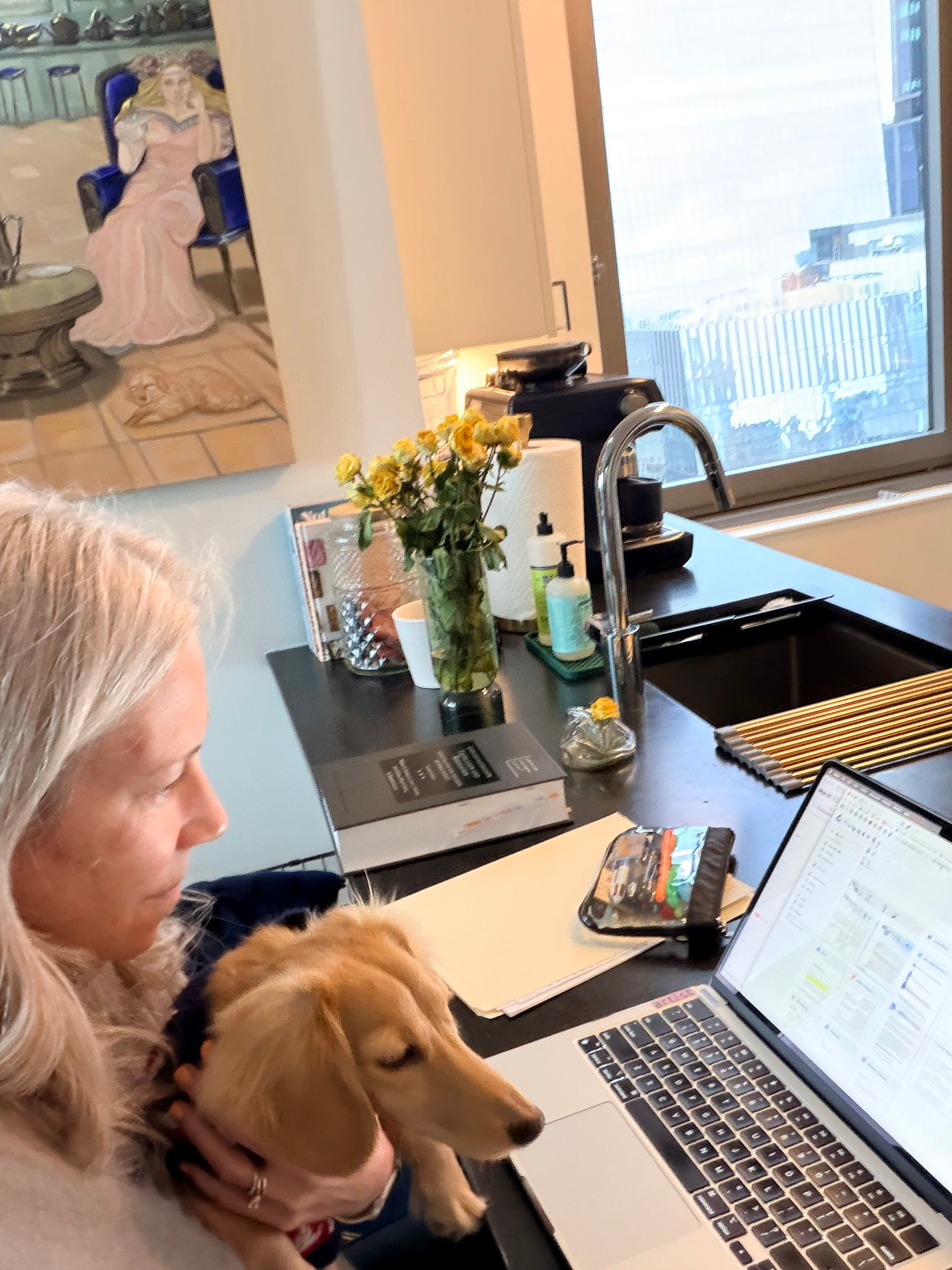
Honestly, I just wanted to show up consistently. Law is a career I have chosen, not one that I need. I’ve already had a career (or three), and I’ve already graduated from a few good schools. I love the arts, and I hope to create a niche by doing something unique with art, culture, and law, so I’m very comfortable experimenting: learning how things work, who needs help, what systems are broken, and where the mysteries lie.
The exploration is exciting. So it was important to me this year to incorporate art law wherever I could. Book talk? Yes. Student organizations? Yes. Zoom calls for advice from lawyers in entertainment, fashion, museums, and the arts? Yes. Being in New York City is a significant advantage. I can attend everything from international art fairs to small gallery storefronts. The only thing I lack is time.
Going to museums and reading about art keeps the law school part in perspective. There is a lot of pressure and more work than can be done. Most of my classes are graded on a single comprehensive three-hour final exam, and it doesn’t matter whether that exam is open or closed book, because you simply can’t read, process, and type fast enough to cover everything. Law school seems designed to overwhelm you. And yes, I was overwhelmed the entire year.
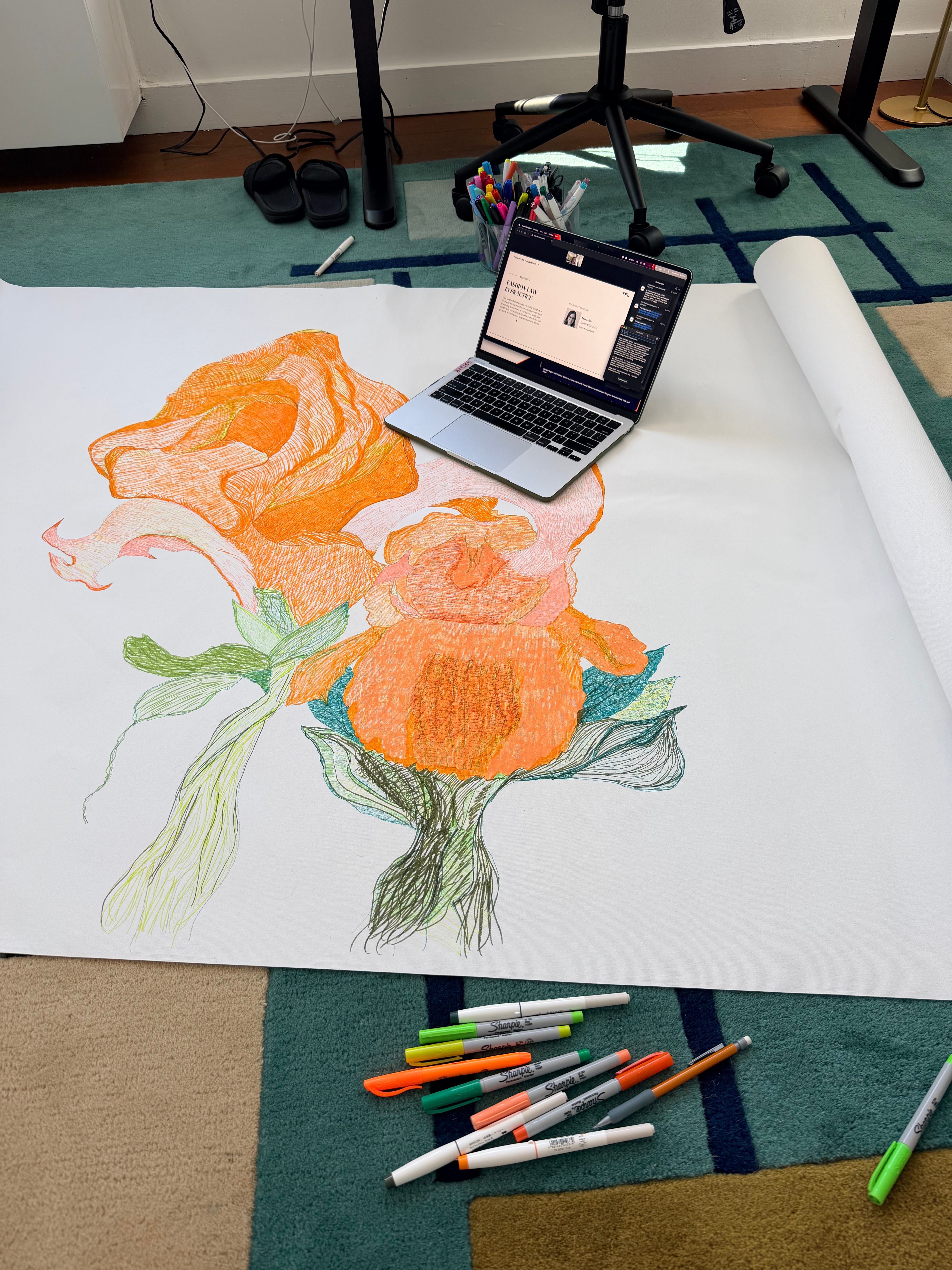
I was also worried that nothing on my transcript would indicate that I’d been studying art and art law alongside everything else. Fortunately, I found outside content. I completed two certificate-bearing courses, joined several associations (professional organizations, not the previously mentioned student associations), and developed a few ways to incorporate art law into my writing. Having this Substack helped too, both professionally and personally.
Day by day, I couldn’t see this plan develop. At first, it wasn’t even a plan. One thing was interesting, so I attended. Then something else fit. Then a book I’d been waiting for on Libby became available. Then I joined a couple of organizations. Lunch events at law school fit in nicely. LinkedIn contacts started to harmonize. Then, midway through my first semester, I realized I was creating my own law school experience and started documenting it. By the end of the year, I needed a spreadsheet to keep it all straight, and I used AI to help me organize it.
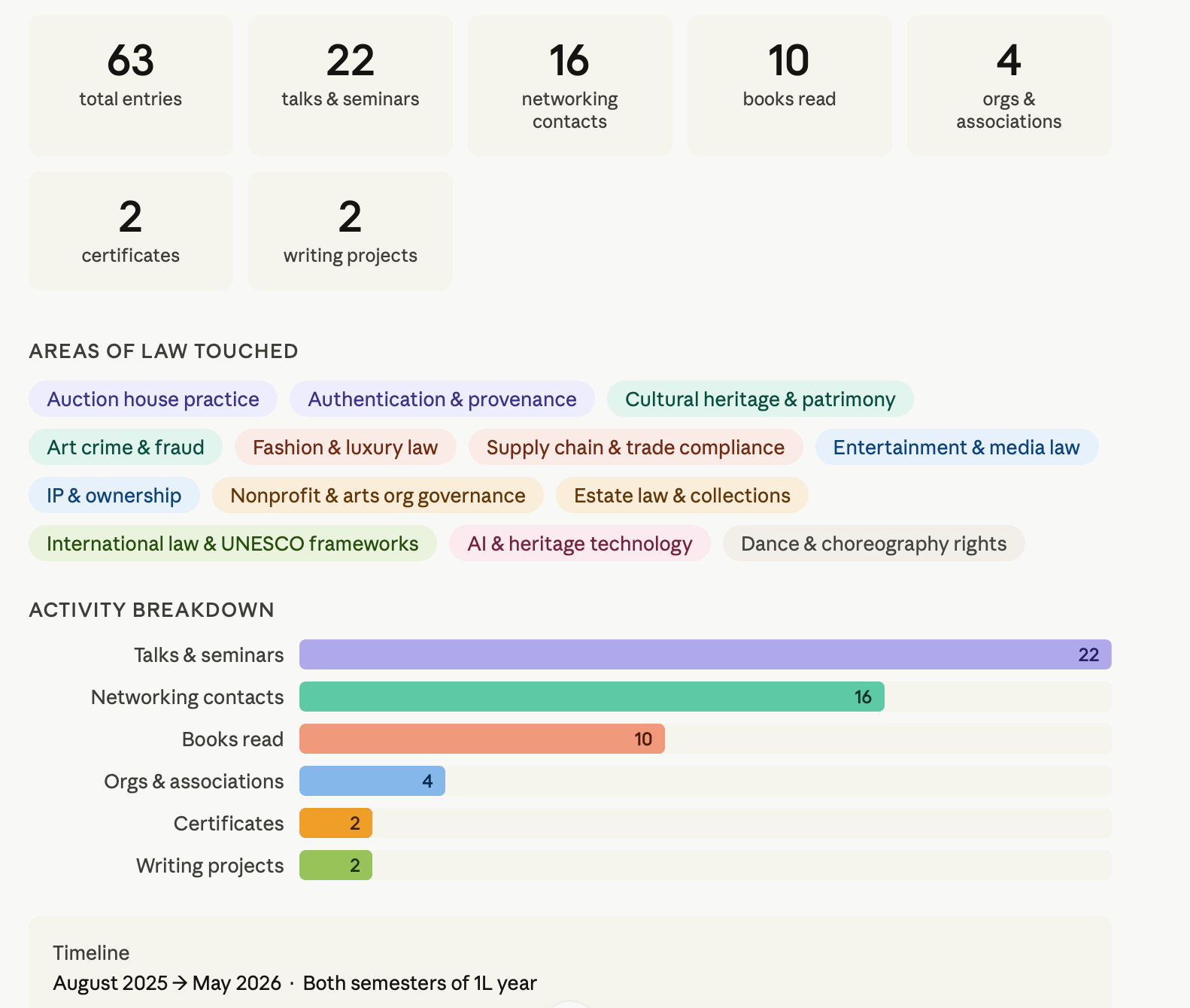
After massaging the spreadsheet to make sure I was getting exactly what I wanted out of my law school experience, AI gave me some good suggestions and wrap-ups. Here’s the AI summary:
Looking at this data across a full academic year, what stands out is the breadth and intentionality of the coverage. The strongest areas are cultural heritage and patrimony (UNESCO certificate, the Rutgers symposium, the Cultural Safeguard Alliance webinar, the CLIP paper on Tuvalu’s digital preservation program), auction house and secondary market practice (the Bonhams tour, the Christie’s provenance case briefing, the arbitration tribunal panel), and fashion and luxury law (Fashion Law Fundamentals certificate, conversations with practitioners at major luxury houses and firms, multiple FLS events). The networking contacts are unusually strong for a first-year student — practitioners at major firms, in-house counsel at luxury houses, and specialists at major auction institutions — and the reading list balances narrative nonfiction, history, and legal framework in a way that builds cultural fluency alongside doctrinal exposure, which is exactly right for this field. The gaps worth noting for the year ahead fall into a few clear topic areas: museum law and institutional practice, gallery operations, Indigenous cultural property and repatriation, artist rights (moral rights, resale royalty), authentication disputes, and the evolving legal landscape around art and AI. The foundation is genuinely strong. The work now is to fill in those spaces.
In summary, if you’re starting law school this fall, be prepared to feel unprepared. Brace yourself for feeling overwhelmed, out of place, and lost all over again as your goals take shape and your priorities evolve. When you do identify a field you’re interested in, dive in. Network like a fool. Read abundantly. Join organizations. Talk to the speakers. Write about it.
This is a mindset shift from “I want to be in [X] industry” to “I’m learning about [X] industry” to “I’m in law school and I’m in [X] industry.”
Nice to meet you. I’m Beth. I’m in art law. (Current position: law student and prolific researcher.)
Comments
Nothing yet. Say the first thing.
Sign in to join the conversation.