
Amit Raghuvanshi | The Architect’s Notebook
🗓️ Aug 6, 2026 · Deep Dive ·
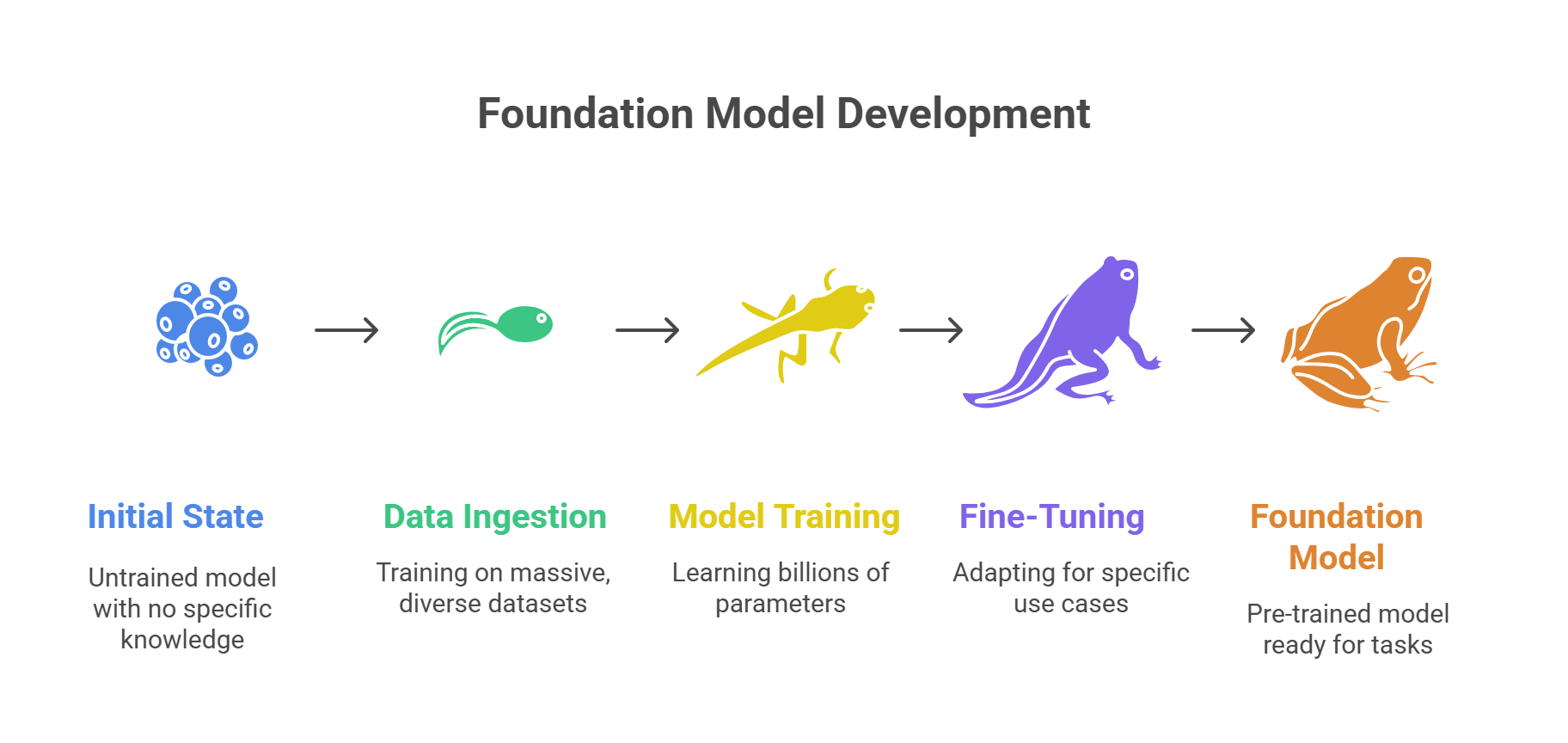
At the heart of Generative AI lies a new class of systems called foundation models.
A foundation model is a large-scale, pre-trained model that serves as a base (a “foundation”) for a wide variety of tasks. Instead of training a model from scratch for every problem, these models are trained on massive, diverse datasets like text, images, code, audio and can then be adapted (fine-tuned) for specific use cases.
Examples: GPT, BERT, Stable Diffusion, DALL·E.
Foundation models require unprecedented scale in three dimensions:
Data Scale: These models are trained on datasets containing hundreds of billions or even trillions of tokens. GPT-3 was trained on about 300 billion tokens, while larger models use even more data.
Model Scale: The models themselves are massive, with billions or trillions of parameters. Each parameter is a number that the model learns during training, and together they encode the model's knowledge and capabilities.
Compute Scale: Training these models requires enormous computational resources, often involving thousands of GPUs running for months. The compute requirements roughly double every 3.4 months, following a pattern reminiscent of Moore's Law.
Key characteristics of foundation models:
Scale: Billions (sometimes trillions) of parameters.
Pretraining + Fine-tuning: First trained on general data, then adjusted for specific tasks.
Multimodality: Some models, like GPT-4 or Gemini, handle multiple types of input (text + images, even audio and video).
Generalization: They often perform well on new tasks without explicit retraining.
Foundation models are like a universal brain - trained once, usable everywhere.
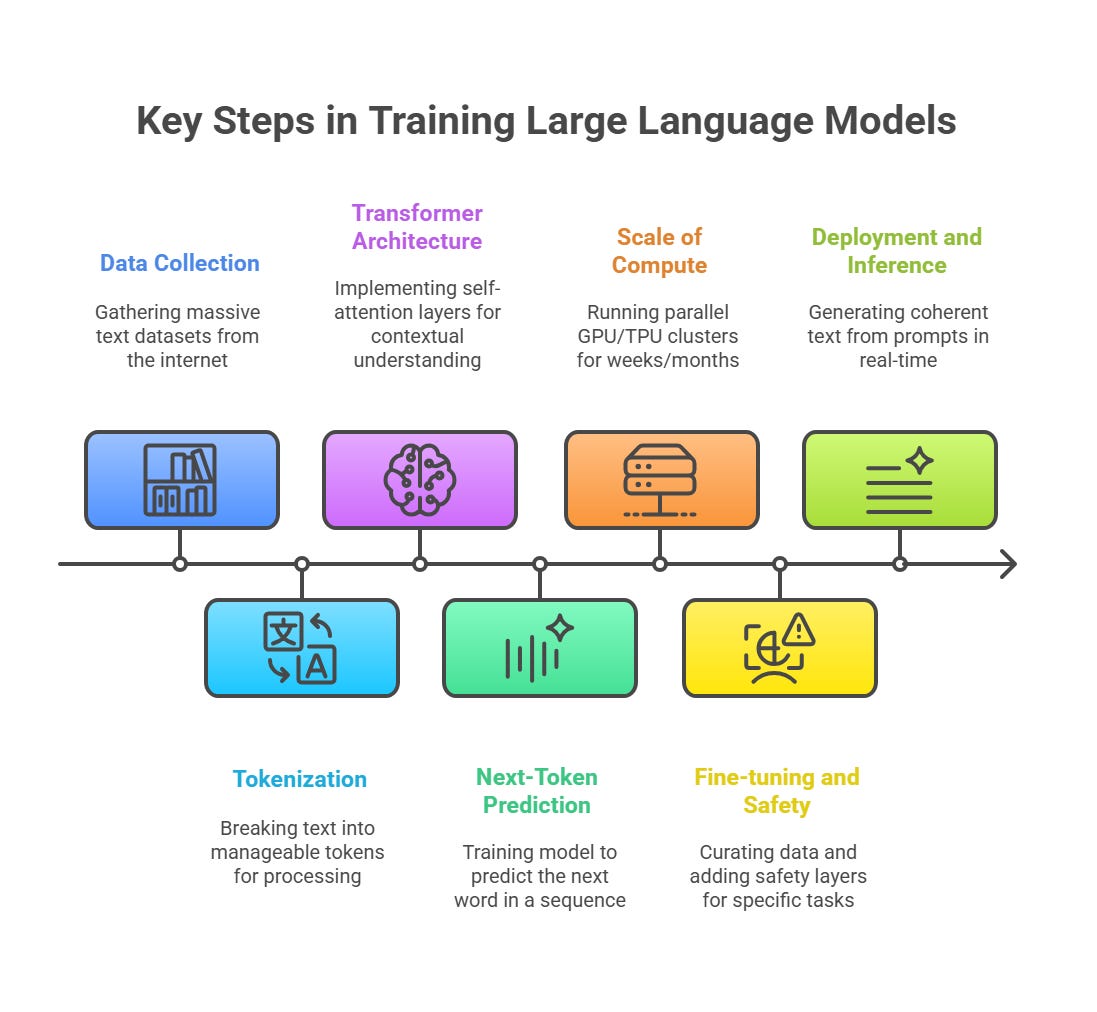
Training a Large Language Model (LLM) is a monumental process. Let’s walk through it step by step.
Collecting Data
Terabytes of text are gathered from the internet: books, articles, websites, code repositories.
This data is cleaned to remove duplicates, errors, or harmful content.
Tokenization
The text is broken into “tokens” - small pieces (words, subwords, or characters).
For example, “Generative AI is powerful” might become
[Gener, ative, AI, is, powerful].
Architecture
The transformer architecture, with its self-attention layers, is the backbone.
Attention allows the model to weigh the importance of each word relative to others in context.
Training Objective
Most LLMs are trained with next-token prediction.
Given a sequence (“AI is”), the model tries to predict the next token (“powerful”). Over billions of predictions, it learns grammar, knowledge, reasoning patterns.
Scale of Compute
Training requires thousands of GPUs/TPUs running in parallel for weeks or months.
Costs can reach millions of dollars in electricity and hardware.
Fine-tuning and Safety
After pretraining, models are fine-tuned on curated data for specific tasks (coding, summarization).
Safety layers (like Reinforcement Learning with Human Feedback, RLHF) ensure the model follows user instructions and avoids harmful content.
Deployment and Inference
Once trained, the model can generate text by starting with a prompt and repeatedly predicting the next word. Each word prediction influences the next, creating coherent sequences that can extend for thousands of words while maintaining consistency and relevance.
The power of foundation models lies in their ability to transfer knowledge learned during pre-training to new tasks with minimal additional training. This transfer learning capability makes them incredibly efficient for developing AI applications.
Developers can take a pre-trained foundation model and adapt it for specific tasks through various techniques:
Fine-tuning: Further training the model on task-specific data
Prompt Engineering: Crafting inputs that guide the model to desired behaviors
In-Context Learning: Providing examples within the input to teach the model new tasks
Parameter-Efficient Adaptation: Modifying only small parts of the model while keeping most parameters frozen
Foundation models have created entirely new ecosystem of AI development. Instead of every company training models from scratch, most now build upon existing foundation models. This has democratized AI development, allowing smaller teams to create sophisticated applications without massive computational resources.
Training starts with a neural network initialized with random weights. The model begins by making completely random predictions, it's essentially generating gibberish. But through the training process, it gradually learns to make better predictions.
The training process works like this:
Forward Pass: The model processes a batch of text and makes predictions about what words should come next.
Loss Calculation: The model's predictions are compared to the actual next words, and a loss score is calculated to measure how wrong the predictions were.
Backward Pass: The gradient of the loss with respect to each parameter is calculated, indicating how each parameter should be adjusted to reduce the loss.
Parameter Update: The parameters are updated in the direction that reduces the loss.
Repeat: This process is repeated billions of times with different batches of text.
Generally, larger models trained on more data with more compute achieve better performance in predictable ways. Small models might struggle with arithmetic, but larger models can perform complex mathematical reasoning. This emergence of new abilities at scale is one of the most exciting and mysterious aspects of modern AI.
Training foundation models involves solving numerous technical challenges:
Memory Management: These models are too large to fit in the memory of a single GPU, requiring sophisticated techniques to distribute the model across many devices.
Numerical Stability: Training can become unstable as gradients explode or vanish, requiring careful initialization and normalization techniques.
Convergence: Ensuring that the training process actually converges to a good solution rather than getting stuck in poor local optima.
Efficiency: Making the training process as efficient as possible to reduce costs and time.
At its core, text generation is a sophisticated prediction game. The model looks at all the previous words in a sequence and tries to predict what word should come next. But how does it make this prediction, and how does it avoid generating repetitive or nonsensical text?
Rather than simply choosing the most likely next word (which would lead to deterministic and repetitive output), generative models output probability distributions over all possible next words. The model might say there's a 30% chance the next word should be "the," a 20% chance it should be "a," and smaller probabilities for thousands of other possibilities.
The sampling process then selects from this distribution. Different sampling strategies create different types of output:
Greedy Sampling always chooses the most likely word, leading to deterministic but often repetitive text.
Random Sampling selects words according to their probabilities, introducing randomness but sometimes leading to incoherent text.
Top-k Sampling only considers the k most likely words, balancing coherence with diversity.
Nucleus Sampling (top-p) dynamically adjusts the number of words considered based on their cumulative probability.
The generated text by Gen AI is Non-Deterministic as it generates test (each word) based on some probability using above mentioned statistical metods.
The "temperature" parameter controls how random the sampling process is. Low temperature makes the model more conservative and predictable, while high temperature makes it more creative and unpredictable. This single parameter can dramatically change the character of generated text.
Modern language models can consider thousands of words of context when making predictions. This long context window allows them to maintain coherence over long passages, remember information from early in the text, and even follow complex instructions that span multiple paragraphs.
The attention mechanism is crucial here, allowing the model to selectively focus on relevant parts of the context rather than being equally influenced by all previous words.
With generative AI, the way we interact with models has fundamentally changed. Instead of writing traditional code, we now craft prompts (natural language instructions that guide the model's behavior). This has given rise to prompt engineering as a new skill that combines elements of programming, psychology, and creativity.
Effective prompts might include:
Clear instructions about the desired task
Examples of good outputs (few-shot prompting)
Context about the intended audience or use case
Constraints or requirements for the output
Persona or style instructions
Now let’s peek into the “magic” of text generation.
When you type a prompt into an LLM, the process unfolds like this:
The input is tokenized and passed through the transformer.
The model estimates probabilities for possible next tokens.
It samples from this distribution, sometimes choosing the most likely word, sometimes picking a less likely one for creativity.
This repeats until a full response is formed.
For example, the model doesn’t “know” facts the way humans do. Instead, it’s stringing together statistically likely continuations of text but because it has seen so much data, the results feel remarkably intelligent.
While language models captured public attention with their conversational abilities, the development of AI image generation has been equally revolutionary. The ability to create realistic, artistic, or fantastical images from simple text descriptions has opened entirely new creative possibilities.
The breakthrough in AI image generation came with diffusion models. In forward diffusion process we keep adding noise to a clear image until we get only noise. And once the algorithm is trained to take the image and create noise out of it, we do the opposite of this process.
So, when we want to generate an image, we start with noise with a prompt, this process is known as Reverse Diffusion. So the algorithm takes some noise and de-noise it to generate the image.
This process is guided by text embeddings that encode the desired image description. The model learns to associate certain noise patterns with specific concepts, allowing it to generate images that match text prompts.
Image generators like DALL·E or Stable Diffusion work differently:
A text prompt (“a cat wearing sunglasses in space”) is encoded into a mathematical representation.
A diffusion process starts with random noise and gradually shapes it into a coherent image, guided by the prompt’s embedding.
Neural networks refine the details until a realistic, novel image appears.
These methods allow unprecedented creative freedom, from photorealistic landscapes to surreal artwork in seconds.
A crucial breakthrough was CLIP (Contrastive Language-Image Pre-training), which learned to associate images with text descriptions. CLIP was trained on millions of image-text pairs from the internet, learning to understand the relationship between visual concepts and their linguistic descriptions.
This connection between vision and language enables text-to-image generation and has applications in image search, content moderation, and multimodal AI systems.
Generative AI has begun transforming industries across the economy:
Content Creation: Writers use AI to overcome writer's block, marketers generate ad copy, and journalists draft initial article versions. While AI doesn't replace human creativity, it augments it in powerful ways.
Software Development: AI coding assistants like GitHub Copilot, Amazon Q help programmers write code faster and with fewer bugs. They can generate boilerplate code, suggest improvements, and even help debug complex problems.
Education: AI tutors provide personalized learning experiences, while teachers use AI to generate lesson plans and assessment materials. The technology is making high-quality education more accessible.
Scientific Research: Researchers use AI to analyze literature, generate hypotheses, and even write parts of research papers. AI is accelerating the pace of scientific discovery.
Healthcare: AI helps generate patient reports, assists in diagnosis, and even helps researchers understand complex biological processes. However, medical applications require extreme care to ensure accuracy and safety.
Despite their impressive capabilities, current generative AI systems have significant limitations:
Hallucination: Models sometimes generate plausible-sounding but factually incorrect information.
Bias: Training data biases can lead to unfair or discriminatory outputs.
Lack of True Understanding: While models can generate human-like text, they may not truly understand concepts the way humans do.
Inconsistency: Models might give different answers to the same question asked in slightly different ways.
Context Limitations: Despite improvements, models still struggle with very long contexts or complex reasoning chains.
Generative AI is still young. Today’s models excel at generating text or images, but the horizon is broader:
Multimodal Integration: Future systems will seamlessly work with text, images, audio, video, and potentially other modalities like 3D spatial data.
Specialized Models: While foundation models are general-purpose, we're also seeing the development of specialized models optimized for specific domains like code, science, or creative writing.
Personalization: AI systems that adapt deeply to individual users, creating unique personalized experiences.
Efficiency Improvements: Researchers are developing techniques to make models smaller, faster, and more efficient while maintaining their capabilities.
Better Control: New methods are being developed to give users more precise control over model outputs, reducing unwanted behaviors and improving reliability.
Many researchers believe that the path we're on - scaling up foundation models and improving their training - could eventually lead to Artificial General Intelligence (AGI), systems that match or exceed human cognitive abilities across all domains.
While we're not there yet, the rapid progress in recent years has convinced many that AGI could arrive sooner than previously expected. This possibility raises profound questions about the future of work, society, and human purpose.
The story of generative AI is far from over. We're living through what historians may well regard as one of the most transformative technological revolutions in human history. From the early dreams of thinking machines to today's sophisticated AI systems that can write, create, and converse, we've made remarkable progress.
Yet in many ways, we're still in the early chapters of this story. The current generation of AI systems, impressive as they are, likely represents just the beginning of what's possible. As we continue to scale models, improve training techniques, and develop new architectures, we may see capabilities that today seem like science fiction.
The future remains unwritten, and we all have a role to play in determining how this remarkable story unfolds. Whether generative AI becomes a powerful tool that augments human capabilities, a stepping stone to artificial general intelligence, or something we can't yet imagine, one thing is certain: the journey has only just begun.
Comments
Nothing yet. Say the first thing.
Sign in to join the conversation.