
When people look at the old quarters of Córdoba or Seville and see narrow lanes threading between high whitewashed walls, the instinctive reading of some may be that it’s organic growth, streets that simply happened, a city that accumulated without an apparent plan. It’s a reasonable assumption, but it’s incorrect. Those streets were actually the outcome of a legal system. Though the rules were never consolidated into a single document. They lived across fiqh manuals, fatwa collections, and centuries of accumulated legal practice, already embedded in the jurisprudence that governed every other aspect of daily life in al-Andalus.
The code was fiqh, and it shaped cities.
Al-Andalus followed the Maliki school of Islamic jurisprudence. Under the Umayyad amirs, beginning with Hisham I (r. 788–796), the Maliki school was adopted as the official legal doctrine of al-Andalus, displacing the Awza’i school that had preceded it. Maliki dominance consolidated through the 9th century and endured across the Umayyad, Almoravid, and Nasrid periods, becoming in time one of the defining characteristics of Andalusi identity itself. What made the Maliki school particularly suited to governing a functioning city was its responsiveness to urf, local custom, as a legitimate legal source. It could absorb and codify existing practice, making it adaptive in the way that good planning law needs to be: firm enough to produce consistency, flexible enough to handle conditions the original framework never anticipated.
The foundational principle underlying all of it was four words: “la darar wa la dirar”. No harm and no reciprocal harm. Derived from the hadith (Prophetic tradition), this was an operative legal rule from which jurists derived specific, binding rulings on construction, drainage, windows, walls, street use, and the placement of trades. A vast range of building disputes in an Andalusi city could be framed through it, from drainage and window placement to street encroachment and the siting of trades.
The texts that make this legible as a system rather than a set of isolated rulings are the fiqh manuals and fatwa collections that accumulated over centuries of real disputes. The most important for urban construction is Ibn al-Rami’s al-I’lan bi-Ahkam al-Bunyan, a 14th-century manual devoted entirely to building law, translated into English by Besim Hakim as Rules for Compact Urbanism. Ibn al-Rami was a master mason in Tunis, and his manual reads accordingly: a practitioner’s record of how disputes were resolved, what rulings held, and what the law required of builders in specific situations. Through the shared Maliki tradition, the framework it documents was operative across the broader western Islamic world, including al-Andalus.
What these texts collectively produced was a hierarchy of legal obligations governing how buildings related to each other and to the street. Maliki jurists distinguished between street types based on use, a standard public thoroughfare required a minimum of seven cubits, roughly 3.4 to 3.8 metres, enough for the passage of a camel with its full load, while streets carrying livestock traffic required significantly more. Windows on street-facing facades had to be set above eye level: if a window created a direct line of sight into a neighboring home’s interior courtyard, it had to be raised or sealed. Drainage of household wastewater into public streets was prohibited. Rainwater gutters were required. Sabat structures, the enclosed overhanging bridges between buildings that appear throughout historic Andalusi streetscapes, were regulated through the same no-harm and privacy logic, they had to leave sufficient clearance for mounted riders and could not block light to the street below.
Enforcement rested with the qadi, the judge, who adjudicated disputes as they arose.
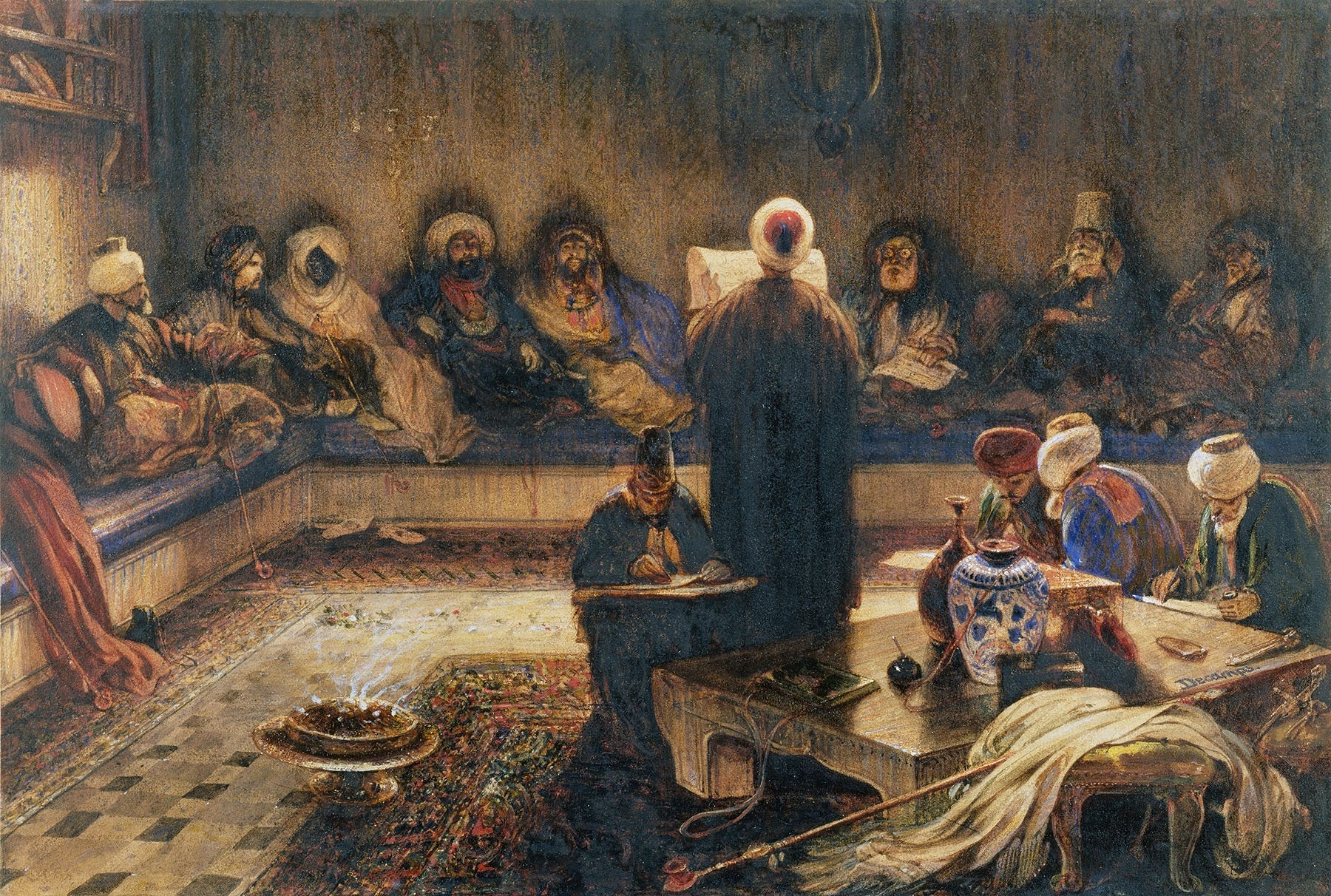
The Andalusi sources record what this looked like in practice. Mazzoli-Guintard documents a Córdoba case in which Ibn al-Salim, chamberlain of the emir Abd Allah, encroached on a public street by incorporating it into his garden and surrounding the seized space with a wall. The majority of jurists ruled against him. He was ordered to demolish the wall and restore the road. The case is notable because Ibn al-Salim had direct access to the ruling house, and the legal mechanism held regardless. Fierro and Molina report a 972 intervention by the caliph against street encroachment in Córdoba, in which shops that had narrowed a street bordering a moat were purchased and demolished on the caliph’s orders to restore passage. In the Córdoban fatwa tradition, Ibn Attab (d. 1069) addresses repair obligations for shared alleys, concluding that a neighbor who refused to contribute to necessary repairs could be compelled to do so. Maliki jurists, including Sahnun, treated public-road encroachment as requiring restitution under the no-harm principle, with Sahnun ruling that usurpations demanded full restoration even after twenty years had passed, because public roads do not prescribe.
The fina’, the semi-public threshold zone immediately in front of a house, had a defined legal status that shaped Andalusi streetscapes at the micro level. The owner could use it, place objects on it, even eventually incorporate it into the building, but only if the remaining road width stayed above the required minimum. The moment it fell below that threshold, any neighbor had standing to bring a complaint and demand its removal.
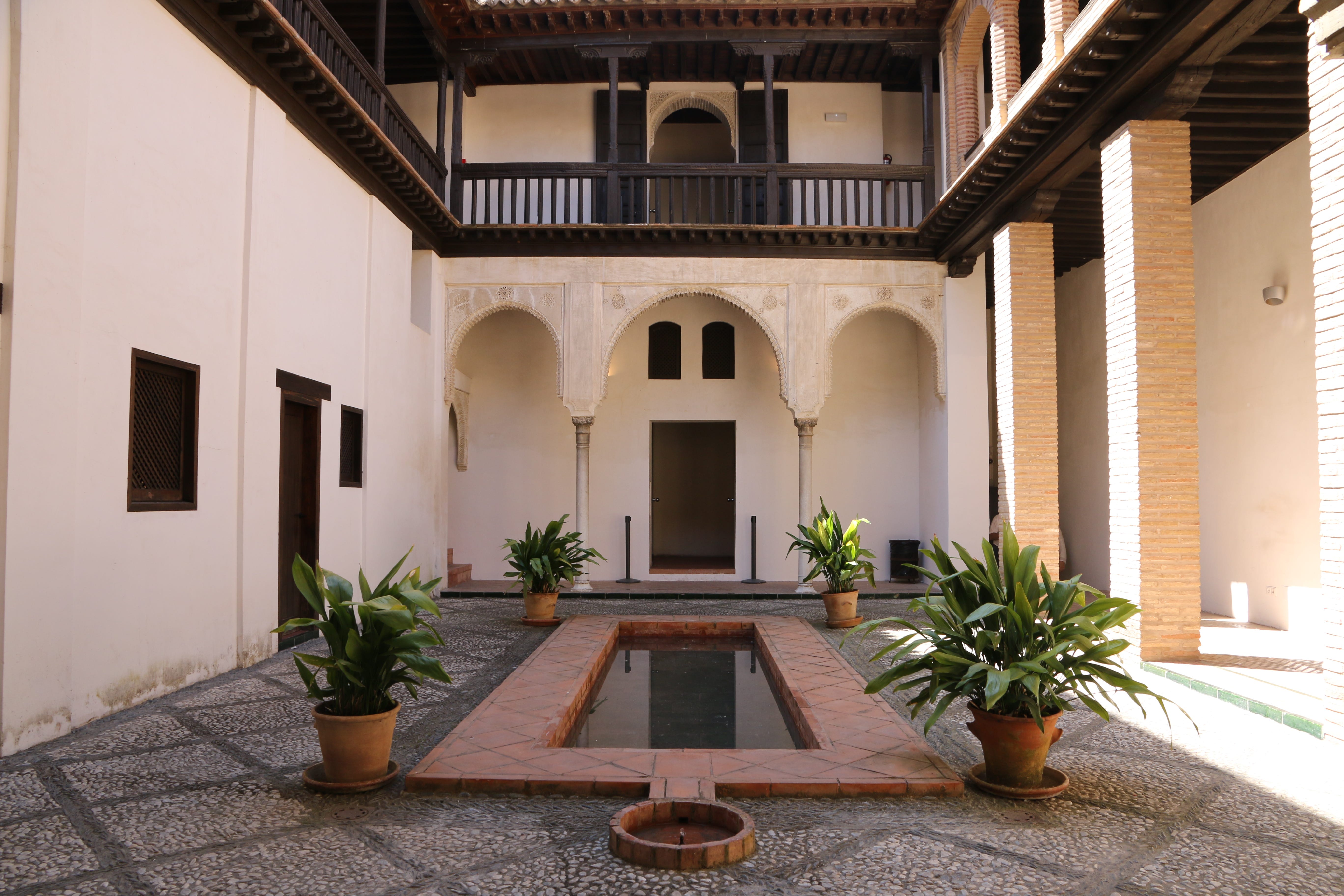
The bent entrance that appears in nearly every Andalusi home, the skifa, the angled passage between the street door and the interior courtyard that prevents anyone outside from seeing in, was the architectural response to a legal expectation the Maliki framework consistently upheld: the interior of a domestic space was protected from the street. The skifa recurs across al-Andalus because the legal pressure that produced it was consistent across al-Andalus.
The placement of trades operated through the same logic. Tanneries, dyers, slaughterhouses, and smithies each produced legally cognizable harm: noxious smell, noise, wastewater. Fierro and Molina note that dyers who spread wet fabrics on public roads, blocking passage and soiling the clothes of passersby, were among the categories of offender regularly brought before judges. The displacement of harmful trades away from residential fabric was the accumulated outcome of successive rulings responding to successive complaints over generations, each applying the same foundational principle to a new set of facts.
The visual character we now associate with the old city, the deep shade of narrow streets by mid-morning, the high blank walls that separate the street thermally and acoustically from the domestic interior, the inward-facing courtyard where light, greenery, and daily life are concentrated inside the building, and the narrow shared alleys that in some cases were closed at night with communal gates under the collective control of residents, emerged over centuries through the accumulated effect of juristic rulings. These features were not the result of a single design decision but are the material residue of a legal framework that repeatedly applied the same principles, especially “no harm and no reciprocal harm,” privacy, passage, and nuisance prevention, to successive building and urban disputes.
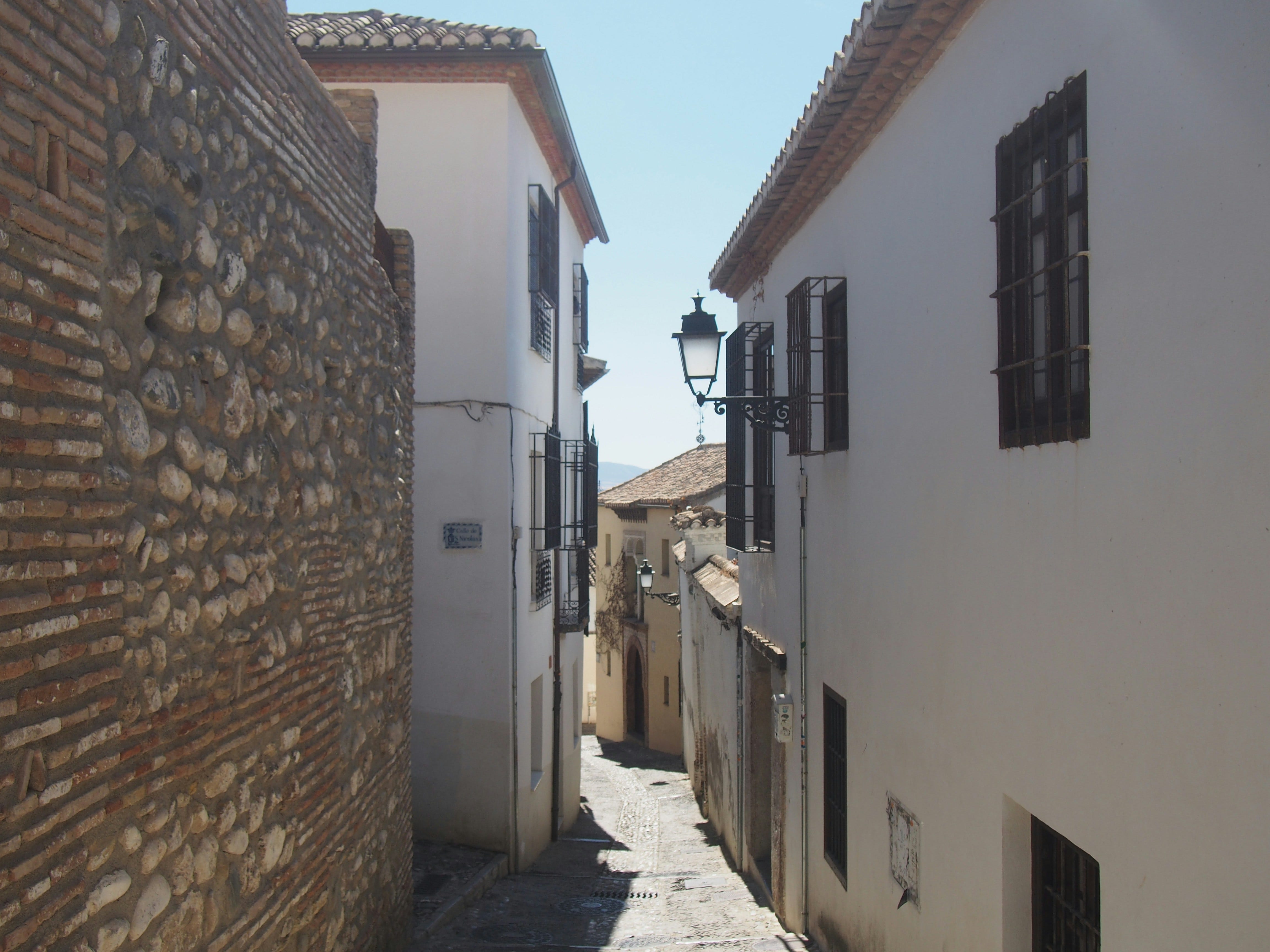
When someone today describes the old quarters of Seville or Córdoba or Granada as atmospheric, or when a contemporary architect reaches for the courtyard and the narrow street as solutions to urban heat and noise, they are responding to the built outcome of hundreds of years of juristic rulings on drainage, light, privacy, and passage. Urban form follows whatever a society decides to protect. In al-Andalus, the law protected privacy, passage, and the absence of harm. The city that resulted was the physical record of those priorities, written in street widths and entrance angles and the height of windows above the ground.
Maliki Law and al-Andalus
Berrada, Rachid. “The Mālikī School of Law in Andalusia and Its Impact on the Development of European Legal Systems, Journal of College of Sharia and Islamic Studies, Qatar University, Volume 42, Issue 2, (2024)
Fierro, Maribel, and Julio Molina. “The streets of al-Andalus (first part)” and “(second part).” alandalusylahistoria.com, 2024.
Islamic Jurisprudence and Urban Form
The Impact of Islamic Jurisprudence Principles on the Urban Environment. Posthumanism Journal.
Hakim, Besim S. Arabic-Islamic Cities: Building and Planning Principles. London: Kegan Paul, 1994.
Urban Space Management in Cordoba. Doha Institute, 2025.
Building Law and Ibn al-Rami
Hakim, Besim S. Rules for Compact Urbanism: Ibn al-Rami’s 14th-Century Treatise.
These are not just abstract ideas to me.
They are part of how I see the world. They shape the way I think about space, pace, and what makes a home feel like it remembers something deeper.
They are what guided the process behind something I made for others who feel the same way.
This is a 56-page visual and written guide on Moorish design for modern spaces.
It includes:
Core design principles rooted in Moorish-Andalusian tradition
Practical suggestions and layout ideas
Visual references and moodboards
A calm, intentional approach to creating beauty through atmosphere and meaning
The guide is for those who want more than just style. It is for people who are seeking feeling, presence, and a quiet elegance in their spaces.
You can find it here: https://ahmednaseem.gumroad.com/l/neo-moorish-home
Thank you for reading.
Whether you come for the the ideas, or the quiet philosophy behind it all, I’m truly grateful.
Until next Friday,
The Andalusian Edit
Comments
Nothing yet. Say the first thing.
Sign in to join the conversation.