
When Filippo Brunelleschi completed the dome of Florence Cathedral in 1436, his name was attached to it immediately and has remained attached to it ever since. We know what he looked like. We know his rivalries, his obsessions, his methods. The dome required hundreds of workers, engineers, and craftsmen to build. But the culture that produced it needed a name for the authorship, and Brunelleschi’s name is what it chose. He is the first figure in Western architectural history who looks recognisably like what we now call an architect: the individual whose vision the building is understood to express, whose authorship is the point.
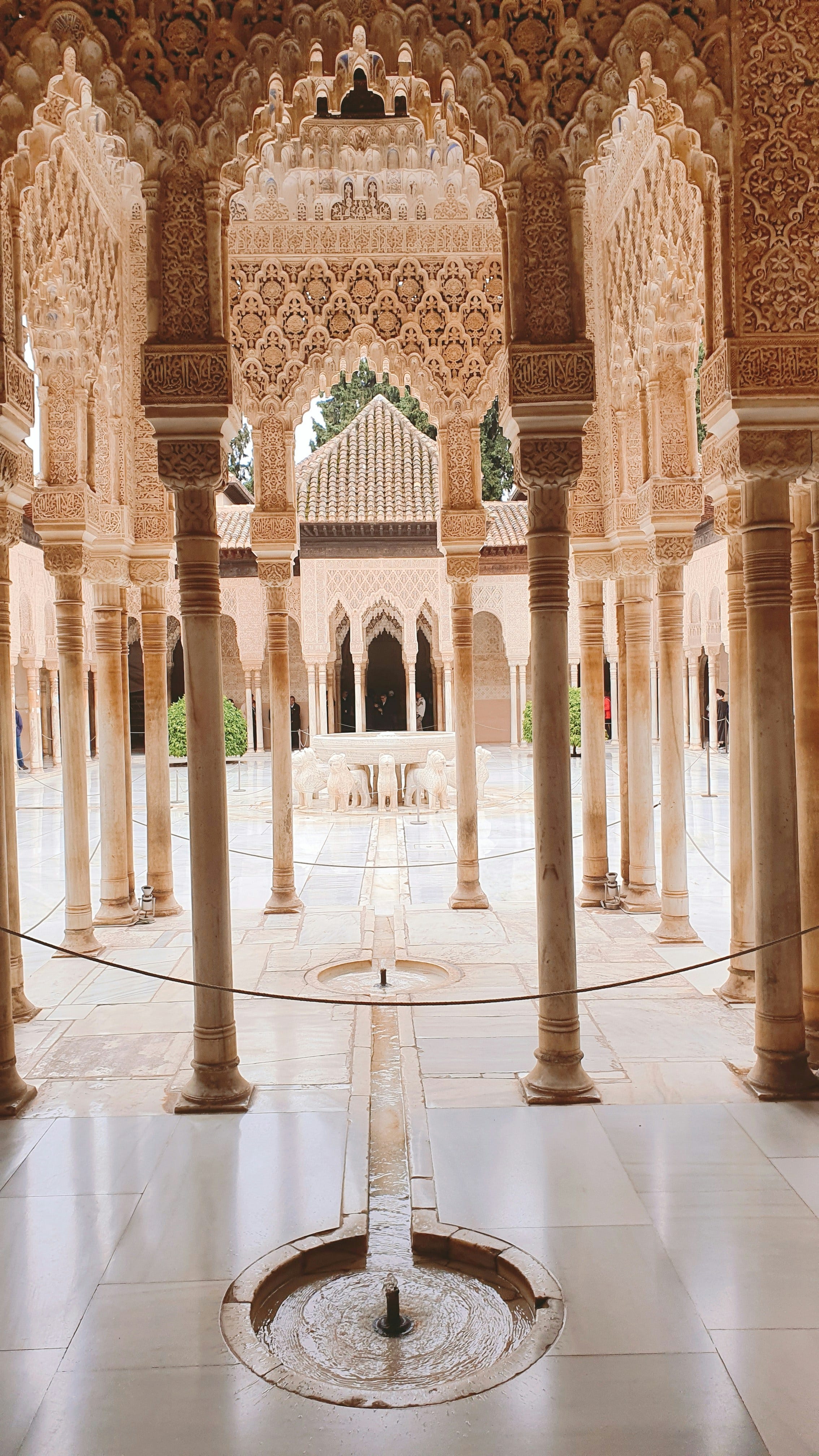
The Court of the Lions in the Alhambra was built roughly 56 years early, sort of around the same period, under Muhammad V of Granada, and completed by around 1380. We do not know who designed it, not because the records were lost or poorly kept, but because the question of who designed it may not have had a meaningful answer in the terms we are asking it. No single person in Nasrid Granada was identified as the building’s author, not in the sources, not in the inscriptions, not in any account of its construction that survives. That absence is not a gap in the historical record. It is a statement about how an entire civilisation understood the relationship between a human being and a work of beauty.
It is worth being precise about what the Western architect actually is, because the figure is so familiar that it seems natural rather than constructed.
The culture of named architectural authorship has a specific history. It emerges fully in the Italian Renaissance, solidifies in the eighteenth century with the professionalisation of architecture as a discipline with its own institutions, examinations, and legal authority, and reaches its most extreme form in twentieth century modernism, where buildings are named after their designers as a matter of course. Fallingwater is Wright’s. The Pompidou Centre is Piano and Rogers’. The Guggenheim Bilbao is Gehry’s. In every case, large teams of people built these structures. The attribution to a single name is a cultural choice, not a literal description of how the building came to exist.
That cultural choice carries assumptions so deeply embedded they are rarely examined. It assumes that what matters about a building is the individual vision behind it, that the creative act is one of invention rather than transmission, and that the person whose name appears on the drawings is the author in the same sense that a novelist is the author of a book. These assumptions determine not only how we credit buildings but how we talk about them, research them, and experience them.
None of this is universal or at least wasn’t before. It is the product of a specific moment in a specific part of the world. Understanding Islamic architecture in al-Andalus requires setting it aside, not because it is wrong in its own context, but because it is the wrong framework for what you are trying to understand.
If not the architect, then what? The buildings of al-Andalus were not accidents. The Court of the Lions, the Hall of the Ambassadors, the mirador of Lindaraja: these are spaces of extraordinary precision, where proportions, light, material, inscription, and ornament work together with a coherence that could not have emerged without intelligence organising it. The question is what kind of intelligence, and where it lived.
The answer is that it was distributed across at least four figures, none of whom held the whole vision alone.
The patron set the programme. The sultan or the wealthy merchant was not a passive commissioner handing money to a designer and waiting for results. He was an active shaper of what the building needed to do politically, spiritually, and spatially. What survives from the Nasrid period makes this concrete: Muhammad V commissioned the poet Ibn Zamrak, who served as his court secretary and later as his chief minister, to compose the verses that would be inscribed across the walls of the spaces he was building. The choice of which Quranic verses appear in which rooms, which royal titles are inscribed at which heights, which poems speak in the voice of the building itself addressing the visitor directly, these were decisions made at the level of the patron and his court, not delegated to someone else. Ibn Zamrak’s name is known to us because he was a political figure who left a documented life. The craftsmen who carved his words into the plaster are not known, though their work is what made his words permanent. The patron’s intelligence is physically present in the building.
The craftsman held the technical language. The zellige cutter, the plaster carver, the carpenter working in cedar: these were not labourers executing someone else’s vision. They carried within themselves a body of geometric and material knowledge that determined what was possible. The building could only be what their accumulated skill allowed it to be. Arab sources from the Nasrid period praised the quality of the master craftsmen working on the Alhambra’s plasterwork and tile mosaics by name of craft rather than by personal name, which is itself revealing: the craft was the identity, not the individual. Their knowledge was not recorded in drawings or architectural treatises. It lived in the hands and was transmitted through practice, from master to apprentice across generations, each generation refining what it had received.
The mathematician organised the surface. The geometric patterns of Islamic architecture are not decorative invention in any casual sense. They are solutions to mathematical problems about how to tile a plane infinitely without repetition, how to move between scales, how to encode symmetry and variation simultaneously. Someone understood this mathematics well enough to devise patterns that were then executed by the craftsmen. Whether that person was also a craftsman, a scholar employed by the court, or a figure who existed at the intersection of both is unclear from the surviving record. But the geometry is not accidental, and it is not simple. It represents a level of mathematical understanding that deserves to be called intellectual labour in any serious sense of the term.
The poet completed the architecture. The inscriptions on the walls of Andalusi buildings are not captions added after the fact. They are part of the spatial experience, encountered at specific heights and positions, in specific rooms, making specific arguments. The verses of Ibn Zamrak inscribed around the Lion Fountain are not simply beautiful writing placed near a beautiful object. They interpret the fountain, give it meaning, and direct how the person standing in that space should understand what they are seeing. The poet did not decorate the building. He finished it. Take the poetry away and you do not have the same building with bare walls. You have a different building, incomplete.
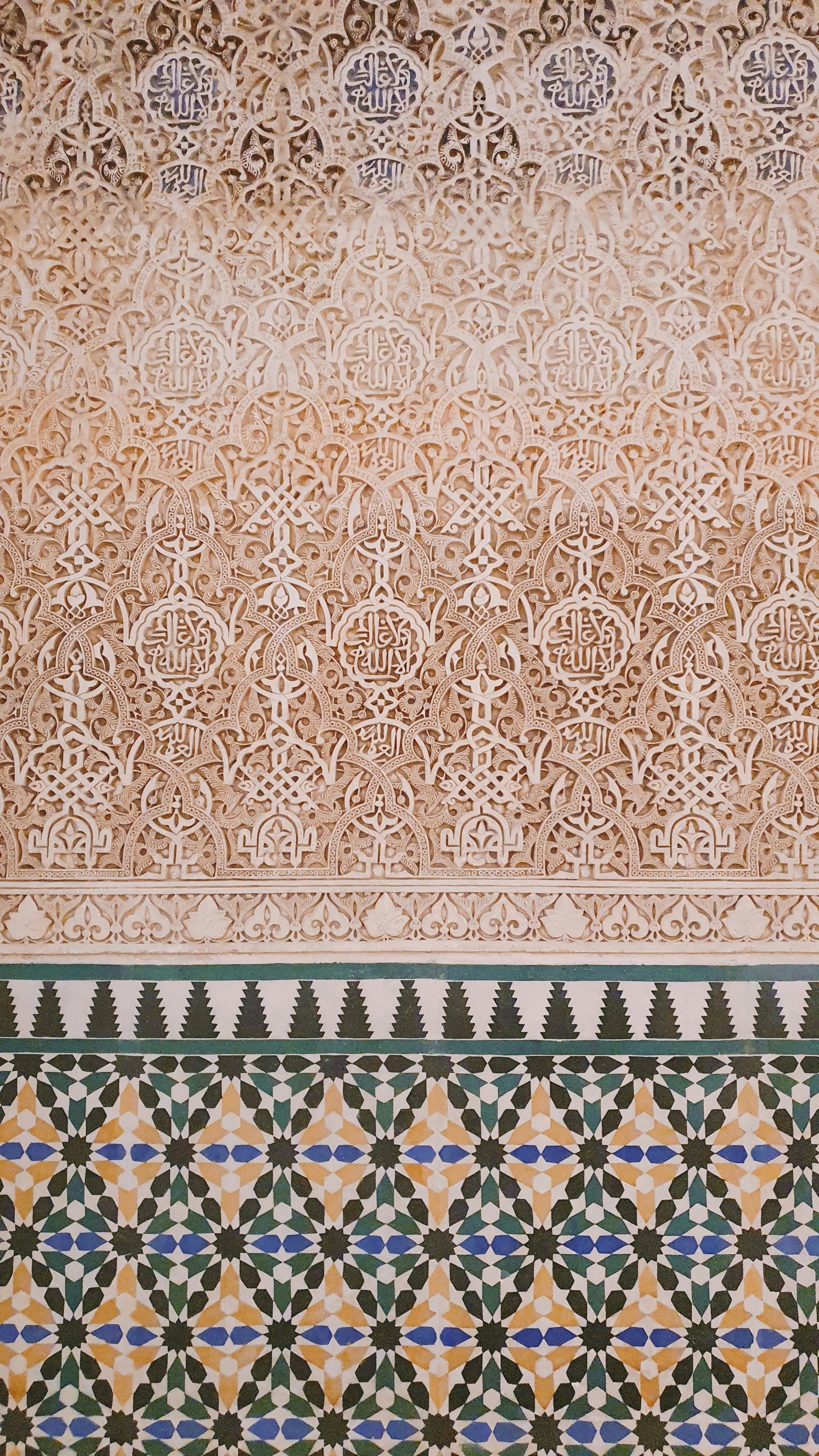
The craftsmen who built the great buildings of al-Andalus did not sign their work. This is often read as a social fact about status: that they were workers whose names were not considered worth recording, invisible in the way that labourers tend to be invisible in historical accounts dominated by the powerful.
There is truth in that reading, but it is not the whole story.
Within the Islamic philosophical tradition, the making of something beautiful was understood as an act directed toward God rather than toward personal recognition. Beauty in Islamic thought is not a human invention. It is an attribute of God, and the person who makes something beautiful is a conduit for something that ultimately does not belong to them. Whether individual craftsmen in al-Andalus understood their own anonymity in precisely these terms cannot be proven from the surviving record. But the theological framework was present, and it offers the most coherent account of why a culture capable of recording the names of its poets, its sultans, and its scholars did not record the names of the people who built its greatest buildings. To sign the work within that framework would be to claim an authorship that, theologically, was not yours to claim.
This is not humility in the apologetic sense. It is a position about where creative authority resides. Ibn Khaldun, writing in the fourteenth century, treats craft in the Muqaddimah as one of the defining markers of civilisational depth, something that accumulates across generations rather than being created by individuals. The craftsman does not invent. He inherits, refines, and transmits. The tradition is the author, and the individual craftsman is the tradition’s current embodiment.
That understanding produces a different relationship to the work. The Western architectural culture that named Brunelleschi needed the building to bear his name because the building was understood as the record of his vision. The Andalusi craftsman left no such record because the building was not his vision to record. It was the tradition’s latest expression, and the tradition would continue after him.
Andalusi architecture worked differently from what came after it. Because no single intelligence held the whole, the building could absorb contributions from multiple sources without losing coherence. The coherence came not from a person but from a shared language: the geometric system, the material tradition, the spatial conventions, the inscriptional practice that everyone working on the building understood and operated within. Individual variation was possible within that language. The slight irregularities of hand-cut tile, the improvised detail in a plaster panel, the poet’s specific choice of verse for a specific wall. These did not disrupt the whole because the whole was held by the tradition, not by an individual.
What was lost when the architect arrived is not a romantic idea about collective making or anonymous craft. It is a specific technical and philosophical capacity: the ability to build coherently from a shared language rather than from a single vision, and to understand the work as belonging to something larger than the person who made it.
We still do not know who exactly designed the Court of the Lions. We will probably never know, and not only because the records are incomplete. We do not know because the question, framed in these terms, did not quite have an answer in Nasrid Granada. The building was not designed by a person in the sense we mean when we say that. It was produced by a tradition, channelled through a patron’s programme, a craftsman’s hands, a mathematician’s geometry, and a poet’s words.
The author of the Court of the Lions is all of those people simultaneously, and none of them individually, and also the centuries of accumulated practice that made it possible for them to work together without any single person needing to hold the whole.
Stand in that courtyard long enough and something shifts, the columns are too slender for the weight they appear to carry, the water moves through channels that seem to defy the direction of the slope, the inscriptions address you directly, in the first person, as if the building itself is speaking. Nothing about the space resolves into a single point of origin, a hand you can trace it back to. It keeps opening outward and that is not a feature of the design, it is what the design is.
These are not just abstract ideas to me.
They are part of how I see the world. They shape the way I think about space, pace, and what makes a home feel like it remembers something deeper.
They are what guided the process behind something I made for others who feel the same way.
This is a 56-page visual and written guide on Moorish design for modern spaces.
It includes:
Core design principles rooted in Moorish-Andalusian tradition
Practical suggestions and layout ideas
Visual references and moodboards
A calm, intentional approach to creating beauty through atmosphere and meaning
The guide is for those who want more than just style. It is for people who are seeking feeling, presence, and a quiet elegance in their spaces.
You can find it here: https://ahmednaseem.gumroad.com/l/neo-moorish-home
Thank you for reading.
Whether you come for the the ideas, or the quiet philosophy behind it all, I’m truly grateful.
Until next Friday,
The Andalusian Edit
Comments
Nothing yet. Say the first thing.
Sign in to join the conversation.