
France, Germany, Spain, the Netherlands, Taiwan and Britain all had to answer the same question. Most answered it in a law.
What you need to know
High-speed rail cannot have level crossings. Every farm lane in the corridor becomes a binary decision: build a structure, or extinguish the access.
France and Germany settled this by law. Farmers sit on a body that can compulsorily redraw the farms and the farm tracks together, the proponent pays, and there is a right of appeal. Canada has no equivalent mechanism at all.
Nobody has decided who maintains the crossings. Alto says the approach is "still being developed." France needed a decade of litigation and an Act of Parliament to answer the same question.
Livestock crossings and machinery crossings are different structures. A standard cattle underpass is about 2.1 m high; a modern combine or grain cart needs 4 m or more. Alto's spokesman only ever says "machinery."
Closing crossings puts farm equipment on public roads. The OFA's own figure: slow-moving vehicles are 3.8 to 4.8 times more likely to be in a fatal collision per kilometre. Irish farmers build underpasses to get animals off the road.
Britain pays neighbours who lose value but no land. Canada offers nothing — and Bill C-15 also removed the Hearing of Necessity.
Alto's agricultural pages did not exist until March–May 2026 — the month its surveyors started knocking on doors.
The greenfield corridor was the bidders' idea. A Privy Council Office note shows the government went to market for a 200 km/h project on mostly existing rights-of-way. The consortia proposed new ones. They won.
The premise nobody argues about
High-speed rail cannot have level crossings. Alto says so: the network must operate on fenced tracks with no level crossings. The UPA says the same from the other side: 300–320 km/h requires high fencing on both sides, making level crossings impossible, so only viaducts or tunnels would let producers reach their land.
That turns every farm lane and field entrance into a binary decision. A structure gets built, or the access is extinguished. Three families of approach seem to exist internationally.
1 — Reorganize the land
France
France treats severance as a structural injury to the agricultural fabric, and fixes the fabric.
Under article L.123-24 of the Code rural, the project owner must remedy the damage the works cause to the land structure. A commission of local landowners and farmers then decides whether to run a compulsory reallocation of parcels across the affected zone. If it decides in favour, the préfet sets the prescriptions and the president of the departmental council orders the operation.
So the answer to "which farm roads stay open" is usually: we redraw the farms and the road network together. Reallocation moves each operator's parcels to one side of the line, reducing how many crossings are needed. New farm tracks are built as connected works and become the property of the landowners' association. The whole plan then goes to its own public inquiry with the tracks designated.
The proponent pays for the procedure and for remedying the severance.
Farmers sit on the deciding body. Not a consultation — a commission with the ability to make a decision.
There is an appeal route, to a departmental commission and then the administrative courts. It doesn't rely on the view of one Minister.
Worked example: the operations run for the LGV Bretagne–Pays de la Loire in the Mayenne. France also owes a duty to the farming economy as a whole: since 2014, article L.112-1-3 requires a preliminary study setting out measures to avoid, reduce and collectively compensate effects on the territory's agricultural economy.
The maintenance question France settled by statute
Who maintains an overpass in fifty years? In France this took a decade of litigation to resolve. Loi n° 2014-774 of 7 July 2014 requires a convention between the new infrastructure's manager and the severed road's owner covering surveillance, maintenance, repair, renewal and eventual transfer. The default is that the infrastructure manager bears the charges, and the structure's characteristics must reflect the traffic needs of the severed road as defined by that road's manager — not the railway. It sits at article L.2123-9 of the Code général de la propriété des personnes publiques.
Germany
Where rural land is taken for major works including rail lines, a system is in place that spreads the land loss of directly affected owners — who may otherwise face threats to their operations' viability — across a wider circle of owners in solidarity. Its purposes expressly include regulating the severing of contiguous holdings and the interruption of the road, track and watercourse network.
The proponent bears the costs of both the remedy and the procedure.
The extent of loss-spreading must be settled in agreement with the agricultural professional representation — the OFA and UPA would hold a statutory role.
Disputes go to a dedicated independent decision-making body with lay and expert assessors.
Spain and the Netherlands
ADIF gives the farm road network its own paper trail: standalone annexes documenting each intercepted track and its restoration, structure by structure — see the Talayuela–Cáceres annex. Farm-road works can also be their own project with their own public information stage and individualised schedule of affected property.
The Dutch went under it. The HSL-Zuid's 7.1 km bored tunnel beneath the Green Heart was built specifically to spare the peat-meadow landscape, and the 1994 policy paper's most protective variant was a 45 km bored tunnel between Rotterdam and Amsterdam. The hierarchy: reuse existing corridors, tunnel where the landscape is valued, greenfield as a last resort.
2 — Engineer the severance away
Taiwan
Of the 345 km route, roughly 275 km is elevated structure, over 263 km of it standard viaduct on 25–30 metre spans, and the Changhua–Kaohsiung viaduct runs 157.3 km continuously. On viaduct there is no fenced corridor at grade and no severance, because the crossing is everywhere.
A caution. Taiwan's viaducts cross rice paddies often under a hectare. Eastern Ontario is 20–40 hectare fields worked with larger equipment than anything used in Taiwan. The viaduct solution is more attractive here to avoid agricultural losses — and least likely to be offered, on cost.
3 — Compensate and just move on
United Kingdom
Section 7 of the Compulsory Purchase Act 1965 requires regard to damage sustained by reason of severing the acquired land from the owner's other land. Two features matter, because Alto mirrors them.
First, UK guidance defines accommodation works as anything the acquiring authority pays for on retained land in order to reduce the claim for severance, injurious affection or disturbance. It is a cost-management tool for the promoter: the promoter builds a crossing when a crossing is cheaper than the claim. Second, the measure is a before-and-after comparison of retained land, which the literature recognises may give a lower figure than the real cost of severance to the claimant.
Where that leaves Canada
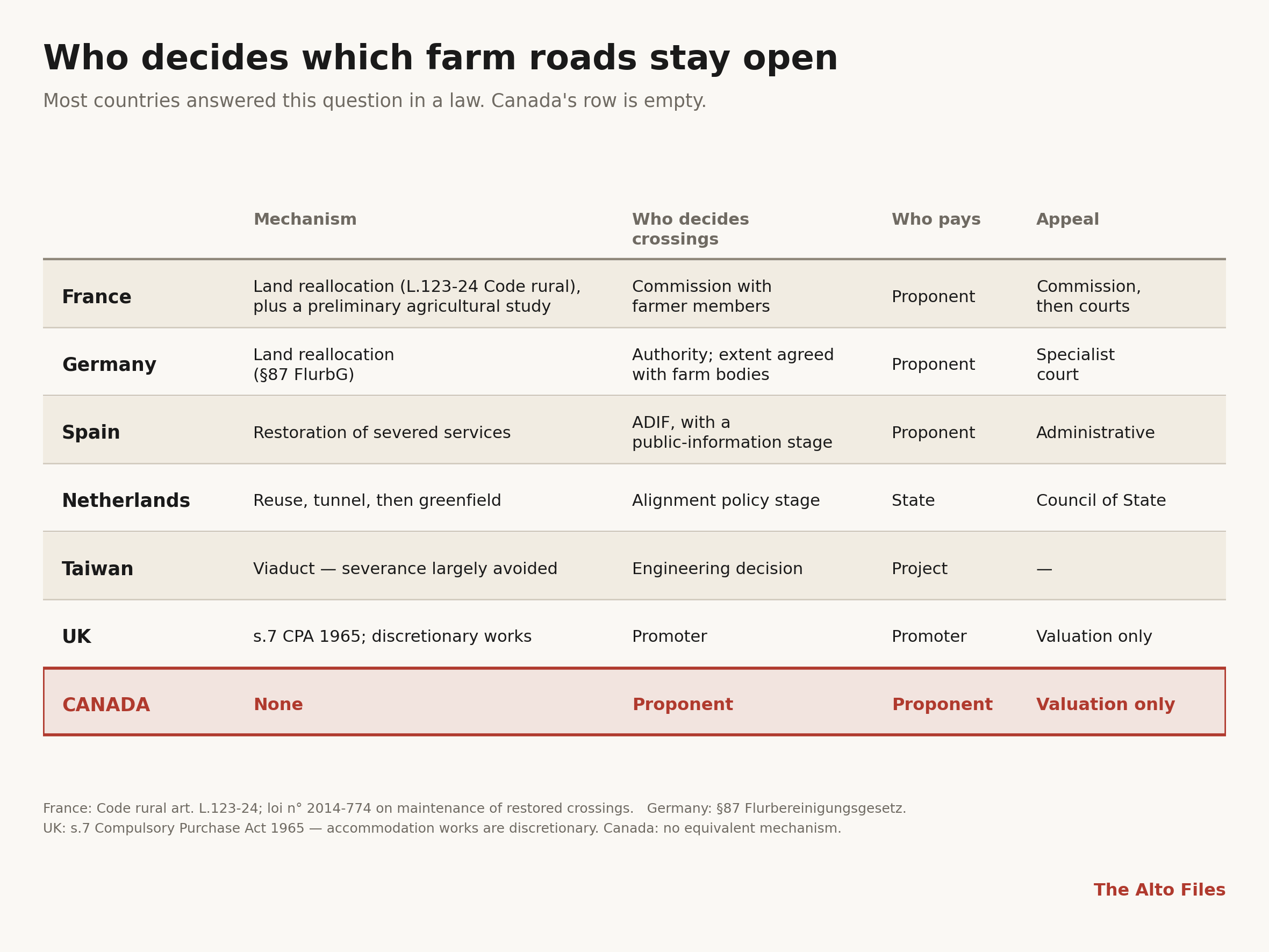
Questions this raises
Will the agricultural crossing plan be published as a standalone document with an independent public comment stage, as ADIF does in Spain? Will it be a law and not a changing website?
Is there any forum in which a farmer can appeal the design of access, as opposed to the price of land?
Has Transport Canada or Alto examined any land-consolidation mechanism, and what is it?
Why is there no law or published standard? Who has retained the authority to set one in the contract?
No posts
Comments
Nothing yet. Say the first thing.
Sign in to join the conversation.