
Alto is a crown corporation. Crown corporations are required to submit a corporate plan to the government for approval. Once approved, a summary of the plan is required to be posted on the crown corporation’s website for the public and media to read. Either no media have read Alto’s, or they did and found nothing to report.
So I guess I have to be the one to break the news of Alto and Canada’s secret land re-organization plans impacting private landowners in Ontario and Quebec. Think you own your land and that the government, a crown corporation or a private development partner cannot just re-draw the boundaries as it sees fit without regulations and process? Ha! Not if Alto gets its way.
Where is the public debate and discussion about this that happens in other countries? Where are the laws to protect landowners and the independent process? Where is the transparency? And why am I still the only person writing about any of it? I’d like to get back to my law practice at some point.
The Corporate Plan
One sentence on page 21 of Alto’s corporate plan proposes to reorganize land across rural Ontario and Quebec.
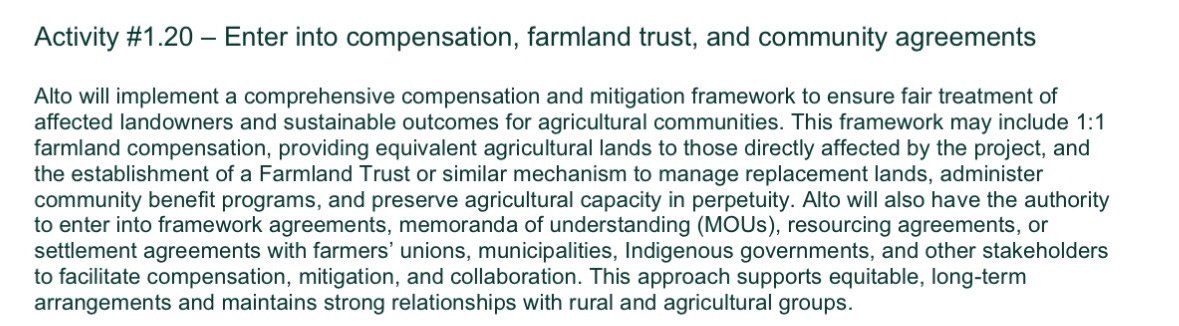
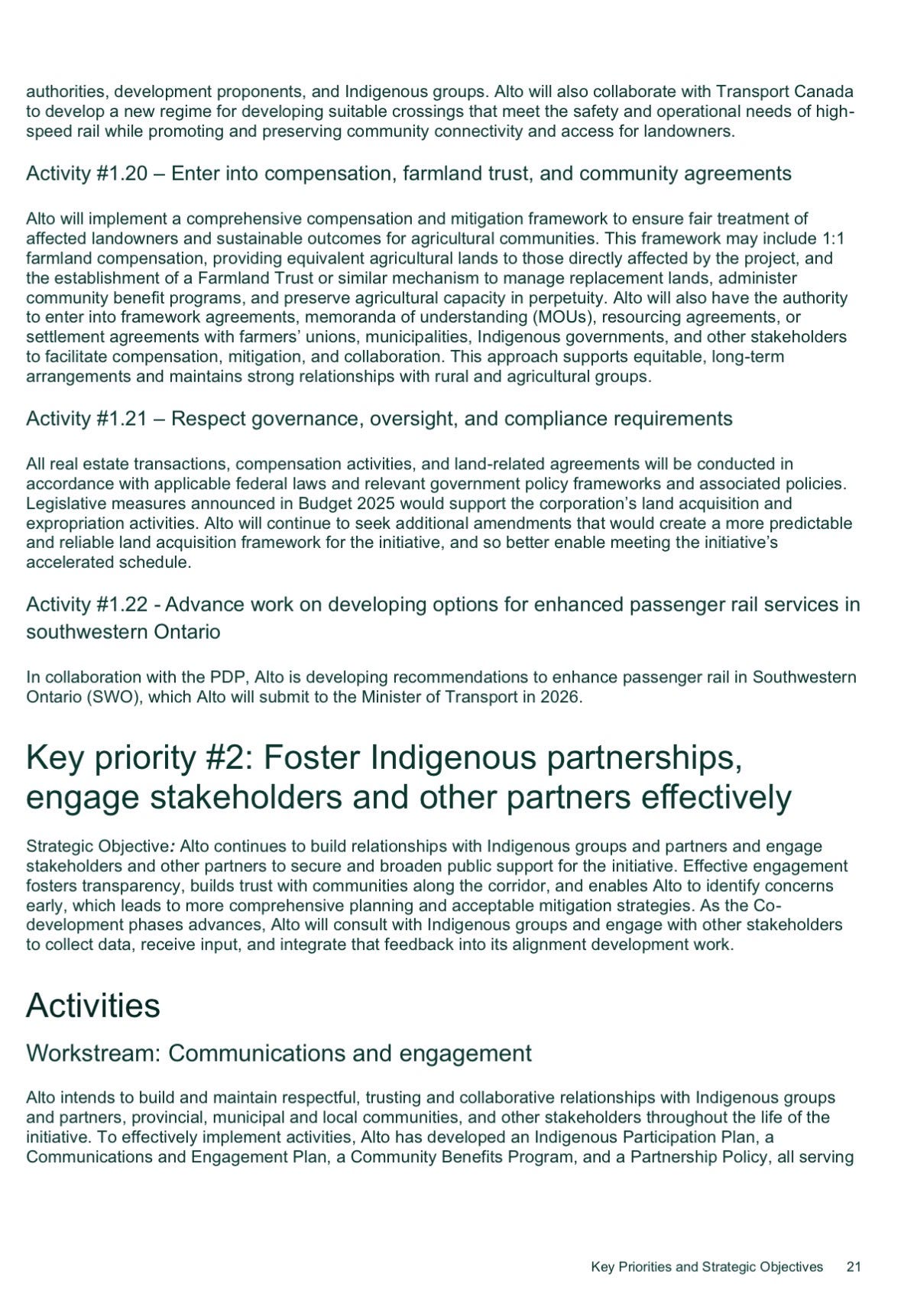
Alto's Corporate Plan Summary for 2026-2027 to 2030-31 is 77 pages and is published on Alto's Transparency and Trust page. On page 21, under Activity #1.20, "Enter into compensation, farmland trust, and community agreements," the corporation writes this:
This framework may include 1:1 farmland compensation, providing equivalent agricultural lands to those directly affected by the project, and the establishment of a Farmland Trust or similar mechanism to manage replacement lands, administer community benefit programs, and preserve agricultural capacity in perpetuity.
That is the whole of it. I searched the full text of the document. The word "farmland" appears on page 21 and nowhere else in the 77 pages.
Read that one sentence carefully, because it proposes three distinct things and only one of them has ever been described openly to the public.
The first is land as compensation for land. Not money, land. A farmer who loses ten hectares to the right of way would receive ten hectares of equivalent agricultural land somewhere else. That is not how federal expropriation works in Canada and it is not what Alto's public materials describe. Canada has no laws or regulations to administer such a thing and determine how land gets into it and from whom it is taken and how land gets out and to whom it goes.
The second is an institution. A Farmland Trust, or something like it, which would hold and "manage replacement lands." A body that acquires farmland, holds it, and allocates it. We have no laws or regulations that would establish such an entity or govern how it would work.
The third is perpetuity. I spent an inordinate amount of time in law school learning about that rule (while desperately trying to stay awake). The trust would "preserve agricultural capacity in perpetuity." That is a strong phrase with a specific meaning in property law and no obvious vehicle behind it. Which new government agency will administer all of this land and for whose benefit? Or are we handing that power over to a private partner as well?
Treating privately owned land in this manner has no precedent in Canada and no laws allow for it or govern it. A change of this magnitude needs to have significant public discussion and debate and not just be slipped into some omnibus bill this coming fall or next spring. Where is the legislation and where is the public debate? Where are the expert committees? Why is this hidden in a PDF on a corporate plan that only I have read?
Read it yourself here: Alto (VIA HFR - VIA TGF Inc.), Corporate Plan Summary 2026-2027 to 2030-31, page 21, Activity #1.20. Available at altotrain.ca/sites/default/files/2026-06/alto-corporate-plan-2026-2027-summary.pdf, linked from Alto's Transparency and Trust page under "Corporate Plan."
What the public version says instead
Alto does have a page about an agricultural land trust. It is at altotrain.ca/en/property-acquisition/working-with-agricultural-community, under the heading "Communities and local benefits." It reads:
"Alto is looking at the potential creation of an agricultural land trust, that could support long-term initiatives connected to the project."
The page then describes what those initiatives would be:
opportunities for youth,
innovation,
knowledge-sharing, or
other priorities identified with associations.
The website explains the purpose in a single sentence, which is where the two documents part company completely. The website says the trust is being explored as one way to help offset the loss of agricultural land by supporting initiatives that improve productivity on remaining land. Remaining land. Not replacement land.
The public trust is announced on the website as a program vehicle. It says it funds things that make the acreage you still own more productive. The corporate plan trust is described very differently - as a land-holding and distributing vehicle. It manages replacement acreage that displaced farmers receive instead of what they lost. They have to get the land from somewhere.
Those are two very different institutions with different assets, different legal structures, different impacts on private property and interests and different consequences for whether or not a farm or agricultural business or community survives a partial taking. Organizing benefits for negatively impacted communities is normal for a purpose-built crown corporation for a project. But giving them the authority to completely re-organize entire communities and land ownership is absolutely not normal in this country. Those actions require extensive legislative change to set up God knows how much necessary administrative bureaucracy and also procedural protections both to protect land owners and also to prevent against corruption and self-dealing. Alto is not fit for that purpose and should not be given such authority - especially not quietly.
The phrases "1:1 farmland compensation," "equivalent agricultural lands," and "replacement lands" do not appear anywhere on Alto's public property acquisition pages. I checked all four of them. That wording only exists in the corporate plan and no journalist has asked about any of it.
What the public pages say instead is all about money. The Frequently Asked Questions page, under Property and land, states that property owners "will be compensated at market value for the property to be acquired, as well as for losses and reasonable third-party fees incurred," and that if expropriation were required, the federal Expropriation Act would apply and would be administered by Public Services and Procurement Canada.
The Compensation Principles page sets out seven principles. Market value at highest and best use. Disturbance costs. Impact on the remaining property. Business and farm losses, including crop losses calculated over a 100-year period. Special difficulties. Independent appraisals, with Alto paying the owner's professional fees. And a seventh, "Practical solutions beyond money," which mentions "replacement arrangements" among a list of mitigation measures without defining what is being replaced. Perhaps the phrase “practical solutions” intends to capture the idea of re-dividing up land throughout a region as Alto sees fit to do based on what private companies decide they need to build a railway.
The Alto webpage then works through two detailed examples. A 50-hectare cattle farm losing a three-hectare strip. An 80-hectare crop farm losing four hectares plus a two-hectare temporary area. In both, every head of compensation is monetary, and the only forward-looking remedy offered is that Alto "may work with the owner to improve the productivity of the remaining land" through drainage upgrades, field reconfiguration, improved access, irrigation, or soil enhancement.
Neither worked example contemplates the farmer receiving land or land being reorganized. There is no hint of it even being considered at all. How do you engage with the public on an idea when the idea itself is hidden - months after consultations closed?
What the government says
Transport Canada published its key messages on the High-Speed Rail Network Act, dated June 17, 2026. Under the heading Land Expropriation, the department states that the adjustments to the expropriation regime are intended, among other things, to "ensure the existing compensation for expropriations remains in place for this project."
“Existing compensation.” Section 26 of the federal Expropriation Act. Market value, plus disturbance, plus the special economic advantage limb for owner-occupants. Money.
There is no reference on that page, or on Transport Canada's overview page for the Act, to a farmland trust, to replacement land, or to compensation in kind. There is no discussion of completely reorganizing the land and where the replacement lands come from.
The government's stated position is that nothing about compensation changes. Fascinating that they approved Alto’s corporate plan which considers something much different.
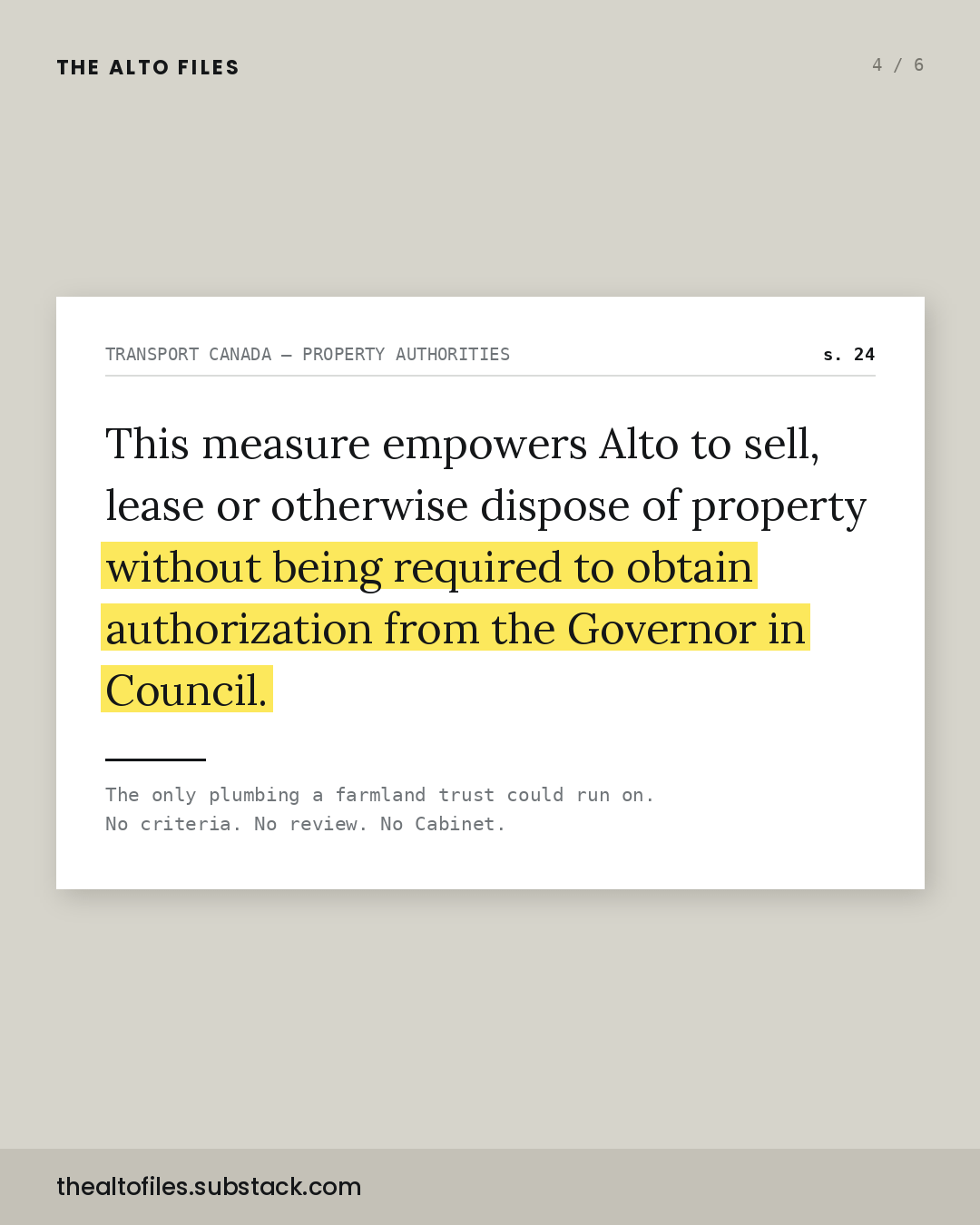
The same government page does contain one measure that matters under Property Authorities. It records that the Act "empowers Alto to sell, lease or otherwise dispose of property without being required to obtain authorization from the Governor in Council," aligning Alto with Canada Post, CMHC and the Bank of Canada. Transport Canada justifies it by reference to utility relocations and easements, of which there will be hundreds.
That is section 24 of the Act, and it is the only plausible legal plumbing for a farmland trust. It is also the provision that would let land leave a trust as easily as it entered one. It sets up absolutely no guardrails for Alto or the public on how these decisions are made, who makes them and how the public interest is protected and not abused in the process.
Did this country learn nothing from the corruption during the last wave or railroad development and how land was handed out and organized to benefit government insiders? Are we seriously setting the exact conditions necessary to do it again?
What the statute says
I read the High-Speed Rail Network Act in full. It is S.C. 2026, c. 3, s. 191, enacted through the Budget 2025 implementation bill and assented to on March 26, 2026. It has ten headings: Alternative Title, Interpretation, Declaration, Approval, Impact Assessments, Right of First Refusal, Prohibition on Work, Expropriation, Property of the Corporation, and Indigenous Knowledge.
There is nothing in it about exchange, replacement, consolidation, redistribution, land banking for agricultural purposes, or a trust.
Section 17(2) removes the requirement that Alto attempt to purchase before requesting expropriation. Section 17(3) deems the Minister to be of the opinion that the interest is required for a public work and obliges expropriation. Section 18 disapplies sections 8, 9, 10 and 11 of the Expropriation Act, which are the provisions governing the hearing before a commissioner. Section 21 gives an owner 30 days from Canada Gazette publication to file a written objection, and section 22(2) entitles them to reasons only on written request after the fact. Section 23 excludes from market value any increase resulting from work done in breach of a prohibition notice.
The definition in section 2 is narrow. An "interest or right required for the high-speed rail network" means an interest the Corporation requires "for the purpose of a railway." That is the trigger for the expropriation power. It does not reach land acquired in order to give it to somebody else.
Which raises the obvious problem with the Farmland Trust as drafted. To hand a farmer equivalent acreage, Alto must first obtain acreage it does not need for the railway. It cannot expropriate for that purpose on the face of the Act. It would have to buy on the open market, at scale, in the same corridor where it says on page 19 that it is acquiring proactively in order to protect the alignment "from speculative pressures."
Does nobody see the irony?
The eight-year encumbrance, and the remedy that is not there
The two most consequential sections of the Act for a landowner are 8 and 12.
Section 8 lets Alto register a notice of right of first refusal against title on any land it "is of the opinion that it may require." Not land it requires. Land it may require. Under section 8(4)(e) that notice can sit on title for eight years. Under section 10(1), any sale to a third party while it is registered is void, or in Quebec null. If the owner does find a buyer, section 9 requires them to hand Alto the signed agreement, and Alto has 60 days to step into it.
Section 12 lets the Minister register a notice of prohibition on work, lasting up to four years under section 12(8)(e). Section 13 then bars the owner, and any lessee or occupant, from undertaking any work beyond preventing normal deterioration or maintaining normal functional state. Section 14 authorizes entry to verify compliance or appraise, and makes obstruction a summary conviction offence.
Transport Canada's key messages say this is "intended to prevent undue increases in land value prior to acquisitions."
Now the part that is missing.
The Act contains no obligation on Alto to buy. An owner whose title carries an eight-year right of first refusal, who cannot sell, who cannot improve, has no mechanism to compel a purchase if they wish to escape the nonsense. The only compensation available is section 16, for "actual loss" caused by a prohibition on work, claimable in writing within one year after the notice ceases to have effect.
Compare the United Kingdom. HS2 paired safeguarding with an Express Purchase scheme and, in rural areas, a Voluntary Purchase Zone. The stated intention was that blight notices would be accepted from all eligible property owners in the safeguarded area, even where the property was not required to construct the route, and that the package as a whole would be more generous than the statutory code. HS2 acknowledged in terms that a long construction period would have negative effects on housing markets and that property blight is typically worst during that stage.
Canada adopted the restraint and left out the remedy for landowners. Every land tool in the High-Speed Rail Network Act benefits Alto. Nothing protects the public.
Acquisition without a route
Alto's numbers show land purchasing beginning before anyone knows where the railway goes.
The study corridor is approximately 10 kilometres wide. The right of way will be approximately 60 metres. A narrowed corridor for the Ottawa to Montreal segment is expected in fall 2026, and the alignment after that.
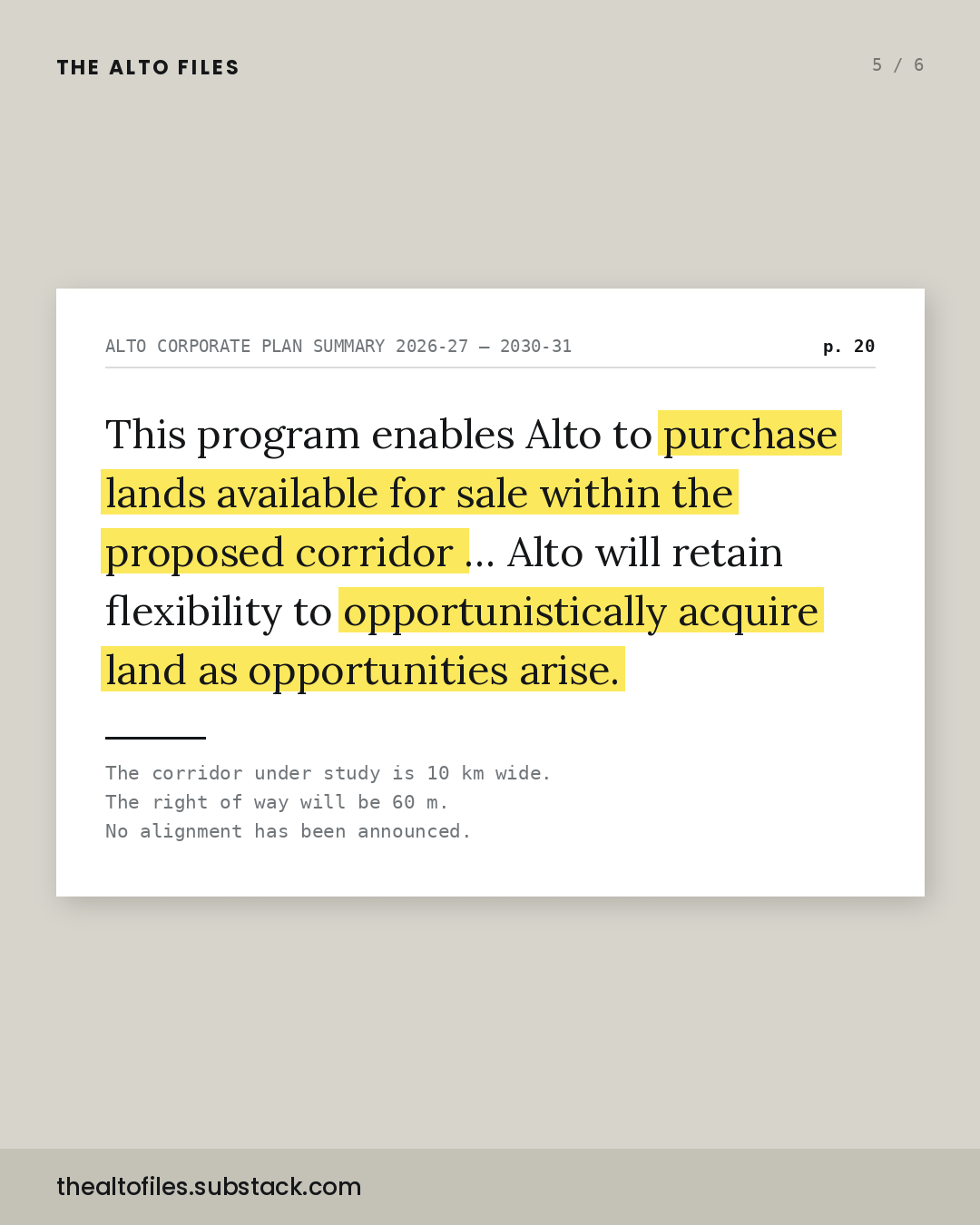
Meanwhile, page 20 of the Corporate Plan describes an Early Acquisition Program under which Alto may "purchase lands available for sale within the proposed corridor," secure strategic parcels, and preserve areas required for the future alignment, station footprints, maintenance facilities and construction staging. It states that Alto "will retain flexibility to opportunistically acquire land as opportunities arise." The property acquisition page says the same thing in plainer words: if a property of interest becomes available for sale, Alto can assess the opportunity to make an offer.
Municipal councillors have also been told at meetings with Alto that land is already being purchased even though the route is not determined. They tell councillors that they will just sell it if they don’t need it. They haven’t told councillors about any land reorganization plan - at least not ones not covered by NDAs. Someone should ask the Mayor of Ottawa and rural councillors about it. I’m curious what they know. Same with the farm organizations. What, if anything, have they been told?
Page 20 also records, at Activity #1.15, that Alto may purchase or seek to have expropriated lands for industrial production and resource acquisition, including borrow pits, quarries and excavated material disposal areas. They certainly don’t advertise that.
Activity #1.18 provides for incremental acquisitions to maintain options for rail-adjacent or project-specific development. Activity #1.19 states that Alto may reserve or assemble parcels adjacent to station areas for transit-oriented development and to "leverage long-term value creation."
And page 54 puts a number on it. Land Acquisitions, in thousands of dollars, for years ending March 31: $50,911 in 2025-26, $112,389 in 2026-27, $145,210 in 2027-28, $36,313 in 2028-29, $47,073 in 2029-30, nil in 2030-31. Total $340,985.
Fifty million dollars was budgeted for land acquisition in a fiscal year during which no alignment existed and the first public consultation had only just closed.
Annex 3, on page 44, then lists as a planning assumption that Alto "initiates 'willing buyer, willing seller' land acquisitions in 2027 with additional funding," with acquisition for the first bundles of Segment 1 completing by 2029.
None of this is hidden. It is in the capital table. Nobody has exposed it.
Nobody is talking about any of it.
The questions for municipalities and journalists to ask
I have many and I’m sure farm businesses and rural municipalities have many, many more. They and the public should be part of this conversation and these plans. The secrecy is completely unacceptable and is beyond infuriating.
1. Is 1:1 farmland compensation an Alto commitment, a Cadence proposal, or a government idea? Where are the details of the idea or plan?
2. Under what statutory authority would Alto acquire farmland that is not required for the purpose of a railway, in order to transfer it to a displaced farmer?
3. What is the legal form of the Farmland Trust? A charitable trust, a non-share corporation, a Crown subsidiary, a Quebec fiducie d'utilité sociale?
4. Who is the settlor, who are the trustees, and who are the beneficiaries?
5. How is "in perpetuity" achieved in Ontario, given the rule against perpetuities, and how is it achieved in Quebec under the Civil Code? Are they the same instrument on both sides of the Ottawa River?
6. Where does the replacement land come from, in a corridor where Alto has said it is acquiring proactively to prevent speculation? Who already owns the land to be taken?
7. Who decides which farmer receives which parcel, on what criteria, and with what right of review? Who decides which land owner loses their land to put into the farm trust and be re-distributed? What are the rights of review?
8. Is equivalence measured by area, by soil class, by drainage, by distance from the home farm, by nutrient management capacity, by income or by whatever Alto decides on any given day? Where is the legislation and regulations?
9. What happens to supply-managed quota, which is not land, does not travel with replacement acreage, and is subject to relocation limits in both provinces?
10. What is the tax treatment of a land-for-land exchange, and has the Canada Revenue Agency been consulted at all?
11. How does a federal Crown corporation reallocating protected agricultural land interact with Quebec's agricultural land protection regime and Ontario's provincial land use policy, given Transport Canada's own statement that provincial laws of general application may still apply to all of it since none of this is central to building a railway?
12. Was the Farmland Trust discussed with Dairy Farmers of Ontario, Les Producteurs de lait du Québec, the UPA, the OFA, or the Ontario Farmland Trust, and is Alto aware that the last of these is an existing organization with the same name? Has it been involved already and for how long?
13. Why does the public website describe a trust that improves productivity on remaining land and gives financial benefits to communities, while the Corporate Plan describes a trust that manages replacement lands?
14. Why is the only written statement of 1:1 compensation in a corporate plan summary, and do more details appear in the full Corporate Plan, which is not published?
15. What was Cadence's role in developing this framework? Why isn’t the government responsible for this? Are we seriously leaving this up to the private sector? Does nobody else see a problem with that approach?
16. Does the section 24 power to dispose of property without Governor in Council authorization mean land can now move into and out of a farmland trust - all without Cabinet approval, if this scheme proceeds at all?
17. Given that the Act creates an eight-year right of first refusal and a four-year work prohibition with no corresponding duty to purchase, why was no equivalent of the HS2 express or voluntary purchase scheme included?
18. The plan says Alto will "continue to seek additional amendments" for a "tailored land acquisition framework." What amendments, and will they be introduced as standalone legislation or through another budget bill?
What France actually has, and where it came from
France - where members of the Cadence consortium are from - has run “compulsory agricultural land reorganization” around major public works for decades, and it is worth being precise about both the mechanism and its origins, because the origins are dark. They come from the aftermath of the First and Second World Wars. Seriously.
My apologies for all of the French in this section. I read French poorly and do not wish to mess up any translations, so I am keeping many French titles and terms to ensure accuracy and that I do not lose anything by relying on Google Translation.
The modern mechanism is “aménagement foncier agricole et forestier”, in Book I, Title II of the “Code rural et de la pêche maritime”. Article L. 123-1 defines it as operating through a new distribution of fragmented or dispersed parcels, with the principal aim of constituting farm holdings in a single block or in well-grouped large parcels.
Article L. 123-24 is the provision that applies to large public works. Where expropriations for works falling under articles L. 122-1 to L. 122-3 of the “Code de l'environnement” are liable to compromise the structure of farm holdings in a defined zone, an obligation is placed on the “maître d'ouvrage”, written into the declaration of public utility itself, to remedy the damage caused by participating financially in the execution of land reorganization operations and connected works.
In France the developer does not choose whether to reorganize land. The obligation attaches to the public utility declaration, which is the instrument that authorizes the project at all. It is a condition of proceeding.
The rest of the sub-section allocates power away from the developer. The “président du conseil départemental” conducts and implements the procedure. Communal or intercommunal land commissions, with farmer representation, propose the perimeter and decide allocations. Where the developer is the State or one of its public establishments or concessionaires, agreement to extend the perimeter is given by the prefect. Under L. 121-15, an extension beyond the zone disturbed by the works is charged to the department rather than the developer.
The cost allocation is also legislated. Under the L. 123-25 framework, the footprint of the works may be levied across all parcels within the perimeter, so that the levy does not affect any holding in a proportion incompatible with its viability, and the price of the land ceded to the developer is distributed among the owners in proportion to their contribution. The burden of a linear taking is spread rather than landing on whoever happens to sit under the line. And no financial contribution can be demanded from the affected owners where the operation is carried out under L. 123-24.
There are limits and deadlines. Under R. 123-30 and following, for non-linear works the footprint is excluded from the reorganization perimeter and the perimeter cannot exceed twenty times the area expropriated. Where a commission decides in favour of including a linear work's footprint within the perimeter, the président du conseil départemental must order the operation within one year of the developer's request, failing which the developer may fall back on expropriation.
Article L. 123-4 requires equivalence by nature of culture, and where the nature of the land occupied by the works makes a departure unavoidable, the shortfall is compensated by attributions.
That is what a land reorganization regime looks like when it is written into a law. Named independent decision-makers. A defined perimeter with a numerical cap. Roles established by legislation. A cost-sharing rule. A timetable. An equivalence standard. A funder who is not also the decider.
Now the history, which is the ugly part.
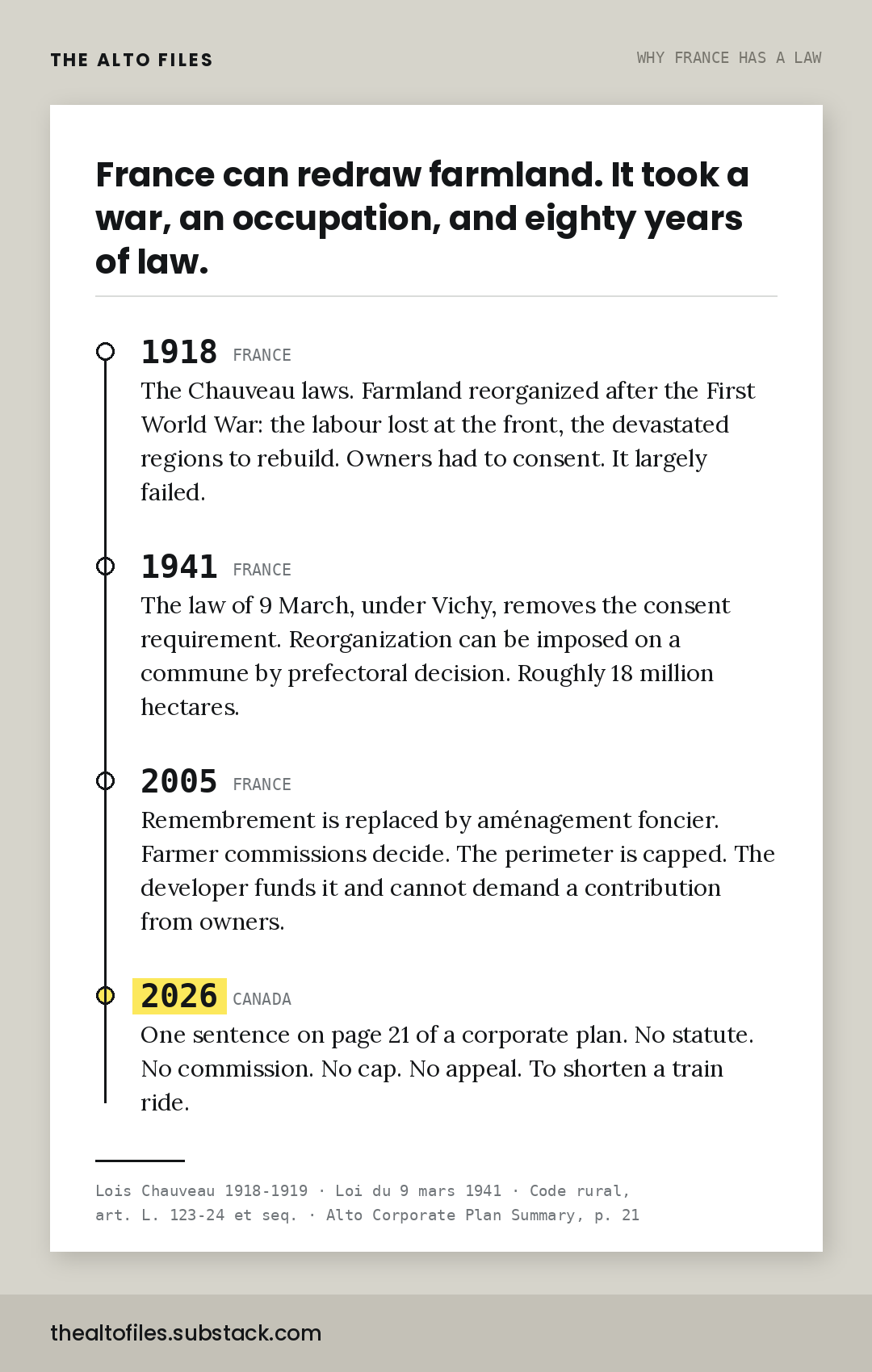
The first French laws on remembrement came out of the First World War. The Chauveau laws responded to the loss of agricultural labour at the front, the resulting push to mechanize, and the need to re-establish vanished property boundaries in the devastated regions from the war. Those laws required the consent of owners, and largely failed for that reason.
The law that made it work came into force in 1941, enacted under the German occupation Vichy governmental authority. Its “innovation” to make the law work was to remove the owner consent requirement entirely.
Yes, I was somehow able to trace Alto back to Nazi Germany. I definitely wasn’t expecting to find that.
Remembrement could be imposed on a community without the agreement of a majority of affected owners, on prefectoral decision. Roughly 18 million hectares were reorganized under it. It survived the Liberation in July 1945 and remained the legislative framework for French land reorganization until the rural development law of 23 February 2005 replaced remembrement with aménagement foncier agricole et forestier.
France spent fifty years putting safeguards back in place to protect communities and land owners after the German occupation. The nature protection law of July 1976 imposed impact studies before remembrement, after the environmental costs became undeniable: bocage and hedgerow destruction, erosion, drained ponds. The rural land law of December 1985 moved project ownership and financing of remembrement operations to the departments.
The compulsory land reorganization power that Alto's page 21 gestures at has, in the country that pioneered it, a legislative pedigree running through an occupation government during the Second World War, and France has been legislating against that inheritance ever since. Even now, with a full code, elected decision-makers, farmer commissions, perimeter caps and appeal routes, it remains contentious.
Alto proposes the function with none of the framework. No statute. No commission. No cap. No allocation criteria. No appeal. No war to justify extreme measures. One permissive sentence in a corporate plan summary, decided by Alto.
The justification for such property ownership mayhem is different. The French regime was built in the aftermath of wars, occupations, food security, the reconstruction of a completely shattered countryside and the rebuilding of an economy and industrial capacity after wars.
This corridor is being reorganized so that people can travel between Toronto, Ottawa, Montreal and Quebec City in less time by passing through the communities considered for reorganization.
What are we even doing here? What country is this?
The Canadian precedent: take land first, figure it out later
Canada does not have an equivalent to aménagement foncier. The federal Expropriation Act compensates in money under section 26. The High-Speed Rail Network Act, which I have read in full, creates no power of exchange or redistribution. A survey of every provincial land consolidation statute is a separate exercise, and I have not done it, so I put this as the narrower and verifiable claim: there is no federal statutory mechanism for compulsory agricultural land reorganization in Canada, and the Act Parliament passed in March 2026 did not create one. I highly doubt any province has this mechanism.
What Canada does have is Mirabel.
On April 15, 2019, Transport Canada announced it was restarting a process begun in 2008 to sell surplus lands from the former Mirabel airport reserve, 748 acres in the unleased sector that had remained vacant since expropriation, back to the owners expropriated in 1969 or to their estates. Media accounts put the original expropriation in the range of 97,000 acres, a figure I have not verified against a primary source and flag accordingly.
The federal record on assembling farmland at scale is a record of taking far more than was needed and spending five decades trying to figure out what to do with it or to try and give it back at a much higher price than what was paid to acquire it. That is the Canadian precedent Alto is operating against, in a corridor where Mirabel is a real place on the map.
Maybe this time we should try figuring out what we are going to do with the land before we take it and how we are going to deal with the excess land that the government will take and not use? Maybe we should spend some time at all thinking about the people who already live on that land and preparing for the negative consequences that has already hit them.
What happens next
Alto is asking for more. Page 10 of the Corporate Plan lists, among four areas where government action is required, "a tailored land acquisition framework, beyond the initial measures introduced in the High-Speed Rail Network Act, that accommodates the needs of large linear projects." Activity #1.21 on page 21 says Alto "will continue to seek additional amendments that would create a more predictable and reliable land acquisition framework."
Predictable and reliable for whom is the question.
The Act removes the pre-taking hearing, removes the obligation to try to buy first, allows acquisition and expropriation to proceed ahead of the impact assessment decision under section 7, and permits an eight-year encumbrance on title with no duty to purchase and no mechanism to force a purchase in dire financial circumstances.
In England it took banks being unable to sell properties acquired when mortgages defaulted to lobby the government for a mechanism to force the purchase of properties in impacted areas. Can we not learn from that and set something up to get ahead of this situation? I guess we will likely have to wait for the banks since nobody seems to be listening - or even talking to - the people who actually live here. Not unless you are a politician or NGO under an NDA.
If the Farmland Trust and 1:1 compensation are what Alto intends, they should be in a statute, debated in Parliament, with criteria, an allocation process, a right of review, and a funding rule. That is what France eventually did, and France started from a much worse place.
If they are not what Alto intends, then page 21 should not say so, and someone should explain why a document approved through the Governor in Council process describes a compensation framework that the corporation's public website and the government of Canada does not.
The Canadian Railway Developer Scandal - the Pacific Scandal
The first major political scandal in Canada after Confederation was about a railway. It is known as the Pacific Scandal. I plan to write more about this in another article as the parallels are there.
On April 2, 1873, Lucius Seth Huntington rose in the House of Commons and alleged that Sir Hugh Allan and his associates had been promised the contract to build the Canadian Pacific Railway in return for campaign funds. The evidence was a set of letters that had been stolen from the office of Allan's lawyer, John Abbott, and sold to Liberal members for $5,000. Sir John A. Macdonald resigned as prime minister on November 5, 1873. The scandal is usually remembered as a story about money, and it was. But the more consequential part came afterward, and it was about the land.
When the contract was finally made, An Act respecting the Canadian Pacific Railway, passed in 1881, authorized a subsidy of twenty-five million dollars in money and twenty-five million acres of land, together with land for right of way, stations and other purposes, "and such other privileges as are provided for in the said contract."
Those other privileges included a twenty-year prohibition on competing lines to the south and an exemption from taxation on the main line. Parliament debated those terms. Members moved amendment after amendment against them and lost. The point is that the terms were on the table and the vote was recorded. Whatever else can be said about 1881, the contract was public before the land was given away.
Land is again the real consideration in a railway project, and again the arrangements governing it are not fully visible. Alto is budgeting to acquire land before an alignment exists, at $50.911 million in 2025-26 and $340.985 million over five years. It may assemble parcels next to stations to "leverage long-term value creation." Section 24 of the High-Speed Rail Network Act lets it sell, lease or otherwise dispose of property without Governor in Council authorization to whoever it wants.
The agreement with its private developer partner has not been made available to parliamentarians. A compensation framework that would reorganize farmland across two provinces appears in one sentence of a corporate plan summary with no statute behind it.
In 1881, at least, Parliament could read the contract.
We appear to be just trusting Alto with all of it.
What could possibly go wrong?
Sources: Alto, Corporate Plan Summary 2026-2027 to 2030-31, pages 10, 19, 20, 21, 44 and 54 (altotrain.ca). Alto property acquisition, compensation principles, agricultural land, working with the agricultural community, and FAQ pages (altotrain.ca). High-Speed Rail Network Act, S.C. 2026, c. 3, s. 191, assented 26 March 2026 (laws.justice.gc.ca). Transport Canada, High-Speed Rail Network Act Key Messages and Overview, 17 June 2026 (tc.canada.ca). Code rural et de la pêche maritime, articles L. 121-15, L. 123-1, L. 123-4, L. 123-24, L. 123-25 and R. 123-30 and following (legifrance.gouv.fr). Transport Canada news release, 15 April 2019, on Mirabel surplus lands (canada.ca). HS2 property and compensation consultation materials on safeguarding, express purchase and the voluntary purchase zone.
No posts
Comments
Nothing yet. Say the first thing.
Sign in to join the conversation.