
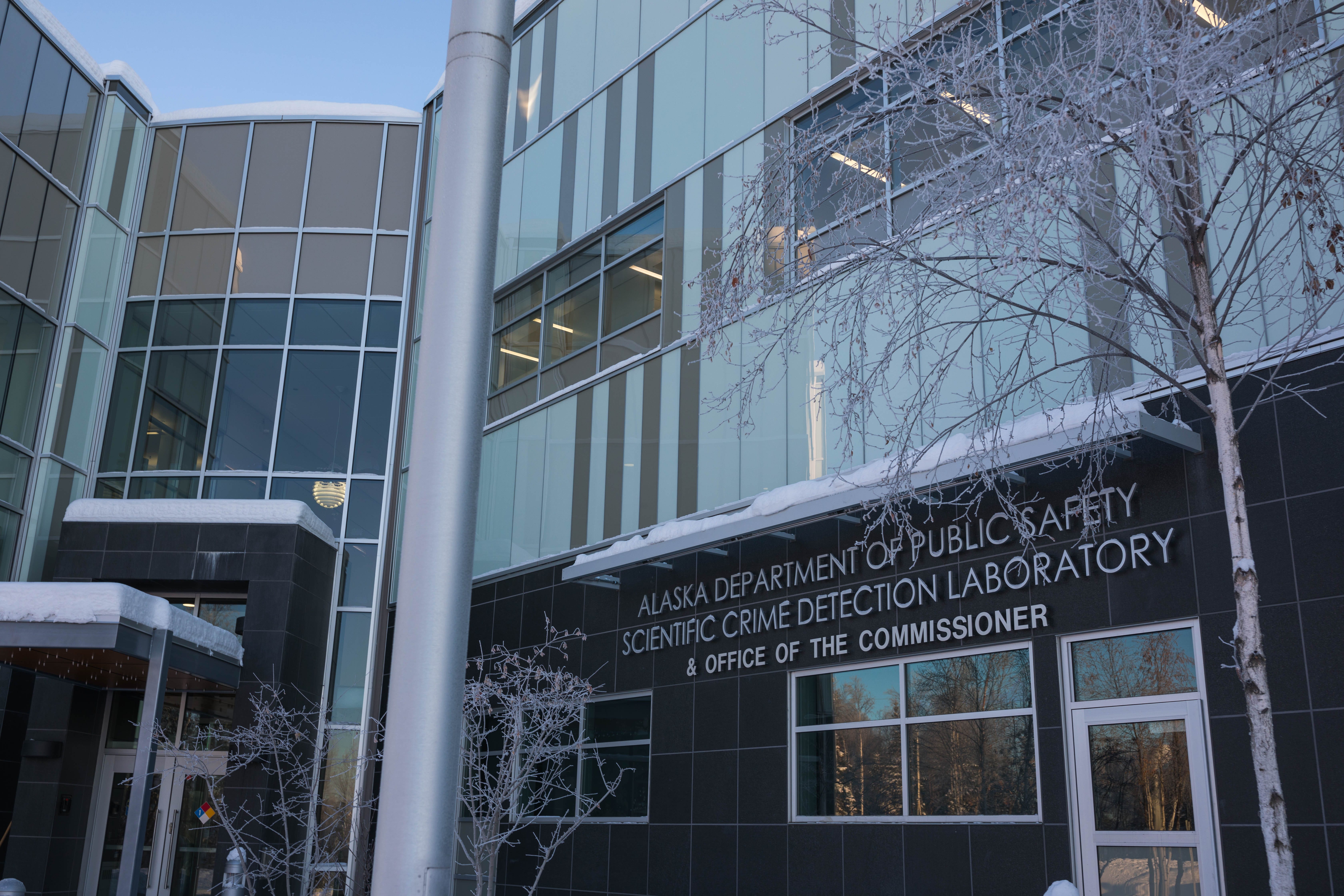
Years before the public was asked to trust Alaska’s death investigations, auditors had already found problems inside the state crime lab.
In 2017, a special audit by the Alaska Division of Legislative (DLC) pulled back the curtain on the Alaska Scientific Crime Detection Laboratory and showed the public something interesting - a $90 million high-tech crime lab with unfinished forensic space, bureaucratic offices tucked inside, and serious safety and credibility problems.
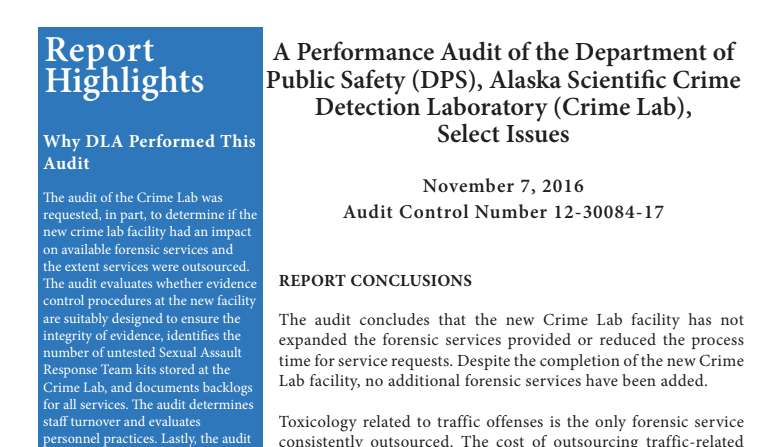
The lab opened in June 2012.
According to the DLC report, planning and design started back in 2004 and cost about $16.8 million. In April 2010, the Alaska Legislature approved another $75.75 million specifically for construction.
The public was told this 84,000-square-foot building was being built for forensic work and future expansion, but at the time of the DLC audit, nearly one-fifth of the building was left as unfinished “shelled-out space” to save money.
Instead of being used for future forensic expansion, some of that space was being used for administrative offices, records, supplies, and storage. At one point, the Commissioner of the Department of Public Safety and DPS administrative staff were using the space. The DPS Office of Professional Standards also occupied the lower floor of one wing.
DPS later moved the Commissioner’s staff out of the crime lab space and across the street in late 2020, according to Forensic Magazine. Around that same time, the Anchorage Assembly approved a lease agreement allowing the Anchorage Police Department to move staff and equipment into the building for $1 a year for five years, with an option to extend.
The stated goal was to “utilize existing capacity,” “maximize efficiency,” and “standardize forensic science practices.” That sounds good.
The 2016 audit also found problems that should have shaken public confidence.
In 2012, a minor was given an electronic key card and allowed to help with drug inventories.
In 2014, Alaska appointed Dr. Zientek as the state’s only Chief Medical Examiner, despite the fact that he had previously been convicted in Virginia on three felony drug charges, later reduced to misdemeanors. His medical license had also been suspended. The Virginia medical board reinstated his license in 2007, but with restrictions.

In 2015, the lab moved to a “self-service” evidence vault because of budget cuts. DLC auditors warned that this increased the risk of theft.
But here is the biggest problem, without a new performance audit, the public has no way to know whether any of that actually happened.
That question matters even more when you remember the Kyle Hopkins Lawless series, in partnership with ProPublica from 2021. He detailed how Alaska law enforcement agencies had failed to collect DNA from more than 21,000 people arrested for qualifying crimes, even though they were required to do so under state law.
So we have a big beautiful building to do all of this work, with promises of efficiency and capability, being underutilized. Protocol issues. Evidence at risk. The DLC report is now more than a decade old, have things been remedied?
Can we get a new audit?
Because without one, we do not know what changed, and at some point, “trust us” is not good enough.
We are being asked to trust a system that has already been warned about safety breaches, poor judgment, unused forensic space, and weak oversight.
We are being asked to trust the only Chief Medical Examiner Alaska has, and his team that handles evidence, autopsies, toxicology, DNA, and death investigations.
But really, why I started even looking into the Crime Lab is the fact that we are being asked to trust an office that seems to reach for the same catch-all phrase when Alaskans die under questionable circumstances:
Natural causes.
Thanks for reading The Alaska Record by Amber Batts ! This post is public so feel free to share it.
Comments
Nothing yet. Say the first thing.
Sign in to join the conversation.