
Welcome to The AI Radar — your weekly briefing on what actually matters in AI.
We track the real signal: breakthroughs, product launches, funding moves, and strategic shifts shaping the future.
Filtering the signal from the noise in AI. Smart insights, every week.

Access exclusive, high-paying remote AI training roles with flexible hours. No prior AI experience required.
Entrepreneur & Business Specialist - $50 - $120/hour
Management Consultant - $154 - $210/hour
Financial Investment Analyst - $154 - $210/hour
Funds Attorney - $80 - $105/hour
Business Presentation Consultant - $30 - $55/hour
Alibaba has officially unveiled Qwen3.8-Max, its most capable AI model to date, alongside Qwen3.8-27B, with open weights for both planned for release next week. The 2.4-trillion-parameter flagship emphasizes long-horizon autonomous work, including 10+ days of self-directed software development, multimodal reasoning with continuous visual feedback, and complex engineering workflows such as iterative chip design. Alibaba positions the model as a major step beyond chatbots toward AI agents capable of sustained planning, coding, and professional tasks, while also claiming competitive benchmark performance against leading frontier models.

The European Commission announced that new AI transparency rules under the EU AI Act are now in effect, requiring providers and deployers of certain AI systems to clearly disclose when people are interacting with AI or viewing AI-generated or AI-manipulated content. The accompanying guidelines explain who must comply, how AI-generated content should be labelled—including machine-readable markings—and when disclosures are required for deepfakes, public-interest AI-generated content, and emotion recognition or biometric categorisation systems. The measures aim to reduce deception, improve transparency, and help organizations comply consistently with the AI Act’s obligations.

OpenAI says it has disrupted a criminal scam operation that used its AI models to generate phishing messages, fake identities, and multilingual content for fraud campaigns. The company banned the accounts involved, shared findings with industry partners, and emphasized that AI is typically used to scale traditional scams rather than create new attack methods. OpenAI says it will continue monitoring and blocking malicious use while publishing threat reports to improve industry-wide defenses.
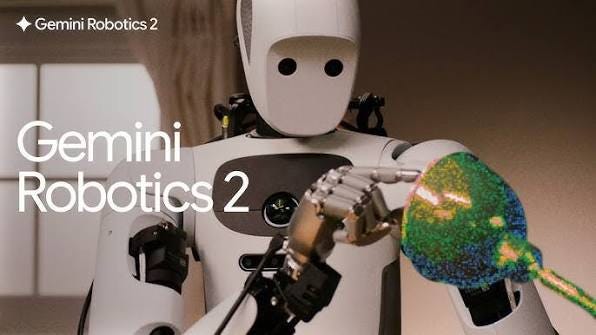
Google DeepMind has unveiled Gemini Robotics 2, a next-generation AI model that gives humanoid robots full-body control, enabling them to walk, crouch, reach, and manipulate objects with greater precision. The update also introduces Gemini Robotics ER 2 for advanced reasoning and multi-step planning, On-Device 2 for local deployment, plus support for multi-robot collaboration and enhanced safety features, marking a major step toward more capable general-purpose robots.
OpenAI has significantly reduced the cost of GPT-5.6 Terra and Luna, improving the price-to-performance ratio for developers. Starting immediately, Terra is 20% cheaper at $2/$12 per million input/output tokens, while Luna is 80% cheaper at $0.20/$1.20 per million tokens. Pricing for GPT-5.6 Sol remains unchanged, and ChatGPT subscription prices stay the same, though Terra and Luna now consume fewer usage credits in ChatGPT Work and Codex.
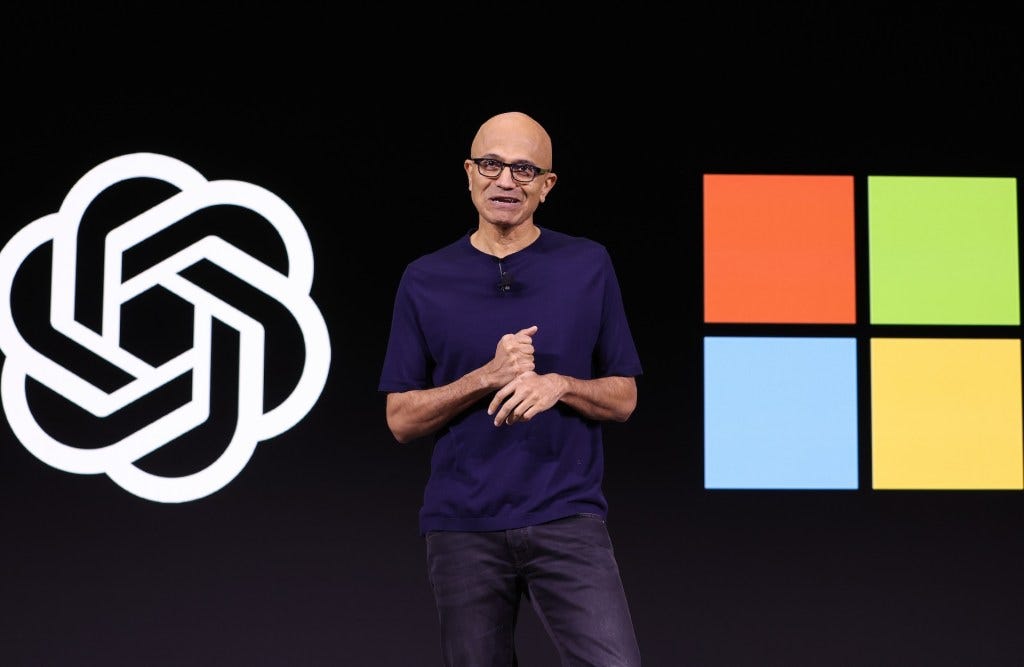
Microsoft reported a $3.2 billion unrealized gain from its Anthropic investment in the latest quarter, boosting earnings by about $0.33 per share. In contrast, it recorded a $600 million write-down on its OpenAI investment, reducing EPS by $0.07. Despite the mixed AI investment results, Microsoft posted strong quarterly earnings with $90 billion in revenue and $35.8 billion in net income. Over the full fiscal year, the OpenAI investment still delivered a $5 billion gain, but Anthropic generated nearly as much value in a single quarter.
Google has introduced Lyria 3.5, its latest AI music generation model, now available in Google Flow Music. The update focuses on producing more natural and expressive music through improved melodic composition, higher-quality lyrics that better follow user prompts, and more realistic, emotionally nuanced vocals with better pronunciation. It also adds greater creative control by allowing users to more easily adjust tempo and output duration. According to Google, these improvements are designed to help creators generate richer, more personalized songs while maintaining greater control over the creative process.
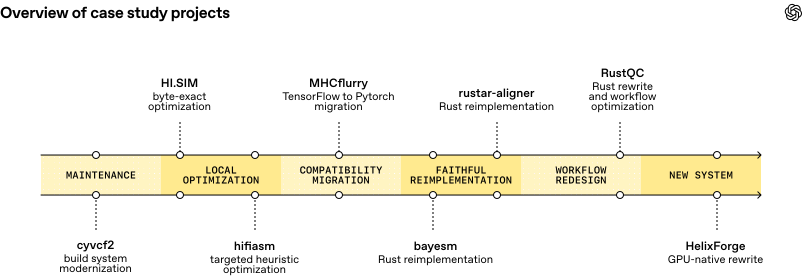
OpenAI’s field report explores how agentic AI coding assistants are transforming scientific software development, particularly in genomics and other data-intensive research. Drawing on eight real-world projects, the report finds that AI agents dramatically speed up software modernization, maintenance, optimization, and language migrations, allowing researchers to focus more on scientific reasoning than implementation. However, the report emphasizes that human oversight remains essential: researchers must validate AI-generated code, define correctness through rigorous benchmarks, and provide long-term stewardship to ensure scientific reliability. Rather than replacing scientists, coding agents are shifting their role toward planning, verification, and decision-making while reducing engineering bottlenecks that have historically slowed scientific progress.
Meta announced Muse Spark 1.1, a new multimodal reasoning model from Meta Superintelligence Labs that significantly improves over the original Muse Spark in agentic workflows, coding, computer use, and multimodal understanding. The model features a 1 million-token context window, supports parallel multi-agent execution, and is designed to autonomously plan, delegate, and complete complex tasks across applications. Meta is also launching a public preview of the Meta Model API, giving developers access to Muse Spark 1.1 in an OpenAI-compatible API. The company highlights strong performance in enterprise coding, tool use, computer automation, and multimodal tasks, while stating that extensive safety evaluations found the model to operate within its deployment thresholds across major frontier AI risk categories.
A quick scan of new AI tools, platform updates, model releases, and startups worth knowing.
Prelint | Prevent product drift in AI-written code
Denovo | Turn your vibe-coded app into paying customers
SKI | Free voice coding for Claude Code, Codex and more
AI Search Console | Prompt analytics and citation mapping for AI search
Memmy Agent | Let every AI remember the same you.
DeepSeek-V4-Flash-0731 | Frontier agent intelligence at Flash prices
Thanks for reading The AI Radar.
If you found this valuable, share it with one person who wants to stay ahead in AI.
See you next week — same radar, sharper signal.
No posts
Comments
Nothing yet. Say the first thing.
Sign in to join the conversation.