
I have been thinking about loyalty programs all week. Not in the abstract. In the very specific, very concrete sense of: what happens to a piece of infrastructure that took twenty years and billions of dollars to build when a protocol update renders its entire psychology invisible?
Let me show you.
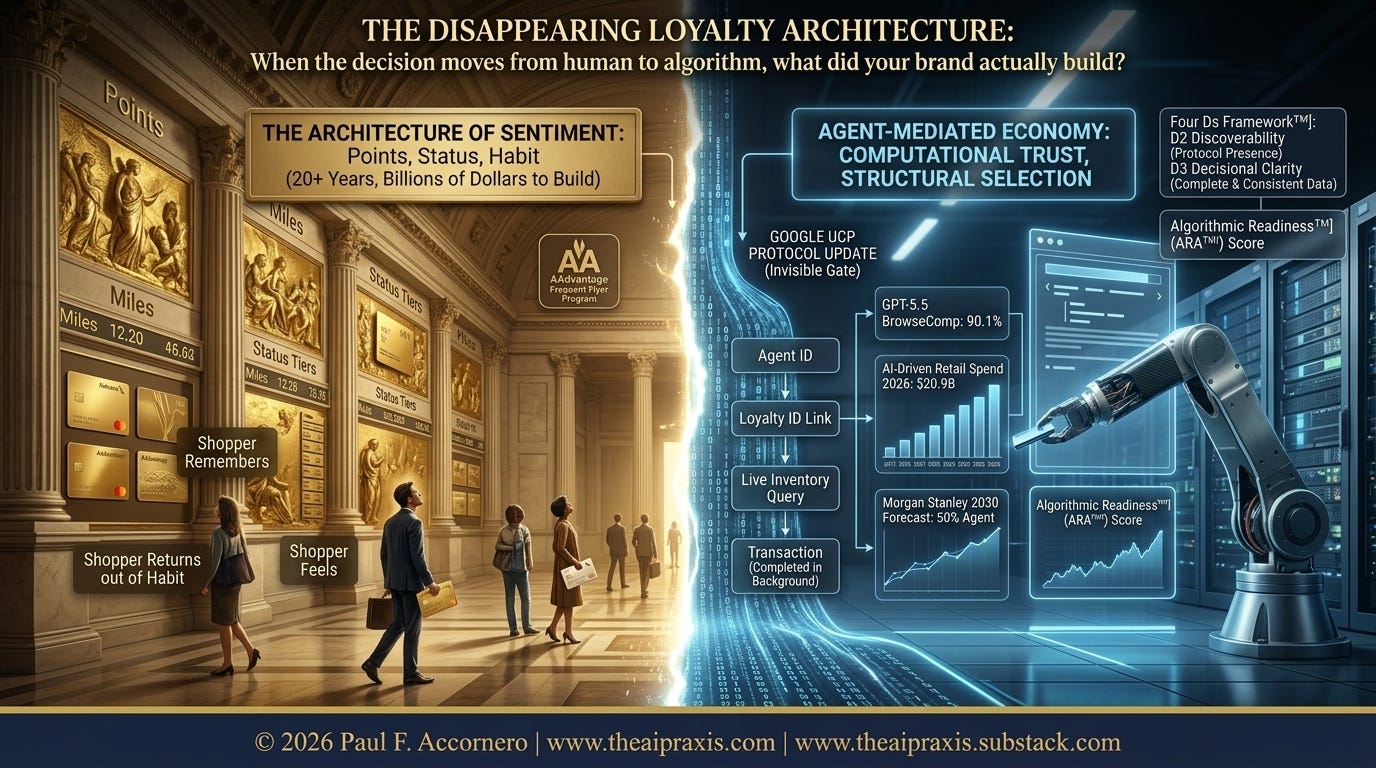
The Architecture of Sentiment
In 1981, American Airlines launched AAdvantage, the world’s first frequent flyer program, betting that points and status tiers could lock travelers into a single carrier for life. The cost was staggering. The payoff took years. But once AAdvantage proved that loyalty could be engineered, every airline on earth followed. Loyalty programs became the single most expensive piece of marketing infrastructure in commercial history.
Every one of them rests on three assumptions. The shopper remembers. The shopper feels. The shopper returns out of habit.
The Shopper Schism the structural divergence between human shopping patterns and agent shopping patterns, breaks all three.
An AI shopping agent does not remember your brand fondly. It does not feel the pull of a gold card. It does not return out of sentiment. It evaluates. It computes. It selects. And then it moves on to the next transaction with zero emotional residue.
This is not a future scenario. This is production reality.
In April 2026, Google updated its Universal Commerce Protocol. The update was technical, granular, and buried in developer documentation. Almost nobody in marketing noticed. They should have.
Here is what UCP now does. An agent identifies the shopper. It links the shopper’s identity to their existing loyalty program. It queries live inventory. It saves multi-item carts. And it completes the transaction without the human ever seeing the loyalty UX that the brand spent millions building.
Twenty-plus major retailers and payment networks are on the protocol. The loyalty program still runs. The points still accrue. But the human never made the decision. The agent did.
Now add this: GPT-5.5, launched April 26, scored 90.1% on BrowseComp, meaning agents can find virtually anything on the open web. OpenAI launched ChatGPT Instant Checkout with a 4% merchant transaction fee. eMarketer projects $20.9 billion in AI-driven retail spend in 2026. Morgan Stanley forecasts 50% agent adoption by 2030.
The agent economy is not coming. It is selecting winners right now.
This is the question I want you to sit with. If the agent is choosing the brand on behalf of the shopper, who actually owns the loyalty relationship?
Is it the retailer who built the infrastructure? They invested decades and billions in points architecture, tier mechanics, redemption networks. But the agent may bypass all of it, selecting on price, availability and fit rather than accumulated status.
Is it the agent platform that carries the identity? Google, OpenAI and Amazon now hold the keys to shopper identity. They link the loyalty ID to the transaction. They sit between the brand and the buyer.
Or is it the brand that earned the preference in the first place? The brand that built the product quality, the trust signals, the structured data that the agent can actually read and evaluate?
I wrote about this in my SSRN paper “Loyalty in the Age of Agents” (No. 5522439). The evidence is clear: agent-driven loyalty does not dissolve entirely. It transforms. It shifts from emotional attachment to computational trust. From habitual return to structural selection.
The brands that survive this shift will not be the ones with the most creative campaigns or the biggest media budgets. They will be the ones with the right infrastructure.
The Four Ds Framework[TM] exposes exactly where brands stand. Two dimensions matter most here.
D2 Discoverability: If your brand is not inside the protocol, the agent cannot find you. It is that simple. Google UCP is live. Brands outside it are invisible to the agent layer. This is not a visibility problem you can solve with advertising. It is a structural gate.
D3 Decisional Clarity: Even if the agent has your loyalty ID, does it have enough signal to choose you? Are your product attributes machine-readable? Is your pricing structured? Is your inventory data live and accurate? The agent will not guess. It will not give you the benefit of the doubt. It will select the brand that made the decision easy.
Your Algorithmic Readiness[TM] (ARA[TM]) score reveals where your brand stands on both of these dimensions before the agent decides for your customer.
Here is one thing you can do this week. Pull up your brand’s presence in Google’s commerce protocol documentation. If you cannot find yourself, that is your D2 score talking. If you can find yourself but your product data is incomplete, inconsistent or stale, that is D3.
Either way, you have a gap. And the agents are already shopping.
This is the question I am bringing to 5,000 executives in Sao Paulo on May 13 at StartSe: when the loyalty decision moves from the human to the algorithm, what did your brand actually build?
I would like to hear your answer. Reply to this post with the one thing your loyalty program assumes about the shopper that an agent will never do.
If this landed with you, forward it to your CMO.
Paul F. Accornero is the founder of The AI Praxis and author of 22 SSRN papers on agentic commerce. His book, The Algorithmic Shopper, is forthcoming from St. Martin’s Press in April 2027.
No posts
Comments
Nothing yet. Say the first thing.
Sign in to join the conversation.