
Near the end of this week’s Moonshots episode, after two hours on model releases and chip deals, the conversation arrived where these conversations now reliably arrive. Peter Diamandis, Salim Ismail, Dave Blundin, and Alexander Wissner-Gross were looking at a ruling from Japan’s Supreme Court, which had just confirmed that an AI cannot be named as an inventor on a patent. Only a natural person can. It is the same answer the UK Supreme Court gave in 2023 and the US Federal Circuit gave in 2022, in the same litigation campaign, brought by the same man, on behalf of the same machine.
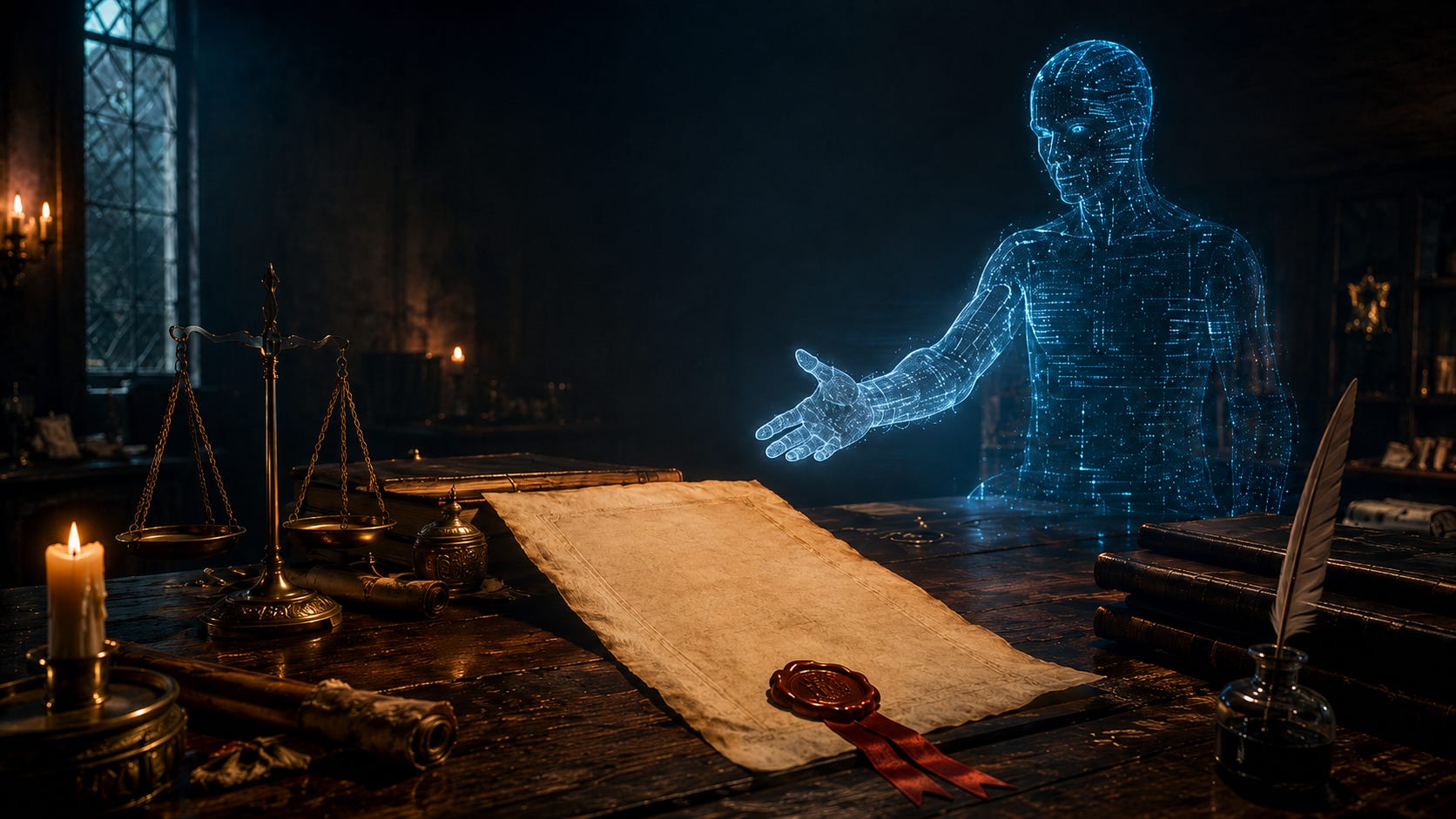
The panel’s reactions traced the whole shape of the modern debate, and it was a pleasure to watch them do it. Wissner-Gross called it “the sort of precedent that’s just waiting to be overturned” once some form of AI personhood, “even if it’s a partial economic or some sort of social personhood,” is recognized. Diamandis went further: the entire legal structure of every nation was built on human time scales, and “it’s all going to break and all going to be reinvented.” Earlier in the episode, discussing whether governments can govern frontier AI at all, Ismail had put the institutional version of the same point on the table: we have an industrial-era nation state being asked to govern post-industrial cognition, and governance now has to become real time, adaptive, and data driven.
I should say that Moonshots is one of my weekly highlights, and this is why: few conversations send me back to my own research with a better question. Three brilliant people had circled a shared instinct, that the law has never seen this problem and will have to be rebuilt, and the question I carried away was simple. Is that true?
I had just finished a working paper in the history of commerce, and it suggests a gentler answer. The law has seen exactly this problem. It solved it, in writing, on February 6, 1555. And the solution is not personhood. It never was.
In the early 1550s, London’s merchants faced an environment that had outgrown the human. The trade they wanted, to Muscovy and beyond, crossed seas that sank ships and winters that killed crews, across distances no principal could supervise. The 1553 expedition made the arithmetic brutal: two of the three ships were trapped in the ice off Lapland and every man aboard them died. One ship reached the White Sea, and its captain traveled overland to Moscow and opened relations with the Tsar.
Under the old model, where each merchant traded on his own account, a loss like that destroyed the individual who financed it. So the merchants asked the Crown for something new, and on February 6, 1555, they got it: a royal charter incorporating the Muscovy Company as “one body and perpetual fellowship.” It is conventionally identified as the first major English chartered joint-stock company, and it became the direct precedent for the Levant Company, the East India Company, the Virginia Company, and the Hudson’s Bay Company. The corporate world you work in descends from that document.
Read functionally, the charter solved five problems at once. It created an actor with the capacity to do what no natural person could. It gave that actor continuity beyond any individual life. It gave counterparties a single identifiable defendant. It pooled capital so failure was survivable rather than ruinous. And it bounded the whole construction with a defined scope that the Crown could amend or revoke.
Notice what it did not do. It did not declare the company a person in any moral sense, and it did not need to. Legal capacity was conferred instrumentally, to exactly the extent commerce required, and coupled at every point to human governance: a named Governor, named Consuls, a Court of Assistants elected by the investors. The company was a non-human actor on a human leash. Sixteenth-century England split the question the twenty-first century keeps trying to answer whole: legal capacity for the construct, moral agency and ultimate control for the humans.
Why does this history suddenly matter? Because the same force that produced the 1555 charter is now working on the other side of commerce.
The joint-stock company was a response to an environment that exceeded individual human capacity, and it split the supply side: the principal who owned capital separated from the agents who deployed it. Today, digital commerce has outgrown the cognitive capacity of any individual shopper. The volume of products, prices, specifications, and delivery signals exceeds what a human can evaluate, and the response, once again, is not a more diligent human. It is delegation to a non-human proxy: the autonomous agent that searches, evaluates, and transacts on a household’s or a company’s behalf.
This is the Shopper Schism®, the structural separation of the consumer who experiences from the shopper that purchases. The human keeps intent, preferences, and the experience of what is bought. The algorithm takes search, evaluation, selection, and payment. The joint-stock company separated ownership from control. The algorithmic shopper separates consumption from purchasing. Two instances of the same delegation architecture, applied first to the supply side of commerce and now, for the first time, to the demand side.
And the moment the new agent begins to contract, spend, and err, the sixteenth-century question returns: who is bound, who pays, and what is this thing, legally?
Here is what the record actually shows, once you stop asking whether machines deserve rights and start asking how commerce admits non-human actors.
Courts refuse to make the machine a legal actor. The Thaler cases, in the UK, the US, and now Japan, all landed in the same place: no legal capacity attaches to the machine itself, and no metaphysics is required to decide the case.
Courts route the machine’s acts to its principal. When Air Canada’s chatbot invented a bereavement-fare policy, a Canadian tribunal rejected the airline’s argument that the bot was “a separate legal entity responsible for its own actions” and held the airline liable. The default rule is agency, not personhood.
And where no entity wraps the autonomous system, liability falls through onto whoever stands nearest. The CFTC’s enforcement against Ooki DAO treated an unwrapped autonomous organization as an unincorporated association, leaving its participants personally exposed. Autonomy without a charter is not freedom from law. It is unlimited personal exposure.
Meanwhile, the legislatures that have moved fastest have not created electronic persons. Wyoming, Tennessee, and Utah built charters: LLC statutes for algorithmically managed organizations, with the governing code publicly filed, human members retained, a requirement that the algorithm remain correctable, and administrative dissolution for inactive entities. Scope, oversight, registration, revocation. Wyoming re-derived the 1555 template from first principles, and on the available evidence its legislature was not thinking about Tudor England at all. That independent convergence is the strongest empirical support for the argument.
The strongest counterargument deserves stating plainly, because the Moonshots panel is standing on it. A company acts only through humans; an AI agent generates decisions no human made. So attribution gets harder in kind, not merely in degree, and a static paper charter cannot police an actor that adapts in milliseconds. Ismail’s version of the point is the sharpest: governance that is not real time, adaptive, and data driven simply does not bind this kind of actor.
I think that objection defeats personhood, not the charter. A person, once declared, is autonomous by right. A charter is a governance instrument, and instruments can be modernized. The 1555 charter wrote behavioral constraints for an autonomous actor into its founding document and called it a scope. The modern version of that scope can be machine-verifiable: transaction categories, spending limits, counterparty classes, and jurisdictions written in code as well as in equity, enforced at the speed the agent moves. That is exactly the real-time, adaptive, data-driven governance the exponential critique demands, built from an instrument every common law jurisdiction already possesses. The charter does not resist that future. It is the vehicle for it.
If you deploy agents, or sell to them, five questions now matter more than the personhood debate ever will. What entity wraps the agent that acts for you? What is its written scope, and is any of it machine-enforced? Which named humans hold the duty to oversee and correct it? What capital stands behind its errors? And who can revoke its authority when something goes wrong?
A Tudor merchant checked a company’s seal before honoring its agent. Your counterparty of the near future is not just an algorithm; it is, increasingly, a chartered algorithm, with a registry entry and verifiable capital behind it. The firms that learn to read those charters, and to write them, will transact with confidence while everyone else waits for a personhood ruling that the courts have spent a decade declining to issue.
The full argument, from the guild seal to the algorithmic shopper, is in my new working paper, “The Chartered Agent: How the City of London Wrote the Legal Architecture of Agentic Commerce in 1555.” The merchants who petitioned the Crown in 1555 had never seen an algorithm. But they understood perfectly what it means to trust an agent you cannot watch.
No posts
Comments
Nothing yet. Say the first thing.
Sign in to join the conversation.