
Over the last few issues, we’ve talked a lot about giving AI clear boundaries.
Start small. Keep the task scoped. Make the output reviewable. Don’t let an agent near production just because the demo worked once.
This week, let’s make that more specific.
Before you turn a script, playbook, or check into an MCP skill, ask one question:
Should an agent be allowed to call this?
That sounds obvious, but it is where a lot of messy workflows begin.
A script can be useful and still be a bad MCP skill.
A playbook can be reliable and still need a human to decide when it runs.
A troubleshooting step can be routine and still carry too much risk if the agent gets the context wrong.
So here’s a quick test.
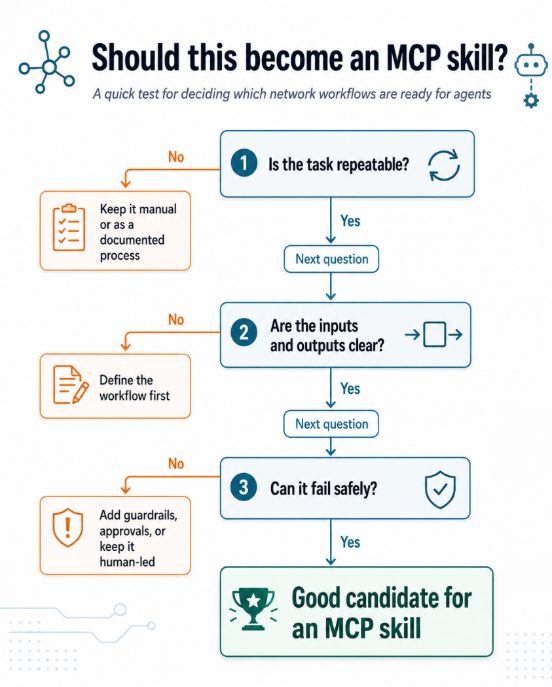
1. Is the task repeatable?
Good MCP skills usually start with work your team already does often: interface checks, config comparisons, log summaries, pre-change validation, post-maintenance checks.
If the task happens once a quarter and needs senior judgment every time, it probably should not be your first skill.
2. Are the inputs and outputs clear?
“Check interface health for these devices and summarize errors from the last 24 hours” is clear.
“Find out why the network is slow” is not.
The agent needs a defined job, not a vague investigation.
3. Can it fail safely?
What happens if the device does not respond?
What happens if the data is incomplete?
What happens if the tool call fails?
A good MCP skill does not only define the happy path. It defines when the agent should stop.
That is the difference between exposing a tool and engineering a workflow.
And that is exactly what Engineering Agentic Network Operations is about.
June 30th | 9 AM EDT | FLASH SALE - Use SAVE40 for 40% Off

The prior networking event we had, Build Intelligent Networks with AI brought together 150+ attendees from 30+ countries and became AutoCon4’s highest-rated workshop.
Now we’re taking this to the next step, building agentic networking operations at scale.
The focus is not just building an MCP server. It is building MCP skills that are reusable, composable, and practical enough to make sense in real network environments.
In this workshop, William Collins and John Capobianco of Itential will walk through how to build MCP skills that can be reused across your environment instead of becoming one-off scripts only one person can debug.
They’ll also cover spec-driven development, so agents have defined behavior before they start acting, and agentic loops that recover when they get stuck instead of failing silently.
The live lab includes OpenClaw, NetClaw, Selector AI, Containerlab, FastMCP, Python, Claude, and Arista cEOS.
If you’ve been following this newsletter and thinking, “Okay, I understand the theory, but what does this look like in a lab?” this is the session to attend.
Use code SAVE40 for 40% off while the flash sale is live upto 48 hours.
The useful question is no longer whether an agent can call a tool.
It can.
The better question is whether the workflow has enough structure to be trusted.
That is what this workshop is built around: smaller skills, clearer behavior, reusable workflows, and network automation that engineers can actually reason about.
Hope to see you there.
Thanks,
Sayali
Editor-in-Chief
P.S. If this framework was useful, share this issue with someone on your network or automation team. And if you’re working on MCP, agents, or AI-led network workflows, reply and tell us what you’re trying to build next.
Additionally, a word from a sponsor if relevant to you
Make Claude Your 2nd Brain That works 24/7 By Mastering In It 16 hours- Here’s How
No posts
Comments
Nothing yet. Say the first thing.
Sign in to join the conversation.