
Hi, before we continue, a quick word from our sponsor.
Social engineering is about manipulating people’s emotions. Identify the susceptibilities that hackers use to exploit people.
This NINJIO Insights Report dives into the key emotional susceptibilities that make social engineering work and offers concrete steps that your security team can take to equip your workforce to resist cyberattacks.
Now, back to infrastructure and AI.
This week, we have two hands-on sessions for teams trying to move AI from side experiments into real platform and DevOps workflows.
The common thread: AI is only useful when the system around it is strong enough to keep it grounded, reviewable, and reusable.
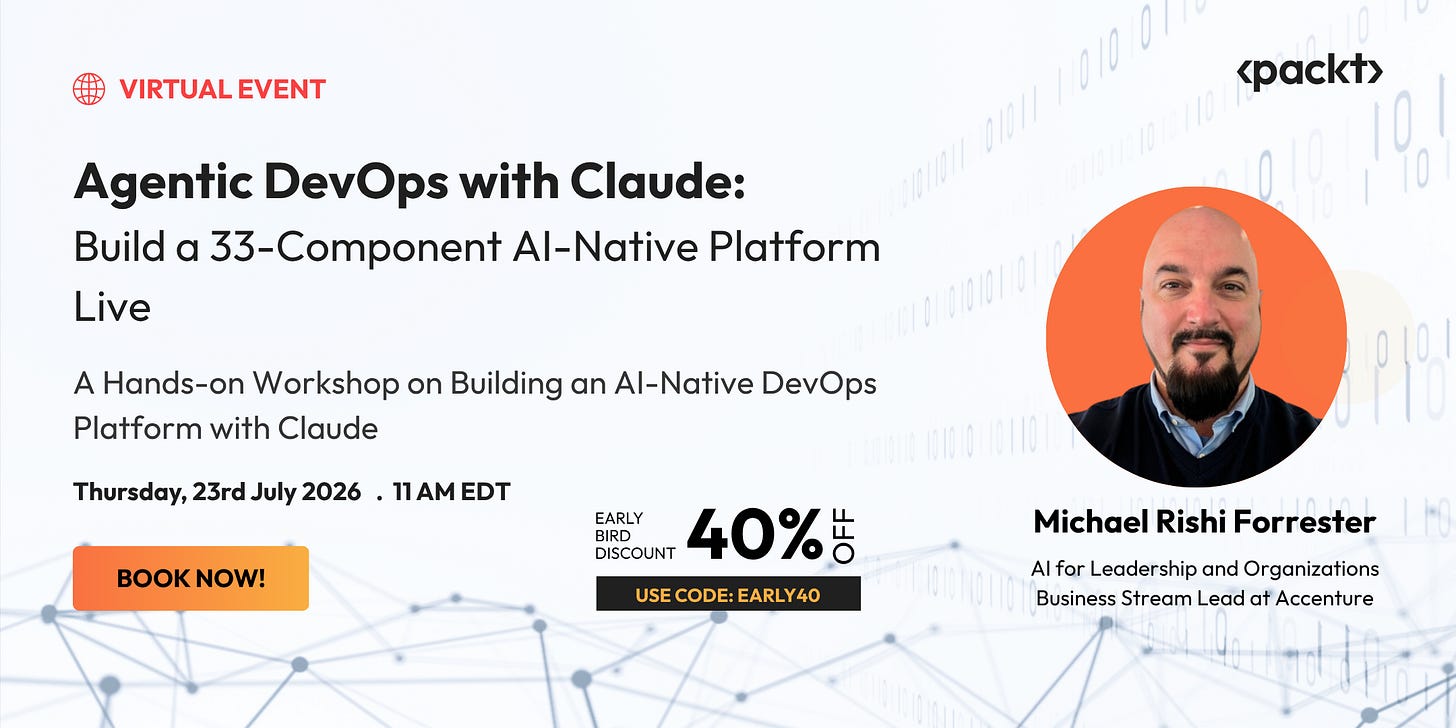
Agentic DevOps with Claude | July 23rd
Early Bird Live Now - 40% Off | Last 48 hours before it’s sold out
Claude Code is not just generating snippets here. It is helping build the platform.
In this 4-hour live workshop, you’ll see a 33-component AI-native internal developer platform built on a real Kubernetes cluster, with ArgoCD, Backstage, kgateway, and an observability stack included.
The cluster is provisioned for you. You leave with the repo and a working reference architecture your team can study, adapt, and build on.
Michael Rishi Forrester from Accenture, previously at KodeKloud, is running this one.
Limited seats available.
📅 Thursday, July 23 | 11:00 AM EDT
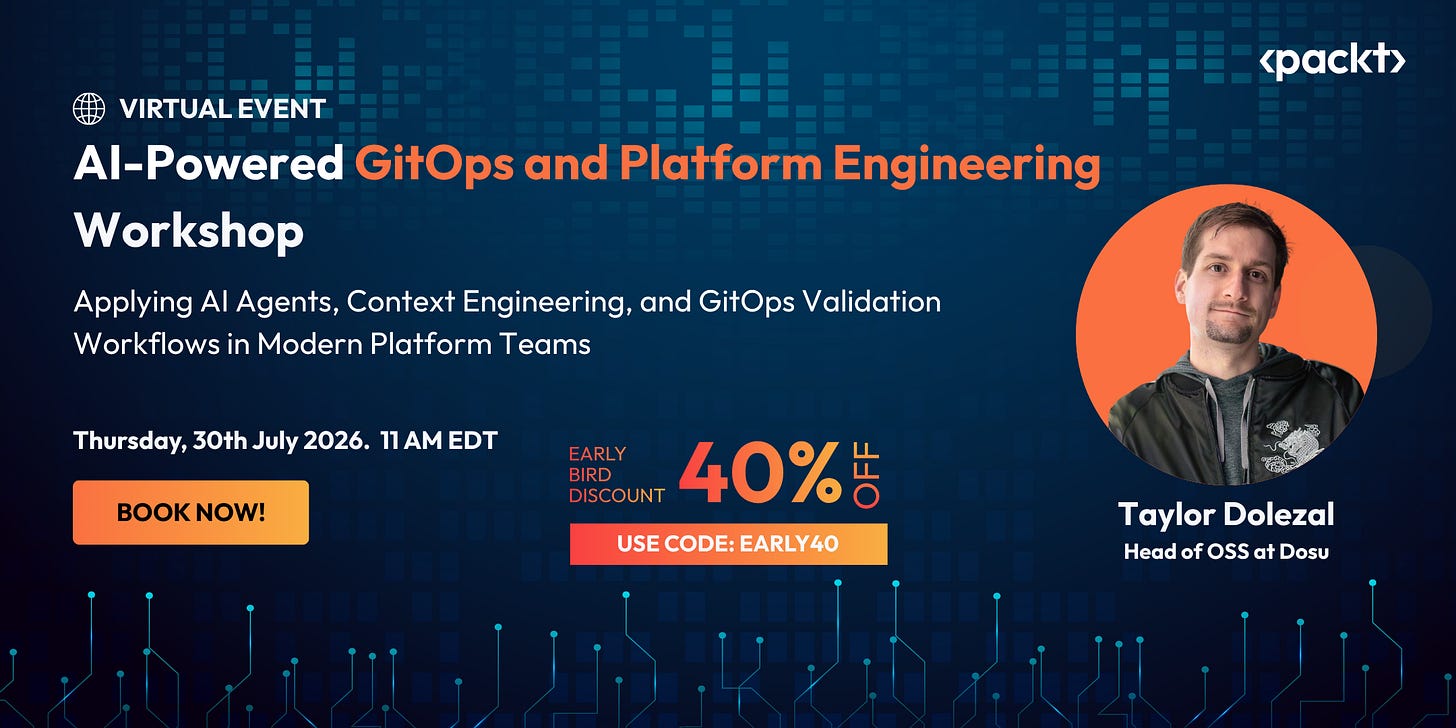
AI-Powered GitOps and Platform Engineering Workshop | July 30th
Early Bird Live Now - 40% Off | Last 4 days before it’s gone
Your AI agent does not know your manifests are stale.
That is the problem.
In this 3-hour hands-on workshop, you’ll work through real ArgoCD and Flux workflows, see live demos comparing fresh versus stale context, and learn how to turn repeated agent tasks into tooling your team actually keeps.
The session covers drift detection, change review, validation, and the parts of platform engineering AI tools usually get wrong because nobody gave them current operational context.
Taylor Dolezal from Dosu, an AI-native knowledge infrastructure company for agents and humans, is running this one, drawing on patterns from 100,000+ repos.
Limited seats available.
📅 Thursday, July 30 | 11:00 AM EDT
Both sessions point to the same issue from different angles.
AI is not hard to demo. It is hard to operationalize.
The moment agents get involved in real DevOps, GitOps, or platform workflows, three questions start to matter more than the prompt itself: does the agent have fresh context, is validation built in, and can the repeated task become reusable team-owned tooling?
So here’s a quick test before you give an agent more responsibility.
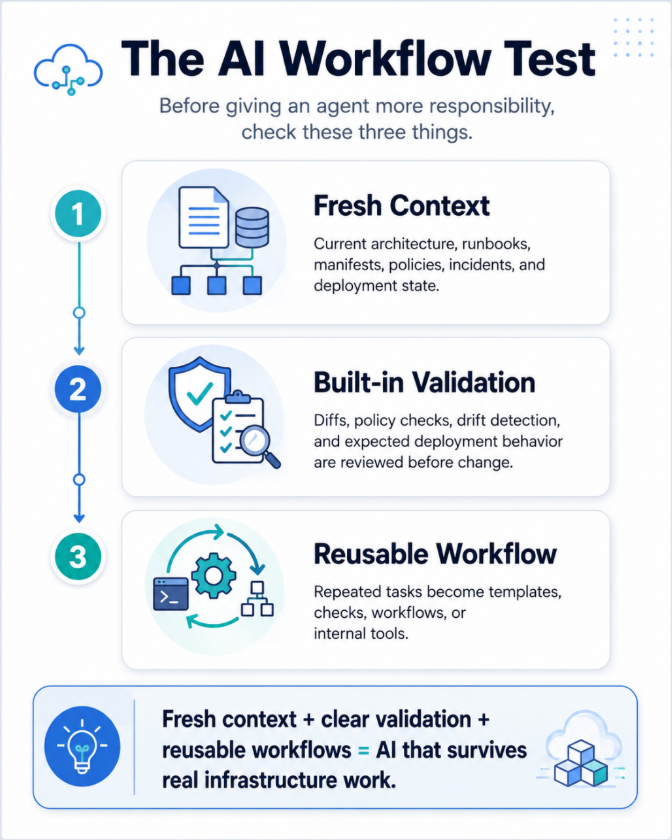
Start with these three questions.
1. Is the context fresh?
Most AI failures in operations do not start with a bad model, they start with stale context.
The agent answers based on yesterday’s architecture, last month’s runbook, or a ticket pattern that no longer applies.
For platform teams, context freshness matters because the environment changes constantly: manifests, service owners, policies, dependencies, deployment history, incidents, and rollback procedures.
If the agent cannot retrieve current context, it should not be trusted with current decisions.
2. Is validation built into the workflow?
AI output should not move straight from suggestion to execution, there should be a validation step.
In GitOps environments, that might mean checking manifests, reviewing diffs, validating against policy, detecting drift, or confirming that a proposed change matches the expected deployment state.
The workflow should make review easier, not optional.
The useful question is not “did the agent produce something?”
It is “can the team verify it quickly and confidently?”
3. Can the repeated task become team-owned tooling?
If an engineer keeps asking an agent the same thing every week, that is a signal.
Maybe the task should become a reusable workflow, template, validation check, or internal tool.
The goal is not to collect clever prompts.
The goal is to turn useful AI-assisted work into something the team can maintain, improve, and trust.
That is where AI starts becoming part of platform engineering instead of sitting beside it as an experiment.
The pattern is simple:
Fresh context
Clear validation
Reusable workflows
That is the difference between AI that demos well and AI that survives contact with real infrastructure work.
If your team is working through these questions right now, the two sessions above are worth a look. One shows what it looks like to build an AI-native platform live. The other goes deeper into GitOps, context engineering, validation, and reusable agent workflows.
Book your seat while Early Bird pricing is still live.
Thanks,
Sayali
Editor-in-Chief
P.S. If someone on your team is experimenting with Claude Code, GitOps, platform engineering, or AI-assisted infrastructure workflows, share this issue with them. And if you’re already testing agents in production-adjacent work, reply and tell us where they are helping, or where they are still getting stuck.
No posts
Comments
Nothing yet. Say the first thing.
Sign in to join the conversation.