

Hi, I’m Raffaela, and welcome to AI Leadership Edge, a newsletter for investors and business leaders who want to gain leverage with AI.
Join a community of 41,000 board directors and leaders, with 13,500+ newsletter subscribers. Subscribe free and get the AI Boardroom Edge Course.

This edition is powered by BoardLens, the AI edge for boards and portfolios. Your board materials, read against thousands of outside signals through your lens, never trained on and auditable to source. Independent directors use it on one board, GPs across the whole portfolio.
Start free at boardlens.ai, there is a demo company inside so you can try it without uploading anything of your own.

On 9 July, Volkswagen’s Supervisory Board met to consider one of the largest restructuring plans in the company’s history. CEO Oliver Blume put forward factory closures, up to 85,000 job cuts, and a broad overhaul of the Group.
The employee representatives and the State of Lower Saxony, who together hold a majority on that board, voted against key elements of it. What followed was an unusually public power struggle with the shareholder side, and it is still running.
Süddeutsche Zeitung called it “the ungovernable corporation”, because four separate power centres have to align before any major strategic decision can move: the Porsche-Piëch family, the works council, the State of Lower Saxony, and Qatar.
None of those four is irrational, and each has a legitimate claim. The family holds the founding stake. The works council represents an enormous workforce with statutory rights. Lower Saxony is a shareholder with a political mandate. Qatar is a long-term investor. We can only hope they can get to grip with the power struggles and focus on the urgent turnaround.
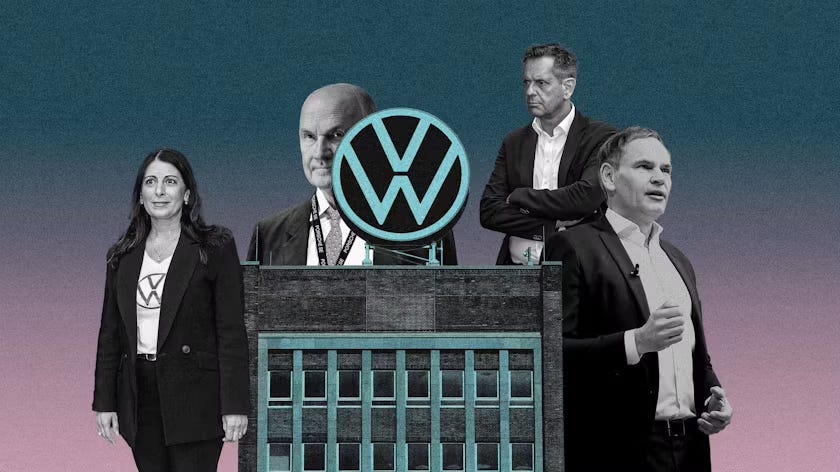
Read the analysis → Süddeutsche Zeitung on Volkswagen, the ungovernable corporation
Moonshot, a Beijing lab, released Kimi K3 this week, and on its own benchmarks it outperforms every available model except two: Anthropic’s Claude Fable 5 and OpenAI’s GPT-5.6 Sol, both released in the last two months.
And it does so at a fraction of the price. Moonshot will charge $15 per million output tokens, against $30 for GPT-5.6 Sol and $50 for Claude Fable 5. It also claims 2.8 trillion parameters, against an estimated 1.5 trillion for Claude Opus 4.8.
Kimi is reportedly stronger on coding and agentic work than recent GPT and Claude releases while costing a third as much. Coding capability is a major revenue driver for both American labs, and both are eyeing IPOs. Markets noticed: the announcement moved Taiwan, Japan, and the Nasdaq, which recorded its biggest dip of the week.
Xi Jinping used the moment to applaud China’s progress on low-cost AI and to call for “a symphony of global cooperation”, while criticising US efforts to restrict China’s access to AI technology.
Read the story → China’s Powerful New Moonshot AI Model Closes Gap With US Rivals
The Data Driven VC Landscape 2026 is out, stating the core question has flipped. Firms used to ask whether to build an internal tech stack. Now they ask where to point it to generate alpha.
61% build for effectiveness, 39% for efficiency. Most are building to find opportunities others cannot see rather than to do the same work faster.
Two archetypes, both working. Workflow Builders run lean with no engineering team, stitching together off-the-shelf tools and automations. Fullstack Builders hire in-house engineers and build infrastructure around proprietary data. There is no verdict yet on which wins.
The staffing ratio is remarkably stable. Roughly one engineer for every five investors, and it holds across every AUM tier. Smaller funds show the efficiency gains most clearly: compared with 2025, lower-AUM firms run 25% smaller investment teams, while larger-AUM firms run 20% larger ones.
And the spending mix moved fast. The ratio between engineering salaries and data, tools and tokens went from 2:1 to 1:1 in a single year. Funds now spend as much on tokens and data as on the engineers. Budgets by AUM: under $100m spends $85k, $100 to 500m spends $185k, $500m to $1bn spends $470k, and $1bn plus spends $588k.
For fund directors and LPs: at the next LPAC, ask which archetype your manager is, and whether the tech spend is producing sourcing advantage or only saving analyst hours. One is a differentiator you are paying for. The other is an operating cost that should show up in the management fee conversation.
Read the full report → The Data Driven VC Landscape 2026
On Monday Beijing released 《北京市关于加快智能体引领发展的若干措施》 — a set of measures to accelerate “agent-led” development. There’s no budget attached yet and the rumours around it are running well ahead of the text, but the level of detail is startling, and it tells you exactly where China thinks the value in this cycle sits: not in the foundation model, but in everything wrapped around it.
A few of the measures are worth reading twice:
A dedicated policy line for “Harness Engineering” (驾驭层工程) — context management, task persistence, multi-agent orchestration — plus a state-built marketplace for agent skills. The orchestration layer, not the model, gets its own industrial policy.
The One-Person Company (OPC) formalised as a legal corporate form — a solo founder plus a fleet of agents, one-click incorporation, articles of association auto-generated. A structural bet on what a “company” even is.
Billing shifting from token consumption to outcomes — TaaS, AaaS, and explicitly RaaS, Results as a Service. The national statistics bureau is involved, so token consumption becomes an official economic indicator.
Agents embedded in phones, glasses, wearables, robots and cars — paired the same day with a consumer subsidy: 15% off across 10 product categories, capped at 1,500 RMB, robots included.
Protocols, agent frameworks and device operating systems pushed open-source, distributed via the China-SCO centre, with compute and new token vouchers on the demand side.
Boardroom takeaway: This is a statement of where a state sees the value being created in the future: the harness, the orchestration, the outcome-based business model, the hardware it’s embedded in. For investors, read the subsidy map as the signal: China is putting demand-side money behind the application and agent layer, not the model.
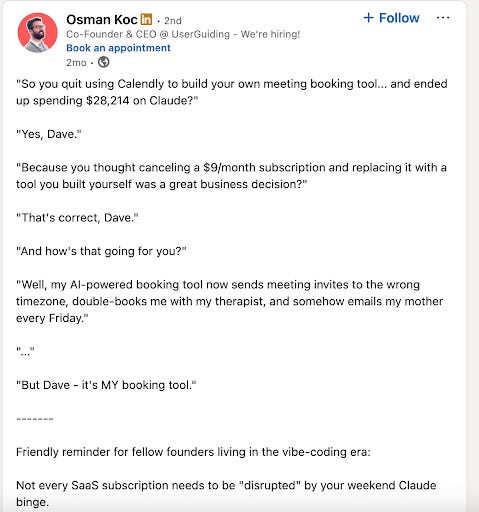
Osman Koc on what the vibe-coding era is costing founders: a $9 a month Calendly subscription, replaced by a bespoke booking tool that took $28,214 of Claude usage and now emails his mother every Friday.
Credit: Osman Koc. See the full post here

Sam Altman@sama
we did not have our best last 12 months ever, which is mostly my fault, but we are about to have our best 12 months to date. the team is doing amazing work and i think you’ll be very happy with what they’ve got cooking for you. i am happy about this for many reasons, but mostly
6:06 PM · Jul 16, 2026 · 2.51M Views
2.27K Replies · 892 Reposts · 24.6K Likes
Sam Altman: “we did not have our best last 12 months ever, which is mostly my fault, but we are about to have our best 12 months to date.”
Credit: @sama on X.
Subscribe for the weekly read on where governance and AI actually meet. Paid subscribers get The Executive AI Index, the Top 10 Prompting Hacks, and The AI Leadership and Boardroom Toolkit, plus two full editions every week.
Many subscribers expense it as professional development.
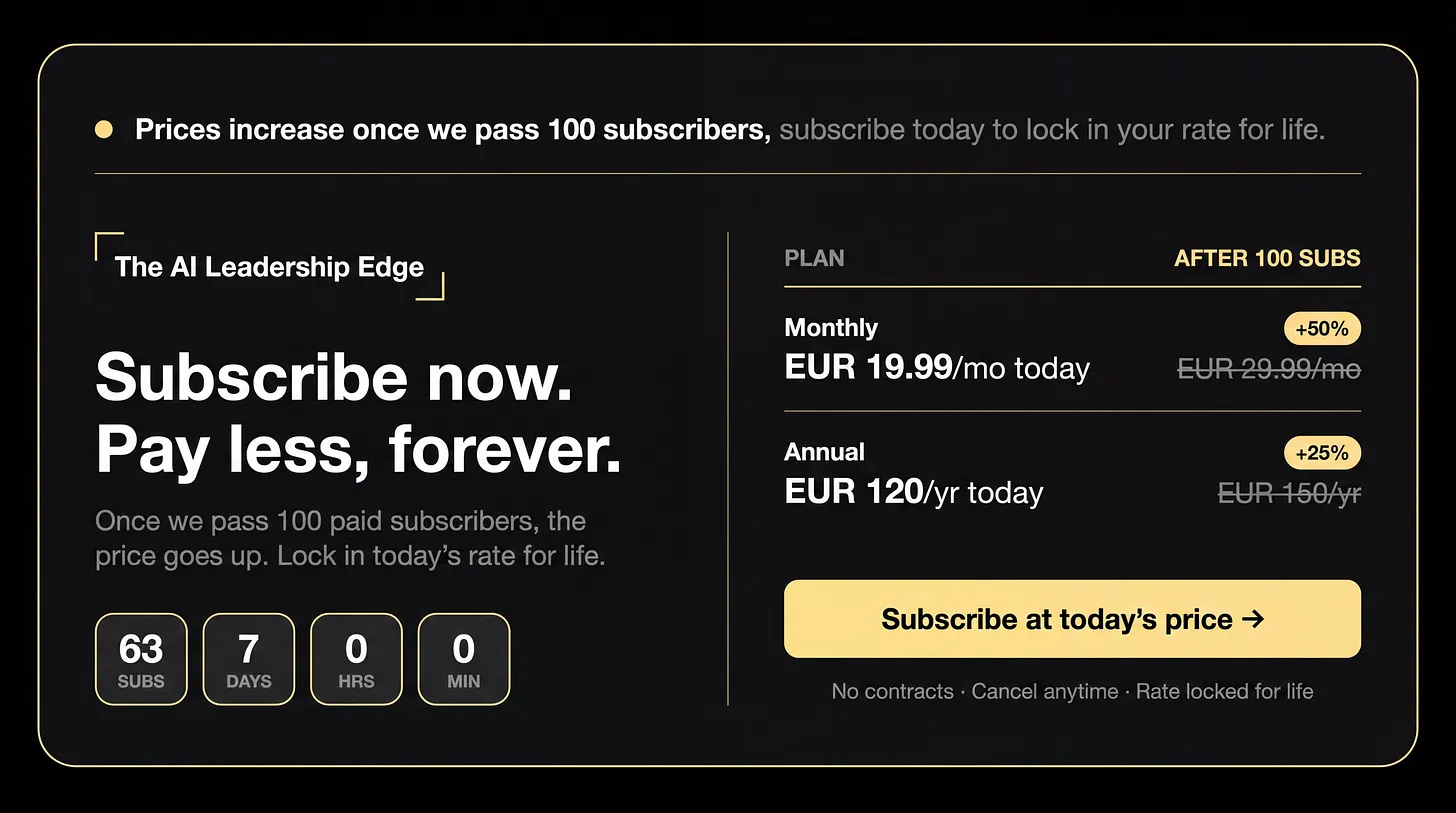
As a paid subscriber you get every playbook in this series. The 5 most worth reading alongside this one:
1️⃣ The Board Director’s AI Prompt Library Read here ->
2️⃣ The Top 10 AI Boards Worth Watching Read here ->
3️⃣ The Post-Raise Guide Read here ->
4️⃣ The Post-Investment Playbook Read here ->
5️⃣ What the best PE boards do that the rest don’t Read here ->
🗣 Or invite a friend: refer 1 friend and you get The AI Leadership Prompt Library.
A community of 41,000 board directors and leaders. 13,500+ newsletter subscribers are already inside.
Warmly,
Raffaela
No posts
Comments
Nothing yet. Say the first thing.
Sign in to join the conversation.