
Hi, I’m Raffaela, and welcome to AI Leadership Edge, a newsletter for investors and business leaders who want to gain leverage with AI.
Join a community of 41,000 board directors and leaders, with 13,500+ newsletter subscribers. Subscribe free and get the free AI Boardroom Edge Course - A six day executive course to lead AI from the boardroom and turn it into value across your boards and portfolio.

This newsletter is brought to you by BoardLens, the AI Edge for Boards and Fund Partners. One living intelligence layer that reads your board materials and thousands of outside signals, all through your lens: your expertise or thesis. You drive outcomes across every board and portfolio, in a fraction of the time, with far less risk of missing what matters. Try it for free at www.boardlens.ai
You would never hand a new analyst a task in one sentence and walk away. Most leaders do exactly that to AI a hundred times a week, then blame the model for the generic answer.
Here is what actually happens. You hand the model an empty brief, it fills every gap with a guess, and guesses average out. That is why so much AI output across our industry sounds identical. Not the same tool. The same missing context.
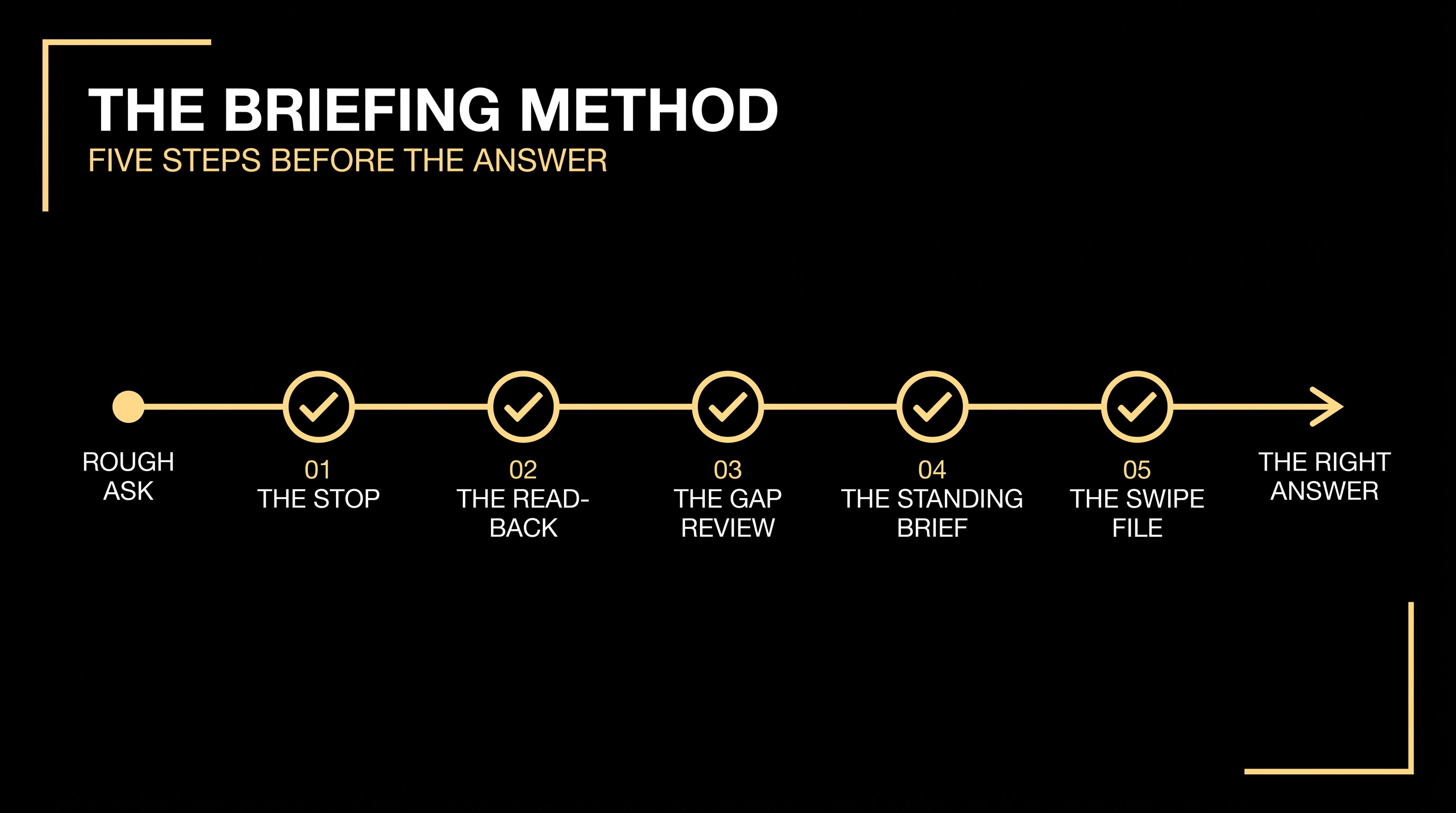
So I wrote down the method I run on my own work before anything real leaves my desk. I call it the Briefing Method. Step 1 is free below. Steps 2 through 5, including the three ready-made briefs for board packs, IC memos and portfolio reviews, are for paid subscribers.
A prompt is an instruction. A brief is a transfer of judgment. The prompt tells the model what to do. The brief tells it what the work is for, who will read it, what it must not say, and what a strong version looks like. Every one of those is a decision only you can make, and every one you skip, the model makes for you, by guessing.
This is why prompt collections plateau. They polish the instruction and leave the judgment empty. You do not have a prompting problem. You have a briefing problem, and it has a fix that costs thirty seconds per task.
One boundary before we start. Mechanical tasks do not need a brief. Translate this, reformat that, fix the typo: just ask. The method below is for work with judgment and consequences in it, the memo, the analysis, the recommendation, the decision.I covered the prompt half in the Top 10 Prompting Hacks. This guide is the half that comes before it.
One rule before the first step. A confidential IC memo, an LP letter, a board pack, an unannounced number, does not go into a public chatbot. Everything here runs in a private workspace where your material never leaves your control and is never used to train a model.
That rule is set once and never bent, no matter how good the model gets. With it in place, everything below is safe to run on real work.
This runs in your private workspace, never a public chatbot.
The first sign of a good analyst is the question they ask before starting. Hold the model to the same bar. On real work, its first job is to show you what it does not know, not to produce an answer.
So the first move of the method is simple. You give the rough task, and you forbid the answer:
Do not answer yet. First, brief me back:
1. The decision or outcome this work is for, as you understand it.
2. The context you are missing that would change the output.
3. The fewest questions that would close those gaps, five at most,
and only questions whose answers change the result.
Start the work only after I confirm the brief.
Then answer its questions. Two minutes of back and forth, and you have handed over the judgment the output was always going to need.
That single pause converts the model from a fast typist into a careful analyst. Everything downstream inherits the quality of this step.
For leaders: if the first response is always an answer, your outputs are running on guesses. The fix is not a longer prompt. It is a shorter question list.
🔒 Below the paywall, the four steps that turn a rough ask into work you can stand behind:
→ Step 2, The read-back: the thirty-second check that catches a wrong brief before it becomes a wrong response
→ Step 3, The gap review: the five questions that turn a first answer into one you can use
→ Step 4, The standing brief: write your context once, stop re-explaining yourself every session
→ Step 5, The swipe file: three fill-in briefs, the board pack read, the IC memo pressure-test, the portfolio review
→ Plus the boundary: the tasks where briefing is a waste of time, and the one question that tells you
Paid subscribers also get The Executive AI Index, the Top 10 Prompting Hacks, and The AI Leadership and Boardroom Toolkit, plus two full editions like this every week.
Most subscribers expense this as professional development.

As a paid subscriber you get every playbook in this series. The five most worth reading alongside this one:
1️⃣ Build your Own Chief of Staff with AI. Save $160,000 and 10 hours a week. Read here ->
2️⃣ The Top 10 Prompting Hacks for Leaders, Investors & Boards. Read here ->
3️⃣ The art of delegation in times of AI. Read here ->
4️⃣ The New Metric for AI Productivity. Read here ->
5️⃣ 15 AI Playbooks that Drive Results for Leaders, Boards and GPs. Read here ->
🗣 Or invite a friend and earn rewards along the way:
→ 1 friend = The AI Leadership Prompt Library
A community of 41,000 board directors and leaders. 13,500+ newsletter subscribers are already inside.
Comments
Nothing yet. Say the first thing.
Sign in to join the conversation.