
Most AI-generated work fails before a single frame is generated.
Not because the prompt was weak. Because nobody decided what story was being told.
We’ve spent three years obsessed with the last six inches of the process — the prompt box, the syntax, the magic words. Meanwhile the decisions that actually determine whether work lands happen upstream, before anyone opens a tool. And those decisions haven’t changed in a hundred years of commercial storytelling. They’re just easier to skip now, because the machine will happily produce something regardless.
That’s the trap. AI will never tell you that you started in the wrong place. It will only make you faster at going there.
What kind of story is this?
What moments does it need, and in what order?
How do I frame each one?
How do I get the model to produce what I actually see in my head?
Miss the first and the other three won’t save you. You’ll generate twelve gorgeous images that add up to nothing, and you won’t be able to name why.
I’ve built a system for each of those four decisions — not theory, but the ones I actually run on client work when a deadline is real and a budget is attached. They’re now live as the Lab Manuals, included with every paid subscription..
Here’s what each one is, and why it exists.
They're now live as the Lab Manuals — four downloads, available to paid members.
The decision:

Seven narrative structures — Problem–Solution, Before–After–Bridge, Hero’s Journey, Origin Story, Testimonial, Brand Manifesto, Epic Quest. Each with its skeleton, the business goal it serves, and a classic example that earned its reputation: Dollar Shave Club, Nike, Apple, Ben & Jerry’s, Patagonia.
Why it’s here: Because “something emotional” is not a brief, and neither is “make it feel premium.” When a client hands you a vague objective, the professional move is to translate it into a structure you can defend in the room. The quick-reference table does exactly that — objective in, narrative shape out. It’s the difference between having a point of view and having a mood board.
The decision:
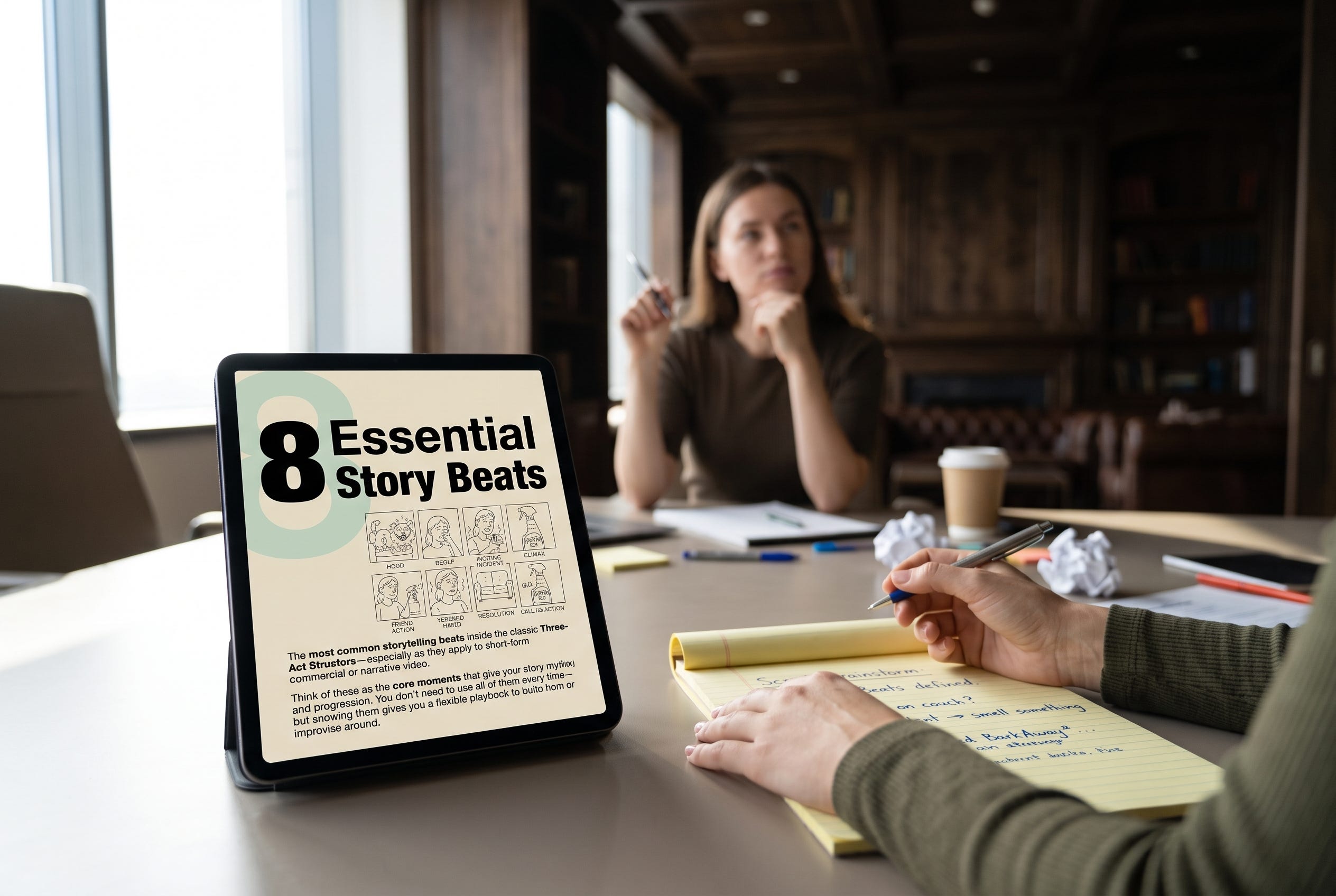
Hook, Setup, Inciting Incident, Rising Action, Midpoint, Climax, Resolution, Call-to-Action. For each: when it lands, the job it does, and lines you can steal the shape of. One continuous example runs the whole arc, so you watch the beats connect rather than meeting eight disconnected fragments.
Why it’s here: A narrative structure without beats is a diagram. This is where it becomes a sequence. It also includes the compression rule most people get wrong — a thirty-second spot only hits four or five beats, but the arc underneath never changes. Problem, struggle, breakthrough, result, action. Cut a beat, not the arc.
The decision:

15 shots across 4 phases — Context & Setup, Character & Connection, Action & Progression, Detail & Emphasis. Each with a visual example and the specific job it does in a scene. Then 8 pairings that work, 5 that break, and 4 principles governing the rhythm underneath.
Why it’s here: This one matters more in AI work than it ever did on set. When you shoot, you get coverage — options, safety, room to fix it in the edit. When you generate, every cut has to be decided before it exists. There is no coverage. Which means the sequence has to be right in your head first. That’s why the section on pairings that break is the most useful part of the document: establishing straight to extreme close-up, reaction into establishing. Sequences that fail for structural reasons, not aesthetic ones.
The decision:

16 variables organized into 4 phases — Narrative, Aesthetic, Cinematic, Technical — plus the Clarity Rule and two worked examples. Built as a desk reference. Print it, hang it, refer to it before you generate.
Why it’s here: Because piling on adjectives and hoping is not a method. When an output comes back wrong, most people rewrite the entire prompt and start over. That’s not iteration — it’s rolling the dice again. Isolate the variable, change one thing, and you’re directing instead of gambling. Same discipline you’d apply on a set where the clock is running.
Already a paid member?
All four are live. Open → the Lab Manuals
Reading free?
You’re not missing the thinking — you get all of it, permanently. The Lab Manuals are the working version: the systems, the sequences, the reference you print and hang. That’s what a paid subscription buys. Upgrade →
Narrative → Beats → Shots → Generation. That’s the whole pipeline, and each layer constrains the one below it.
Skip the top and you’re making beautiful frames in service of nothing. Skip the bottom and you have a great idea you can’t execute. The reason this publication keeps returning to human judgment isn’t sentiment — it’s that every one of those four decisions is a decision. The model doesn’t make them. It just carries them out, faithfully, whether they were good or not.
I don’t paywall the belief. I paywall the implementation.
Every argument I make about why judgment, taste, and authorship still matter stays free. Permanently. Those ideas are supposed to travel — to LinkedIn, into your team’s Slack, into a conversation you have with a client next week. Locking them would defeat the point of writing them.
The Lab Manuals are the other half. The systems, the sequences, the reference you print and hang.
If you’re a paid member: they’re live now. Go get them → [The Lab Manuals]
If you’re reading free: you’re not missing the thinking. You’re getting all of it. What’s behind the wall is the working version — and that is what your subscription buys.
More coming. The next one I will be adding soon, is a worksheet rather than a reference: a one-page canvas for running a project through Human → AI → Human, with the decision rights written down before the tool opens.
— Brian Sykes
Let me know if you want more of these kinds of resources.
Vote with your LIKE, COMMENT, or SHARE.
Comments
Nothing yet. Say the first thing.
Sign in to join the conversation.