
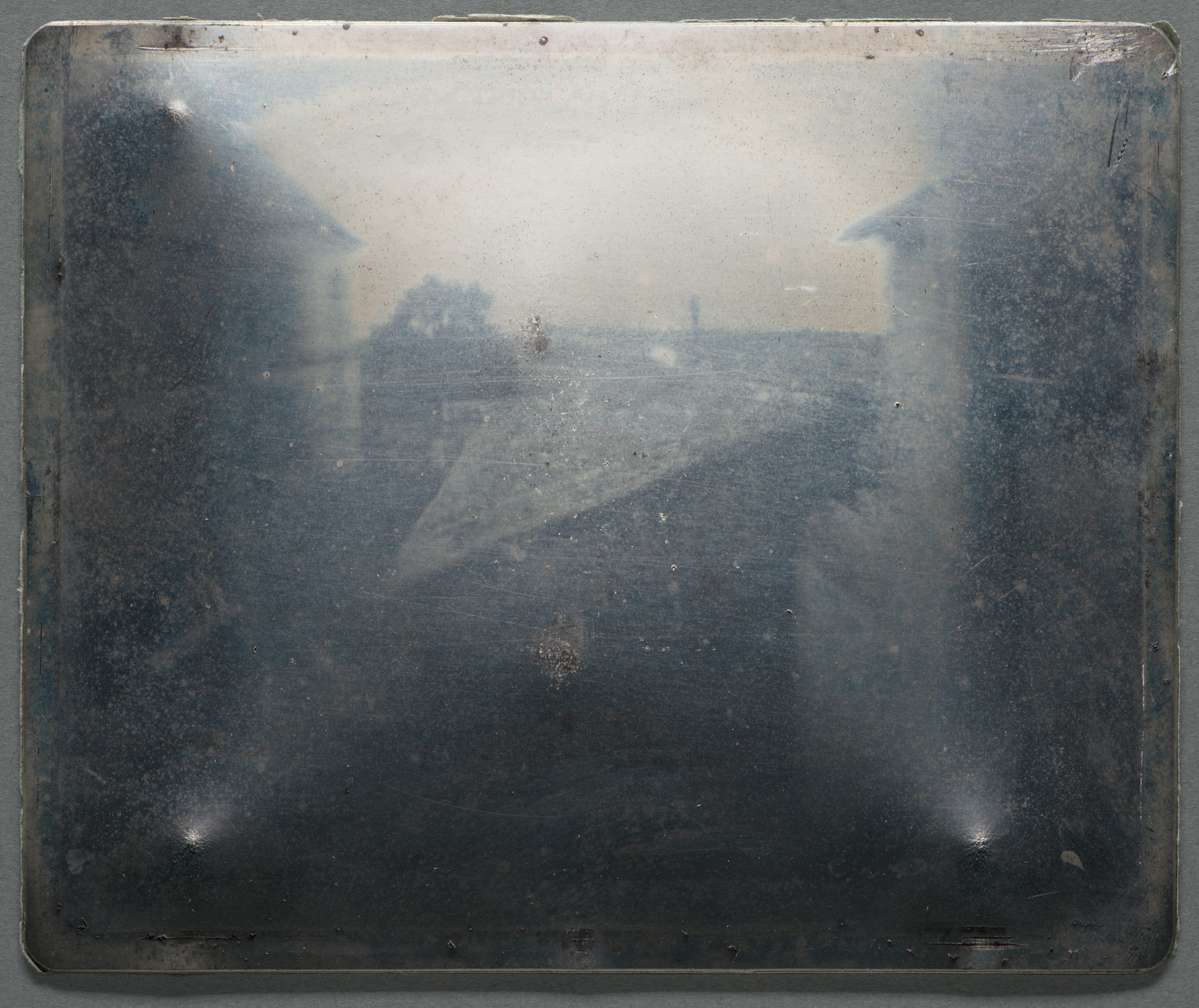
Look closely at the image above - View from the Window at Le Gras and you’ll notice something impossible. The sunlight falls on the buildings from the left. It also falls on them from the right.
Both, at once, in the same frame.
That isn’t damage or a flaw in the plate. Joseph Nicéphore Niépce’s exposure ran so long that the sun had crossed the entire sky while the picture was being made. What you’re looking at isn’t just a moment frozen in time. It’s a summer day, averaged.
It explains why there are no wildflowers in the first fifteen years of photography. A breeze would be enough to erase a subject completely. The medium didn’t begin with what photographers wanted to shoot — it began with the short list of things that would hold still long enough to be shot at all. Rooftops. Plaster casts. Table settings. Dead game birds. Basically the still life studies that were being captured as paintings.
Every technique that follows in this series is, in one way or another, an argument with that limitation.
I might be the world’s worst for this very thing. My wife jokingly asks (as I set out to make homemade pasta) - “Why not just buy some pasta from the store?” Genuinely a reasonable question - and totally how she would solve the problem that technically isn’t a problem. A solution has been found that works, is affordable, and is readily available in many varieties.
So why do I (being one of those sorts of people) decide to keep inventing new ways to address this non-issue? The best way to answer that, might be this… it is not for lack of a solution I do it. For me, it is the discovery and learning, and the finished result that I accomplished.
Let’s examine this in the world of image making.
Maybe history isn’t your thing. Fair. But the phone in your pocket takes a photograph in a thousandth of a second, and the first photo ever made took the better part of a day — long enough that the sun moved across the entire sky mid-exposure. Everything in between is people making pasta from scratch when the store was right there.
That’s why I’m writing this. Not to make you nostalgic for chemicals, but to hand you the vocabulary. When you type “wet plate collodion” into a prompt box, I want you to know you’re asking for something a man mixed in a darkroom tent in 1851 because he was dissatisfied with two processes that already worked fine. Knowing that, changes what you ask for. It also changes what you notice when you get it back.
Three years ago I wrote that each new innovation isn’t a replacement — it’s a fresh layer on the canvas of art history. I still believe that. AI didn’t erase these techniques any more than photography erased painting. It just gave us a new way to reach for them. So here’s the long version, few pictures and all. Save it. Come back to it.
If this post feels TL;DR, then skip down to: “Making these style images with AI” and check out the prompts and renders with AI.
Here’s the thing most people get backwards about the invention of photography.
Nobody needed to invent the image. The camera obscura had been described by Mozi in China in the fifth century BCE, worked out optically by Ibn al-Haytham around 1021, and was in common use by Renaissance painters as a drawing aid. For roughly two thousand years, you could walk into a darkened room, watch the world outside appear upside down on the wall, and trace it.
The image they could ‘create’. Keeping it was the problem.
Johann Heinrich Schulze established the raw material in 1727, when he found that silver salts darken on exposure to light. Thomas Wedgwood and Humphry Davy took the obvious next step around 1802 and made silhouettes on silver-nitrate-treated leather. They worked beautifully... for just a little bit, but the image continued to darken in ordinary daylight until the whole surface went black and the picture disappeared into itself.
Wedgwood and Davy could capture. They could not stop. For a generation, that was the wall.
Niépce solved it by abandoning silver entirely.
He coated a polished pewter plate with bitumen of Judea — a naturally occurring asphalt used at the time as an etching resist. Bitumen has a useful property: light hardens it. Where the projected image was bright, the coating cured; where it was dark, it stayed soluble. A wash of lavender oil and white petroleum rinsed away everything that hadn’t hardened, leaving the image standing in cured asphalt on bare metal.
Nothing in it was light-sensitive anymore. The picture was chemically finished, and therefore permanent.
He called it heliography (sun-writing). The first successful one, in 1822, was a contact copy of an engraving of Pope Pius VII. It survived until 1909, when an attempt to photograph it for reproduction destroyed it.
View from the Window at Le Gras dates to 1826 or 1827 and still exists, at the Harry Ransom Center in Austin. Its exposure is traditionally given as eight hours, though researchers have argued the double-sided lighting implies several days. Either figure lands in the same place: the first photograph is not an instant. It’s a duration.
Worth noting for later in this series — Niépce also used bitumen to etch printing plates, producing the first photomechanical reproductions. The photogravure and photo intaglio processes we’ll get to later, trace directly back to this same asphalt.
In the summer of 1832, Niépce and Daguerre — by then partners — made something interesting.
They took the residue left from distilling lavender oil, dissolved it in alcohol, coated it onto a silvered plate, and exposed it. Development happened in the fumes of white petroleum. The result was a soft whitish image sitting on mirror-bright silver, appearing positive or negative depending entirely on how you tilted it.
They named it the physautotype. Exposures still ran about eight hours.
It’s the forgotten branch of the family tree, and it deserves a place in this series precisely because it went nowhere. Not every technique becomes the future. Some are simply someone finding out what happens (ie - making homemade noodles).
Niépce died in July 1833, still working in hours.
Daguerre kept going alone, and in 1835 arrived at the idea that actually made photography possible.
Everything before him required the exposure to complete the change. The light had to do all the work, start to finish. That’s why it took a day. Think in relation to something being sun-bleached, it is the length of exposure that changes the visual properties.
Daguerre found that a brief exposure — far too short to produce anything visible — left an invisible latent image on an iodized silver plate. Mercury vapor then amplified it into a picture. The light only had to start the process. Chemistry finished it.
Exposure times collapsed from hours to minutes.
That single conceptual move is the most consequential idea in this entire series, and it isn’t about materials at all. It’s about noticing that you don’t have to finish the job in one step. Nearly every process that followed — every developed-out paper, every wet plate, every roll of film — is a descendant of that observation.
Two years later he had a fixing method. In 1839 the process was announced publicly, and John Herschel supplied hyposulphite of soda as a superior fixer, drawing on a chemical property he’d identified back in 1819.
The wall came down that year. Part 2 picks up there, with two rival processes announced within weeks of each other.
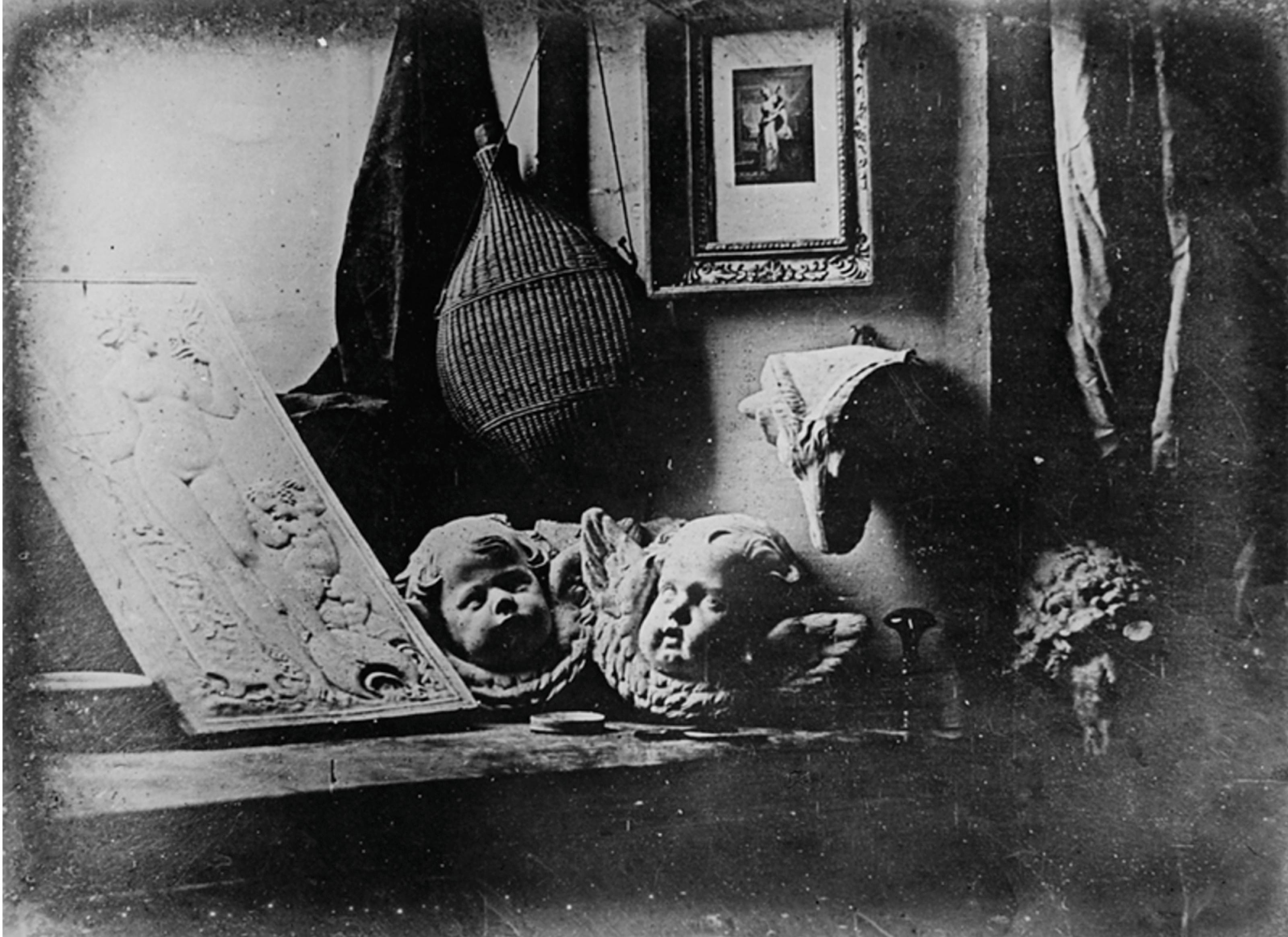
With any of the image generators, you can write a prompt that asks very simply for it to produce “a daguerreotype image” and get a monochromatic (maybe b/w) image with texture and age marks. You can describe the process, and end up with quite possibly a confused AI as to what the subject is and where you are going with things.
Let me show you.
The less than ideal options first.
A daguerreotype-style image of a 19th-century photographer in 1830s France, operating an early wooden box camera on a tripod in an outdoor courtyard, wearing period-accurate formal attire with a vest and cravat, surrounded by vintage photography tools and early equipment, soft natural lighting, shallow depth of field, historic and scientific atmosphere, documentary realism --no modern outfits, color, smiling, digital elements --raw --ar 7:5 --stylize 250
This is a Midjourney prompt, and here is the results:
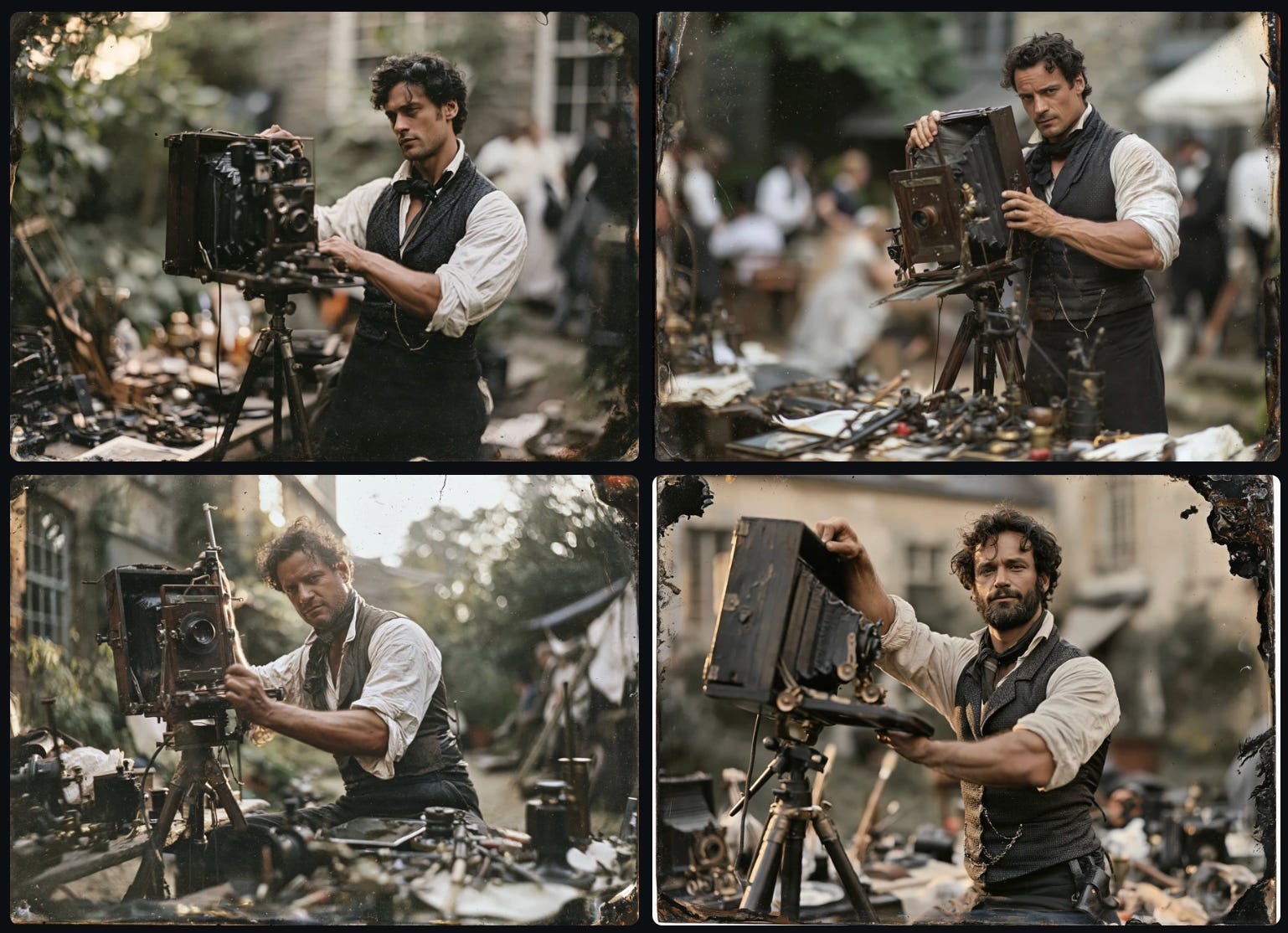
It has a period vibe in the clothing, focus and equipment… but color was not available for quite a while yet for this photo style.
Comments
Nothing yet. Say the first thing.
Sign in to join the conversation.