
Back in 2023, I introduced the "12 Essential Prompt Elements" — the idea that specificity in prompting doesn't just get you the result you're after, it puts you in the Creative Director's chair instead of leaving the outcome to chance. That framework was built for Midjourney originally, but it held up just as well across other image generators.
Earlier in this series I mentioned that the current approach builds on David W Litwin’s original workflow. I took what he provided and added a bit more human-in-the-loop control, expanding his structure into what you now learning to my “16 Elements of Generative Control.”
This piece is that expansion in full: every element, broken out by phase, with the vocabulary to make each one land. This one took me all day to put together, but I really want you to have the Desktop Resource and how to use this in your prompting.
Want to REALLY leverage the 16 Elements of Generative Control? Copy the entire document and use it to TEACH your LLM model, then reference it when asking for a prompt to be created! This one document is worth a year’s subscription… so thanks to my paid subscribers!
There’s no interface here — no dial, no toggle, nothing to click. Every one of the 16 Elements lives inside the same plain block of text you type into Midjourney, Nano Banana 2, or GPT-Image-2. What actually varies from element to element is three things: word count, word choice, and word position.
Word count and choice determine influence. A one-word Setting — “rooftop” — barely registers in the output. A loaded, sensory Setting — “cracked rooftop tar, humming AC units, string lights sagging between poles” — visibly shapes the result. The element itself didn’t change; how many words you spent on it, and how specific those words were, did.
Position matters. These models tend to weight words closer to the front of the prompt slightly more heavily than words near the end. So the order you write the 16 Elements in isn’t cosmetic — whatever you list first is quietly getting more attention than whatever you tack on at the end.
You’re working inside a token budget. Every model has a practical limit on how much prompt text it processes effectively. Tokens are the currency, and that currency is finite. Try to write all 16 elements out in exhaustive detail and you’ll blow past that budget — diluting everything, and pushing your lowest-priority details past the point the model reliably reads them at all. This is why earlier, I requested ChatGPT to write my prompt to fit 2000 characters.
That’s the real mechanic behind “priority of focus.” It’s not a metaphor — it’s a budget. Decide which three or four elements are doing the actual work in this generation, put them first, spend most of your words on them, and either compress the rest to a phrase or cut them entirely.
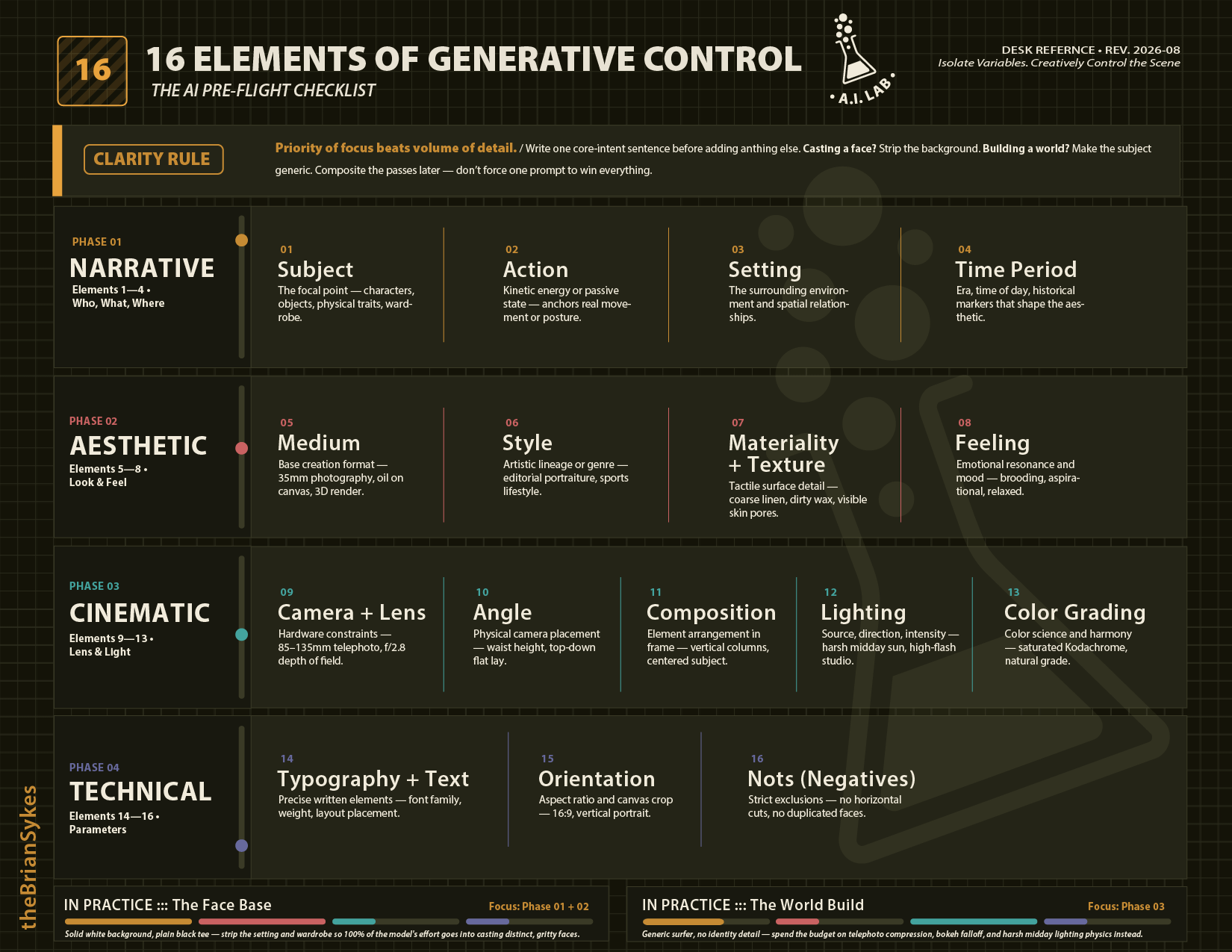
Before you touch a single one of the 16 Elements, start here.
Priority of focus beats volume of detail. Write one core-intent sentence — plain, specific, and about the one result that matters most for this generation — before you add anything else. That sentence is the Clarity Rule check: if you can’t state your intent in one sentence, you don’t have a prompt yet, you have a wish list.
Casting a face? Strip the background out of that sentence entirely. Building a world? Make the subject generic and let the sentence describe the space instead. The core-intent sentence tells you, in advance, which of the 16 Elements below are even relevant to this generation — everything else stays quiet, or gets left out completely.
This is also where you decide your passes. Don’t force one prompt to carry the casting, the world, the lighting, and the color grade all at once — composite them later. The Clarity Rule is the filter that keeps a sixteen-item vocabulary from turning into a sixteen-item demand list.
Every element that follows is optional. The one core-intent sentence is not.
Elements 1–4 · Who, What & Where
Before any style or lighting is applied, the model has to understand the physical reality of the scene. This is the layer most people rush past — but it’s the one that determines whether everything you build on top of it feels inhabited or just decorated.
Comments
Nothing yet. Say the first thing.
Sign in to join the conversation.