
Editor’s Note: One of our primary goals—and honours—at The 44 North is offering editorial mentorship & opportunity to emerging voices. We were so impressed by submissions to our inaugural essay contest that we decided to publish not only our Top 3 but our Top 15 essays, alongside personalized writing and editing support. Over the next several weeks, we’ll be sharing those essays with you here. Please enjoy!
Please note: This essay is written as if in the year 2040, imagining what the ~fifteen years between now and then might look like. Ultimately, it envisions what they have the potential to look like. As such, the research and sources that framed & inspired this piece are included at the end of the page.
by Shreeya Jagadeesh
In Canada, 2040, hunger is no longer a consequence of poverty and inequality. Rather, food insecurity is recalled as an inability of systems to produce educational outcomes, impact family stability, and affect long-term health outcomes. Students are now coming to school well fed and prepared to learn—not by chance, not because they are entitled to it, but because there’s finally a public responsibility for providing them with healthy food. Parents no longer have to devote all of their resources to buying food or paying rent, and food banks are a cautionary nod to a situation in which emergency feeding became an ongoing solution to a much greater problem. It wasn’t an instant change. It happened because people—especially youth—didn’t think that hunger was normal in a country that professed itself to be the land of opportunity and fairness.
Hindsight is 20/20, and food insecurity was never a secret. It was once present in every classroom, house, and community in Canada, but was often overlooked or regarded as a temporary measure. Students’ difficulties focusing in school were not necessarily due to their lack of motivation or ability; many were trying to learn while hungry. Parents ate in private to enable their children to feed—food was stretched and rationed while they tried to maintain normal routines. Meanwhile, healthcare systems addressed illnesses aggravated by poor nutrition, and governments stuck to short-term solutions rather than dealing with the root causes of the issue.
One of the most salient illustrations of this challenge was the creation of food banks, originally designed as emergency support systems to assist families through hard times. Eventually, however, they came to be a staple for many Canadians. Food banks provided compassion and relief, but studies revealed that they were not a long-term solution to food insecurity. They offered immediate help, but they weren’t able to ease the financial burdens that drove families into hardship. Stigma, transportation issues, and embarrassment were barriers for many Canadians who experienced food insecurity, keeping them from ever using a food bank. This brought a reality to light: Hunger was not just a matter of charity—it was due to the failure of systems to provide basic needs.
Food insecurity remained a growing problem due to wages not rising in tandem with the increase in housing and grocery prices. A full-time job no longer provided stability.
Research found many adult workers in food-insecure households, employed by one or more paid work activities, who still couldn’t afford basic needs. Slowly, hunger was separated from the notion of unemployment or budgeting mistakes. Rather, it mirrored a trend of unaffordability, in which life increasingly costs more than one can afford.
Scientists and medical practitioners began to explore food insecurity in depth, and its relationship with health was too obvious to be overlooked. Long-term physical health complications, including diabetes, hypertension, and lowered immunity, were attributed to poor nutrition. The effects expanded beyond physical health, however. Young people in food-insecure households had significantly greater levels of anxiety, mood disorders, and developmental problems than youth with stable food access. Studies revealed that food insecurity was also a significant factor in mental health, despite other social and economic factors being taken into consideration.
The effects were particularly devastating for children and youth, since nutrition impacts the brain, attention span, and learning. Hunger often manifested itself in the classroom through concentration problems, behavioural difficulties, or a lack of ability to perform academically. Some students experienced situations which occurred outside of school, with effects that continued into adulthood—reduced health status and elevated mental health risk as a result of food insecurity. Eventually, this was realized by policymakers. However, hunger was not just a moral matter; it was also a public health issue that could’ve been prevented.
Changes in thinking brought forth new ideas on preventive versus reactive action. The most significant shift occurred when people began to think of food as an integral part of health and not a separate entity. The concept of “food as medicine” was introduced via programs that featured meals, healthy food prescriptions, and nutritional education, in partnership with health care providers. It was discovered that these programs enhanced diet quality, reduced visits to the hospital and enacted better management of chronic diseases. There was a shift from reactionary support to addressing preventable conditions when communities became serious about addressing hunger’s cause directly.
Local solutions also emerged in communities, in addition to policy change. Mobile food markets expanded access in areas with limited food availability, and Indigenous communities bolstered food sovereignty efforts that were culturally sensitive and grounded in Indigenous knowledge and practices related to food. Schools extended child feeding to enable students to learn rather than be distracted by hunger. These shifts marked a new awareness that food insecurity was related to health, education, dignity, and opportunity simultaneously.
The push was largely led by young people: Students held food drives in the school, lobbied for policy changes, and spread messaging about the link between hunger and long-term health consequences. They didn’t take food insecurity for granted and demanded evidence-based action rather than symbolic solutions from governments. Compassion was still a significant driver; young people shifted the debate surrounding hunger to one of justice and accountability. They turned statistics into conversations, advocacy into discussions, and frustration into action.
By 2026, millions of people continued to suffer from food insecurity. The situation remained a strain on families, schools, and health care systems. But over the past fourteen years, Canadians have learned an important lesson. There never had to be a time when people didn’t have enough food.
Because the failure of policies so often paved the way for food insecurity, policy change could also help to alleviate it. Investments in income support, affordable housing, school meal programs, better healthcare partnerships, and fair wages restored systems that weren’t working for people but instead against them.
Now, in 2040, Canadians recognize that hunger was never just about food. It was a matter of dignity, fairness, health, and opportunity. Believers didn’t take pain for granted; they created the futures they envisioned. In communities all over the country, there is hope, and it’s been passed down from generation to generation. We don’t have to dream of a food-secure future now; it’s happening. We’ve built it.
Food Banks Canada. (n.d.). HungerCount. Food Banks Canada. Retrieved January 5, 2026, from https://foodbankscanada.ca/hunger-in-canada/hungercount/
Food prescribing in Canada: evidence, critiques and opportunities, HPCDP: Vol 44(6), June 2024. (2024, June 19). Canada.ca. Retrieved January 5, 2026, from https://www.canada.ca/en/public-health/services/reports-publications/health-promotion-chronic-disease-prevention-canada-research-policy-practice/vol-44-no-6-2024/food-prescribing-canada-evidence-critiques-opportunities.html
Government of Canada. (n.d.). Evidence synthesis – What is known about the prevalence of household food insecurity in Canada during the COVID-19 pandemic: a systematic review. https://www.canada.ca/en/public-health/services/reports-publications/health-promotion-chronic-disease-prevention-canada-research-policy-practice/vol-42-no-5-2022/prevalence-household-food-insecurity-canada-covid-19-pandemic-systematic-review.html
IC/ES. (n.d.). Study reveals link between food insecurity and children’s mental health services use. https://www.ices.on.ca/news-releases/study-reveals-link-between-food-insecurity-and-childrens-mental-health-services-use/
Join one of the largest communities of dietitians in the world. (n.d.). Dietitians of Canada - Join one of the largest communities of dietitians in the world. Retrieved January 5, 2026, from https://www.dietitians.ca/foodinsecurity
National Library of Medicine. (n.d.). More food for thought: a follow-up qualitative study on experiences of food bank access and food insecurity in Ottawa, Canada. https://pubmed.ncbi.nlm.nih.gov/35337301/
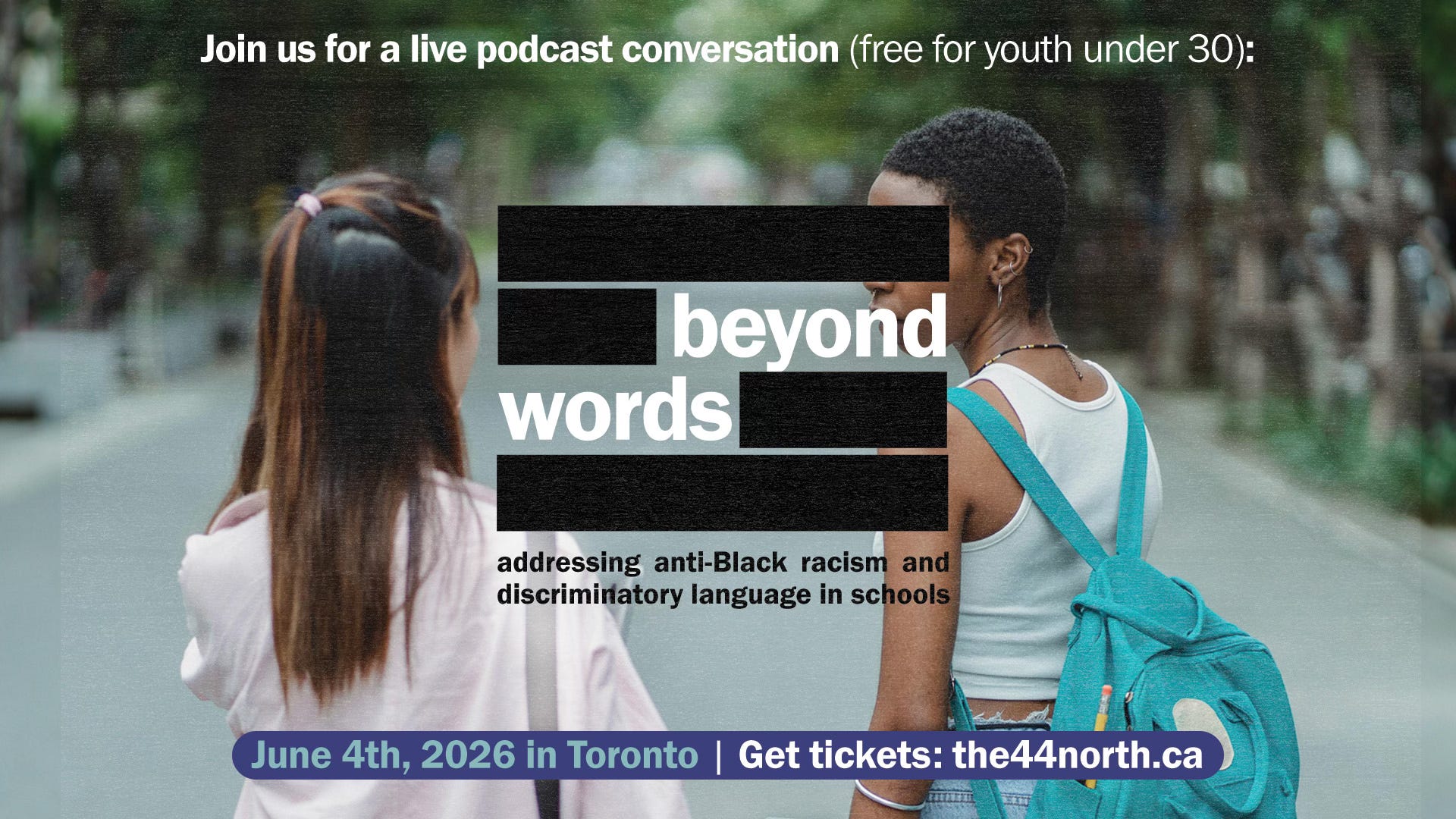
LIVE PODCAST EVENT | Beyond Words
Language plays a powerful role in shaping what is tolerated, ignored, challenged, or normalized in schools.
Harmful language doesn’t exist in isolation—it affects school climate, student safety, and a sense of belonging.
In partnership with Harmony Movement, University of Toronto Schools, and Unsinkable, our discussion will feature 4 panellists who will explore the role of language in both reinforcing harm and creating the conditions for more respectful, inclusive, and courageous school communities.
Hosted by Asante Haughton and Kritika Sharda, the discussion will explore what responsibility different community members hold and what it takes to build environments rooted in dignity, accountability, repair, and inclusion.
Remaining true to The 44 North principle of grounding discussion in action, panellists will not only share what needs to change, but who has the power to create that change, and what courage and responsibility look like in practice. Rather than asking young people to share painful experiences for the benefit of others, the event is designed to honour youth insight, wisdom, agency, and vision.
How do we reclaim voice, identity, belonging, and agency in a world that tries to define and contain us?
For our second annual youth essay contest, The 44 North invites young writers to explore questions of power, personhood, culture, identity, and self-definition for a chance to win up to $1000!
What we’re looking for: We welcome essays that are personal, thoughtful, and engaged with the world around you. Strong submissions may draw on lived experience, family or cultural history, community life, social issues, or research where relevant. We’re seeking original writing that connects personal experience to larger social, political, or cultural realities.

Workshop: July 24th, 7:00 pm EDT / 5:00 pm MDT
Join us for a 2-hour workshop with Christine Mejukah Weeber
Spells & Taboos: The Social Lives of Poems
Poems live in social worlds. So do we. How do these social worlds reveal, erase, disrupt, or erupt understandings? How can anthropology help unveil these social worlds? And more, how can anthropology + poetry help us witness and communicate these worlds in terms of power, agency, identity, culture, belonging, kinship, history, and more?
In this 2-hour workshop, participants will explore a brief history of anthropology and its contemporary manifestations. They will also pick up a few anthropological tools for understanding broader social worlds and the possibilities of poetry within those. Participants will craft their own poems as knowledge-makers in particular “fieldsites” to wrestle with power, negotiate self-identities, unveil taboos, and unseat “spells,” or taken-for-granted assumptions.

Comments
Nothing yet. Say the first thing.
Sign in to join the conversation.