

They’re not asking, Is this brilliant? Is this well-written?
They’re asking more down-to-earth questions:
Is this for me?
Can I trust this writer?
Is reading this worth my time?
If those answers aren’t clear, they quickly move on.
Turns out that’s exactly how literary agents evaluate manuscripts.
Mark Malatesta is a former literary agent turned author coach who just published a great article on how literary agents size up manuscripts.
I love how Malatesta’s article covers both fiction and nonfiction. And his nonfiction tips apply very much to white paper writing.
He says a literary agent might only read the title, the first few lines, or the first few pages of a manuscript before rejecting it.
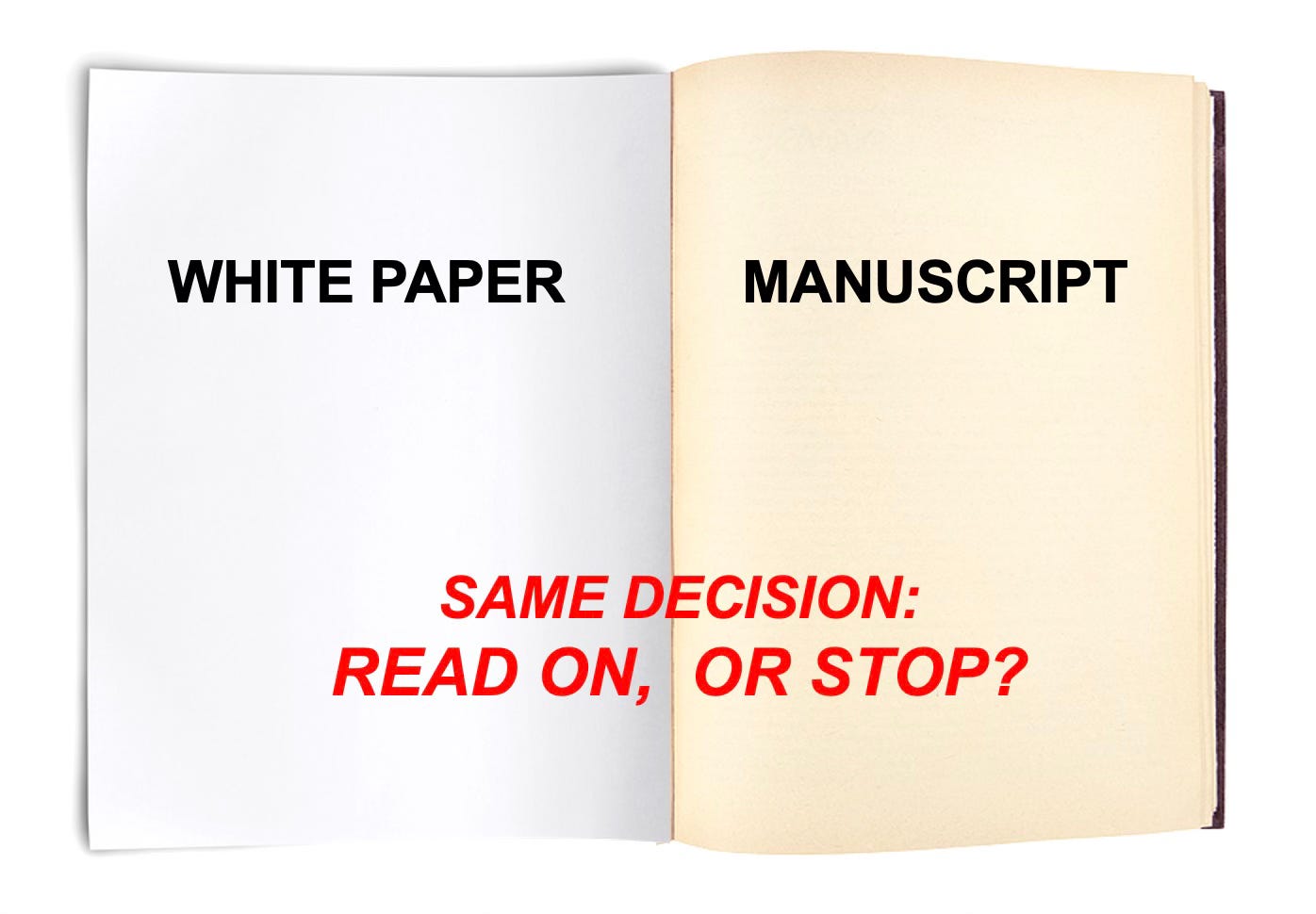
The very same thing happens with B2B content: A prospect might only read the title, the first few lines, or the first few pages of a white paper before rejecting it.
But isn’t that unfair? Subjective? Nasty?
Here’s a classic list of reasons why a prospect might not bother looking at your white paper:
They don’t like the title
They don’t like the cover
They’re not interested in the topic
They think it’s too long
They think it’s too hard to read
None of this is about whether the content is any “good.” Or about how well the content is written.
It’s about how someone decides in a flash whether to read on. They’re not being nasty. They’re just protecting their time.
Here’s a test I apply to everything I write. After reading the opening, can a target reader answer:
Who is this for?
What problem does this discuss?
What promise does this make?
Why keep reading?
If those answers are fuzzy, the opening isn’t doing its job. And you risk getting your white paper rejected quickly.
As you may know, I’ve retired from writing white papers. Now I’m writing fiction.
I’ve given myself a year to practice writing short stories. No pressure to publish. Just lots of practice and learning, building my confidence as I go.
By mid-March, I’ve written four short stories I’m happy with. (At some point, I’ll set up another Substack where you can see those.)
What I’m discovering—over and over—is how unforgiving the opening is.
If I don’t orient the reader quickly, if I don’t signal what’s at stake, if I don’t keep the story moving forward, that piece fails. Immediately.
The reader abandons it and goes on to something else.
That discipline has been eye-opening. And yet familiar. Because it’s the same discipline white paper writers face every day: earning the reader’s precious time and attention.
The article that sparked this reflection is worth reading in full: https://getaliteraryagent.com/writers-first-pages-chapters-literary-agents/
I’ve quoted just a small portion here.
The entire piece is a master class in how agents and readers make fast, practical decisions. And most of it applies directly to white papers.
Different audiences. Different stakes. But it’s the same question:
Have I earned the reader’s attention?
So whatever you’re writing, fiction or nonfiction, a white paper or a piece of romantasy, use your opening well. That way, you’ll win over your reader, whether they’re a B2B prospect or a literary agent.
Comments
Nothing yet. Say the first thing.
Sign in to join the conversation.