
“How many languages do you know?” is a stupid question. That is not to say that I don’t sometimes ask it too simply because there’s no alternative.
It’s easy to answer when it’s your native tongue (yes, I know Russian), when you reached native-like fluency (yes, I know English), or if you don’t know the language, not even a tiny bit (no, I don’t know Japanese).
It gets complicated when the language in question is one you learned, spoke, understood at some point in life or are currently learning, speaking, understanding. Case in point: my German, my Portuguese, my Sinhalese.
The problem with using the word “know” next to the word “language” is that a language is not finite. It’s not a poem you can learn by heart. Not a book you can read to the last page and close. It’s not a binary (I know the language — I don’t know the language), but a spectrum (basic — intermediate — fluent).
And then within that spectrum there are more spectrums like: I can understand well, but I can barely say anything. I can say what I need to say, but I can’t keep up when listening to natives converse. I can read a book slowly, but writing an essay would be difficult.
In my head, I imagine each language as a set of 4 sliders, like the ones you use to control volume on your computer. In my case, for Russian, the handles for all four sliders are set close to a 100%. For English, they are at 90-95%.
When it comes to Portuguese, my listening and reading sliders are at 30%, but speaking and writing are at 1%. I learned Portuguese when I spent a year in Brazil in 2012. 14 years later I can still understand the basics, but could not produce a full sentence to save my life.
Reaching the part of my brain that stores Portuguese vocabulary feels like digging through a pile of clothes in an old-timey chest. The Portuguese words are somewhere at the bottom. As I keep trying to find the word for eggplant in Portuguese, I have to go through all the other eggplants in other languages. Is it baklazhan? Nope, that’s Russian. Aubergine? Nope, that’s German or English? Or both? Whatever, throw it out. Brinjol? No, that’s Sinhalese… but somewhere close… Beringela! Wow, that took a while.
Do I know Portuguese?
My relationship with Sinhalese (the language spoken in Sri Lanka where my husband is from) might be even more complicated. The handle on my listening slider is at 60-65%. I can understand pretty much everything my husband tells our kids, all the day-to-day conversations at my in-law’s house. I wouldn’t be able to keep up with a discussion about politics or any major issues.
My speaking slider is at 20-25%. I can explain what I did today or give directions to a tuk-tuk driver. I can not chat with my husband or our Sri Lankan family and friends.
My reading and writing skills are at 0% because have you seen the Sinhalese alphabet? Yikes!
Do I know Sinhalese?
Finally, my German. I have the official certificate from Goethe Institute that I know German at a B1 level. As per my teacher’s estimate, my actual level is B2+
In case you are not familiar with this system A1-A2 is basic level, B1-B2 is intermediate, C1 is fluent, C2 is full proficiency. C1 is what most foreigners need to easily navigate life in a new country. So I am almost there, but not quite.
In real life, a few days ago someone asked me why I don’t speak German. “I do?” I replied in English, embarrassed. How did that happen?
Last Sunday I stopped at a bar to have a drink and read my book and accidentally found myself at a table with three German girls on a night out. We exchanged pleasantries in German, but after a few lines, sensing my unease, they switched to English. Which is when the question popped up: How come you don’t speak German? Of course, I do. I just freeze when I have to have a casual conversation. This exchange with my friend Yvonne is the best way to explain it.
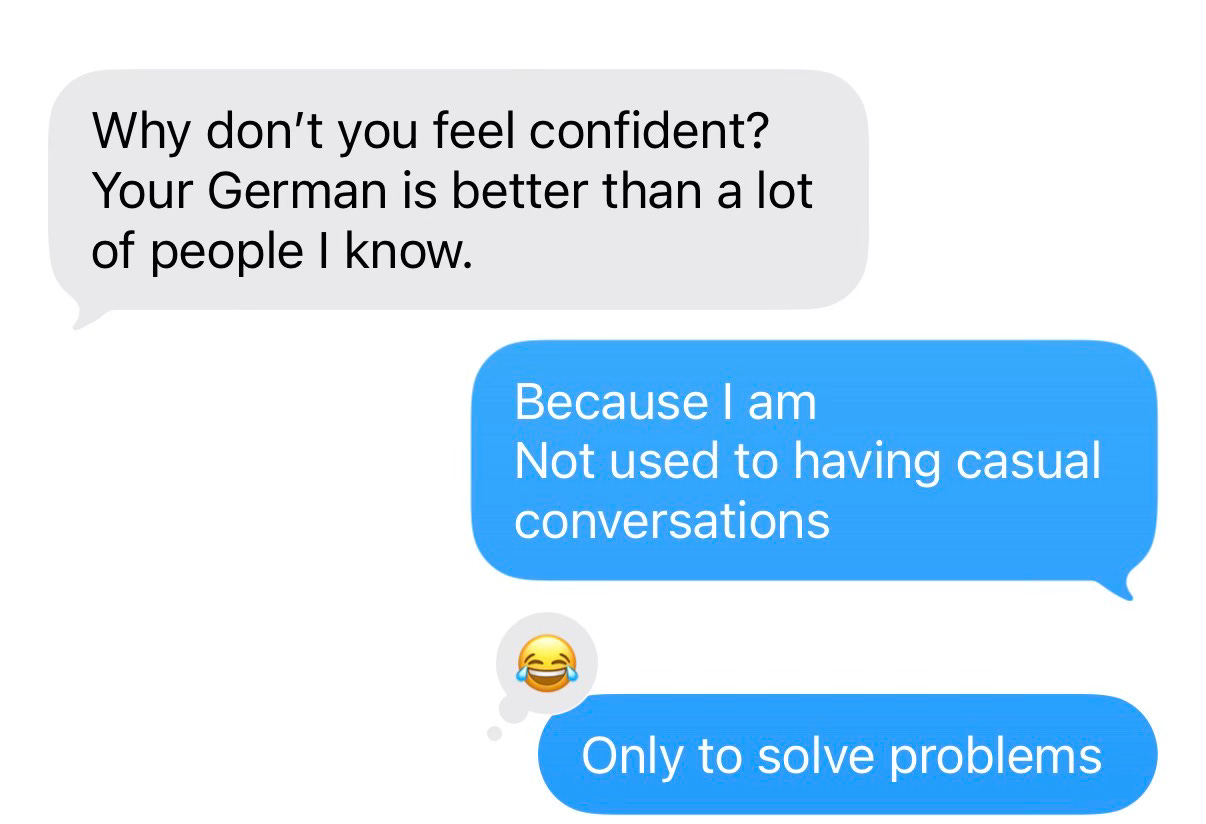
You see, I mostly use German to get shit done. I can explain to a repair technician what’s wrong with my dishwashing machine, I can discuss my son’s progress with his kindergarten teacher, I can describe the exact specifications of my future kitchen to an Ikea designer.
I cannot have a deep meaningful chat with a German friend. Or rather I could, painstakingly for me, painfully — for the friend in question, but I refuse to.
Here’s the conundrum. You would think it’s easier to speak in a foreign language to a friend, rather than a stranger. A friend will make you feel comfortable, a friend won’t judge, a friend knows your struggle. A stranger, on the other hand, does not care about you. Which, now that I think about it, is a good thing and the reason in reality it’s the exact opposite.
I am not shy speaking German to government officials and repairmen. I have a goal and German is a vehicle to get me to that goal. When I need to get my dishwasher fixed, I will use all means available — my grammatically incorrect German, wild gesturing, pantomime — to get it done.
When I speak to friends there’s no goal per se. A good conversation is in itself the goal. I want to get my point across in a nuanced manner, my humor to shine through. I want the flow, not the stumbling over and over trying to remember whether table is masculine or feminine.
Do I know German?
When someone asks me how many languages I know, the answer varies. On bad days I want to say 2 (Russian, English), usually I would answer with 3 (Russian, English, German), when I am feeling bold I might say 5, immediately adding that they are not all on the same level.
After that disastrous conversation at the bar, I’ve decided I need to push my German to the next level. I’ve been in my comfort zone for the past two years. Time to get awkward.
Probably an even bigger trigger was finally getting my German passport. I am a German citizen, y’all! I feel incredible responsibility to speak the language of my new home fluently. For me personally, it’s a must, a non-negotiable.
My worst nightmare right now is landing in Germany after a trip, presenting my passport to the border control officer and hearing him say: How come you don’t speak German? Luckily, in Hamburg airport, there’s an automated system for EU citizens. Hopefully, in a few years, it won’t matter because the only thing giving me away would be my accent.
No posts
Comments
Nothing yet. Say the first thing.
Sign in to join the conversation.