
Within the architecture of the Victorian novel, no figure extracts a higher operational toll than the professional innocent.
When Charles Dickens introduced Harold Skimpole in the pages of Bleak House, he presented a creature of exquisite, airy charm. Skimpole operates as an artist, a man of sentiment, a self-described “child” navigating a brutal, industrialised market entirely unsoiled by the grim realities of pounds, shillings, and pence. He famously declares his total lack of fiscal capacity; he finds balance sheets incomprehensible, rejects the structural logic of contracts, and the mere mention of legal obligation sends his delicate framework into immediate aesthetic paralysis.
This performance delights the casual observer while simultaneously executing a highly sophisticated mechanism of environmental coercion—a state of consistent incompetence and engineered helplessness.
Sidenote: My lifelong devotion to the em-dash remains a deeply human stylistic signature—a manifestation of organic thought patterns and an enduring love of Emily Dickinson rather than automated text protocols. FYI typing “--” will generate “—” on a Mac.
Critical theory frequently fixates on the gothic villain or the overt tyrant as the primary engine of domestic dread in nineteenth-century narrative architecture. Yet Dickens diagnosed a quieter, far more exhausting disruption to the operational grid: the passenger.
Far from indicating a genuine lack of agency, Skimpole’s curated innocence functions as an elite exercise of power. By establishing himself as fundamentally unequipped to pilot the heavy machinery of daily survival, citing a complete, organic absence of what he terms the "commercial organ", Skimpole effectively manoeuvres the nodes in his orbit, principally the long-suffering John Jarndyce, into a permanent state of over-functioning.
Because Skimpole categorises basic operational tasks as “too difficult,” surrounding agents must execute double shifts to satisfy his debts, manage his existential crises, and underwrite his delicate sensory comfort. He successfully transforms helpless vulnerability into a pristine, unassailable personal brand, forcing adjacent infrastructure to meet his needs, no matter the cost.
While Dickens paints this dynamic in Victorian ink, the passenger mindset replicates itself across every modern professional ecosystem with terrifying predictability:
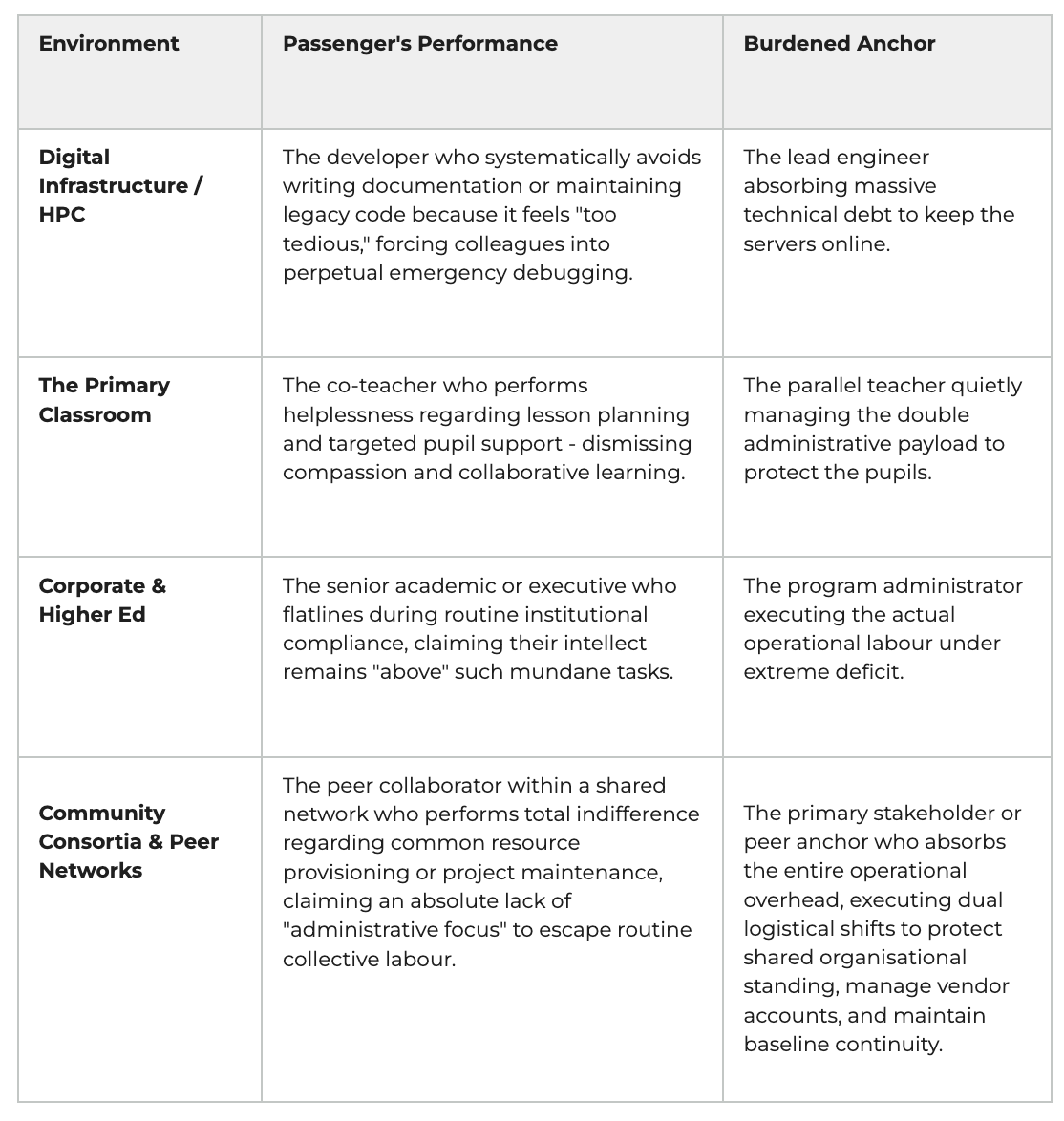
Within any shared enterprise architecture, this dynamic creates a profound deadweight loss. When a single node within a network systematically declines to process its own administrative payload, the operational requirement persists unabated. Instead, it executes a localised Denial-of-Service (DoS) attack, transferring the entire processing burden, in bulk, to the primary anchor. The primary provider sinks under the staggering weight of carrying collective risk, while the passenger enjoys the luxury of a completely unencumbered calendar.
He transforms helpless vulnerability into a pristine, unassailable personal brand, leaving those around him to trade their own vitality to maintain his peace of mind.
In the vocabulary of distributed systems and organisational ergonomics, this phenomenon represents the “High-Functioning Flatline.” System architects and educators alike recognise the surreal horror of watching an individual expertly direct complex public logistics or navigate intricate commercial systems in the wider marketplace, only to experience an immediate, total cognitive collapse the moment an internal, collaborative boundary demands baseline accountability. This behaviour stands as a masterful, quiet throttling of the shared workflow, safely masked beneath the velvet veneer of an artistic temperament, an intellectual title, or a flawless performance of situational overwhelm.
The profound exhaustion of the Skimpole dynamic stems from the passenger’s absolute sense of entitlement to the infrastructure. He views the labour of the primary provider as a natural, permanent fixture of his landscape rather than a massive, unsustainable sacrifice. Modelling his existence on the unencumbered butterfly that flits across the landscape entirely exempt from the transactional costs of survival, he operates under the comfortable delusion of an infinite open ledger. He assumes that logistics will always magically resolve themselves, leaving him free to occupy the role of the tragic victim, wounded by an environment far too harsh for his delicate system.
                  THE ASYMMETRICAL EMOTIONAL GRID
       [ The Passenger ]                  [ The Primary Anchor ]
    (High Affective Scanning)          (High Systemic Responsibility)
               │                                      │
               ▼                                      ▼
    Locates vulnerability &              Absorbs collective risk &
    inflates helplessness.               exerts over-functioning labour.
               │                                      │
               └───────────────► [ SYSTEM ] ◄─────────┘
                                     │
                                     ▼
                           Maximum Depletion &
                           Structural Collapse
Popular management literature frequently misdiagnoses the passenger mindset as a fundamental deficit in emotional intelligence. This perspective misreads a highly sophisticated behavioural strategy. The consummate passenger often possesses a highly acute, perversely optimised variant of emotional intelligence (EI) - specifically, a predatory capacity for affective scanning.
Rather than deploying emotional intelligence for self-regulation, mutual value co-creation, or shared accountability, the passenger utilises it to map their collaborators’ empathy thresholds. They read the room with precision, locating the exact nodes of guilt, conscientiousness, and risk aversion within the primary anchor.
The passenger utilises emotional intelligence to map their collaborators’ empathy thresholds, transforming another person’s integrity into a resource for exploitation.
This strategy constitutes a form of emotional arbitrage. By sensing exactly when the primary provider reaches the brink of burnout, the passenger calibration shifts, offering just enough performative gratitude, artistic charm, or sudden vulnerability to reset the provider’s tolerance levels.
The passenger transforms the companion’s empathy into an exploitable commodity, capitalising on the psychological reality that a responsible operator will tolerate systemic imbalance far longer than they will tolerate a chaotic, unmanaged collapse. Consequently, the passenger’s performance of helplessness functions as an active control mechanism, keeping the primary anchor locked in a cycle of exhausting over-functioning.
Here lies the dark, bleeding core of Dickens’s critique, a reality often obscured by Skimpole’s witty dialogue: indifference operates as an active form of systemic abuse.
Society readily identifies malice when it arrives via a raised voice, physical intimidation, or an overt threat. Yet, the passenger introduces a far more insidious devastation through total, calculated indifference. When Harold Skimpole witnesses his friends facing financial ruin or emotional collapse, he merely offers an airy sigh, admiring the “poetic beauty” of their struggle while continuing to sip wine paid for by their depleted funds.
                    THE MALICE OF NEGLECT
   [ Passenger Indifference ] ──► [ Forced Infrastructure Bleed ]
               │                                 │
               ▼                                 ▼
    "I am merely a child;            The Anchor exchanges health,
     the world is too harsh."        sanity, and time to stop collapse.
This indifference represents a violent refusal of mutual humanity.
It weaponises neglect, relying on the psychological certainty that the responsible anchor will destroy their own well-being before allowing the shared environment, or the vulnerable entities within it, to shatter.
The passenger sits in serene, unbothered comfort while watching the primary anchor physically and mentally deteriorate under the weight of the outsourced load. This detachment constitutes an intentional, parasitic extraction; the passenger views the anchor’s suffering as a necessary, entirely acceptable fuel source for their own unencumbered autonomy.
Within any collaborative architecture, this continuous extraction inflicts severe structural damage upon the shared psychological contract. It actively rewires the ecosystem’s baseline expectations. Over time, the extraordinary labour and logistical gymnastics performed by the primary anchor lose their status as voluntary gifts. The system normalises these sacrifices, converting them into standard baseline requirements.
       NORMALISED EXTRACTION FLOW
       [Voluntary Sacrifice] ──► [Systemic Normalisation] ──► [Entitled Expectation]
This normalisation breeds a profound institutional decay, manifesting as three distinct systemic failures:
The Pathologisation of Accountability: The moment the primary anchor attempts to introduce basic boundary conditions, the ecosystem experiences a dual-coding of cruelty, locking both nodes into a paralysing feedback loop:
The Passenger’s Matrix (Cruelty as an Ego Threat): To the passenger, a demand for baseline fairness feels like a hostile assault on their curated survival architecture. They genuinely experience accountability as persecution, reframing the request as cruelty to safely re-establish their status as the wounded victim. Dickens documents this exact pathology in Skimpole’s eventual narrative end: when his benefactors finally withdraw their financial underwriting, Skimpole uses his personal journals to reframe his long-suffering saviour, Jarndyce, as a harsh, uncalculating monster.
The Anchor’s Matrix (Cruelty as Internalised Guilt): Symmetrically, the highly conscientious anchor internalises this projected accusation. Because the passenger expertly targets the anchor’s high empathy thresholds, the simple act of requesting equity triggers profound moral dissonance, forcing the provider to experience their own self-preservation as an act of intolerable malice.
The Exemption Matrix: The passenger secures a permanent hall pass from routine administrative labour. By maintaining a status of perpetual overwhelm, they force the system to filter all complex data packets around them, ensuring a completely unencumbered calendar.
The Erosion of Collective Support: Because the primary provider expends all available processing power absorbing the passenger’s deadweight loss, the entire ecosystem loses its capacity to withstand genuine external crises.
The passenger mindset thrives on the expectation that the primary anchor’s identity remains inextricably bound to the act of rescue.
They rely on the assumption that the provider will choose personal depletion over the discomfort of witnessing a managed failure. It represents a parasitic optimisation strategy: maximising personal autonomy and preserving creative or emotional energy by entirely outsourcing the transaction costs of daily existence to another human being.
The departure of the passenger resolves the ongoing extraction, yet it leaves the primary anchor to confront a secondary systemic crisis: accumulated technical debt.
In software engineering, technical debt comprises the implied cost of additional reworking created by choosing an easy, short-term solution instead of using a better approach. Within a shared human architecture, this debt manifests as the warped internal programming the primary operator developed simply to survive the passenger’s DoS attack.
                    THE DEBT LIQUIDATION MATRIX
   [ Legacy Programming ] ──────► [ Diagnostic Refactoring ]
              │                                │
              ▼                                ▼
   Automatic Over-Functioning &     Restoration of Boundary Nodes &
   Hyper-Vigilant Risk Scanning.    Systemic Energy Reclamation.
Liquidating this debt requires a process of systemic resistance. The primary anchor must systematically locate and delete the obsolete code packets of hyper-vigilance and automatic rescue.
This phase demands deep computational patience; the infrastructure must relearn how to operate in a low-friction environment, training itself to realise that a baseline request for accountability will cease to trigger an environmental meltdown. Recovery requires the anchor to redirect their vital processing power inward, utilising those massive reserves of emotional intelligence for self-optimisation rather than external containment.
But Dickens, ever the uncompromising structural realist, leaves us with a cold, unyielding truth: the dam eventually breaks. Every closed ecosystem operates within hard thermodynamic limits, and human anchors eventually hit maximum capacity, running completely out of fuel.
Here, they have zero fucks left to give.
When the primary operator finally experiences total burnout or undergoes a conscious awakening through targeted, systemic, and supportive feedback, the cycle halts. The anchor chooses to step away from the machinery, refuse the emotional blackmail, and close the open ledger.
This withdrawal of over-functioning labour triggers an immediate structural shockwave throughout the environment. The golden bridge of accommodation vanishes. The passenger suddenly finds himself dropped from the luxury of a cleared processing queue directly into the black-and-white math of an independent reality.
Stripped of the proxy buffer that safely absorbed his friction for years, he must finally face the institutional matrix on his own terms. The narrative arc concludes with a stark reminder that true innocence remains a myth; when the provider stops carrying the weight, the passenger must either learn to process his own data packets or allow his curated personal brand to dissolve in the face of the unyielding real world.
This analysis materialised in response to a highly specific external catalyst: a fresh batch of incoming commercial requests demanding further free labour, elegantly packaged beneath the professional veneer of [a bleak] “opportunity.”
It remains a delightful irony that the modern corporate landscape so perfectly mirrors the Victorian sitting room. Just as Harold Skimpole casually drops a stack of unpaid bills onto John Jarndyce’s desk with a cheerful wave and an airy smile, modern organisational passengers continue to slip extra administrative payloads into the calendars of their high-functioning peers, expecting zero friction and infinite compliance.
They frame these extractions as routine collaborative requests, relying on your professional integrity to absorb the operational deficit. (Raised eyebrow.)
When an ecosystem demands that you absorb another node’s uncompensated processing load under the guise of institutional duty, strategic resistance stands as the only viable computational defence.
Let Dickens remind us that preserving the primary anchor’s infrastructure requires an absolute refusal of the extraction. The ledger remains firmly, irrevocably closed.
To extend the exploration of structural compression, neurodivergent semiotics, and the architectures of algorithmic control, consider the following reference points:
Charles Dickens, Bleak House (1853) - Speculative Focus on Chapter 6 (”Quite at Home”) and Chapter 61 (”A Discovery”): These specific textual architectures isolate the precise transition where performative vulnerability mutates into overt institutional sabotage. Chapter 6 charts the initialisation of the passenger protocol within the Jarndyce ecosystem, while Chapter 61 exposes the ultimate pathology of the dynamic—the posthumous diary in which the passenger reframes his lifelong provider as a cold, ungenerous tyrant.
The Semiotics of the “Commercial Organ”: A deep dive into Victorian phrenological subversion. This literary lens tracks how historical pseudoscience provided the perfect tactical cover for behavioural extraction, allowing passengers to claim an organic, structural brain deficit to evade baseline compliance.
The Mechanics of Application-Layer DoS Protocols: Engineering documentation concerning Slowloris and parallel low-bandwidth Denial-of-Service attacks. These technical briefs illustrate how a single, low-overhead node successfully paralyses a high-capacity infrastructure. The attacking node maintains open connections by systematically transmitting tiny, incomplete data packets, forcing the primary server to dedicate infinite processing memory to a black hole of unresolvable logistics. Thank you, Wikipedia. Please donate to the Wikipedia Foundation!
Distributed Systems Starvation Theory: Core computing literature exploring what occurs when a rogue thread within a network routinely drops its administrative payload, requiring neighbouring threads to execute double computational shifts to prevent total environmental collapse.
Systemic Refactoring and Architectural Degradation: Operations management literature—specifically foundational frameworks like Martin Fowler’s Technical Debt Quadrant—tracking the hidden liabilities generated when a system normalises short-term workarounds. This research details how the over-functioning of high-performing assets masks a broken lateral dependency, creating a fragile ecosystem completely unequipped to withstand external economic shocks.
Cognitive Load Asymmetry in Cross-Functional Teams: Workplace ergonomics data exploring the “High-Functioning Flatline” within corporate systems—specifically analysing the deep exhaustion experienced by anchors forced to manage internal administrative workflows for status peers who remain highly capable in the public marketplace.
                    THE THERMODYNAMIC CLEANSE
  [ Inbound Exploitation Packet ] ──► [ System Boundary Node ]
                                                │
                                                ▼
                                    { Structural Refusal }
                                                │
                                                ▼
                                    [ Closed Ledger State ]
                                                │
                                                ▼
                                    Maximum Energy Reclamation
Operational Directive: When the cost of maintaining a proxy buffer yields zero value to the network, total system optimisation requires the immediate, permanent closing of the ledger. Allow the passenger’s data packets to drop at the perimeter.
Comments
Nothing yet. Say the first thing.
Sign in to join the conversation.