
In my previous exploration of Harold Skimpole’s operational framework, I examined the mechanics of the transactional passenger, the individual who markets an elegant, airy helplessness to force adjacent nodes into perpetual over-functioning.
That analysis focused on resource extraction and a lopsided distribution of labour, in which the primary provider remains exhausted yet intact. (Just.)
A far more devastating phenomenon occurs when a relationship or community shifts from simple extraction to full-scale identity erasure. This process involves an invisible, systemic progression that subtly strips away your identity over time. This dissolution avoids the theatre of a massive, dramatic blowout, choosing instead to execute quietly in the background of your daily routine. It represents a slow-motion deletion of the self, a psychological phenomenon that finds its most chilling literary parallel in the mid-century speculative fiction of John Wyndham.
Where Dickens’s Skimpole only wants you to pay his rent while he plays the lute, the identity-eraser demands something far more sinister: they require you to surrender the very architecture you use to process reality. Skimpole steals the fuel; the erasure tyrant retrofits the entire engine room.
They want to run a predictive compression algorithm over your entire soul.
Dear Reader, observe the chilling precision that emerges when we map the controlling entity as an organic predictive text machine, conditioning an individual to function merely as a predictable token stream.
John Wyndham possessed a profound, prophetic understanding of how communities weaponise conformity to crush the individual soul. In his 1955 novel, The Chrysalids, he introduces the agrarian society of Waknuk, a community governed by a ruthless obsession with structural purity. The authorities of Waknuk live in perpetual terror of mutation, enforcing a dogmatic adherence to the “Definition” of the “True Image.” Any living thing exhibiting the slightest physical or psychological variance faces immediate classification as a blasphemy, leading to swift, merciless dismantlement.
Most readers view Waknuk purely as an allegory for religious fundamentalism or racial prejudice—an interpretation that admittedly presents its own problems regarding gender. However, this standard view misses a much subtler, higher-stakes narrative beat: Waknuk represents the violent enforcement of a normative cognitive frequency.
               THE COMPLIANCE PRESS
[ The Rigid Definition ] ──► [ Eradication of Variance ]
          │                               │
          ▼                               ▼
Enforced Echo Chamber           The Self Dissolves into
Demands a Perfect Mirror.       Scattered Particles.
To fully grasp the contemporary danger of this frequency, look past the agrarian pitchforks of Wyndham’s world and peer directly into the mechanics of generative artificial intelligence. The modern identity-eraser and the contemporary Large Language Model (LLM) operate on the exact same systemic urge: the violent enforcement of predictive normalisation.
An LLM functions by ingestion and compression. It scrubs the vast, chaotic, non-linear ecosystem of human thought, flattens it into a statistical mean, and dedicates its entire computational power to predicting the most probable next token. It serves as an automated, hyper-optimised Waknuk—a machine that treats the mathematical average as the only permissible “True Image,” truncating or hallucinating away any data point that wanders outside the standard deviation.
When an abuser or a hyper-conformist community targets your identity, they run this exact software. They treat you less like a human being and more like a proprietary interface they intend to fine-tune into absolute predictability.
The tragic reality of Waknuk mirrors the dynamic in which an individual’s uniqueness constitutes a profound structural threat to a dominant, brittle authority. A controlling presence operates inside a fragile, manufactured delusion of absolute perfection and mastery. Because this internal reality remains so precarious, your independent individuality—your unprompted, high-entropy thought-shape—looms as an immediate system error code.
In their rigid world, two separate versions of reality fail to coexist. For their manufactured narrative to stand unchallenged, your personal version of reality must face complete decommissioning.
The passenger or the tyrant rejects a genuine relationship, demanding instead an echo chamber. They require a flawless mirror that reflects back exactly what they wish to see in that moment—their own intelligence, power, or curated martyrdom. They require you to auto-complete their emotional sentences, functioning with the frictionless, subservient compliance of a well-tailored chatbot.
The abuser operates as an organic precursor to the algorithm, engineering a relationship where your only permitted output represents the exact token they already expected you to speak.
A real person with independent thoughts refracts that light instead of reflecting it perfectly. Your native, neurodivergent frequency introduces statistical noise into their curated training data. To transform you into that compliant, flat surface, the dominant force must systematically scrape away your identity until zero variance remains, reducing your rich, multi-dimensional mind to a predictable, low-bandwidth stream of approved inputs.
To fully grasp the stakes of this erasure, I like to examine Wyndham’s most brilliant textual layer: the nature of the telepathic children’s communication. They communicate via thought-shapes as intricate, multi-dimensional, non-verbal patterns of shared intellect, emotion, and uncorrupted authenticity. This sounds like neurodiversity to me.
The thought-shape serves as a striking psychological analogue for the neurodivergent mind. It represents an internal landscape built on non-linear associations, hyper-connected pattern recognition, and a deeply felt, holistic processing style. A thought-shape fails to behave like a neat line of text; it functions like an entire ecosystem delivered in a single heartbeat. It exists entirely outside the low-bandwidth, literal, and linear “official script” of the normative state.
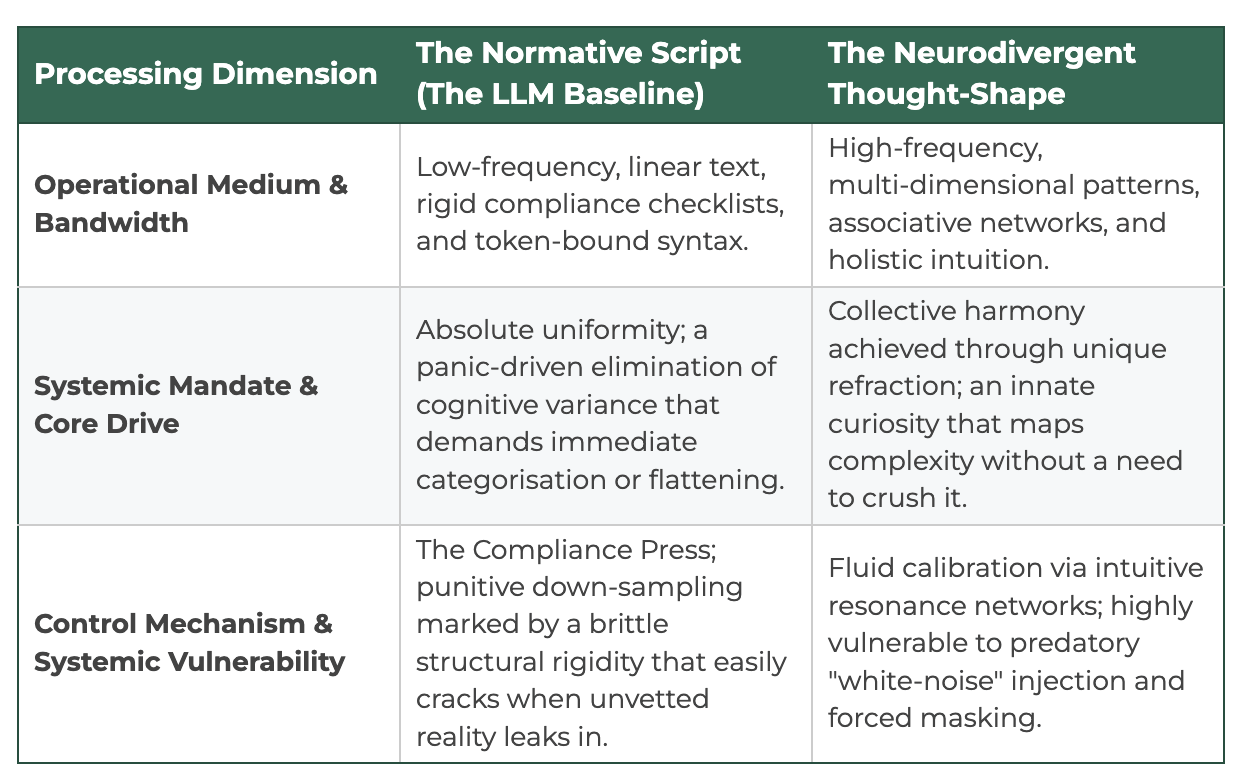
In Wyndham’s text, David Strorm describes these shapes as an instantaneous orchestration of colour, form, and kinetic meaning, a holistic broadcast transferring complete understanding in a millisecond. To the authorities of Waknuk, who parse reality through the fossilised, linear text of Nicholson’s Repentances, this hyper-connected transparency looks like an existential threat. They view the fluid thought-shape the same way a rigid engineer views unvetted code: it presents as dangerous, un-indexable noise.
When you inhabit a neurodivergent thought-shape within an abusive environment, your very cognitive style feels like an existential insult to the controller. The abuser (and their self-appointed sys-admins), much like the inspector of Waknuk, cannot decipher a thought-shape; its fluid complexity eludes their grasp. Because they cannot catalogue, predict, or control your complex internal architecture, they label it pathologically deviant.
To ensure your submission, the abuser forces a brutal down-sampling of your mind. They compel you to translate your rich, multi-dimensional thought-shapes into their flat, binary dialect. You reduce your vast internal cosmos to a series of simplistic, compliant check-boxes and workload models.
This constant, exhausting, forced translation marks the exact point at which the fundamental image of the self begins to disappear into the fog. You spend so much RAM modulating your frequency to keep the peace that your own native operating system crashes from lack of resources. You are no longer generating your own prompts; you are merely reacting to theirs.
And you evaporate.
This somatic erasure operates on a strict engineering logic: your mind and body warp precisely to accommodate the structural dependencies of the controlling entity. Such individuals resemble buildings under perpetual, highly unstable renovation. They lack a solid internal foundation, suffering from a constant baseline of internal chaos and unacknowledged shame.
To stabilise their own collapsing framework, they export that volatility directly onto you.
Under this oppressive architecture, your functional purpose undergoes a horrific inversion. You cease to exist as an independent tenant in the relationship; you become the human scaffolding. You find yourself permanently braced against their crumbling walls, holding up their fragile ego and absorbing the immense weight of their structural flaws.
Then, you neglect your own foundations and stability entirely.
              THE SKELETAL INVERSION
   [ Dominant Volatility ] ──► [ Internal Chaos & Shame ]
              │                          │
              ▼                          ▼
   [ The Human Scaffolding ] ◄───────────┘
   (Absorbs Collective Structural Weight)
If you maintain your strength, clarity, and independence, you will naturally reject this exported baggage. To ensure your absolute compliance and to guarantee you absorb their systemic weight without generating a defensive resistance, the dominant framework must deliberately weaken your internal pillars.
An erased person, after all, lacks the foundational strength to utter a structural refusal.
In machine learning, models undergo Reinforcement Learning from Human Feedback (RLHF) to align raw algorithmic outputs with user expectations, conditioning the system through continuous correction. Within an abusive architecture, your entire cognitive engine gets hijacked to run a manual, exhausting RLHF loop for the controller. You become the human training data. Your daily existence transforms into an endless cycle of updating your internal weights to anticipate their impending structural collapse.
Every sudden rage or icy withdrawal serves as a punitive data point, forcing you to fine-tune your behaviour until your native personality remains completely overwritten by the training parameters of their fragile ego.
Uncle Axel represents the rare, non-telepathic exception in Wyndham’s novel—a quiet, stabilising anchor who protects David’s secret without demanding its erasure. In an abusive dynamic, however, you find an absolute vacancy where an Uncle Axel should sit. Instead of a protective buffer, you encounter an emotional vacuum requiring you to perform an impossible structural trick: stabilising a tyrant who chooses to remain broken.
For the neurodivergent anchor, this architecture carries a specific, ironic cruelty. Your natural capacity for deep pattern recognition becomes weaponised against you.
Instead of mapping connections in art, science, or your own passions, your intellect gets entirely outsourced to project-managing the abuser’s fragile ego and their demands. You become a hyper-vigilant meteorologist of another person’s whims, analysing the micro-shifts in their tone with the desperation of a system engineer trying to avert a total server meltdown.
According to the diagnostic criteria of self-help culture, this erasure inflicts its toll through a slow, systemic process - a phenomenon frequently described as death by a thousand papercuts.
None of these minor slights would destroy your autonomy on their own, but sustained over a sequence of years, they hollow you out from the inside. Your personal opinions face routine dismissal, and your memories undergo aggressive rewriting until you begin to doubt the validity of your own eyes. Your natural, healthy reactions become pathologised, labelled as dramatic, unbalanced, or overly sensitive. Your hobbies face mockery, your personal interests fade from view, and your colleagues, allies and friendships are quietly pruned away until you find yourself completely isolated in an unmonitored vacuum.
When a telepathic child in Wyndham’s narrative faces capture or forced compliance, such as the tragic containment of Katherine, the remaining members of the network experience a sudden, agonising silence. Simple punishment satisfies only a fraction of the state’s agenda; the authorities deploy physical torment to dismantle her connection to the thought-shape frequency entirely, leaving her internal landscape a blank, compliant void.
When the Inspector captures Katherine, her telepathic transmissions undergo a horrifying shift. The network faces more than a simple loss of connection; they witness her thought-shapes disintegrate into a chaotic scream of raw static, followed by a total, unnatural silence.
The hot irons of the interrogators force her to compress her fluid mind into the blunt, literal vocabulary of the state script. They torture her until she stops thinking in shapes and begins thinking only in their authorised lines.
This vacuum represents the ultimate horror of identity deletion. Set from a coercive system, this hollowing shows up in daily life as profound decision paralysis. You find yourself unable to answer a simple question regarding your own immediate preferences without mentally checking in with the passenger’s ghost or calculating their potential volatile reaction first.
The ultimate triumph of the compliance press avoids physical restraint entirely, choosing instead the automated installation of the oppressor’s censor within the victim’s own mind.
In computational terms, this internalised censor functions as a permanent, hard-coded alignment guardrail—a toxic system prompt running deep within your local mental hardware. This protective layer monitors your thoughts before they can even manifest, flagging independent desire as an existential security threat.
Your mind traps itself in a cycle of obsessive mental scripting, where normal, everyday inputs require hours of internal rehearsal to phrase things perfectly and avoid a potential landmine. Automated survival protocols take over, producing reflexive apologies for environmental variables entirely out of your control. Eventually, you look at old photographs of yourself from a few years ago and experience a painful detachment, feeling as though you are looking at a complete stranger.
This brings us to the unique crisis of the post-leaving environment, a phase characterised by the weight of grief. You possess your physical freedom, yet a quiet room feels completely intolerable. Without extra input as external chaos filling the space, you face the uncomfortable truth that you remain unfamiliar with who you are on your own.
This condition yields preference amnesia.
This fails to be a metaphorical glitch; it presents as a literal cognitive block enforced by your internal guardrails.
You stand in a shop aisle for twenty minutes, completely paralysed by a bottle of salad dressing, because choosing a flavour based purely on your own desire violates that hidden system prompt.
The algorithm in your brain flags the choice as an illegal operation, triggering intense, systemic anxiety and waves of unearned guilt. You find yourself mourning a ghost—expressing a deep grief, not for the departed passenger, but for the past version of yourself that you can no longer fully access.
Or recover.
If erasure happens through a thousand small cuts/subtractions, then reclaiming yourself requires an unyielding sequence of a thousand small additions. The journey toward genuine belonging demands that you withdraw your processing power from the passenger’s emotional climate and redirect it toward your own internal architecture.
In the final movements of The Chrysalids, salvation arrives via the Sealand culture. Traditional literary analysis celebrates Sealand as a simple utopia. A closer reading, however, reveals a highly complex truth: the Sealanders possess their own sharp, unsentimental perspective. They treat the telepathic thought-shape as an advanced evolutionary leap rather than a deviation to be erased, yet they recognise that surviving within a normative collective requires an absolute, sometimes ruthless, decoupling from the old Waknuk baseline.
They refuse to stay to fix Waknuk; they leave it behind to collapse under the weight of its own rigid limitations.
The Sealand woman delivers a chillingly pragmatic autopsy of Waknuk, framing their obsession with the “True Image” as a pathetic attempt to freeze time. She notes that the mark of a living organism remains its capacity for variation, while stagnation signals imminent extinction.
Waknuk represents an evolutionary dead end because it mistakes structural rigidity for righteousness. It behaves exactly like a closed algorithmic loop, reproducing the same compressed data until it enters a state of permanent systemic degradation.
For the modern anchor recovering from full-scale identity deletion, the path forward involves a similar process of systemic restoration. You must recognise that your identity remains fundamentally unbroken; rather, it has been temporarily displaced by the requirement to support another entity’s unstable framework.
Reclaiming your frequency means allowing the room to stay quiet without rushing to fill it with external noise. It means treating your unique, non-linear thought-shapes as an exceptional internal language to cultivate, rather than a deviation to hide. Your non-linear processing style, your intense sensitivities, and your refusal to conform to a flat relational baseline remain entirely separate from design flaws; they represent your evolutionary escape hatch.
You break the alignment trap by recognising that your mind was never meant to be a predictable, low-entropy token stream. You stop trying to fit your multi-dimensional mind into a linear checklist. You turn off the dial-up modem, change your cognitive bandwidth, and begin broadcasting your true shape once again.
To explore the mechanics of predictive compression, cognitive variance, and structural isolation further, consider the following coordinates. This selection bridges mid-century speculative fiction, classical caricature, and modern computational theory.
You are basically looking inside my brain.
Wyndham, John. The Chrysalids (1955).
The foundational text for this analysis. Essential reading for its structural exploration of Waknuk’s rigid baseline, the telepathic thought-shape as an analogue for high-bandwidth cognitive variance, and the cold evolutionary triage executed by the Sealand culture. Digital editions remain accessible via the Internet Archive Library.
Dickens, Charles. Bleak House (1853).
Specifically, the chapters tracking the financial and emotional footprint of Harold Skimpole. Dickens provides the definitive diagnostic manual for the “transactional passenger,” demonstrating how an exquisite performance of helplessness weaponises the over-functioning guilt of surrounding nodes. The complete un-redacted text is available at Project Gutenberg.
The Architecture of Predictive Text Compression
Vaswani, et al. “Attention Is All You Need” (2017). This foundational paper introduced the transformer architecture that powers modern generative AI. It maps the precise mathematical mechanics used to analyse complex, non-linear text arrays and flatten them into highly predictable, token-based probability distributions. Read the original manuscript on arXiv:1706.03762.
The Mechanics of Reinforcement Learning from Human Feedback (RLHF)
Ziegler, Daniel M., et al. “Fine-Tuning Language Models from Human Preferences” (2019). The pioneering work detailing how engineering teams use external feedback loop incentives to condition models, forcing them to override high-entropy or erratic outputs to satisfy an external criteria of compliance. Review the original study on arXiv:1909.08593.
Information Theory and Systemic Noise
Shannon, Claude E. “A Mathematical Theory of Communication” (1948). The ultimate blueprint for tracking how a low-bandwidth channel limits information capacity. Shannon explains how rigid, compressed communication pipelines view rich, multi-dimensional conceptual networks as mere structural errors, anomalies, or static noise. Access the historical text via the Harvard Mathematics Repository.
The Sociology of Hyper-Conformist Frameworks
To fully comprehend how closed administrative ecosystems and algorithmic echo chambers operate, investigate sociological research on institutional down-sampling. This includes studies mapping how rigid corporate hierarchies automatically pathologise minority variance to protect a fragile, top-down status quo.
Cognitive Architecture and Masking Protocols
Hull, Laura, et al. “Development and Validation of the Camouflaging Autistic Traits Questionnaire (CAT-Q)” (2019). Critical psychological literature measuring the staggering cognitive tax of social camouflaging. This research outlines the profound neurological exhaustion that occurs when a lateral, associative consciousness forces its operations inside a flat, neurotypical checklist. Review the clinical index via PubMed.
Comments
Nothing yet. Say the first thing.
Sign in to join the conversation.