

We put out some polls on which artist’s discography you wanted us to tier next, and the voters have decided: Yo La Tengo beat out REM by one vote. I’ve always known YLT as iconic ‘90s indie darlings with a string of highly influential albums. This exercise was my first time venturing outside of their ‘90s output—aside from This Stupid World—and I was struck by how damn consistent their discography was over four decades. So between this and a few new releases, this newsletter is about to hit you with 20 album reviews, so let’s not belabor the intro. Buckle up, bitches.
Before we dive in, here is our agreed-upon tiering criteria:
S-Tier: No-skip tracklist, either among my personal favorites or in the conversation of best albums of all time. (10/10)
A-Tier: Among the best albums of their genre or decade. (9/10)
B-Tier: Among the best albums of their year. (8/10)
C-Tier: An enjoyable listen, worth checking out if you’re a fan of the band or genre, but not quite classic. (6-7/10)
D-Tier: Either mid or hit-or-miss tracklist. (4-5/10)
E-Tier: Pretty bad but not a total trainwreck. (2-3/10)
F-Tier: There is nothing redeemable about this. (1/10)
Let’s get to the goodies.

When it comes to culture war riffraff like the Taylor Swift/Travis Kelce wedding, the most effective way to stay sane is to assume that wealthy celebrities are not at the vanguard of working-class advocacy and to be pleasantly surprised if they happen to have “good” politics. I’m not shocked or upset that an ICE-adjacent ghoul was in attendance because Taylor’s commitments to feminism, LGBTQ, and liberalism always struck me as superficial at best and calculated at worst. I doubt she’s a covert fascist either, but another vapid, out-of-touch celebrity with a personal brand to maintain.
With that being said, the Swifties who flew to NYC to sit outside a wedding ceremony that they weren’t invited to is objectively deranged and embarrassing behavior. Not beating the cult allegations…
Time truly is a flat circle, as 2026 has delivered new releases from the Black Keys, Modest Mouse, Jack White, Muse, Death Cab for Cutie, and the Strokes in a short few months. Interpol is dropping a new album soon.
Since I only really listen to Modest Mouse, Jack White, and the Strokes, I’ll share some quick thoughts (along with the new Charli xcx).
With an abundance of smooth and colourful sounds, this applies the psychedelic twang of The Golden Casket but executes on the concept to much more consistent results. I was pleasantly surprised to be reminded that Modest Mouse are still capable of writing devastating songs with highlights like “Third Side of the Moon” and “Remember Yourself.” But the overall package is the same as the last few records: A decent-enough album, but not necessary for non-fans to hear and certainly should not be someone’s first impression of the band. It’s not quite the return to frantic emo form that has eluded Modest Mouse since Good News for People Who Love Bad News, but Isaac Brock does lead the band to their most sonically cohesive direction for a while, though seemingly at the expense of his trademark poignant lyricism and wild performances. Regardless, this stands as a worthwhile piece of introspective indie, reflecting on a remarkable career.
SCORE: 5/10
HIGHLIGHTS: Third Side of the Moon, Dogbed In Heaven/Give It a Skeleton, Remember Yourself, Look How Far…
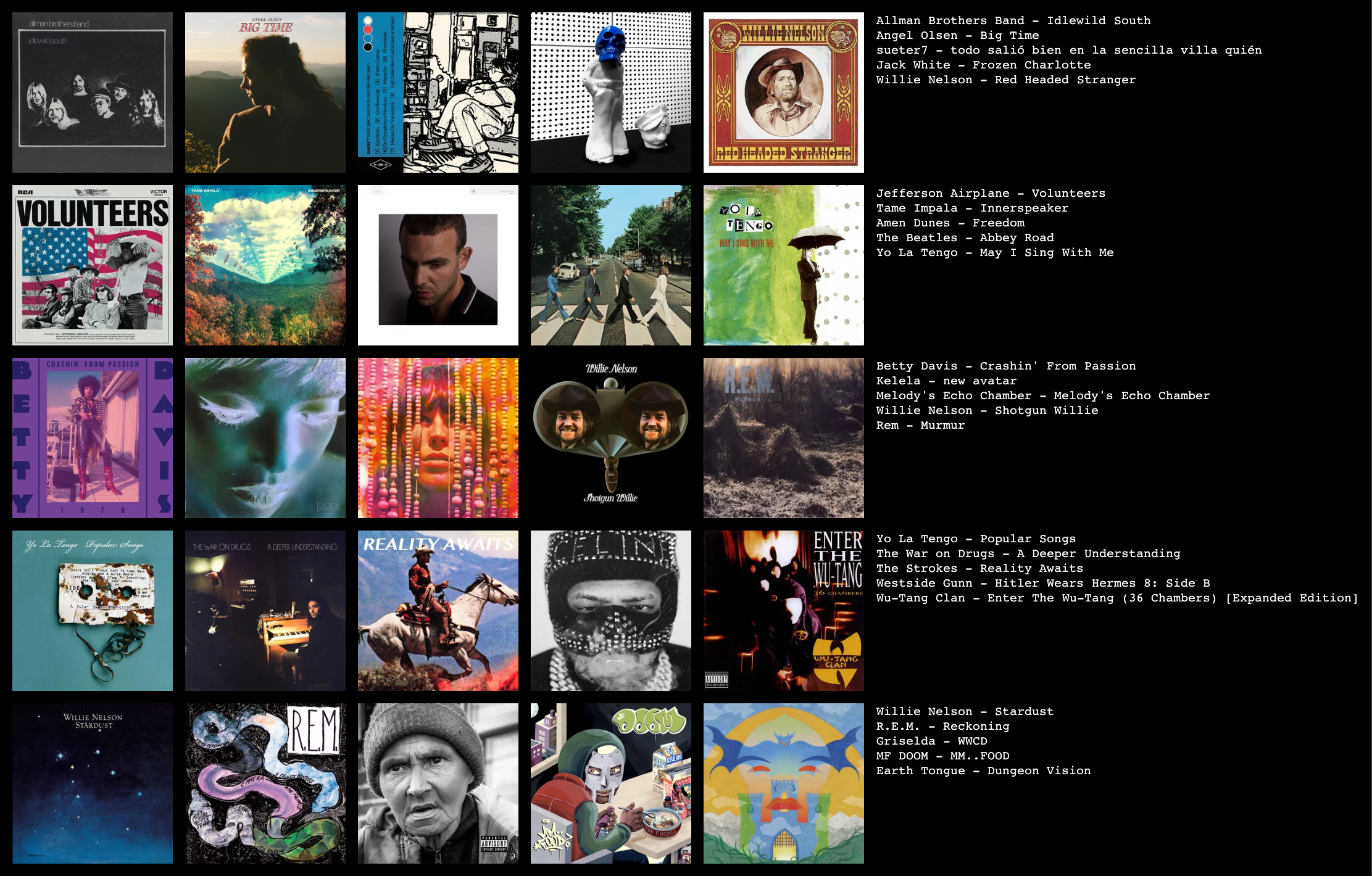
Jack White has now officially released more solo albums than White Stripes albums. No Name sits Jack White’s amp down in the garage, and Frozen Charlotte just keeps on delivering nasty riffs, licks, and pure blues rock. Jack has found his sweet spot in these last two albums, as they represent the White Stripes’ best work. Frozen Charlotte is a bit more spontaneous and angry than its predecessor, but a little less dynamic. This album welcomes us to the Garden of Eden at the end of the world. The Biblical references in the first track—which is a bizarre retelling of the story of Genesis—continue from the allusions from “Archbishop Harold Holmes” and “Bless Yourself” while a screeching, funk-laced guitar riff loops throughout. On “Neighbors Blues,” Jack uses his effects and pedals to make earwormy feedback, and the outrageous solo on “Derecho Demonico” is more proof of his singular guitar talent. The slide guitar on “Dollar Bill” sounds like he’s back to playing those crappy department store guitars on top of whatever $7K Tele Fender gave him to record. The first half of the tracklist is solid, but the second half is unrelenting force of fiery, hooky blues rock.
SCORE: 7/10
HIGHLIGHTS: G.O.D. and the Broken Ribs, Derecho Demonico, Dollar Bill, I Can’t Believe What I’m Hearing, Thick As Thieves, She’s In a Frenzy, Making Contact, Neighbors Blues
BRAT was going to be a difficult album to follow up, but the years since for Charli xcx have been too meta and self-indulgent for my taste. Her Substack reads like the banal musings of a moderately articulate 16-year-old, and that shallow writing carried over to this album, where the lyrics alternate between confessional and cringe and whiffed attempts at philosophy. Everything from the hooks to the album art to the title feels totally lacking in identity. The photo op with Martin Scorsese, John Cale, and Marc Jacobs reminded me of St. Anger era Metallica. Maybe my perception heading into this was tainted by a mocking tweet that said something to the effect of, “I’m Charli XCX and my new song will be a critique and analysis of the current moment called ‘My Critique and Analysis of the Current Moment,’” and her recent post about “anti-marketing.” Feels very art school freshman who thinks they’re an auteur for making music about making music, and the resulting album is so vapid that it calls into question how much of her bangers have been a product of her producers. It’s one thing to make lackluster art, but it feels especially gimmicky and MCU-coded to manipulatively deploy irony to pre-emptively halt any criticism of it. Both this album and the attendant film could’ve been interesting statements on celebrity culture, parasocial relationships, and meta-narratives if Charli fully committed to the bit of satirizing the Eras Tour. There’s a recurring old school power pop production that sounds phoned in, and the B&W aesthetic is tired. I could see this having solid remix potential.
SCORE: 5/10
HIGHLIGHTS: Rock Music, SS26, Camera, I’m Afraid, Wink Wink
This has been described as the dark mirror/evil twin of The New Abnormal, but Reality Awaits also bears many similarities to the electronic wasteland of The Voidz’s Like All Before You—albeit this is far more catchy. Where the free-flowing jams of The New Abnormal broke the Strokes mold of tight, punchy songs and allowed them to breathe and expand—although they still contained a sense of melody and precision. Reality Awaits emphasizes mood and atmosphere, and the tunes here are more formless and meandering. This isn’t necessarily bad, nor is it the unmitigated trainwreck that RYM-types have claimed, but it does make for a bewildering, abrasive, and straight-up bizarre first impression. Fortunately, it turns into a more obsessive earworm on repeat listens. Julian Casablanca’s use of autotune has been controversial, but it isn’t as excessive as the two singles would’ve suggested—although it remains fairly grating on “Falling Out of Love.” Standouts like “Dine N’Dash” and “Going to Babble On” are the fullest realization of the album’s aspiration of fusing cyborg cowboy with sinister new wave. While the back half of the tracklist settles into more familiar Strokes territory, although a bizarro-world version of it, it’s clear the lines that once demarcated the Strokes and the Voidz are eroding. Not every experiment lands, but I can respect that, over two decades removed from their seminal debut, the Strokes continue to push their sound.
SCORE: 7/10
HIGHLIGHTS: Dine N’Dash, Going to Babble On, Going Shopping, Liar’s Remorse, The Fruits of Conquest
Painful exists in different planes of space-time, transcending the present with every arched chord and whispered affections. Sweet autumn hangs in the pleasantly chilled air, drifting through winding backroads, no destination in mind because I’m snug in a warm seat that’s attuned to my body temperature and imprinted curvatures. Shadows and light shape the road. Open fields and unmanicured grass. Everything else is quiet and distant. This bright Sunday afternoon is full of slow nothings—a practically-the-same-but-slightly-different stretch of time that looks back and forward, metastasized by the doldrums of soft beauty. Every tomorrow is wide open and beautiful. A stroll by the stream. The crunchy leaves underfoot invoke a sense of renewal. The crispy air is invigorating, tapping into a season that balances solitude and space with possibility and life. My heart teeters on the edge, leaving me short of breath and falling forward into it. I think of my girl, kissing her and cuddling her, my arm wrapped around her as we look off a cliff and onto rolling hills clashing against the sea and embodying everything so impossibly wonderful about the world. Then we hold hands as we saunter around empty rain-slicked streets in the early night, and these soft splashy sounds make sense of it all. I wouldn’t change anything about my human experience, and it wouldn’t matter if it ended tomorrow.
If Painful embodies autumn, this screams summer. Not in the sense of sweltering mid-July days where the damp puddles of sweat stick your shirt to your back, and the temperature refuses to drop to something more bearable even as the afternoon rolls into the evening. This is a lazy early-June evening where you embark on a long, aimless stroll to the closest beach with your partner and the waves pound against the shore as their heart beats against their chest. It’s the music of love. You can hear the heart beating as one.
The tracklist is a box of chocolates, as every song is different and you have no idea what you’re getting next. “Return to Chicken” is more or less a prolonged guitar solo, “Sugarcube” has a shoegaze vibe, “Damage” is a drone tune, “Shadows” ventures into dream pop, and “Green Arrow” has a mellow guitar strumming over maracas and chirping crickets. “Autumn Sweater” is infectiously simple, built around a modest organ hook and a catchy almost-hip-hop beat. Yo La Tengo turns the Velvet Underground’s “European Son” inside out on “Moby Octopad” by emphasizing its dance elements. They show off range from the moody and jazzy “Shadows” to the country-influenced “Stockholm Syndrome.” This is an hour of uninhibited creativity.
There’s something eerie about being in the presence of meandering silence, in an apartment that doesn’t creak or sigh. Nothing is exciting or new about isolation, just stillness. It’s hypnagogic in the sense that it captures the state of lulling into a slumber. Ethereal and fleeting, this record strikes your thoughts precisely when you don’t fully concentrate on the music, like half-dozing off on a warm pillow. Despite the dreaminess and noise that dominates their sound, it’s always undergirded by a subtle but infectious groove. There’s a somber mood, but also playful. Close your eyes, and you can imagine random conversations with different parts of your subconscious, figments of an overactive moment of lucidity. It’s psychedelic in an off-beat way, as most albums in this genre feature heavy reverb, but here it’s more subdued; this is psychedelic in the instrument choices, the song structures, the recording styles, and the hushed vocals. It’s the sound of a nice night in.
This is Yo La Tengo’s most abrasive album, as if this is their attempt at making a Sonic Youth record. Having to follow up one of the best albums of a decade is no enviable position, but they allowed Electr-O-Pura to be a much sunnier and lighthearted affair with no unifying mood. Between this, Mellon Collie and the Infinite Sadness, and Wowie Zowie, 1995 seemed to be the year of sprawling and unfocused indie masterpieces that reward adventurous listeners who are amenable to open-ended experimentation and randomness. There are plenty of free-flowing songs here, some as vast and abstract as a Pollock canvas, with “Flying Lesson (Hot Chicken #1)” and “Blue Line Swinger” among the most expansive songs Yo La Tengo has ever recorded. But the shorter tracks maintain an epic quality thanks to the soaring guitars and organs. This album is about swallowing the listener in a wall of sound—part noise, part song—where everything seems to be drowning and transcendent.
This is the first album with James McNew as the bassist, and thus the definitive Yo La Tengo lineup has been established. This epitomizes a transitional album, representing the culmination of the band’s ‘80s run, before they started to venture into unmapped territories. The noisy rave-up “Mushroom Cloud of Hiss” is a YLT classic, as its alternating, two-note bassline and static drum pattern feel both indefinite and gratuitous. Other highlights include the acoustic elasticity of “Detouring America with Horns,” the propulsive melodies and trade-off vocals of “Upside-Down,” the ambivalent and brooding “Satellite,” the woozy balladry of “Always Something,” and the full-blooded and expressive “Five-Cornered Drone (Crispy Duck).” The band explores their dreamier side here, and you can see the gestations of Painful in May I Sing’s lustful sound.
This album has been overlooked (including by me) because of its reputation as boring, presumably because there aren’t loud guitars. But that’s not the point here. The post is to establish a gauzy, wistful synthesis of truth and love. The tone is deliberately bleary, with warm keyboard haze, tiptoeing drum loops, wafting saxes, and speckling flutes. It’s subtle, but not obscure or vagued-out. Georgia Hubley’s and Ira Kaplan’s expressions of unswerving love are touching. Every song delivers on the level of thoughtful chill-out music that’s perfect for afternoon walks, for breezy lakeside drives, or rainy days spent indoors. “Beach Party Tonight” is a faded home video of two lovers darting out on bicycles through a foggy morning. “Little Eyes” is a late-night insomniac wandering. “Nothing But You and Me” is a wobbly attempt at making up after an unspecified fight. “Winter A-Go-Go” has a mystical kind of frank sexiness. The 10-minute “Let’s Be Still” has muted trumpets and flutes flickering out over a twinkly keyboard. Just a very tender album.
After the gloomy Summer Sun, Yo La Tengo drops a gigantic smattering of long-winded Krautrock, wild psychedelic meltdowns, soul, lighthearted horn pop, and mellow hazy indie rock. It starts and ends with two long noisy guitar explorations that are reminiscent of May I Sing With Me. Ironically enough, “The Story of Yo La Tengo” is the checkpoint of their career up until the mid-aughts, an epic nod to everything they’ve released to this point. This is all over the place (compliment). Other highlights include “Sometime I Don’t Get You”, “Black Flowers”, “Daphnia,” and “The Race Is On Again.” This album feels like a bifurcation between Summer Sun—a culmination of their run of classic indie albums—and their regenerative late-stage era. I sense a lack of exigency here, as it doesn’t broach new ground in the way that their previous five records continually progressed to more subtle, mature, and gorgeous results. Instead, this feels like a simulacrum of their older records, an obdurately diverse splattering of different styles and experiments that have a danceable charm.
I never fully appreciated Yo La Tengo’s groovy side until Popular Music, as this plays to all their strengths while pushing their sonic borders. Essentially, they take bits of their previous output and reconstruct them as pop-art. “Here to Fall” throws in classic arch-pop string sections and sharp disco violins to some fuzzed-out bass buzz and bubbling psychedelic organ. The deep-seated grooves of something like “Moonrock Mambo” are polished and refurbished into the bouncy perfection of “Periodically Double or Triple.” The giddy fuzz-rock of “Sugarcube” morphs into “Nothing to Hide.” “When It’s Dark” reaches all the way back to their early jangly country-pop roots. The last three tracks all clock in around 10 minutes to give space for some massive guitar excursions. It’s just a great batch of feel-good songs on the verge of combustion.
Yo La Tengo drop a 46-minute album compared to the last few LPs that are roughly three days in length. The results are more focused, rather than a kaleidoscopic barrage. Fade is mostly comprised of sunny indie rock and dream pop, and that’s apparent from the onset with the hypnotic Krautrock thrusting of “Ohm.” “Before We Run” is a dazzling orchestral blowout. There’s also the claustrophobic noise pop of “Paddle Forward,” the adorable “Is That Enough,” and the subdued ambience of tracks like “I’ll Be Around,” “Cornelia & Jane,” and “Two Trains”—all of which recall Summer Sun. It’s some of the best easy-listening music you’ll hear.
This album is hypnotic in a very cathartic way. Yo La Tengo understands how to craft a soundtrack for late-night reflection. The sparse and surreal instrumentation carries a balance of calm, melancholy, and omnipresent darkness. This record has a pretty clear structure: Kick off the tracklist with two loud tunes, a mellow valley in the middle, and then a final sequence that gets back to the I Can Hear the Heart Beat as One-type shit. The disconcerting Krautrock grooves and droning guitars show up in “Tonight’s Episode” and “Until it Happens.” It doesn’t end in some triumphant guitar solo or a pleasant pop cut, but opts for a cut like “Miles Away,” which feels like a barren wasteland after the apocalypse of the abrasive title track. But that wasteland feels strangely comforting and intimate. Listening to this makes you feel tamed by the sun, except it’s night and the droning guitars create a fuzzy atmosphere that hugs you from all sides while drilling your eardrums.
New Wave Hot Dogs:
The Velvet Underground influence is still apparent, but there are glimpses of what Yo La Tengo would become: Noisier guitars, driving rhythms, and appropriately twangy vocals. The pieces are starting to fall into place, namely on highlights like “Clunk” and “Did I Tell You,” but there was still some ground to be covered between New Wave Hot Dogs and indie immortality.
President Yo La Tengo:
President Yo La Tengo is a little fuzzy and messy, but its most arresting moments synthesise the best of their ‘80s output: Abrasive and yelping jams like “The Evil that Men Do (Pablo’s Version)” and “Orange Song,” and bittersweet and loving ballads like “Alyda” and “I Threw it All Away.” “Drug Test” is an amalgamation of these two approaches, and “The Evil that Men Do (Craig’s Version)” is a languid and tempered version of the original, with prominent lounge and Bossa-nova influences. The strange dual-tone guitar of “Barnaby, Hardly Working” makes it a singular track in their discography almost 40 years on, a slow-burning and dancy dirge that refuses to surrender to any cinematic release. Overall, President lacks the precision and atmospheric depth of Yo La Tengo’s subsequent releases, but the experimentations with tone, timbre, and identity amount to an interesting transitional guile.
As their first three albums upped the ante with noise and abrasion, Yo La Tengo calms down with 16 breezy campfire tunes that exist somewhere between indie folk and Twin Peaks. There are few original compositions, as it’s mostly a scattered assortment of covers of John Cale, the Flamin’ Grooves, the Kinks, Gene Clark, other obscure artists, and two acoustic covers of songs from their previous records. The best of which is the rendition of John Cale’s “Andalucia.” “Can’t Forget” is a gorgeous opener, and other highlights include “Barnaby Hardly Working,” “Here Comes My Baby,” “Speeding Motorcycle,” and “Did I Tell You.” At its best, Fakebook is a decidedly plucking, freewheeling, and affecting album that’s surprisingly cohesive despite being comprised of mostly covers. Just some mellow indie suitable for an early morning autumn drive through some backwoods roads.
Like a glass of iced tea on a summer day, this album of mostly covers goes down smooth. At least Yo La Tengo does covers with verve and their own style, as they range from subdued to chirpy love songs. “My Heart’s Not in It” and “I’m So Lonesome I Could Cry” are standouts, and their take on the Cure’s “Friday I’m In Love” gives the OG a run for its money.
While There’s a Riot Going On borrows the title from Sly & The Family Stone’s landmark release, it sounds nothing like abrasive, politically-charged funk. This is a gentle reclamation of lethargy, but in an enveloping and enchanting way. If this album is dismissed as boring or homogenous, it could betray a lack of attentive listening or an attunement to subtlety. The first three to four tracks drift through well-trodden dreamy and sublime jangle before veering into an unnerving experimental sonic labyrinth that twists and turns through airy and electronic tones and Krautrock propulsions. Even a lesser Yo La Tengo is still a solid album, and the ideal setting to listen to this is lying in bed during a scalding afternoon as you wind down.
In a way, this is the perfect pandemic album. The world held in stasis by an airborne virus, so Yo La Tengo drops an album of a half-dozen static drone jams. Unfortunately, this was recorded on one microphone, which means the absence of the stereo spectrum, so it blunts the potential of this being an amazing headphone listen.
Yo La Tengo’s ’80s run of albums is different from the dreamy indie rock they would go on to be celebrated for, as they start as post-punk/alt-country disciples of the Velvet Underground. Their debut certainly sounds like a band trying to find their stylistic footing, but the songs flow well, and they were already willing to experiment with dynamic compositions like on “The Evil that Men Do.” There are also a handful of catchy songs and covers like “The Cone of Silence,” “The Way Some People Die,” and “Five Years.” You can hear the potential, as it was clear they had an extensive record collection and impeccable taste in music, but still needed to learn how to transcend those influences and turn them into a unique statement.
S-Tier: Painful, And Then Nothing Turned Itself Inside-Out, I Am Not Afraid of You and I Will Beat Your Ass
A-Tier: President Yo La Tengo, Electr-O-Pura, I Can Hear the Heart Beating as One
B-Tier: New Wave Hot Dogs, Popular Songs, Fade, This Stupid World
C-Tier: Ride the Tiger, Fakebook, May I Sing With Me, Stuff Like That There, There’s a Riot Going On
D-Tier: Summer Sun, We Have Amnesia Sometimes
E-Tier: N/A
F-Tier:
N/A
Comments
Nothing yet. Say the first thing.
Sign in to join the conversation.