
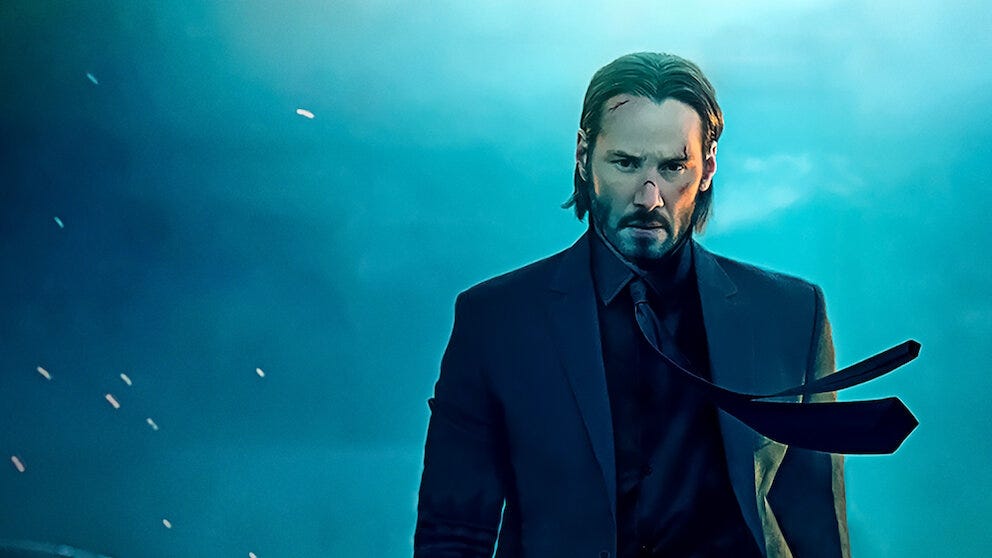
If someone else harmed my beagle, I too would hunt down an entire mob to seek revenge—except I would get owned immediately. John Wick, meanwhile, reshaped the action genre by fusing balletic violence, mythical storytelling, and meticulous world-building. The franchise evolves from a tightly contained revenge story into an expansive saga that explores the vast underworld of hitmen. Its commitment to choreographed movement, practical stuntwork, and tactical gun-fu choreography established a new standard for action blockbusters. Although John Wick is known as a showcase of precise violence, it introduced a stylized neo-noir universe governed by ritual, codes of honor, and consequence, giving the action franchise a renewed sense of narrative structure and thematic heft. As the series progresses, the lore surrounding Wick’s world deepens—the Continental Hotels, the High Table, and the intricate economy of markers and gold coins—and his vengeance for his dog transforms into a meditation on obligation, identity, and the cost of violence.
As the films escalate, Wick descends. The more he fights to escape his past life and the assassin underworld, the more entangled he becomes in it. It’s a tension between individual agency and institutional control. Together, the quadrology offers a cohesive study in how style, choreography, precision, and mythic resonance can create a franchise that’s commercially successful and boundary-pushing.
Anyways, let’s get to it…
(SPOILERS AHEAD)
DIRECTED BY: Chad Stahelski
SCREENPLAY BY: Derek Kolstad
CINEMATOGRAPHY: Jonathan Sela
EDITED BY: Elísabet Ronaldsdóttir
MUSIC BY: Tyler Bates, Joel J. Richard
STARRING: Keanu Reeves, Michael Nyqvist, Alfie Allen, Adrianne Palicki, Bridget Moynahan, Dean Winters, Ian McShane, John Leguizamo, Willem Dafoe
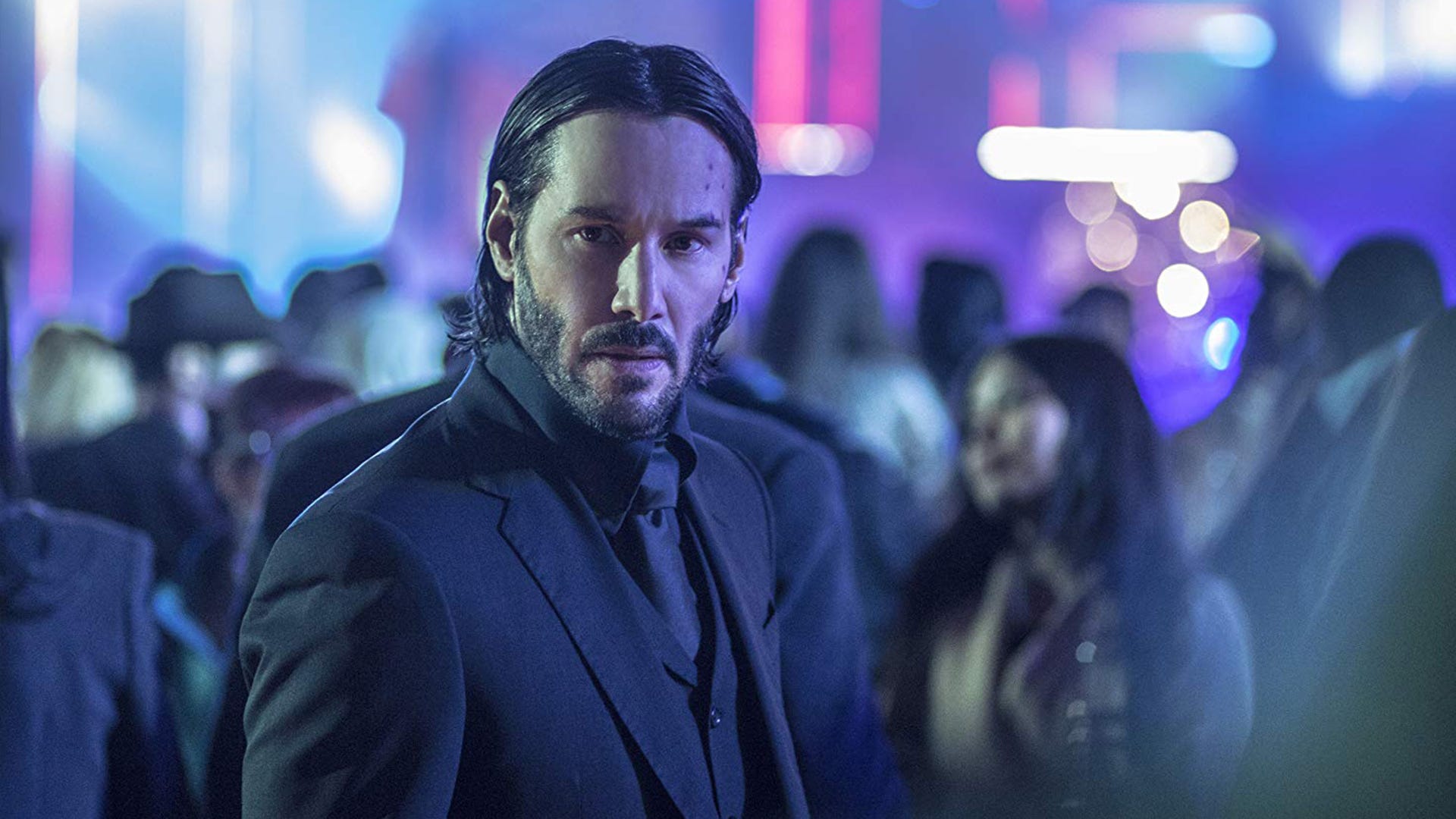
As the titular character ostensibly dies in the opening minutes, only to cut back to a montage of his morning routine with his dead wife’s belongings strewn about his house, John Wick wastes no time setting a tone. “It’s days like today scattered among the rest,” Marcus (a friend and fellow hitman) assured John at his wife’s funeral. “Don’t blame yourself.” Can a man find redemption, or should he be allowed redemption when his sins are so vast? Is John Wick a bad person who became good or a good person who has done bad things? Well, he’s a cold, cunning, ruthless ex-assassin grieving the loss of his wife Helen, and he spends his days recklessly driving his 1969 Boss 429 Mustang to grasp at the adrenaline rush he no longer feels now that he’s out of the hitman life. Helen left him a final gift in the form of a puppy named Daisy, who symbolizes a new beginning and a potential for hope, a continuing connection to his marital bond. When mobsters from his past life break into his home and kill Daisy after trying to intimidate him into selling his Mustang, it not only forces him back into his pathologically violent tendencies, but it destroys the future he yearned for. The man who snuffed Daisy is Iosef, the son of the boss of NYC’s Russian mafia named Viggo Tarasov, and since he’s a fake mobster who doesn’t have the stomach for murder, he left John to presumably bleed out.
When the stolen Mustang is brought to a high-end chop shop, the owner, Aurelio, has this terrified realization on his face, almost revering John as an Angel of Death. Aureolo pulls out the peligroso—which is Spanish for “dangerous”—for John when he strolls into the shop looking for his vehicle, and he is mentally prepared to get murdered by a vengeful hitman. The gesture is about respect, a prominent theme throughout, and especially the consequences of a lack of respect. Viggo, upon learning what his son did, greets him with a glass of Quintessentially Q Vodka, a high-end label that represents wealth and power, made to be sipped by those who exclusively fall into “luxury lifestyle management.” Iosef downs it in one gulp, because he was given a silver spoon but never gained any appreciation for this lifestyle. Viggo immediately punches his son in the stomach, just so he can feel the burn on its way back up, and to send a message: What can be given can be stripped away with ugly violence. Viggo explains to Iosef the full ramifications of what he’s done to John, insinuating that he built his wealth on the bodies of his slain competition, hinting that he hired John to carry out all the dirty work. Meanwhile, John takes a sledgehammer and smashes up the concrete foundation of his seemingly peaceful new life to unearth a chest of weapons and gold coins. “When Helen died, I lost everything,” John tells Viggo. “Until that dog arrived on my doorstep... I received some semblance of hope... an opportunity to grieve unalone... And your son... took that from me... Stole that from me... Killed that from me!” John’s reawakening into a violent world, while not sentimental, is a necessary confrontation with the past he can no longer escape and a need to return to the familiar in the face of loss.
Despite his rage and fury, John offers Viggo the choice to let him exact his revenge and walk away with his business and life or to fall into ruin, and this film becomes a battle between a desperate father and a grief-stricken widower. From there, it’s non-stop cultivated fights and shootouts from stuntmen, gun nerds, and martial arts nerds, so the action choreography is complex, slickly performed, and manages to stay readable despite the chaos. When John takes down a few dozen mobsters in the nightclub, Iosef escapes and slithers into the crowd; the camera is shaky and confused, while John is stalking behind, and the lens is smooth and controlled.
Keanu Reeves intensely trained for gun handling and martial arts, and his fighting looks grounded; even if it’s not realistic, it’s stylistically believable. There’s something visceral about a mid-fight reload, or he fistfights when he’s out of magazines, or he switches between weapons realistically depending on the situation. The entire warehouse assault is a cakewalk for John, and when he finally confronts Iosef, he domes him immediately without even giving him a chance for a last word.
Viggo undergoes a slow but absolute unraveling, as he is always consuming some mind-altering substance. He’s nursing a glass of Russian Standard, a luxury vodka brand most popular among homesick Russian expats, longing for comfort and dulled senses after he realizes he must choose between saving his son or his empire—and he sends a hit squad to John’s house that he knows will fail. Next, he’s sitting alone in a chair, spending all night polishing off an entire bottle of 18-year-old Glenlivet, trying to dull his senses with refined Scotch stereotypically enjoyed by gentlemen, so he understands that his nights of relaxing in his fineries are numbered, and there’s no point in saving and savoring anymore. He rejects vegetable juice because he understands his future to be an inevitable death, and smokes on a sloppily rolled joint, marking the collapse of his facade. Before his demise, Viggo is wasted in the backseat of a limo, screaming for cigarettes and giggling about his impending doom, and he’s reduced to a petulant teenager not unlike his son. He is nothing more than an undiscerning drunk, and he dies slumped over on the pavement in a gutter—alone, rained on, utterly destroyed.
The main question asked only gets the beginning of an answer. The protagonist is sympathetic mostly because his wife passed away and his dog was killed. John exists in a liminal space between his past and his present. His mind is temporally porous, and his body reflects this detachment through its ability to endure both physical and psychic punishment. This porosity intensifies with every kill, becoming more entangled with a violent past. This movie reeks of a man going out in one last rampaging blaze of glory, but John is simply a scorned man calmly writing some wrongs. His fate is more Sisyphean, doomed to roll the murder boulder up a hill only to have to roll it back up over an accumulating pile of dead bodies.
DIRECTED BY: Chad Stahelski
SCREENPLAY BY: Derek Kolstad
CINEMATOGRAPHY: Dan Laustsen
EDITED BY: Evan Schiff
MUSIC BY: Tyler Bates, Joel J. Richard
STARRING: Keanu Reeves, Common, Laurence Fishburne, Riccardo Scamarcio, Claudia Gerini, Ruby Rose, Lance Reddick, Peter Stormare, Bridget Moynahan, Franco Nero, John Leguizamo, Ian McShane
Where John Wick once had agency in his deliberate choice for rampaging vengeance, now he is forced back into his old life of cold-blooded killing. He is addicted to the fatal justice he serves with such panache. With seemingly nothing else to live for, the question of whether John deserves redemption shifts to whether John even deserves to live. Nothing that happens to him can compare to the passing of his wife or a mobster failson murdering his dog, but our protagonist arguably loses even more: His car is destroyed, and his house burns to the ground, as his physical memories connecting him to a different life no longer exist. John is no longer fighting for Helen or Daisy; he is fighting because he fought for Helen and Daisy. All of this is, as you could say, Sisyphean.
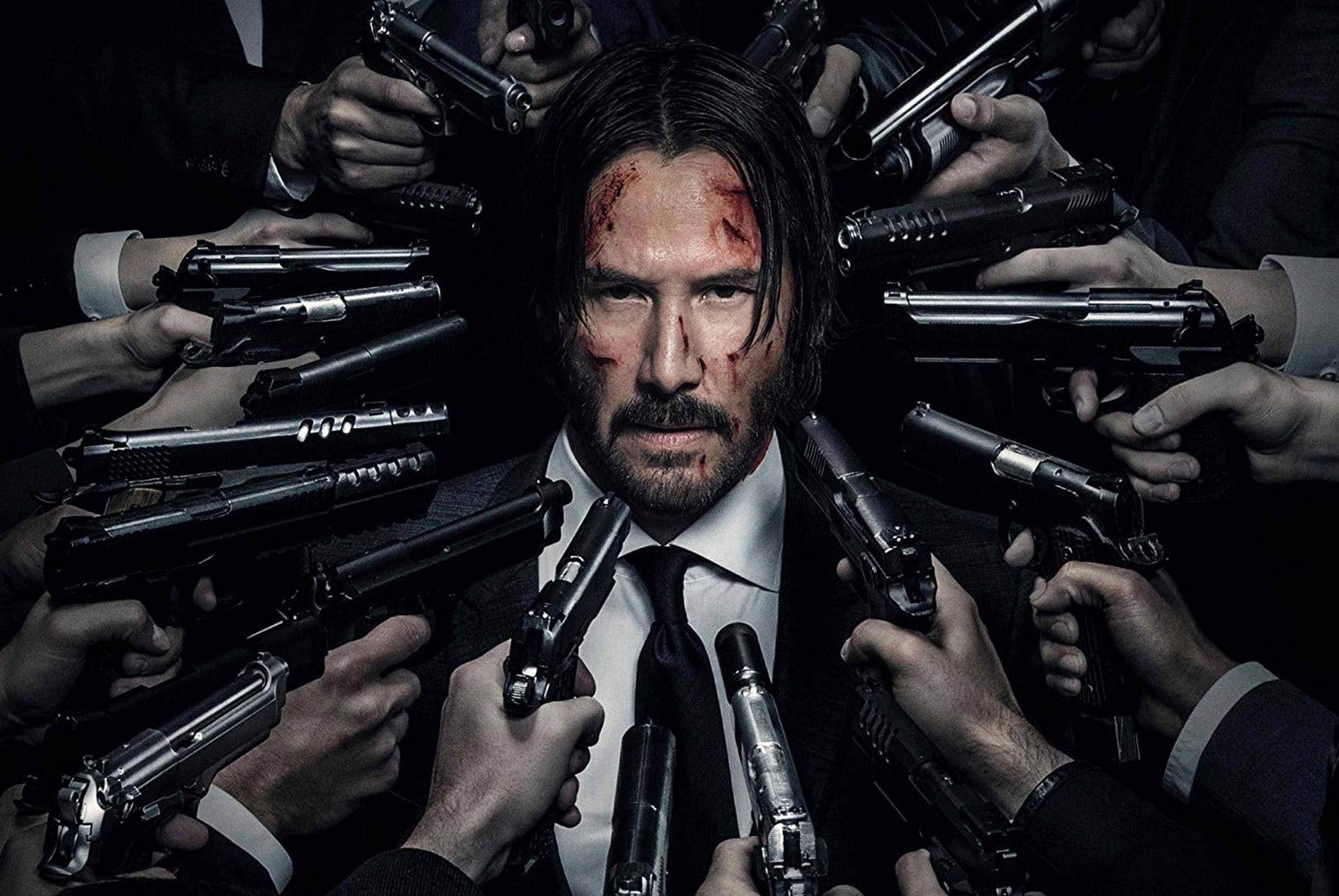
John has already avenged Daisy and now wants to recover his stolen vintage Mustang, and the opening sequence juxtaposes him fluidly moving in and out of shadow, killing anyone who stands in his path, with ricocheting bullets and belabored screams growing more cartoonishly overwrought with dread. From there, we plunge deeper into the mythology of this underworld of assassins, blood oaths, and arcane rules. John’s reputation is built entirely through his $7 million bounty and tales of his exploits. We see how John prepares for his job, as he integrates an array of weaponry into a bespoke suit so he can slice through cold-blooded killers with the grace of Fred Astaire. He is also a man of taste, conversing with a firearm sommelier about weaponry and the metaphors of fine dining.
The action is also expanded—John’s body count here is 128 compared to 51 in the first film—and all the bone-crunching, blood-splattering, and intense battle are all caught in continuous wide shots. The violence is never one-note, running the gamut from darkly humorous to oddly poetic. But it is always brutal: Assassins are sliced in the groin, stabbed in the thigh, snuffed in a subway system, or impaled with a pencil. The more memorable fights involve John creating dance crafted with punches, flips, and gun-fu. Everything is unpredictable—not an immediately obvious sense since we know John will succeed in committing haunting acts of violence against countless opponents—but in the build. We don’t know when he will stop and talk, when a jokey one-liner will arrive, or whether he will punch up, unload an entire clip in a shoot-out, or break into a knife fight. But the camera never flinches, forcing us to bear witness. The film also cannily uses misdirection, building scenes around predisposed action movie expectations before subverting them by having John do something at odds with what we’ve braced ourselves for. It’s an added sense of tension and paranoia that heightens the atmosphere.
John may be a legend, but he can never escape his past. The dichotomy between choice and pathology is clear. While the inaugural film ended with what appeared to be no intent for a sequel, Chapter 2 closes with a purpose to push further. After John kills Santino in the Continental—breaking the hotel’s cardinal rule of providing a safe haven—he is excommunicated from this syndicate, and a cloud of danger begins to close in around him.
DIRECTED BY: Chad Stahelski
SCREENPLAY BY: Derek Kolstad, Shay Hatten, Chris Collins, Marc Abrams
CINEMATOGRAPHY: Dan Laustsen
EDITED BY: Evan Schiff
MUSIC BY: Tyler Bates, Joel J. Richard
STARRING: Keanu Reeves, Halle Berry, Laurence Fishburne, Mark Dacascos, Asia Kate Dillon, Lance Reddick, Anjelica Huston, Ian McShane
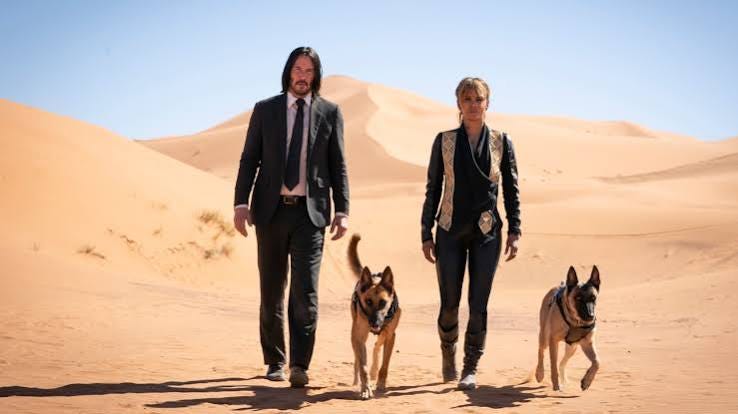
Picking up mere moments after its predecessor—actually, at most, a week has passed since Ioseph had the audacity to kill John Wick’s dog—but hundreds of bodies later, it’s hard to tell if this killing spree is still about vengeance or compulsion. After John is declared excommunicado, the movie plays out like a brutally playful mean streak. John fights swarms of hitmen on horseback, he snaps a seven-foot-tall man’s neck with a rare antique book in the New York Public Library, he throws knives like he’s in a snowball fight, and he travels to Casablanca and finds himself in a shoot ‘em up with a pack of Malinois tearing up opponents by the limb. He simply fights, while looking sharp in a black designer suit, going from point A to point B while knocking over bodies.
Absurdly formal violence is treated with the etiquette of 18th-century fine dining and the grace of Baryshnikov. In this universe, the fighting gets more ridiculous and creative because John has finally shaken off the rust of retirement. When he first reentered this world, we went for the easiest and quickest kills, but as he finds his groove and as his opponents are stronger and fling themselves at him with greater frequency and intensity, he has to adapt. He’s gone from a local mafia gang to specific assassins and his target’s old bodyguard, and now the entire underground assassin world is after him. The same blunt force approach loses effectiveness, and now he’s become a man who has mastered a video game by playing through a campaign on max difficulty.
Adjudicator appears as the underworld’s criminal justice response to John’s transgressions, as for people who live outside the bounds of real-world laws, the few rules they do obey are strict and draconianly enforced. This honor among thieves code is the only thing separating these outlaws from descending into total chaos, preserving the last bit of their humanity. His transgression throws the entire underworld off balance, and it cannot bear its existence, assassins attacking him like white blood cells fending off a disease. As John descends deeper, he loses more of his identity to prolong his life—his tattoo is branded with a cross to mark it as void, he grovels before The Elder, and he severs the finger that adorns his wedding band to prove his fealty.
The root of all conflict around John Wick is his wife: Loving her gave him another point of moral reference. The source of the organization’s repressive power is that its rules are believed to give these outlaws a sense of humanity; one who manages to exist outside of it is unacceptable. John returns to the Continental to free himself of the religion of the Table, to purge all its traces from his mind. As the lobby turns green while SWAT-like mercenaries surround the premises, it signals a person’s inner space, John mastering the creed of this organization and killing it within himself. As John works his way up to the final assassin, Zero—who mirrors John in many ways—the glass-covered rooms mix the colors, mirroring his internal battle of individuation. His battle with Zero is a final slaughter of his inhumane reflexes that suppress his emotions.
The fight completes his arc as a member of the criminal sect, but as the two fall in a state of exhaustion, an ad for a watch is clearly visible from outside the windows, foreshadowing that John isn’t done running after all. Even as Chapter 3 ends, there will be more war, as there doesn’t seem to be a finality to John’s mission.
DIRECTED BY: Chad Stahelski
SCREENPLAY BY: Shay Hatten, Michael Finch
CINEMATOGRAPHY: Dan Laustsen
EDITED BY: Nathan Orloff
MUSIC BY: Tyler Bates, Joel J. Richard
STARRING: Keanu Reeves, Donnie Yen, Bill Skarsgård, Laurence Fishburne, Hiroyuki Sanada, Shamier Anderson, Lance Reddick, Rina Sawayam, Scott Adkins, Clancy Brown, Ian McShane
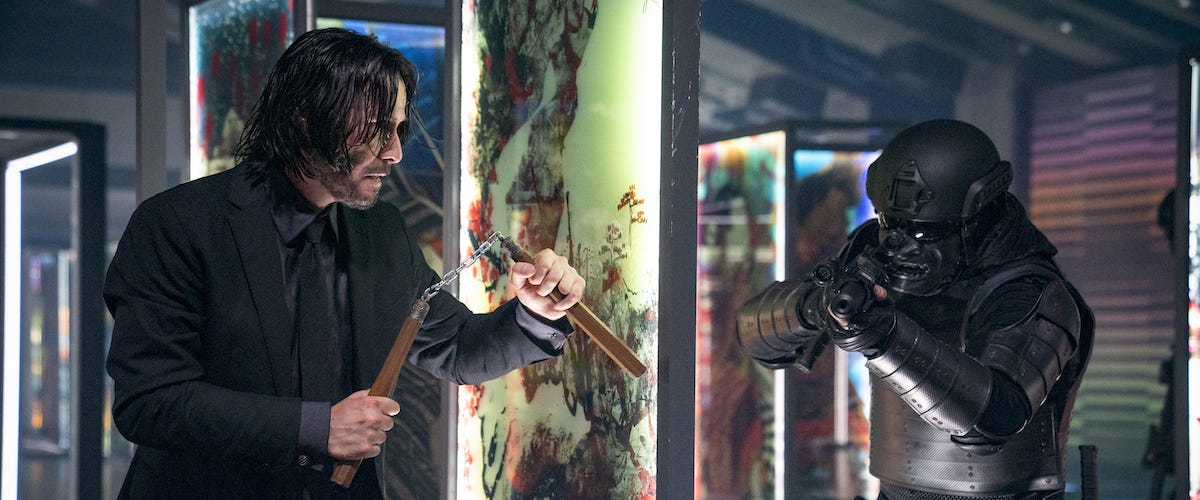
John Wick: Chapter 4 opens with its titular character on the run again—seemingly betrayed and brutalized and left for dead alongside the Bowery King—as the villainous High Table gets in his way. John is once again killing to survive as the stakes rise all the way to Marqu de Gramont, a leader of the High Table who keeps raising the bounty on John’s head while cleaning the messes left behind. His enemies are more desperate to kill him, and seemingly every hitman in this international crime syndicate is out for blood. A recurring theme in this franchise is that anyone who crosses John’s path, friend or foe, usually ends up dead—and here, some of their deaths are brief, others are prolonged and painful.
The opening scene unfolds in Japan, where John seeks help from the head of the Osaka Continental, Shimazu, and runs afoul of a blind High Table assassin named Caine. He trusts and honors John so much that he’s willing to sacrifice everything to sanctify that bond. “Friendship means little when it’s convenient,” indeed. Friendship permeates throughout the film as John has to call on as many favors as possible to somehow survive this level of carnage and destruction. John is pushed to the absolute brink and can only really survive with some kind of support—Bowery King occasionally pops up as John’s Q when he needs a new bespoke bulletproof suit, and Tracker follows John almost as a dark guardian angel as he waits for the price on his head to hit a satisfactory level to collect his payday.
The action scenes zip around the world, from Japan to Paris. They consist of long battles, gun-fu shootouts between John and dozens of hitmen, all filled with momentum and bone-crunching torture. Seemingly every assassin in continental Europe is after John’s head, and the setpieces keep piling on top of one another, all with wonderfully defined stakes. At one point, John and an enemy decide on the parameters of a battle, including time, weapons, and variables. The simplicity of objectives and clarity of intention allow for complex choreography.
John has to battle Killa Harkan and his army of goons in a crowded nightclub, and the dancers barely notice, sometimes parting a bit to let them through, but they don’t stop and stare at the writhing bodies while water pours in. There are multiple bits where John is directly hit by a car, flipping and rolling on top of moving vehicles; and he even commandeers a muscle car and uses it both as movement and weapon as he mops up baddies around the Arc de Triomphe. The cars don’t stop, and no one even rolls down their windows, even as shots ring out in the streets. There’s also a gauntlet in an abandoned building as John moves from room to room with a shotgun that unloads explosive, fiery shells, filling his predatory foes with shrapnel, a Hotline Miami-style bloodbath. The finale does not be satisfied with one firefight or gauntlet, so what begins innocuously as a trip to meet and finally achieve reconciliation quickly turns into another murder spree.
While every John Wick film is set against a somewhat morally grey backdrop of revenge and redemption, Chapter 4 is more blunt with its Christian symbolism, with key scenes in ornate churches and even a High Table representative speaking to God in Latin. And for John to gain forgiveness from the High Table, he has to slay his way and fight to near death. Even if he succeeds, will John Wick be satisfied? Will he ever escape this life without death? Can a globally renowned killer ever be at peace?
The first John Wick may still be the best, but it is essentially divorced from the rest of the franchise. It is tighter and smaller. Bullets actually matter, he actively reloaded mid-fight, and each battle was a grueling step toward his goal of vanquishing Vigo and avenging the death of his dog. As we ventured deeper into the assassin underworld, the franchise veered toward superhero-esque stakes, as the action and set pieces exchanged believability for grandeur. By what is presumed to be the end of this series, we have traversed through a smorgasbord of ridiculous action sequences, and while there are some undeniable flaws, it’s a hell of a ride. It slows down when it needs to, creating delicate character moments in between the chaos, but it also just lets you live out your inner super assassin in moment-to-moment carnage. It is excessive, bloody, beautifully choreographed violence escalated into a gonzo bonanza.
That’s it for this week’s instalment of The Watchlist, brought to you by Beaglesgate Productions.
The Watchlist will be back in August. In the meantime, let me know your thoughts on John Wick, where it places among your personal favorites, or if you think the series is overrated.
Comments
Nothing yet. Say the first thing.
Sign in to join the conversation.