
This is part of the YOUR VOTE, OKLAHOMA series — a free, nonpartisan guide to voting for every Oklahoman. You can start at the beginning with What Is Voting and Why Does It Matter? or catch up with How Do You Find Out When Elections Are Happening?, Are You Eligible to Vote in Oklahoma?, Who Are These People on My Ballot?, What Is Voter Registration — and Do You Actually Need It?, How to Register to Vote in Oklahoma (Step by Step), and What Is a Primary Election?. New here? Welcome. No judgment. No assumptions. Let’s go.
Imagine you and your next-door neighbor head to the polls on the same day. You both live on the same block. You both go to the same polling place.
But when you each look down at your ballots — they might not match.
You might be voting in a State House race that does not appear on your neighbor’s ballot. Your neighbor might be voting in a County Commissioner race you have never heard of. One of you might see a State Senate primary. The other might not.
How is that possible?
The answer is districts.
In Oklahoma, where you live determines what you vote on. Not what city. Not what neighborhood. The exact street address on your driver’s license. And the lines that draw those districts do not always follow streets, fences, or any boundary you can see from your front yard.
This is one of the most confusing parts of voting for the first time. But it is not complicated once you understand the basics.
Let’s walk through it.
A district is just a piece of geography with lines drawn around it. Inside those lines, voters choose one person — or one group of people — to represent them in government.
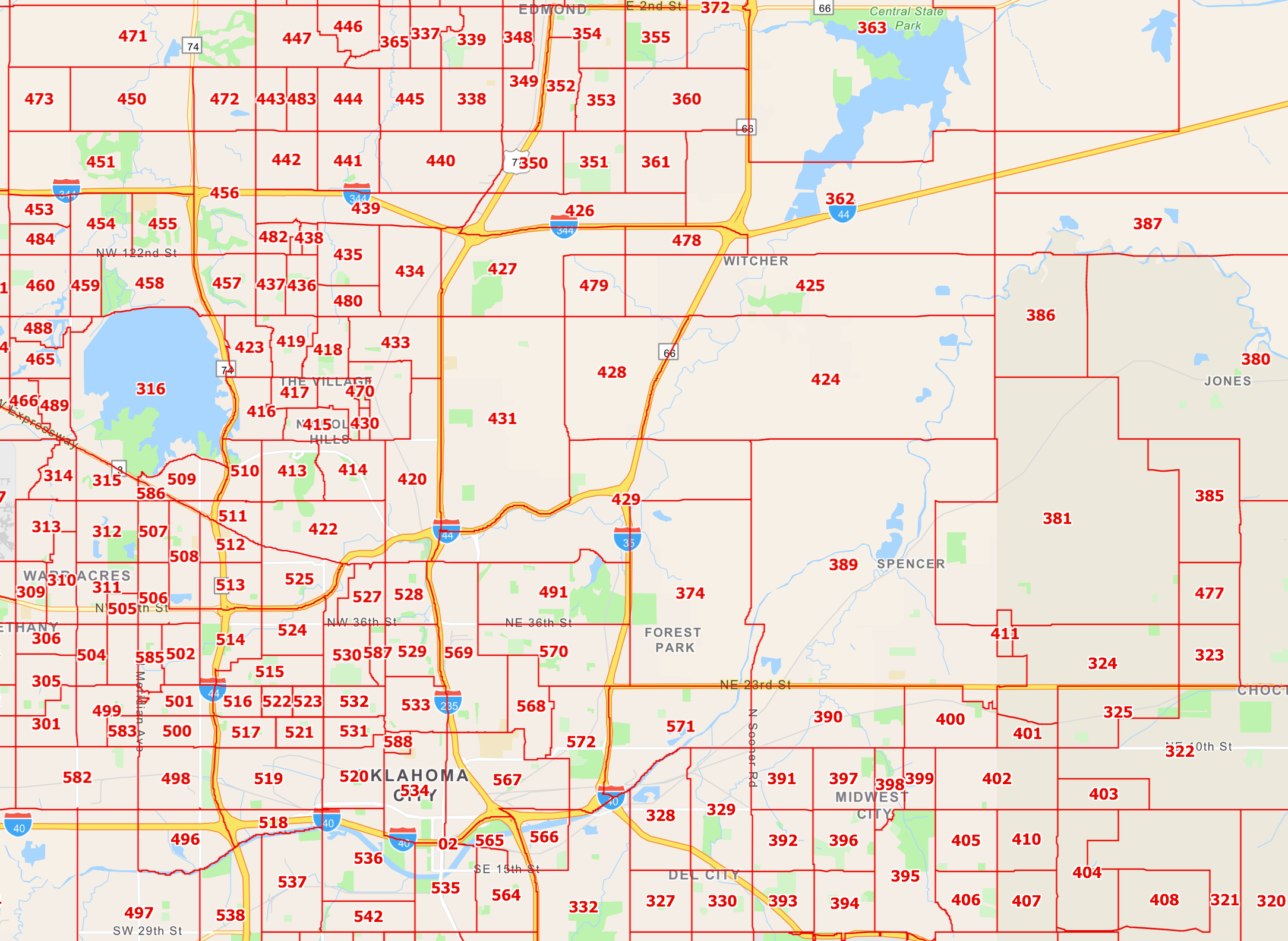
There are a lot of different kinds of districts. Some are huge. Some are tiny. Some overlap with others.
Think of it like a map with several see-through sheets stacked on top of each other. One sheet shows your county. Another shows your State House district. Another shows your school district. Each sheet has its own lines. Where all those lines come together is where you live — and that combination is what makes your ballot unique to you.
Here are the main types of districts you live in as an Oklahoma voter.
Oklahoma has five U.S. Congressional districts. Each one elects one member of the U.S. House of Representatives. These are big districts — each one covers a large part of the state.
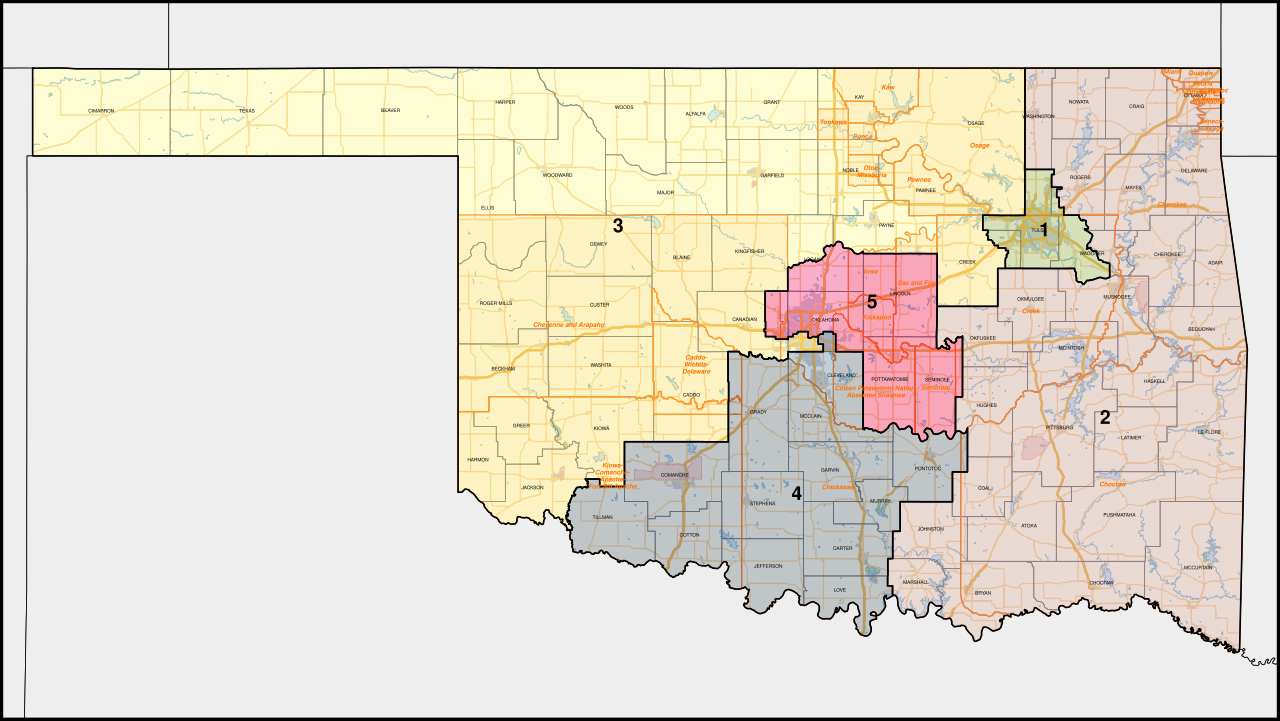
Your congressional district depends on where you live. If you live in northeast Oklahoma, you might be in District 1. If you live in southwest Oklahoma, you might be in District 4. The Oklahoma City area and parts of central Oklahoma are mostly in District 5.
Every Oklahoma voter lives in one — and only one — congressional district.
Oklahoma has 48 State Senate districts. Each one elects one State Senator. State Senate districts are smaller than congressional districts but larger than State House districts.
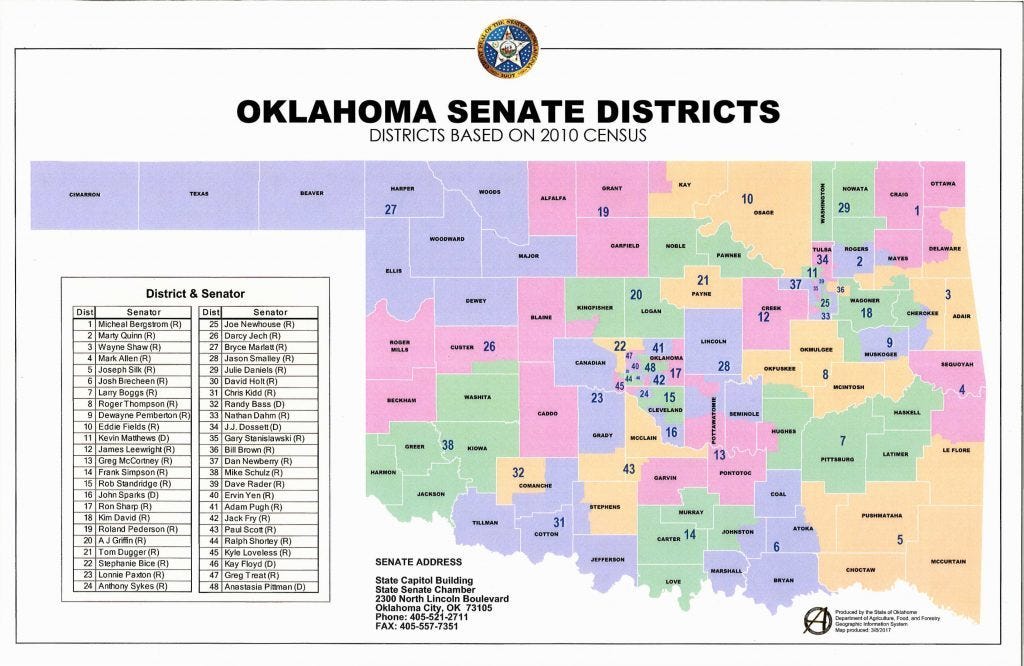
State Senators serve four-year terms. That means only half of the Senate seats are up for election in any given year. So you might live in a Senate district with a race this year — or you might live in one where the race does not happen until 2028.
Oklahoma has 101 State House districts. Each one elects one State Representative. These are smaller than Senate districts — a single State Senate district usually contains two or more State House districts inside it.
State Representatives serve two-year terms. That means every State House seat is on the ballot every two years. If you live in Oklahoma, your State House seat is up for election in 2026.
Oklahoma has 77 counties. Your county is determined by where you live. You vote on county-level offices — like County Commissioner, County Sheriff, County Clerk, County Assessor, and County Treasurer.
County government affects your daily life more than most people realize. County Commissioners decide how local tax money gets spent on roads, bridges, and county services.
Inside each county, there are three County Commissioner districts. Each commissioner is elected by voters in their own district — not by the entire county. So even though you live in, say, Oklahoma County, you only vote for the commissioner in your part of Oklahoma County.
Not every commissioner seat is up in every election. The three commissioner seats in each county are on different election cycles.
You also live in a school district. School districts have their own boundaries that often do not match county or state legislative boundaries at all.
Your school board decides how local schools are run, hires the superintendent, and oversees the school budget. School board elections in Oklahoma are held in February and April — not in June or November. They are separate from the elections most people talk about.
Oklahoma is also divided into judicial districts. There are 27 District Attorney districts statewide. Each one elects one District Attorney — the lead prosecutor for criminal cases in that area. District Judges and Associate District Judges are also tied to these districts.
Whether you see a judicial race on your ballot depends on which district you live in and which judicial seats are up this year.
Finally, there is the smallest piece of the puzzle: your precinct.
A precinct is the specific area assigned to one polling place. Your precinct does not elect anyone on its own — but it does decide where you go to vote on Election Day.
When you walk into the polls — or when you pull up your sample ballot online — you will only see the races that apply to where you live.
That means:
You will only see one U.S. Congressional race — the one for your district
You will only see one State Senate race — and only if your Senate seat is up this year
You will only see one State House race
You will only see county races for your county
You will only see your County Commissioner race — and only if your seat is up this cycle
You will not see races from other parts of Oklahoma. You will not vote on a State House race in Tulsa if you live in Lawton. You will not vote on a County Commissioner race in Cleveland County if you live in Garfield County.
This is why two neighbors can have different ballots. If a district line runs down the middle of your block — and they sometimes do — you and your neighbor might be in different State House districts. Different ballots. Same election. Same polling place. Different choices to make.
This is the good news: you do not have to figure any of this out on your own. The OK Voter Portal will tell you.
Here is how to do it, step by step.
Step 1: Go to the OK Voter Portal at https://oklahoma.gov/elections/ovp.html
Step 2: Click on the OK Voter Portal Login link.
Step 3: Enter your name and date of birth — exactly as they appear on your voter registration.
Step 4: Once you are logged in, look for the option that says “View Voting Districts.” Click it.
Step 5: The portal will show you a list of every district you live in — your U.S. Congressional district, your State Senate district, your State House district, your county, your school district, your county commissioner district, your precinct, and your polling place.
Write these down. Take a screenshot. Save it somewhere you can find it later. This information will be useful for years to come — not just this election.
Step 6 (Bonus): While you are logged in, click “View a Sample Ballot for Your Precinct.” This shows you exactly what your ballot will look like on June 16. Every race. Every candidate. State Question 832. All of it — laid out the way you will see it at the polls.
This is the single best thing you can do to feel prepared for Election Day.
Here is the catch: the OK Voter Portal can only show you your districts if you are already registered to vote.
If you are not registered, the system has no record of your address — so it has no way to tell you which districts you live in.
The voter registration deadline for the June 16 Primary Election is May 22, 2026.
That is three days from today.
If you are not registered, you need to take care of that first — before you worry about districts, ballots, or anything else. Our previous article walks through all three ways to register: How to Register to Vote in Oklahoma (Step by Step).
After May 22, it will be too late to register for the June Primary. There is no same-day registration in Oklahoma.
Right now, go to the OK Voter Portal and do two things:
Check whether you are registered. If you are not, register today.
If you are registered, log in and look up your districts and your sample ballot.
👉 https://oklahoma.gov/elections/ovp.html
Once you know your districts, you will know exactly what races are on your ballot. Once you have seen your sample ballot, the whole thing stops feeling unfamiliar.
The deadline is three days away. Do it today.
Stay Connected With Thanks For Voting OK
Never miss an article in this series. Follow Thanks For Voting OK so you always know what is coming next.
🌐 Web: https://thanksforvotingok.com/
📸 Instagram: https://www.instagram.com/thanksforvotingok
🎵 TikTok: www.tiktok.com/@thanksforvotingok
🦋 Bluesky: @thanksforvotingok.bsky.social
🧵 Threads: https://www.threads.com/@thanksforvotingok
YOUR VOTE, OKLAHOMA is a nonpartisan voter education series. We do not support or oppose any candidate or political party. We just want more Oklahomans to vote.
No posts
Comments
Nothing yet. Say the first thing.
Sign in to join the conversation.