
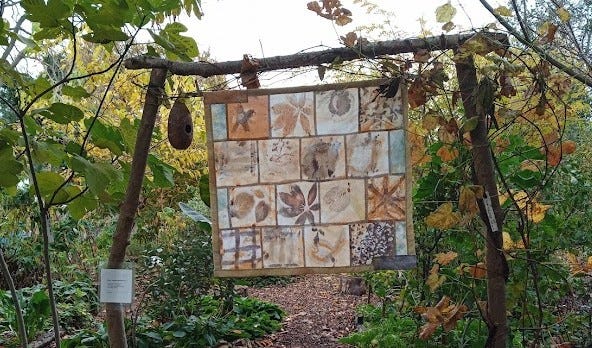
I grow at two dye gardens, one on my allotment and one at Edible Landscapes London (ELL) in Finsbury Park. The garden at ELL is an experiment to see which dye plants will grow successfully in the semi-woodland conditions at Edible Landscapes using Forest Gardening methods. We’re not following a textbook because we haven’t found one that includes both dye plants and forest gardening. There have been some successes, some things that just didn’t work and some curious mysteries.
Our aim is to grow enough plants that produce red, yellow and blue, plus assistant plants to be able to harvest the plants and dye with them. Progress so far:
Madder has been a surprise success. Conventional wisdom says it grows best in sunny chalk meadows but it is thriving in woodchip under the Ginko tree.
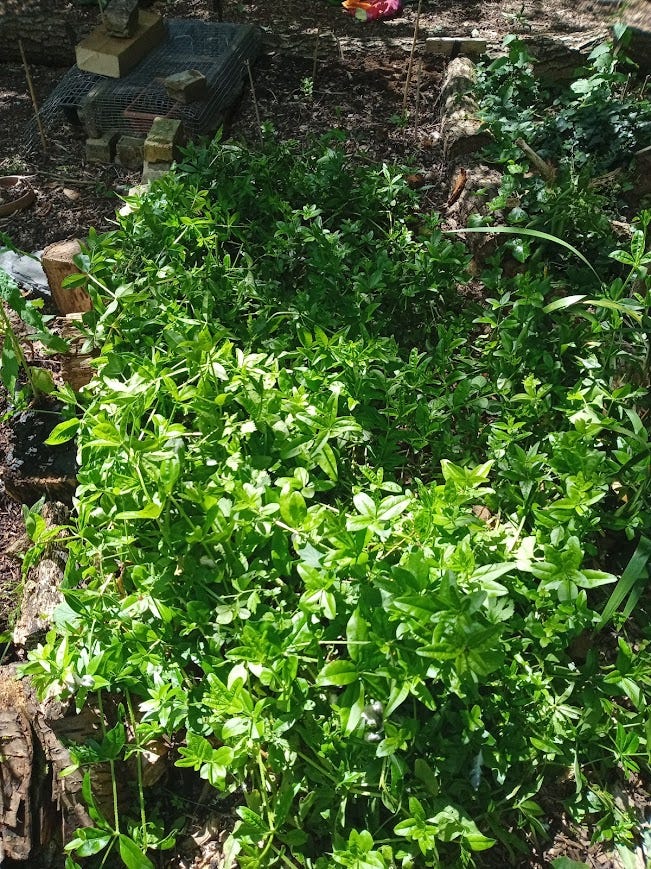
June 2024: Madder at ELL with an ad hoc plant protection system in the background
Giant Rhubarb after two plants mysteriously disappeared, possibly eaten by something with good teeth and a strong stomach, we are now protecting two plants with root training plastic and have hopes that they will survive and grow.
Native Golden rod took a long time to establish, perhaps because it’s under a hyperactive holly tree but is now producing flowers. We need to work out how to stop them turning to seed after harvesting so we can use them.
St Johns Wort also slow to get going, we’re layering the shoots to produce more and making sure it stays clear of leaves in Autumn and winter so it doesn’t rot.
Buddleia. A new addition to the shrub layer, still small but growing successfully.
Chamomile Just hanging on to life, it might need different soil and more sunlight than we have.
Weld is a meadow biennial, it just doesn’t like it at ELL, most plants die, a few produce small flowers. Probably a combination of root competition from the holly and limited sunlight.
Yarrow Growing slowly
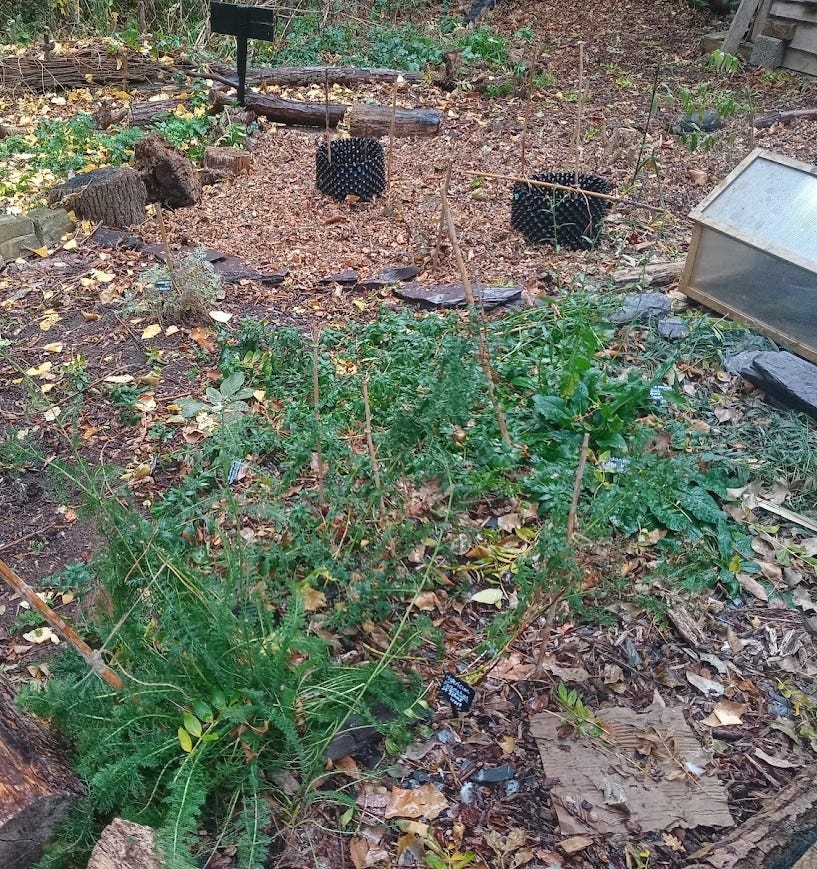
October 2025, Yarrow, Goldenrod and Murasaki with an empty patch where the woad was and two carefully protected rhubarb plants behind
Yew there’s a huge yew tree by the garden entrance and we’ve recently discovered that it can be used for dyeing.
Young Fustic (Cotinus) Planted several years ago and still only a few inches high. May be a plant that needs more sunlight than ELL can give it. The leaves print in beautiful colours, so we’re hoping it will get bigger.
Woad is normally so successful that it’s considered invasive. We haven’t had that experience at ELL. To start with it grew OK but since 2023 it’s just slowly died. There’s probably a number of reasons including root competition from the holly, dry summer conditions and squirrels developing a taste for the young leaves. We’ve departed from normal no-dig forest garden practice, dug a patch of soil to remove the holly roots and replanted in the autumn to try and establish some plants.
Japanese Indigo is an annual that needs a lot of water. As ELL aims to minimise watering we’ve taken a different approach with this plant and improvised a hydroponic system using buckets and air root training pots. It’s worked well and we have produced enough to try fresh plant dyeing techniques.
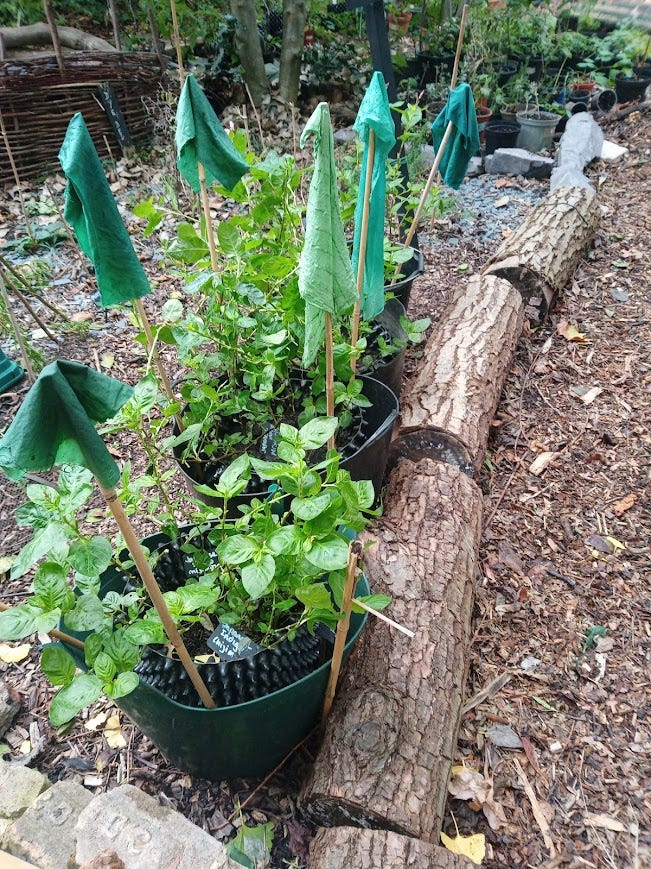
October 2024: Fresh leaf dyeing with Japanese Indigo grown in buckets
Murasaki, another Japanese plant is growing well and self seeding. The roots produce a purple dye. Soon we will be able to dig some up and try it out.
We are planting a small Alder Buckthorn hedge so we can make green ink with the berries
Ginko and Rhubarb both contain Tannins and Oxalic Acid, which we use in plant dyeing. We are planning to plant Staghorn Sumac as another source of tannin. There are thoughts of growing soy beans to “proteinise” cellulose fabric in 2026.
Other residents: We have a variety of non-human garden users, including foxes, squirrels, crows and many invertebrates. Some like to eat our plants or just to pull them up for fun. We don’t want to harm any garden users but we do want our plants to flourish so we are experimenting with physical barriers to protect young plants and scattering chilli to deter squirrels and foxes.
Perennials, Biennials and Annuals: Traditionally Forest Gardens are mostly perennials but some of the best dye plants are biennials or annuals. Deciding what we grow involves a mixture of looking for perennial alternatives for the various colours, for example yew, buddleia and dyers broom for yellow, rather than biennial weld and looking at creative ways of using annuals, such as a semi-hydroponic system for Japanese indigo.
Roots: The garden is sited next to a number of trees, including a fast growing male volunteer holly. The holly has grown an impressive network of surface roots that are too much competition for our smaller and younger plants. It is increasingly affecting their growth and ability to survive. We are looking at controlling the holly and possibly, as it is very common locally and isn’t providing food or shelter for us or other animals, removing it. Most trees do not have shallow roots and can coexist with other, smaller plants, unfortunately this tree can’t.
Water: A few dye plants, particularly Japanese Indigo are thirsty and grown conventionally they need more water, more regularly than we want to provide. We are looking at keeping those plants contained with a reservoir of water so they can grow without daily watering.
No posts
Comments
Nothing yet. Say the first thing.
Sign in to join the conversation.