
Dorothy was Guild member from1950-1972 and a Vice President from 1968. Phoebe died in 1934.
Dorothy and Phoebe were the youngest of Josiah and Emma Wilkinson’s six children, born in 1884 and 1886 respectively. Josiah was a solicitor, the family were financially comfortable and lived in a large house in Kensington. They grew up wearing William Morris fabric in a house full of beautiful arts and crafts.
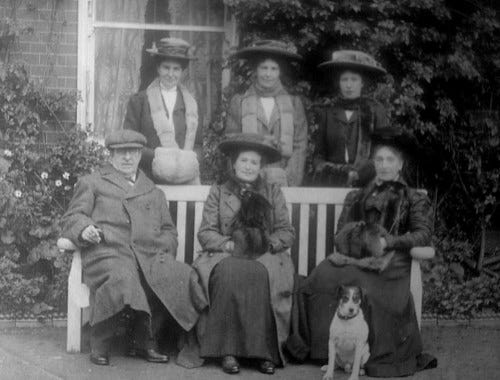
When Dorothy and Phoebe were born, Queen Victoria was on the throne, women could not vote or be granted University degrees in the UK and there was no television or radio. They started their weaving business in1919. When it eventually closed in October 1970, Dorothy, in a newly woven red dress was on on ITV’s “Today” programme in full colour. 1
Dorothy’s inspiration to start weaving was to help other women out of poverty. She had seen the drudgery of young women’s lives during her war time work. In 1918 when her older sister ordered some handwoven material from the Handloom Association to match her carnelian earrings she realised “that might be the job for me to start to employ girls”. 2 It might seem like an obscure choice now but in the 1921 census, weaving was the 4th most common employment for women.
Once Dorothy had decided to take up weaving she trained for 18 months in a “very primitive” Greek technique with Mrs Alston and Miss Parkes in Willesden. Her father then suggested she installed a loom at home in Holland Park and she started work with her sister Phoebe, who took over dyeing the yarn, in Easter 1919.
Her first employee at Kensington Weavers was Miss Parkes, her second a local girl, Florrie, from a Kensington School. They were all working on fabric for the 1920 Ideal Homes Exhibition. She soon had four looms, adopted the “Spitalfield method” to improve quality and opened a shop in Bedford Gardens. She worked with large department stores, took on individual commissions for clients including the Governor of the Bank of England and the Guild of Silence and trained other women to weave.
In 1932 her business, Kensington Weavers, took over the London School of Weaving at the request of the retiring owner, Miss Grassett, moved to larger premises on Kensington Church Street, began teaching for schools and institutions and making looms for sale . Dorothy described this as “a true, live fairy tale with looms, spinning wheels and masses of material of all kinds” 3
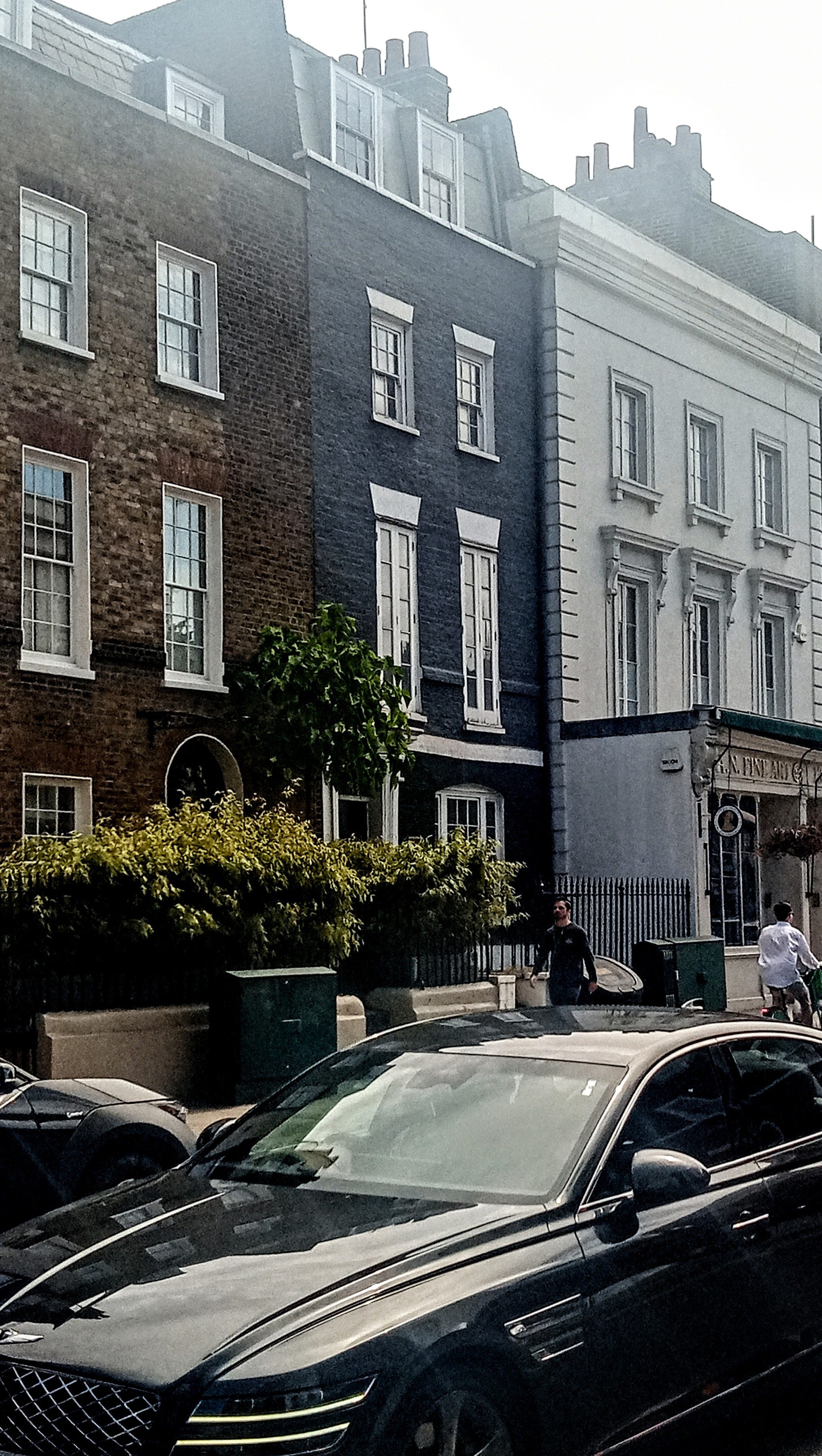
136 Kensington Church Street. Home of the London School of Weavers from 1932 to 1973. (currently an accountants office with a view of a permanent traffic jam)
By 1937 European politics were affecting the business. She employed a Jewish Austrian weaver who had fled the country and was given contacts with Jewish companies needing cloth who could no longer trade with Europe. She successfully dealt with Home Office bureaucracy to get the weaver’s brother to the UK away from imprisonment in a camp, trained him to weave and gave him a job.
The business premises were briefly occupied by the ARP when war started but then returned to weaving. They made a variety of products, including woven heating panels for Southern Rail, “Botany Lengths” for a Czech couturiere and headscarves -because people had stopped wearing hats and power looms were not working.
Dorothy taught widely, giving lectures to LCC Handicraft teachers on weaving and natural dyeing and to WRENs with Violetta Thurston throughout WW2. The school trained displaced Polish people during WW2 through the Polish Resettlement Corps and supplied 50 looms to military hospitals for occupational therapy.
After the war teaching continued with retired military personnel, people setting up their own businesses and displaced persons, including many Poles. One pupil was Gwen Shaw, who went on to found the LGWSD. The International Wool Secretariat became a client, holding classes and summer schools to train spinners and weavers, (but only in wool, no linen!). She also taught at the Institute of Handicraft Teachers summer school for many years. Teaching weaving took Dorothy all over the country. She taught and lectured at Guild summer schools, some of which she hosted at the London School of Weaving and made several trips across the Atlantic including to Canada, where a student wrote a poem in her honour:
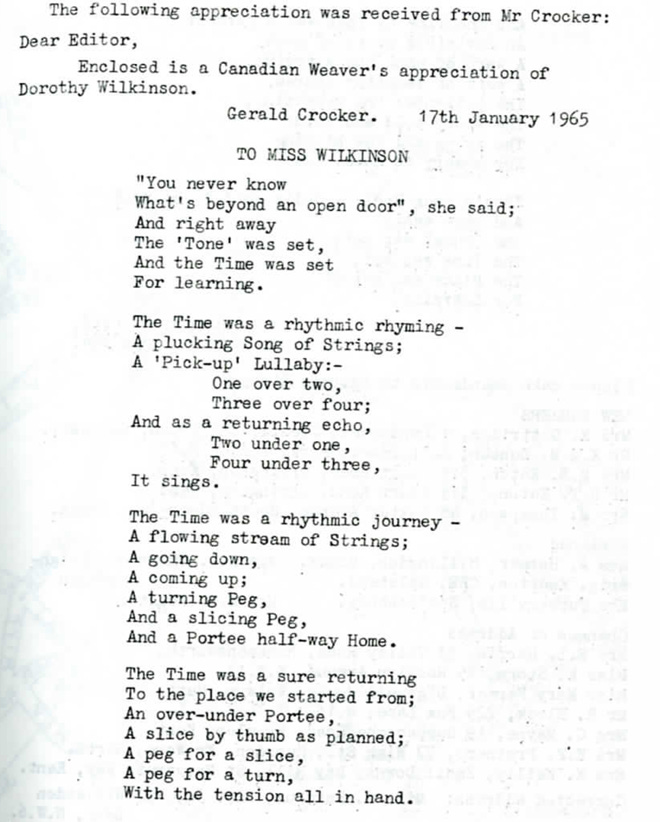
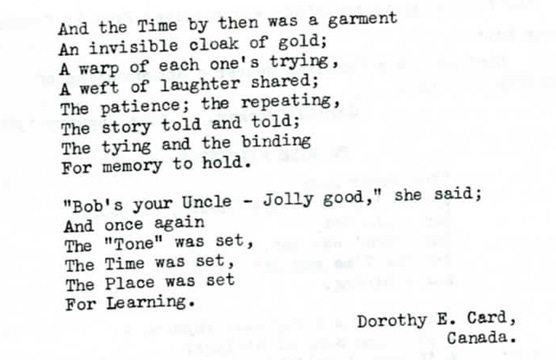
She was sometimes quite forthright about her students, commenting in Issue 29, 1958 that over time people had become “more sheep like but better educating on weaving”
During the late ‘40’s and ‘50’s there were 7 production weavers including Maria Abela, a Latvian who “served the necessary period in domestic work, which was required for women refugees” before joining the business. Women generally left when they got married and had children but some stayed long term, Mrs Moore, who joined in the 1920’s was still with them in the 1960’s. Others came back, sometimes with their daughters. Florrie worked from 1922 to 1930, left, returned in 1949 and stayed until the 60’s. Her daughter Margaret started in the 1940’s leaving in 1954 and coming back in 1962. Some staff had disabilities, Dorothy tells a sad story about Daisy, who was blind, wove tweed for a private girls schools’ uniforms and could feel when it was woven correctly. She had a live in companion who cooked and cleaned for her. When the companion married, she couldn’t find another and had to give up her job and independent life and move into a home.
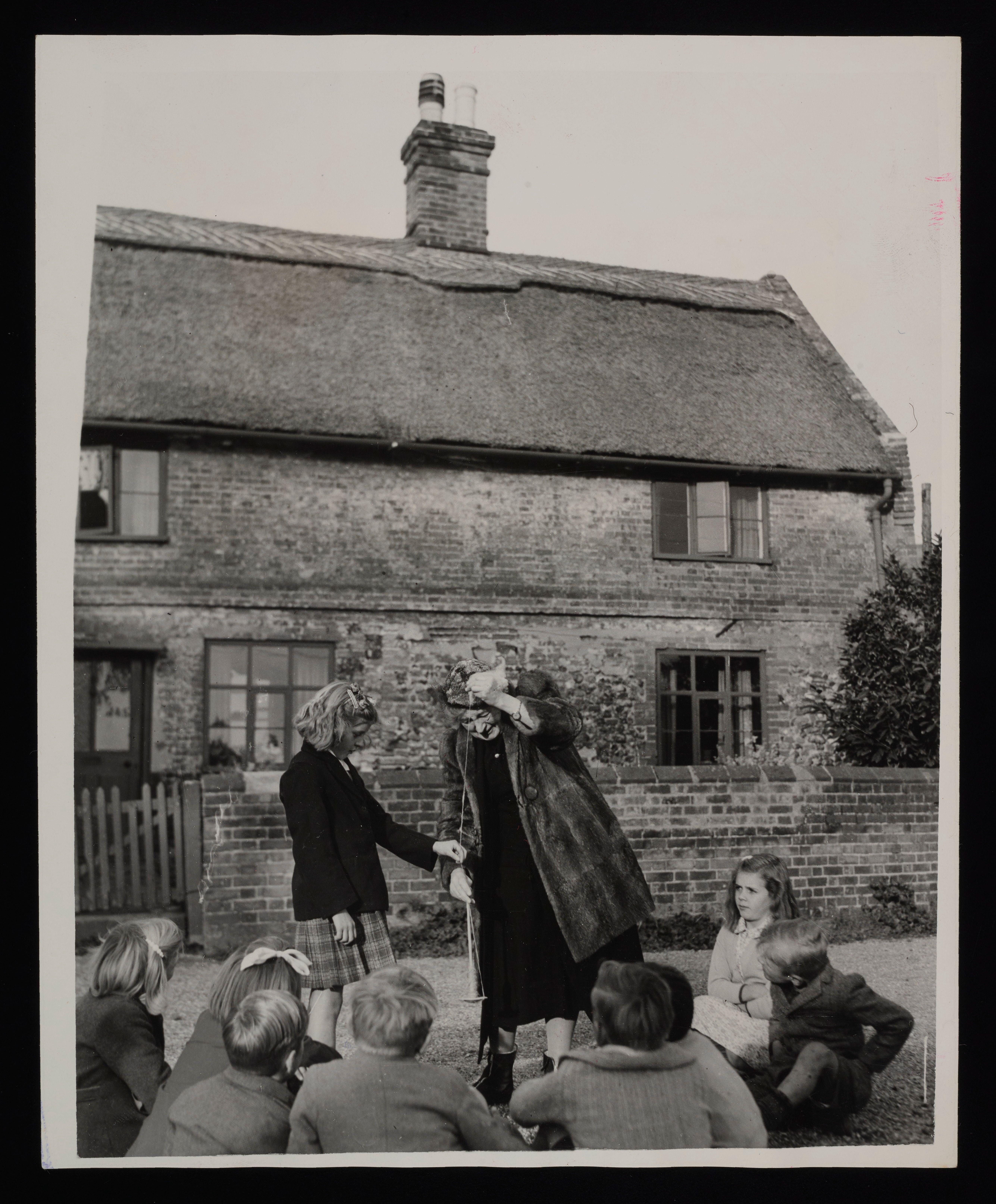
7 Nov 1949 Planet News. “Worstead stages a comeback - Worstead England: In front of one of the two old flint weaver’s cottages, which date back to the original Flemish weavers, Miss Dorothy Wilkinson of the London School of Weaving demonstrates the use of a spindle to young Margaret Smith while other youngsters still in a half-circle watching.
The production of weaving equipment however, expanded. In the mid ‘50’s they received an order from the Crown Inspectorate to supply 250 treadle looms, 250 table looms and 170 spinning wheels to Ceylon. This order was then doubled and over 1000 pieces of equipment were sent. The business, making equipment, teaching weaving and producing cloth continued successfully until 1970 when the original lease expired and the rent increased from £700pa to £1700pa.
Guilds experienced a resurgence in the 1930’s and Dorothy was involved in several during her career. Before becoming a founder member of the London GWSD she joined the first trade guild in London and exhibited tartan silks at the National Guild of Weavers, Spinners and Dyers Exhibition in 1935.
Dorothy says, in one of her later articles that she believes the bespoke weaving work began to decline from the point that their shop was closed and there was no outlet to find new customers. Perhaps due to this experience she was a strong advocate of the London Guild becoming a selling Guild, acting as a showcase and agent for members work. She didn’t succeed in persuading people and the Guild focused mainly on weaving as a hobby and the education of it’s members.
We know quite a lot about Dorothy and Phoebe because Dorothy wrote about her life as a weaver extensively in the Guild’s quarterly magazine, “Warp and Weft”. Part 1 of “32 years a Weaver” was published in 1951, in issue 2; the series continued in every magazine, finishing with Part 73 of what became “47 years a Weaver” in issue 80 in 1970. She celebrated “50 years a Weaver” in 1971, issue 84 when she was 86.
Dorothy lived until 1975 and was still an active, vocal member of the Guild in the early 1970’s. She was much loved and respected, when remembering her, people spoke of her personality and enthusiasm, her indomitable spirit and her skill and patience. Florrie said she would “always remember her with happiness”
ww_Issue002_1951_06.pdf (only available to LGWSD members)
ww_Issue020_1955_12.pdf (only available to LGWSD members)
No posts
Comments
Nothing yet. Say the first thing.
Sign in to join the conversation.