
Sugar has had quite the August. Front-month ICE No. 11 Sugar is up over 20% month to date.1 The price jump has come as traders raced to cover short positions and get in front of a potential supply crunch.2 El Nino3 may already be having an impact. Forecasters see a Super El Nino forming as the event strengthens through year end, and we think the market could only now be starting to price that in.
To be certain, there is plenty of sugar in the world. As late as May, the USDA was projecting a production surplus with ending stocks reaching 44.4 million metric tons.4 For context, this would mark the second consecutive year in which production exceeds usage.5 That is a fundamentally bearish dynamic.
It’s no surprise that the trade has maintained a net-short for the first seven months of the year. What is somewhat surprising is how fast the market has flipped to a net-long.6
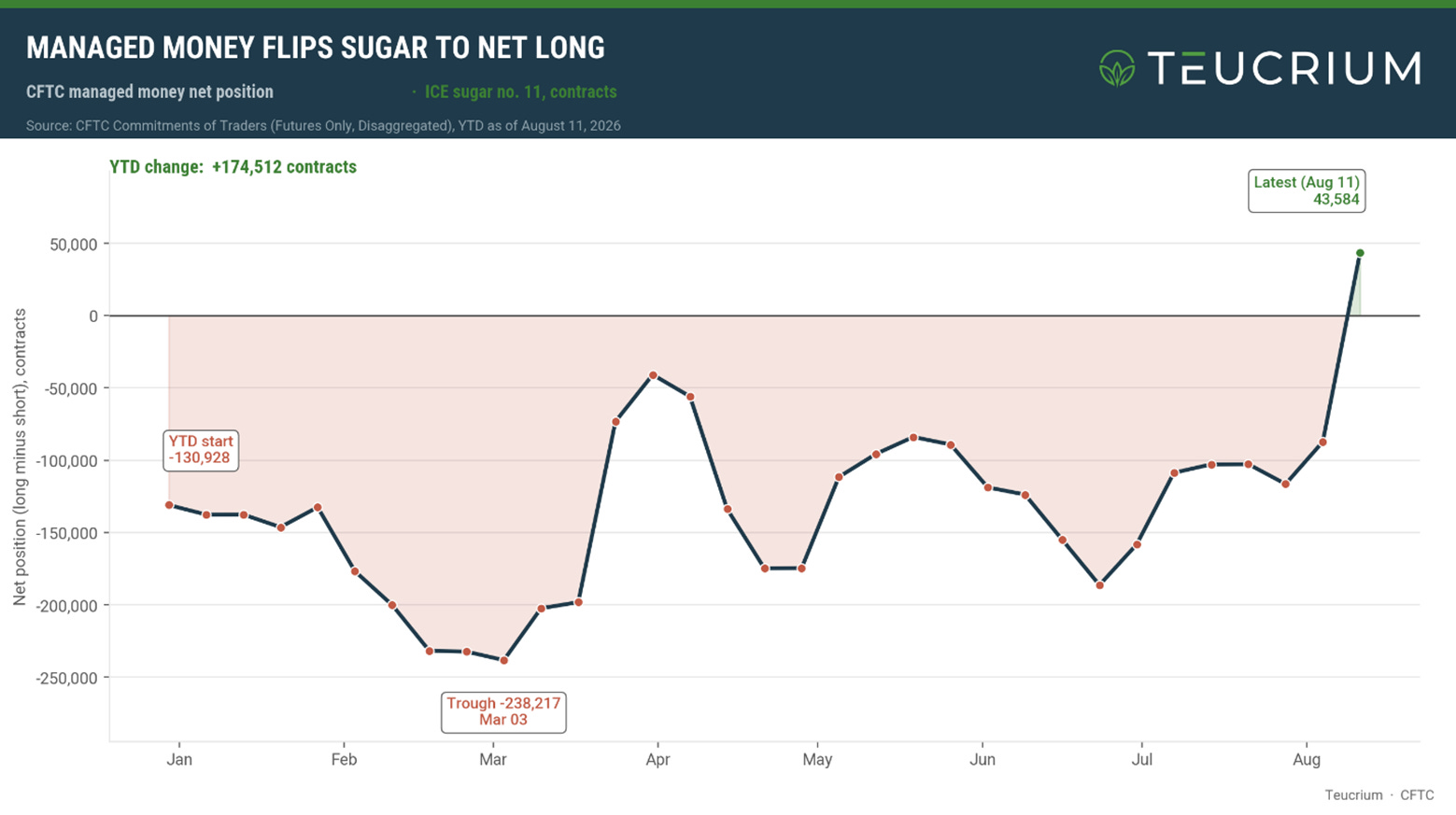
Even so, a bullish narrative has been building, albeit slowly.
For our regular readers you’ll recall that we’ve been keeping an eye on two major stories:
India export restrictions
Brazilian ethanol crush
India and Brazil are global sugar juggernauts. Combined they represent 41% of global production and 59% of global exports.7
India is the smaller of the two, accounting for 16% of global production and ~5.5% of global exports.8 On May 13th this year, India announced an outright restriction on sugar exports.9
Prices rallied into the first part of May, then reverted into a downtrend even after the restriction landed. Taking Indian exports out of the market was not enough to spook the bears, and the trade began adding to the short position straight through June.10
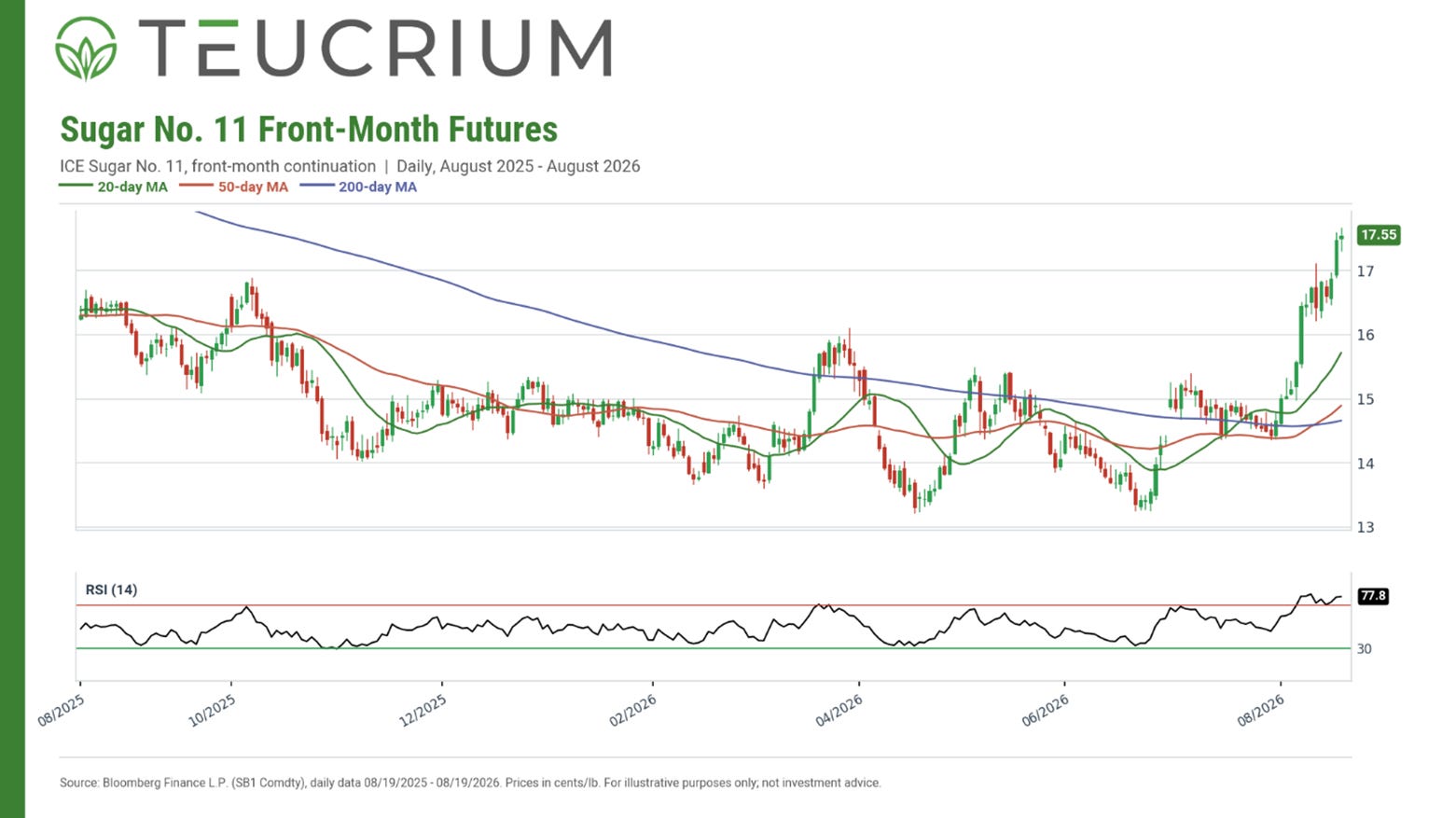
Then in July, reports began circulating that India may scrap its 100% duty on imported sugar.11 The news suggested that record high domestic sugar prices were pressuring leaders in New Delhi to come up with solutions.12 It’s one thing for the market to lose Indian exports; it’s quite another if India becomes an importer.13
In Brazil the focus has been on the ethanol crush. Much like how we in the U.S. process corn for ethanol, in Brazil the mills crush the cane for ethanol. Given the jump in energy prices, mills have been incentivized to crush more cane for ethanol and make less sugar.14 Season to date through July, milling reached 313.21 million metric tons, up 2.1% year over year, while sugar output fell 12.4% to 16.92 million metric tons and ethanol production rose 16% to 16.34 billion liters.15
Still, this is not new news; the market has been following this story closely for some time. In our view, there is a bigger story brewing and the market may only just now be beginning to price it in. That story is El Nino.
El Nino is here, and forecasters expect it to be a strong event.16 Quick reminder: El Nino is the warm-water side of the ENSO (El Nino Southern Oscillation). The oscillation has to do with the yin and yang cycle of sea temperatures in the Pacific Ocean. Those temperatures historically have had major impacts on global weather systems. The more extreme the sea temperatures, the higher the potential for more extreme weather.17
In the sugar-growing regions of Brazil, that extreme weather has shown up as excess moisture. The Center-South cane belt is already experiencing above-normal rainfall which is being attributed to El Nino.18
The timing matters.
Sugar output is measured in kilograms per metric ton of cane.19 That output varies based on the accumulation of sucrose in the cane stalk. When the plant experiences mild water stress (not severe drought, but a controlled reduction in moisture), it shifts its metabolic priority from vegetative growth (producing more stalk and leaf mass) to storing energy as sucrose in the existing stalk tissue.20 When the plant has abundant water the opposite occurs, and the cane keeps growing vegetatively, producing more stalk volume and leaf mass. Stalk volume is largely water and fiber, not sugar.21
Therefore a lack of water stress means a reduced amount of total recoverable sugar from the cane harvest. Brazil’s mills report that number as ATR, short for açúcar total recuperável, or total recoverable sugar: the kilograms of recoverable sugar in a metric ton of cane.22
Both excess moisture and drought have negative impacts on sugar cane production. Whereas it is the above-normal rainfall that hampers Brazilian production, it is the adverse dryness that impacts Indian production.23
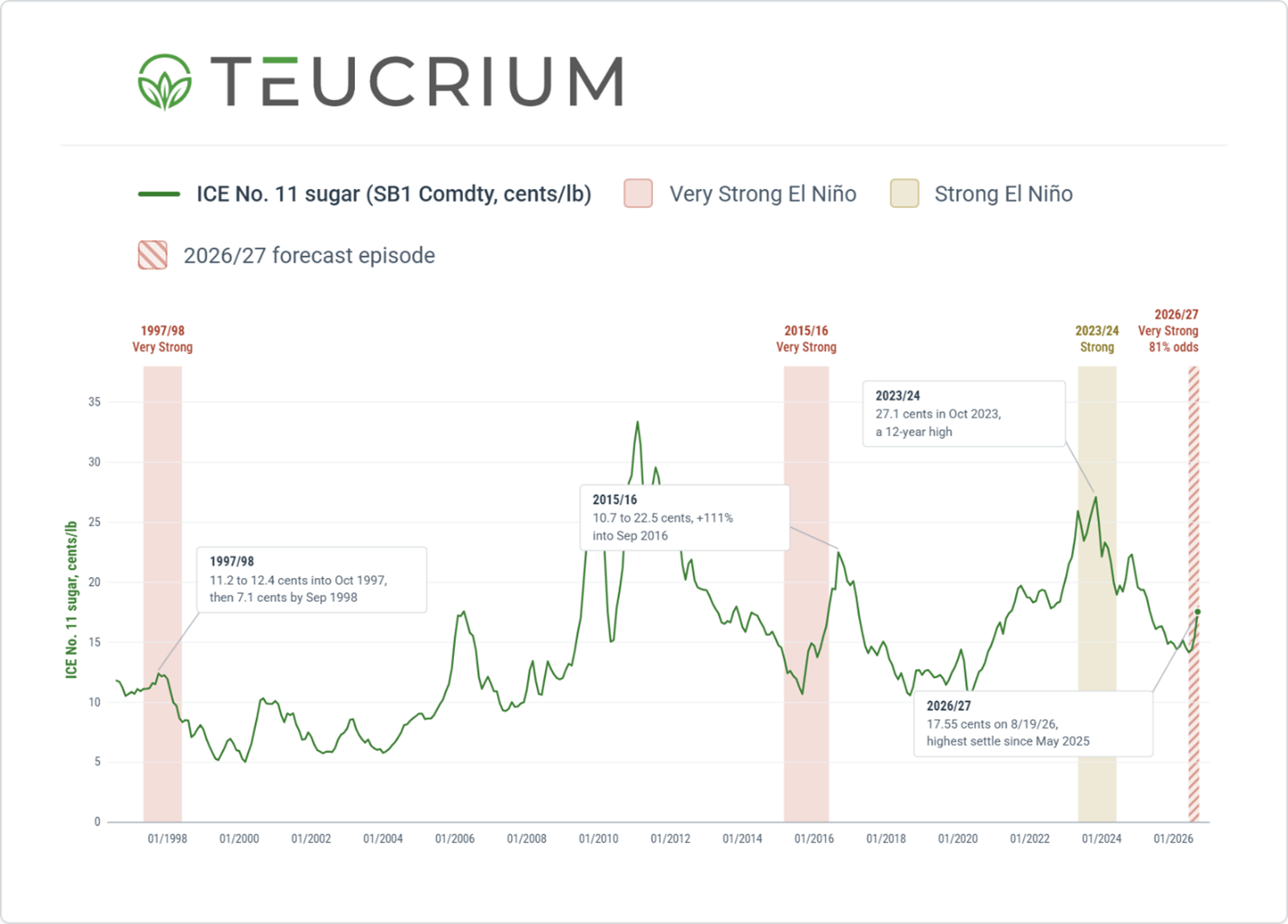
The chart below overlays previous strong El Nino cycles over the front-month ICE No. 11 sugar price continuation chart.24 The record is mixed. In 2015/16 sugar ran from 10.7 to 22.5 cents, up 111% into September 2016. The 2023/24 event carried price to 27.1 cents in October 2023, a 12-year high. The 1997/98 cycle went the other way: 11.2 to 12.4 cents into October 1997, then down to 7.1 cents by September 1998. Front-month settled at 17.55 cents on August 19, the highest since May 2025, which in our view leaves room for more weather premium if this event tracks either of the last two.
Final production numbers for the ‘26-’27 crop year are not yet in the books, and the analyst estimates are all over the map. The latest figures from the USDA (from the May Circular) forecast a 1 million metric ton surplus.25 Green Pool (an Australia-based independent sugar and ethanol research firm that has been publishing global sugar supply/use balance estimates since 2011) published its latest guess on July 29th projecting a 3.3 million metric ton deficit.26 That is a 4.3 million metric ton spread between two credible shops on the same crop year, and it tells you how little anyone knows about the damage done to the balance sheet so far. And after a rally this size, we think the market may have gotten ahead of itself. That happens in commodity markets, particularly when there is rampant short covering as we have seen in the ICE No. 11 contract.27
Sugar prices historically have had low correlations to both stocks and bonds. Going back to 2012 (the year we launched the Teucrium Agricultural Fund Benchmark Index) front-month sugar futures have exhibited a -0.033 correlation to the US Aggregate Bond Index and a 0.127 correlation to the S&P 500.28 The long sugar thesis is heavily dependent on weather, and weather doesn’t care about P/E ratios or 30-year yields. Watch for three prints as we enter Q4: the Center-South numbers UNICA publishes every two weeks, Brazil’s cane industry group, and specifically the ATR print,29 NOAA’s monthly update to the Oceanic Nino Index (ONI), the sea surface temperature gauge of El Nino’s strength,30 and whether New Delhi issues a duty-free import tender.
In the near term, be mindful of the potential for a “buy the rumor, sell the fact” trade pattern on news from India. Rumors of a tender for 1 million metric tons of duty-free sugar are a bullish fundamental factor that might already be priced in.31 If India issues that tender, it could counterintuitively lead to selling.
In our view what matters from here is how much sucrose ends up in the cane, and that is not knowable until the Center-South mills report further into the fourth quarter. Until then, putting aside a potentially healthy near-term pullback, we think the market may continue pricing in a weather premium.
ICE Futures U.S., “Sugar No. 11 Futures,” settlement data, accessed August 19, 2026, https://www.ice.com/products/23/sugar-no-11-futures/data; “Sugar,” Trading Economics, August 18, 2026, https://tradingeconomics.com/commodity/sugar; Mark Bowman, “Sugar Hits 15-Month High,” ADM Investor Services, August 18, 2026, https://www.admis.com/sugar-hits-15-month-high/.
Commodity Futures Trading Commission, Commitments of Traders, Sugar No. 11, ICE Futures U.S., reports of August 4 and August 11, 2026, https://www.cftc.gov/MarketReports/CommitmentsofTraders/index.htm; “Futures and Market Data: 17th August 2026,” Czapp (Czarnikow), August 17, 2026, https://www.czapp.com/analyst-insights/futures-and-market-data-17th-august-2026/.
El Nino literally translates to “the boy child.” Or, as my friend, and long time SNL fan Jill has reminded me, it means “the Nino!”
USDA Foreign Agricultural Service, Sugar: World Markets and Trade (Washington, DC: USDA FAS, May 2026), https://www.fas.usda.gov/data/sugar-world-markets-and-trade-05282026.
USDA FAS, Sugar: World Markets and Trade, May 2026; USDA Production, Supply and Distribution (PSD) Online database, “Sugar, Centrifugal,” accessed August 19, 2026, https://apps.fas.usda.gov/psdonline/.
CFTC, Commitments of Traders, Sugar No. 11, January–August 2026; “Futures and Market Data: 11th August 2026,” Czapp, August 11, 2026, https://www.czapp.com/analyst-insights/futures-and-market-data-11th-august-2026/; “Raw Sugar Climbs to More Than One-Year High,” Business Recorder, August 18, 2026, https://www.brecorder.com/news/40435425/raw-sugar-climbs-to-more-than-one-year-high.
USDA PSD Online, “Sugar, Centrifugal,” 2026/27 forecast, accessed August 19, 2026; USDA FAS, Sugar Annual: Brazil, BR2026-0020 (Brasília: USDA FAS, April 2026), https://apps.fas.usda.gov/newgainapi/api/Report/DownloadReportByFileName?fileName=Sugar+Annual_Brasilia_Brazil_BR2026-0020.pdf.
USDA PSD Online, “Sugar, Centrifugal,” 2026/27 forecast; USDA FAS, Sugar: World Markets and Trade, May 2026.
Directorate General of Foreign Trade, Ministry of Commerce and Industry, Government of India, Notification No. 16/2026-27, May 13, 2026; “India Bans Sugar Exports with Immediate Effect until September 2026,” DD News, May 13, 2026, https://ddnews.gov.in/en/india-bans-sugar-exports-with-immediate-effect-until-september-2026/; “India Bans Sugar Exports Until End-September to Protect Supply,” Bloomberg, May 13, 2026, https://www.bloomberg.com/news/articles/2026-05-13/india-bans-sugar-exports-until-end-september-to-protect-supply.
ICE Futures U.S., Sugar No. 11 settlement data, May–June 2026; CFTC, Commitments of Traders, Sugar No. 11, weekly reports, May–June 2026.
“India Considers Cutting Sugar Import Duty to Ease Record Domestic Prices,” Bloomberg, August 18, 2026, https://www.bloomberg.com/news/articles/2026-08-18/india-weighs-sugar-import-duty-cut-to-curb-record-local-prices; “Govt Weighs Cutting Sugar Import Duty to Curb Record Local Prices,” Business Standard, August 18, 2026, https://www.business-standard.com/economy/news/govt-weighs-cutting-sugar-import-duty-to-curb-record-local-prices-126081800660_1.html.
Indian Sugar and Bio-energy Manufacturers Association (ISMA), ex-mill price data, reported in “India May Cut Sugar Import Duty to Ease Record Domestic Prices: Report,” Business Today, August 18, 2026, https://www.businesstoday.in/latest/economy/story/india-may-cut-sugar-import-duty-to-ease-record-domestic-prices-report-549784-2026-08-18.
“India Is Preparing to Open Its Market to Imported Sugar,” UkrAgroConsult, August 17, 2026, https://ukragroconsult.com/en/news/india-is-preparing-to-open-its-market-to-imported-sugar/.
Ana Zancaner, “CS Brazil 2026/27: Sugar and Ethanol Flexibility Is the Norm,” Czapp (Czarnikow), June 8, 2026, https://www.czapp.com/analyst-insights/cs-brazil-2026-27-sugar-ethanol-flexibility-is-the-norm/.
Ministério da Agricultura e Pecuária (MAPA), Center-South sugarcane production report for the second half of July 2026, released August 2026; Bowman, “Sugar Hits 15-Month High”; União da Indústria de Cana-de-Açúcar e Bioenergia (UNICA), UnicaData, https://unicadata.com.br/.
NOAA Climate Prediction Center, El Niño/Southern Oscillation (ENSO) Diagnostic Discussion, August 13, 2026, https://www.cpc.ncep.noaa.gov/products/analysis_monitoring/enso_advisory/ensodisc.shtml.
NOAA Climate Prediction Center, ENSO: Recent Evolution, Current Status and Predictions, August 17, 2026, https://www.cpc.ncep.noaa.gov/products/analysis_monitoring/lanina/enso_evolution-status-fcsts-web.pdf.
Marina Regina Zechin de Lucca, Itaú BBA, quoted in “El Niño Raises Risks for Brazil’s Cane Harvest Outlook,” The AgriBiz, July 6, 2026, https://www.theagribiz.com/international/el-nino-raises-risks-for-brazils-cane-harvest-outlook/; “CS Brazil Might Face Another El Niño in 2026,” Czapp (Czarnikow), March 17, 2026, https://www.czapp.com/analyst-insights/cs-brazil-might-face-another-el-nino-in-2026/; “El Niño Seen Boosting Brazil’s Sugarcane Crop Despite Harvest Delays,” ChiniMandi, July 2026, https://www.chinimandi.com/el-nino-seen-boosting-brazils-sugarcane-crop-despite-harvest-delays/.
UNICA, UnicaData, “Qualidade da Matéria-Prima,” https://unicadata.com.br/; Consecana-SP methodology described in USDA FAS, Sugar Annual: Brazil, BR2026-0020.
N. G. Inman-Bamber, “Sugarcane Water Stress Criteria for Irrigation and Drying Off,” Field Crops Research 89, no. 1 (2004): 107–22; N. G. Inman-Bamber and D. M. Smith, “Water Relations in Sugarcane and Response to Water Deficits,” Field Crops Research 92, nos. 2–3 (2005): 185–202.
A. Singels, M. van den Berg, M. A. Smit, M. R. Jones, and R. van Antwerpen, “Modelling Water Uptake, Growth and Sucrose Accumulation of Sugarcane Subjected to Water Stress,” Field Crops Research 117, no. 1 (2010): 59–69.
M. J. Robertson and R. A. Donaldson, “Changes in the Components of Cane and Sucrose Yield in Response to Drying-Off of Sugarcane before Harvest,” Field Crops Research 55, nos. 1–2 (1998): 201–08; Inman-Bamber and Smith, “Water Relations in Sugarcane,” 185–202.
India Meteorological Department, monsoon rainfall bulletins, June–August 2026, reported in “Concerns about Tighter Global Supplies Underpin Sugar Prices,” Barchart, August 19, 2026, https://www.barchart.com/story/news/3935626/concerns-about-tighter-global-supplies-underpin-sugar-prices; USDA FAS, Sugar Annual: Brazil, BR2026-0020.
Chart constructed from ICE Futures U.S. Sugar No. 11 front-month continuation prices and NOAA Climate Prediction Center Oceanic Niño Index (ONI) historical episodes, https://origin.cpc.ncep.noaa.gov/products/analysis_monitoring/ensostuff/ONI_v5.php. Continuation series reflect contract rolls and are not a tradable return.
USDA FAS, Sugar: World Markets and Trade, May 2026.
Green Pool Commodity Specialists, 2026/27 global sugar balance revision, July 29, 2026, reported in “Global Sugar Deficit Fears Underpin Prices,” Barchart, August 17, 2026, https://www.barchart.com/story/news/3891185/global-sugar-deficit-fears-underpin-prices; Green Pool Commodity Specialists, https://greenpoolcommodities.com/.
CFTC, Commitments of Traders, Sugar No. 11, August 2026 reports; “Futures and Market Data: 17th August 2026,” Czapp, August 17, 2026.
Teucrium Trading, LLC calculation using front-month ICE No. 11 sugar futures, the Bloomberg U.S. Aggregate Bond Index, and the S&P 500 Index, monthly returns, 2012 through 2026. Correlation figures are historical and not indicative of future results.
UNICA, “Acompanhamento Quinzenal da Safra — Região Centro-Sul,” UnicaData, https://unicadata.com.br/.
NOAA Climate Prediction Center, “Cold and Warm Episodes by Season (ONI),” https://origin.cpc.ncep.noaa.gov/products/analysis_monitoring/ensostuff/ONI_v5.php.
“India Can Allow Import of Duty-Free Sugar Amidst High Price in Domestic Markets,” Trak.in, August 18, 2026, https://trak.in/stories/india-can-allow-import-of-duty-free-sugar-amidst-high-price-in-domestic-markets/.
Comments
Nothing yet. Say the first thing.
Sign in to join the conversation.