

Corn
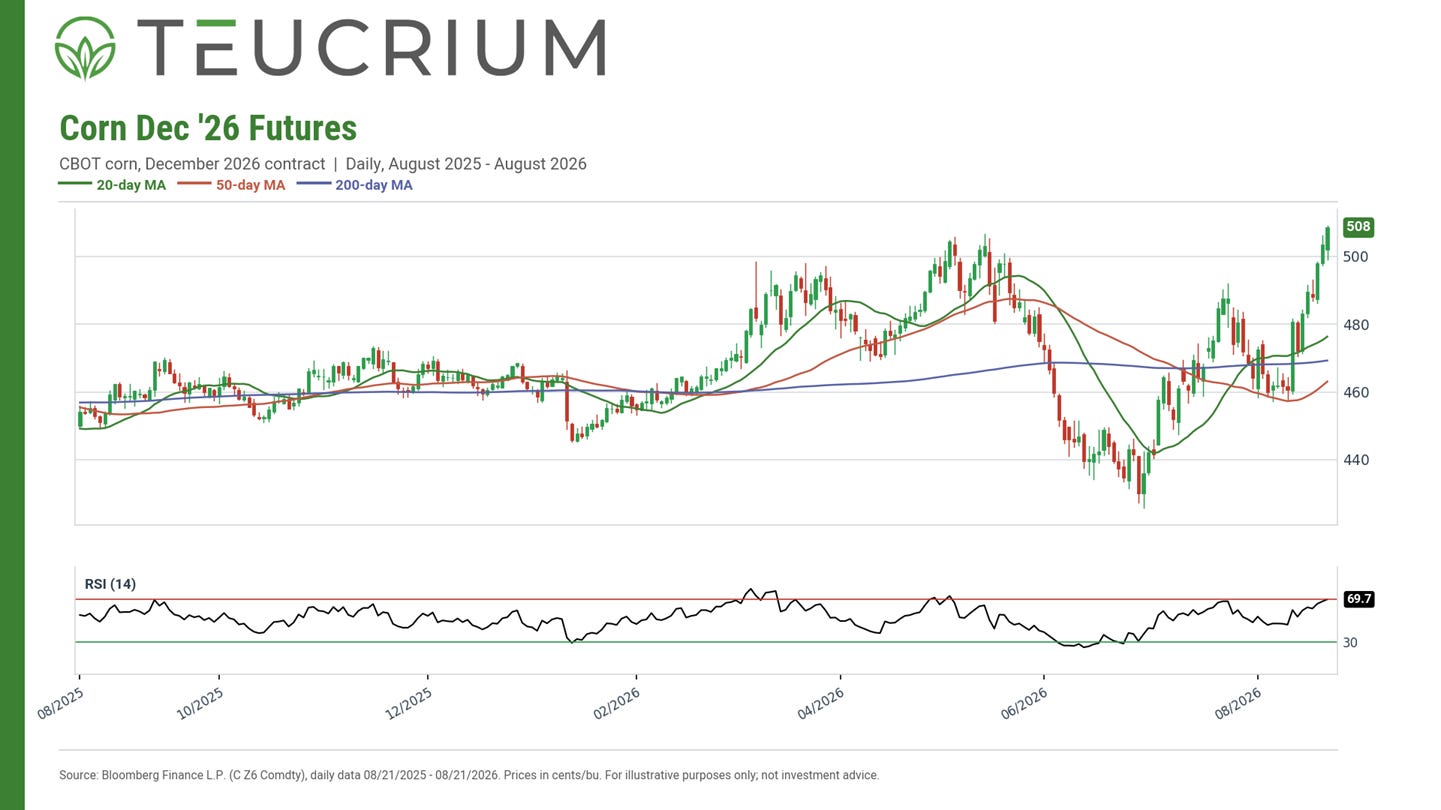
December corn settled at $5.08 1/2 on Friday, up 5 cents on the day and up 25 1/4 cents on the week. The contract hit a 2.5-year high and posted a technically bullish weekly high close. Corn first poked above $5.00 Wednesday night, its first trip there since mid-May.
The Pro Farmer Crop Tour was most responsible for the bullish sentiment. Scouts sampled more than 3,000 fields across 7 states and kept finding the same problem: fewer ears and smaller ones than the crop’s healthy look from the road suggested. Pro Farmer pegged the national crop at 15.344 billion bushels on a yield of 173.2 bushels per acre, well below USDA’s August estimate of 180.7. This is the widest discrepancy between the USDA’s August WASDE projections and the crop tour estimate in at least 20 years.
Chip Flory, who led the tour’s western leg, put it plainly: “Something went wrong with this crop where it determined grain length in particular.” The USDA has already trimmed 2026-27 ending stocks to 1.653 billion bushels, about 10% of expected use, which leaves little room for more yield loss.
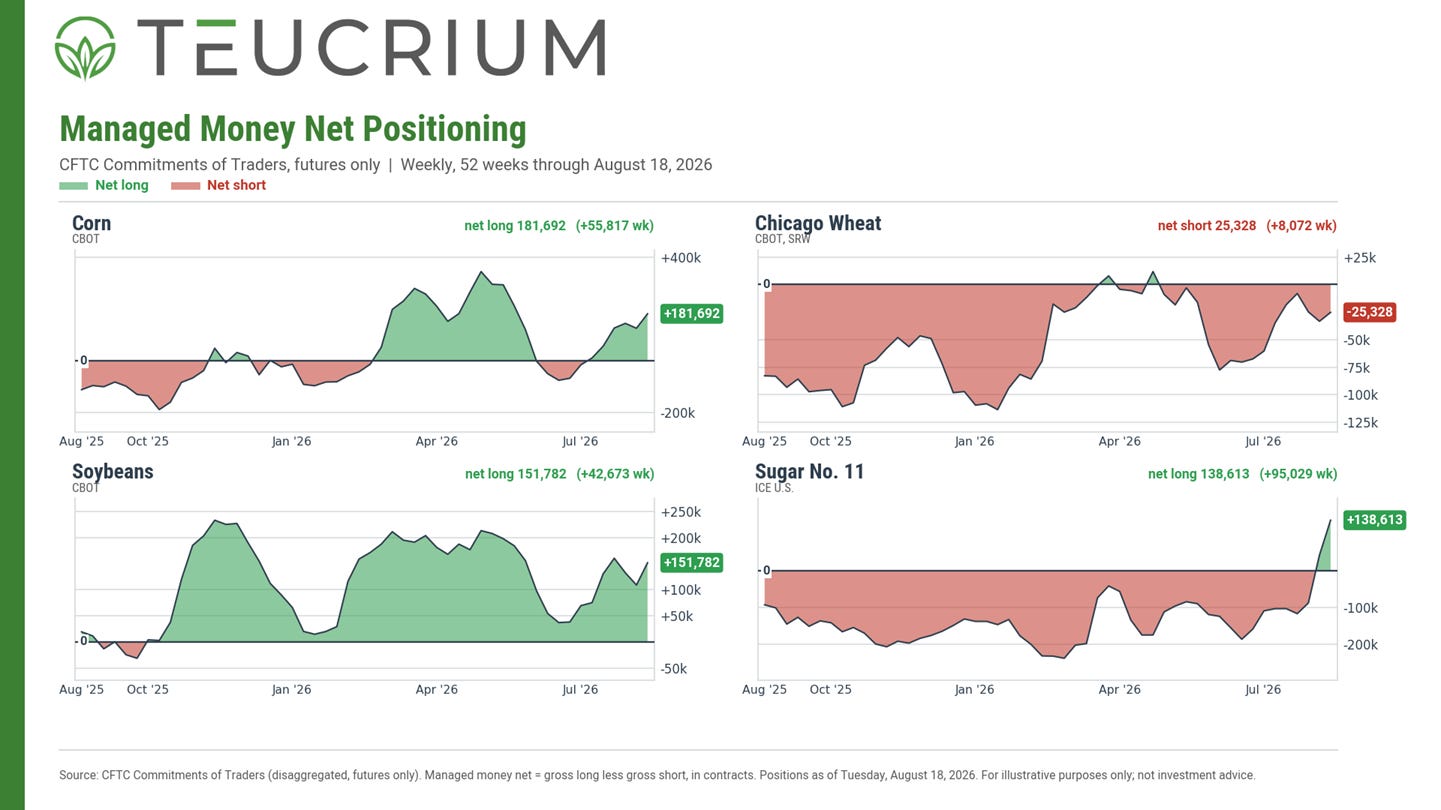
Money managers (the large speculative funds the CFTC tracks each week) bought roughly 55,800 corn futures through Tuesday, lifting their net long position to 181,692 contracts. That’s a fast rebuild, though still well under May’s peak near 344,600. Friday’s close above $5.00 came after that data cutoff, so the funds were likely still adding into the weekend.
Watch the September WASDE. USDA crews start their own field sampling in the coming days, and the tour has typically come in below the government’s number. If USDA’s September yield moves toward 173, supplies could tighten further and prices may find more support; if the cut disappoints, an overbought chart could invite profit-taking. StoneX’s Arlan Suderman expects demand to drive cash prices from here, and with the tour over, fresh bullish fuel may have to come from exports and ethanol rather than the field.
Soybeans
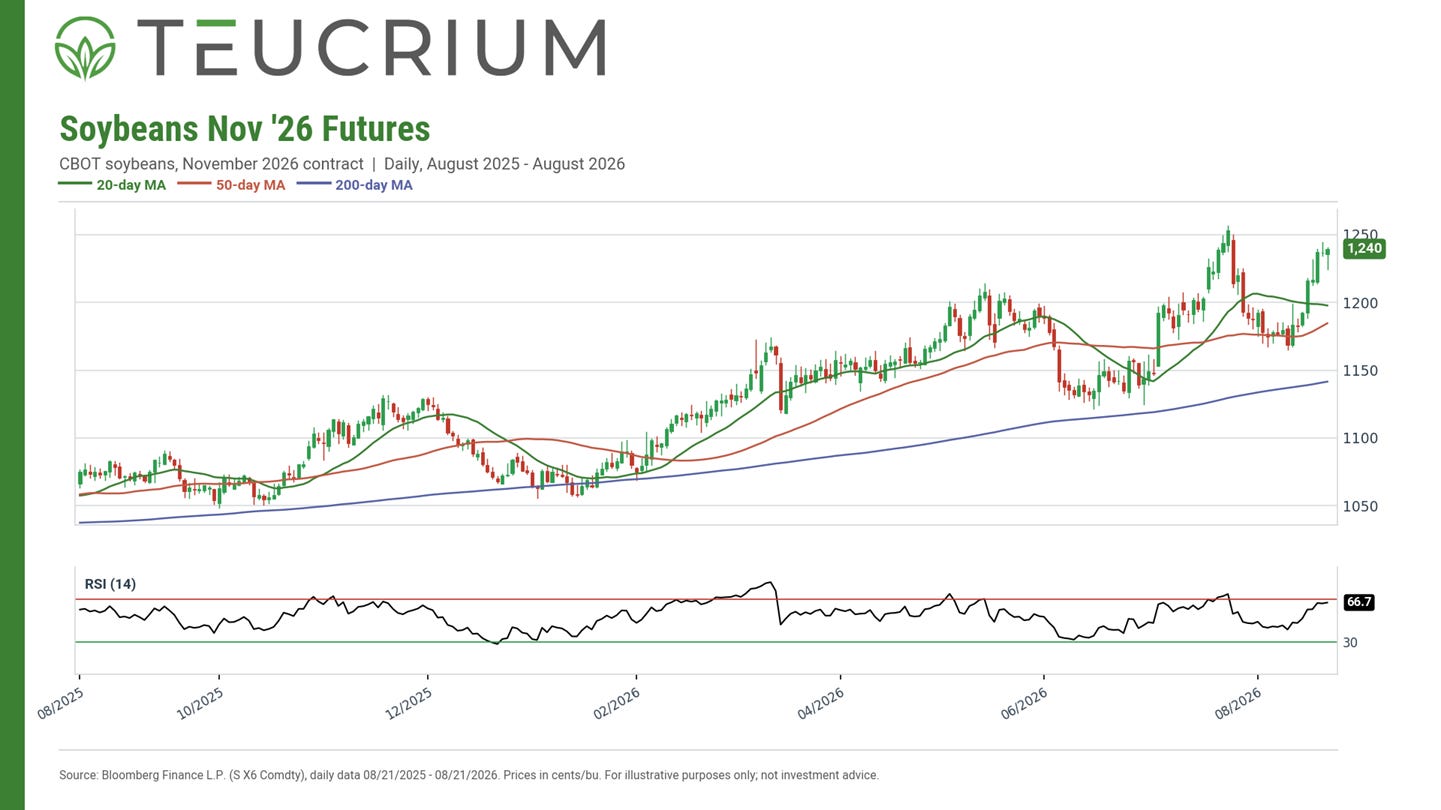
November soybeans settled at $12.39 1/2 on Friday, up about 3 cents on the day and up 47 cents on the week, another bullish weekly high close.
China buyers kept showing up. On Friday morning alone, USDA announced flash sales (large daily export sales the agency must report within 24 hours) of 712,000 metric tons of soybeans to China and another 720,000 tons to unknown destinations. By Standard Grain’s count through Tuesday, China had booked roughly 5.6 million tons of new-crop US beans, about 22% of the 25 million ton goal outlined by the White House. Friday’s China sale pushes that past 6 million.
Domestic demand is running just as hard: NOPA members crushed a July record 216.65 million bushels (crush is the processing of beans into meal and oil), and soybean oil stocks fell to a nine-month low.
Supply news actually leaned the other way. Pro Farmer estimated the bean crop at 4.572 billion bushels on a 53.3 bushel per acre yield, above USDA’s 52.7, with scouts calling soybeans the bright spot of the tour. That estimate landed Friday after the close, so the week’s 47 cent rally ran on daily pod counts, China’s buying, and the crush. Funds bought about 42,700 contracts through Tuesday, taking their net long to 151,782.
Watch the EPA’s small refinery exemption decision, expected by the end of the month. Exemptions would let small refiners out of their biofuel blending obligations, which pulls less soybean oil into renewable diesel and biodiesel. That prospect knocked soybean oil down 183 points Friday, and in our view it could stay a drag on crush demand and margins. The bigger date is September 24, when Presidents Trump and Xi meet. The $17 billion annual ag purchase agreement from May is still unproven, and any progress could add another leg to export demand. If the flash sales go quiet, this rally may have to lean on a smaller-than-expected crop instead.
Wheat
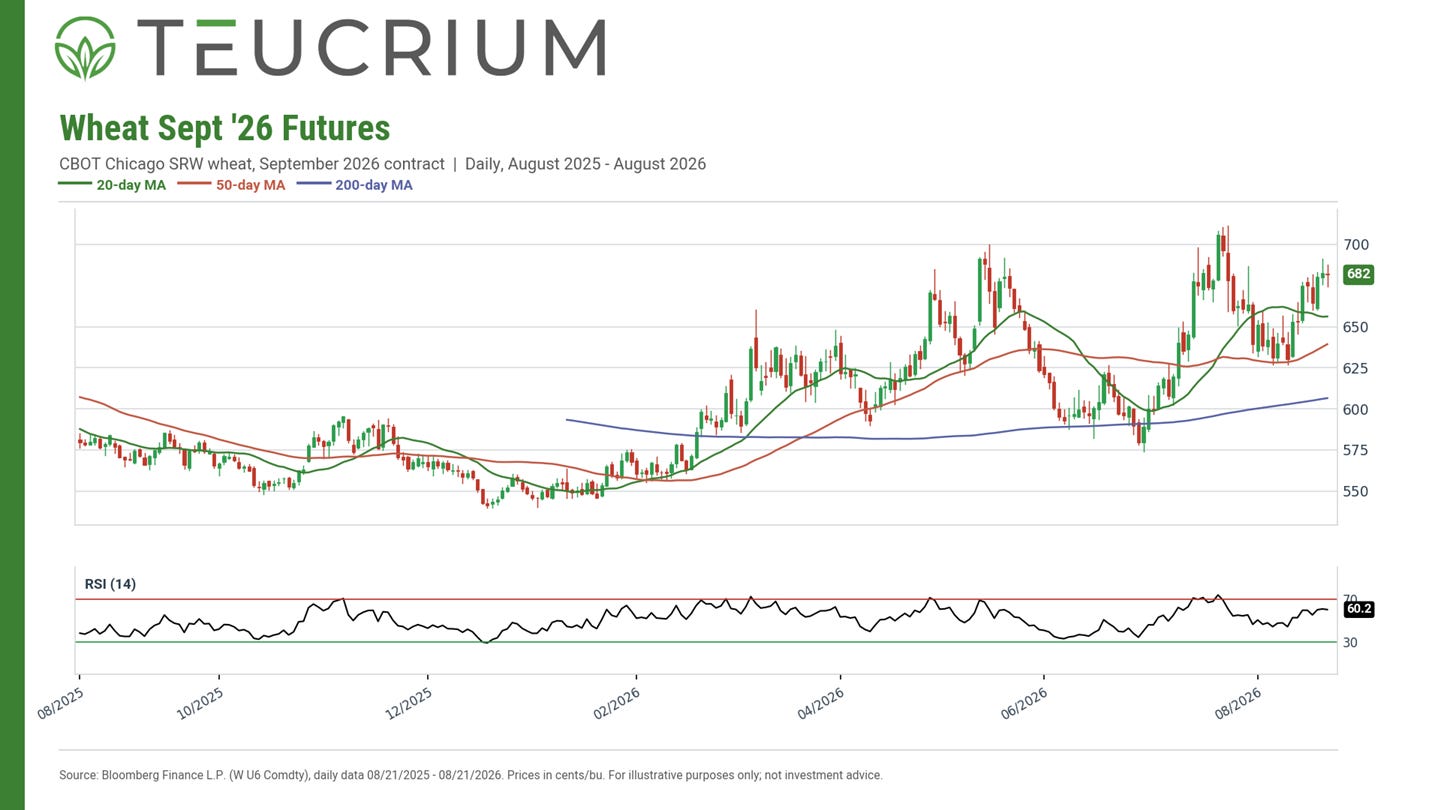
September Chicago wheat settled at $6.81 1/2 on Friday, down 1 1/4 cents on the day but up 6 3/4 cents on the week. Kansas City hard red winter wheat ended the week at $7.56 1/4, up 2 cents, while Minneapolis spring wheat jumped 20 cents to $6.98 1/4.
The trade’s focus remains on the Black Sea. Russia and Ukraine together supply more than a quarter of world wheat exports, and the two have spent a month striking each other’s ports. Standard Grain’s Joe Vaclavik reported that more than 97% of their combined Azov and Black Sea grain export capacity is now offline. SovEcon cut its estimate of Russia’s August wheat exports to 2.2 million metric tons, against a typical 5 million for the month, and consultancy ASAP Agri warned Ukraine’s full-season wheat exports could fall to 5 to 10 million tons from 14 million last year. Russian insurers are refusing to cover grain vessels, calling the risk of loss close to 100%, per Marex’s grain desk.
Buyers are adapting: Indonesia is booking Australian wheat, Bangladesh is pulling from Romania, and some importers have inquired about North American supply. Even so, funds remained net short 25,328 Chicago wheat contracts as of Tuesday.
The market has rallied for three weeks with speculators still leaning short.
Watch what happens if the ports reopen. Vaclavik made the point all week: grain is piling up inside the Black Sea region, and that supply could flow back into world markets quickly if hostilities subside, which may be why wheat rallies keep stalling.
On the other side, Ukraine’s government has flagged a significant risk that its farmers skip winter wheat planting this fall, and it warned world prices could rise sharply if Black Sea supply stays offline. The risk runs both ways, and positioning suggests the market hasn’t picked a side.
Sugar
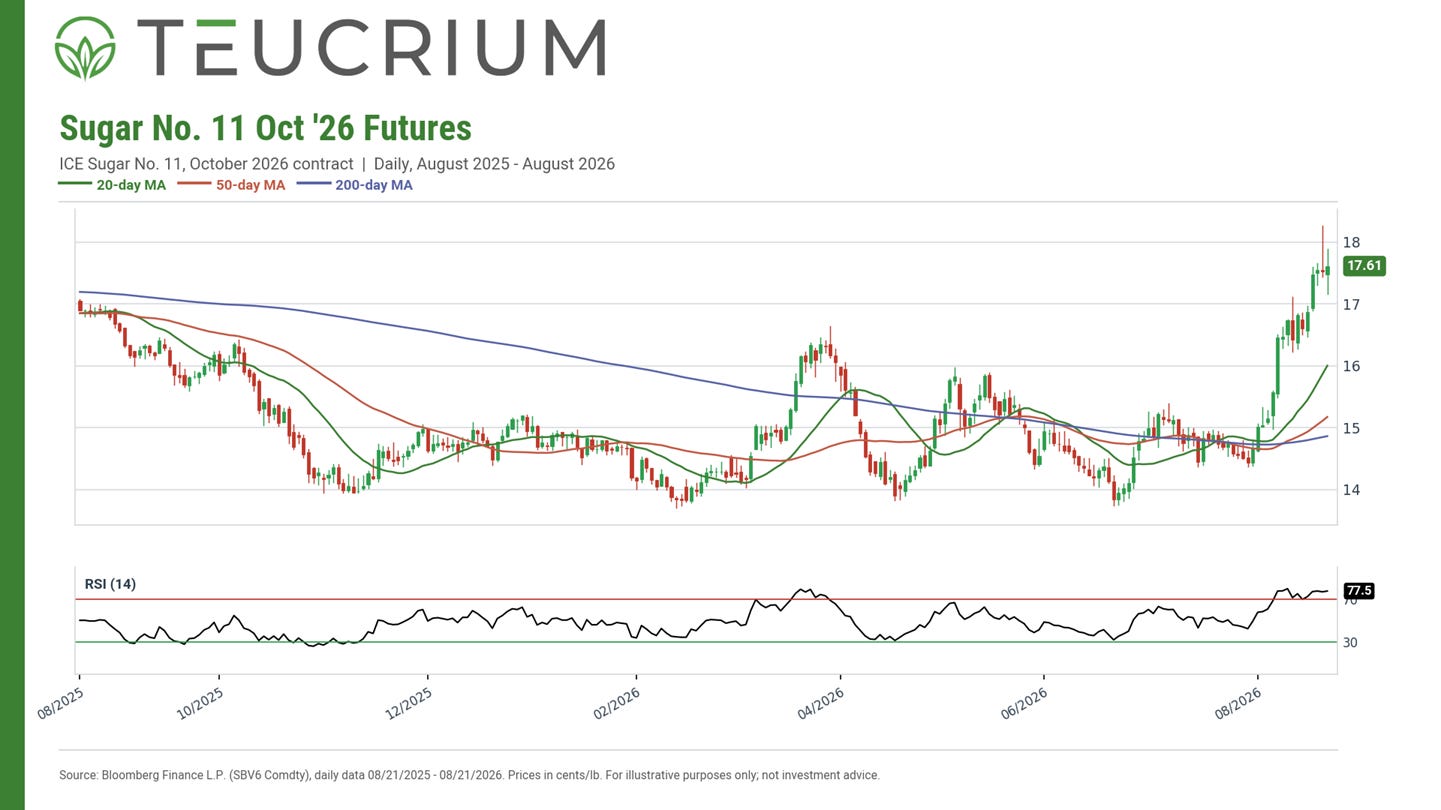
October Sugar No. 11, the world raw sugar benchmark, settled at 17.61 cents per pound on Friday, up about 6% on the week and its highest close in more than a year.
India moved the market. On Thursday the government allowed duty-free imports of 1 million metric tons of raw sugar through October 31, the country’s first sugar imports in nearly a decade, after domestic prices hit records near INR 54,000 to 55,000 per ton, up roughly 40% in a year. New Delhi also capped how much sugar bulk buyers can hold into the festival season.
Brazil is adding to supply concerns with Center-South sugar production down 12.4% so far this season as mills favored ethanol for most of the year.
Money managers have turned bullish. Funds swung from net short 87,188 contracts on August 4 to net long 138,613 on August 18, their largest net long in at least a year.
Watch whether the rally feeds its own correction. Higher prices are already pulling Brazilian mills back toward sugar: Czarnikow’s Pedro Mizutani told Reuters the firm will raise its Center-South production forecast to 39 to 39.5 million tons, and Hedgepoint went further, projecting a 3 million ton global trade surplus for 2026/27 and calling 17 to 18 cents hard to justify. Its own sugar desk halves that surplus to 1.5 million once India’s imports are counted. India’s actual import bookings (the application window runs through August 28) and El Niño rains in Brazil’s September-to-November harvest window could decide which view wins.
After a move this fast, some giveback would not surprise.
Comments
Nothing yet. Say the first thing.
Sign in to join the conversation.