
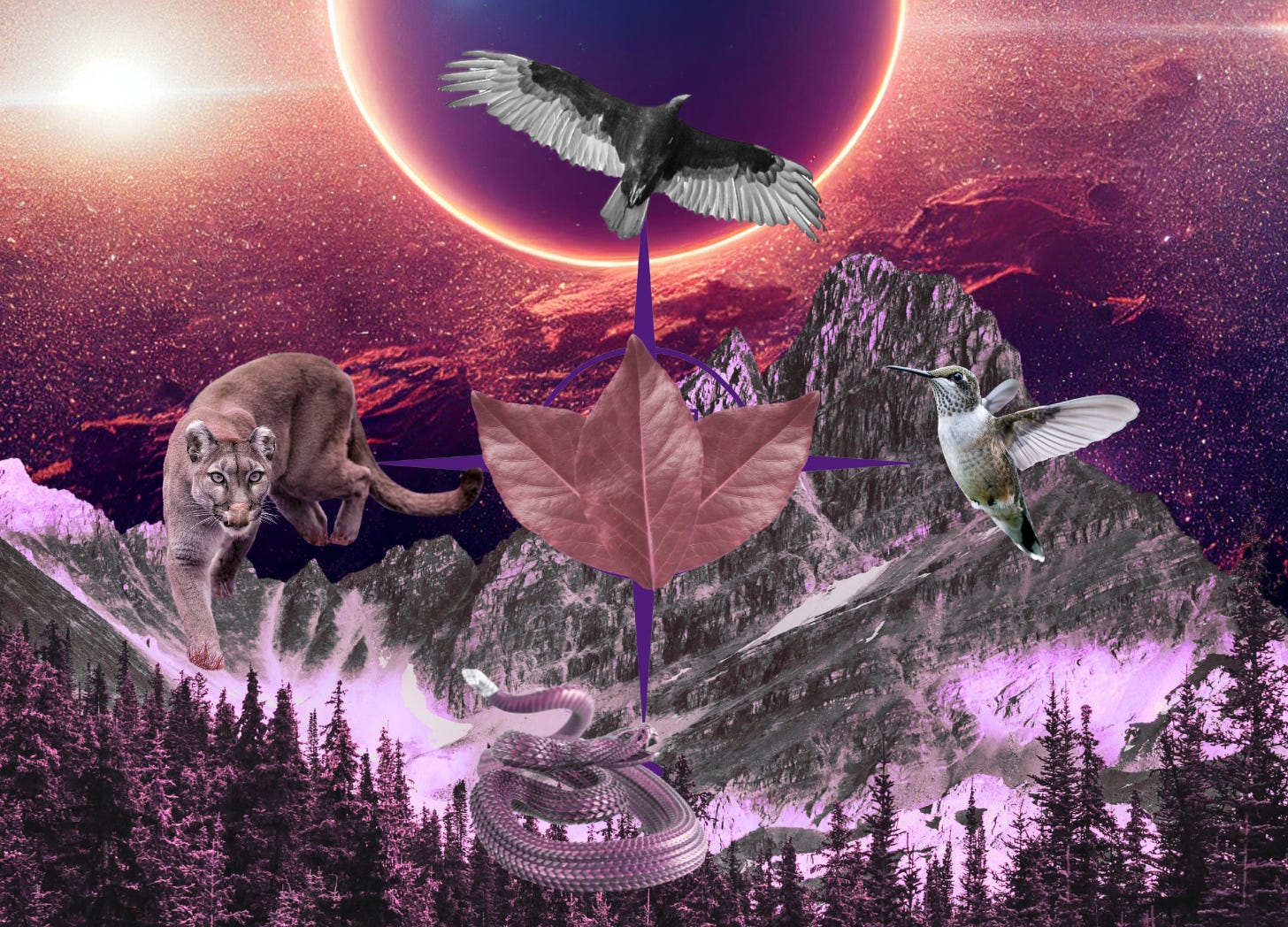
Enter into the tierra of our collective imagination. A landscape built by our memories and our dreams.
We are portals waiting to be awakened. We hold the technologies of our ancestors to find our way back home.
We are the past, reborn. We are the future, becoming.
We are the descendants of our Elders’ wisdom, and we are the story-makers of future prophecies.
We stand at the entrance to a cave in La Valle Sagrado in Peru, where Ñaupa Iglesia (Choquequilla) is nested. A portal from the ancestors before the ancestors. A place that unlocks things we didn’t even know Iwecould remember. It is a portal into portals.
The air is heavy, and we sit down together. We lay down our kintus of Coca as our offering, and close our eyes, entering into the land beyond time.
“Nothing happens in the ‘real’ world unless it first happens in the images in our heads,” - Gloria Anzaldúa
We beat the drums and remember. We beat the drums and listen. We beat the drums and re-story our way into tomorrow, together as the smoky breath of our songs hits the air, in this chamber of rebirth.
Exiting the portal space, we carry only what we need to move forward.
We carry our tierra on our backs, backpacks full of home as we cross imaginary borderlands on our movement into the North, where we practice by heart the lessons our Elders gave us.
Given to us by the plant kin, the water kin, the earth kin, and Pachamama, herself.
Given to us by Bachué, as she emerges from la Laguna de Iguaque.
We were there when she arrived.
Given to us by Bachué, when she returns in her serpent form.
We are there where she left.
There is no history, not really, because all the stories are always unfolding. Each one is a ceremony born again. Like Mama Coca, herself, always being reborn - in every new crop season, and every new kintu.
New leaves are reborn in every season. We are the site of the next rebirth.
Pachakuti is on its way.
Pachakuti is here.
We are ready because we have been preparing for all time.
We are ready because we are the memories from all times.
We carry all these precious elements with us on our backs, wrapped up in our Mesa, along with our khuyas.
We carry all of these sacred elements in our backpacks, as we cross the border again. Returning to the North with everything we need.
We are our ancestors’ visions unfolding. We are creating the visions for our descendants in real time.
We are prophecy awakening for the season ahead.
“There’s no single answer that will solve all our future problems. There’s no magic bullet. Instead, there are thousands of answers—at least. You can be one of them if you choose to be.” ― Octavia E. Butler, A Few Rules for Predicting the Future: An Essay
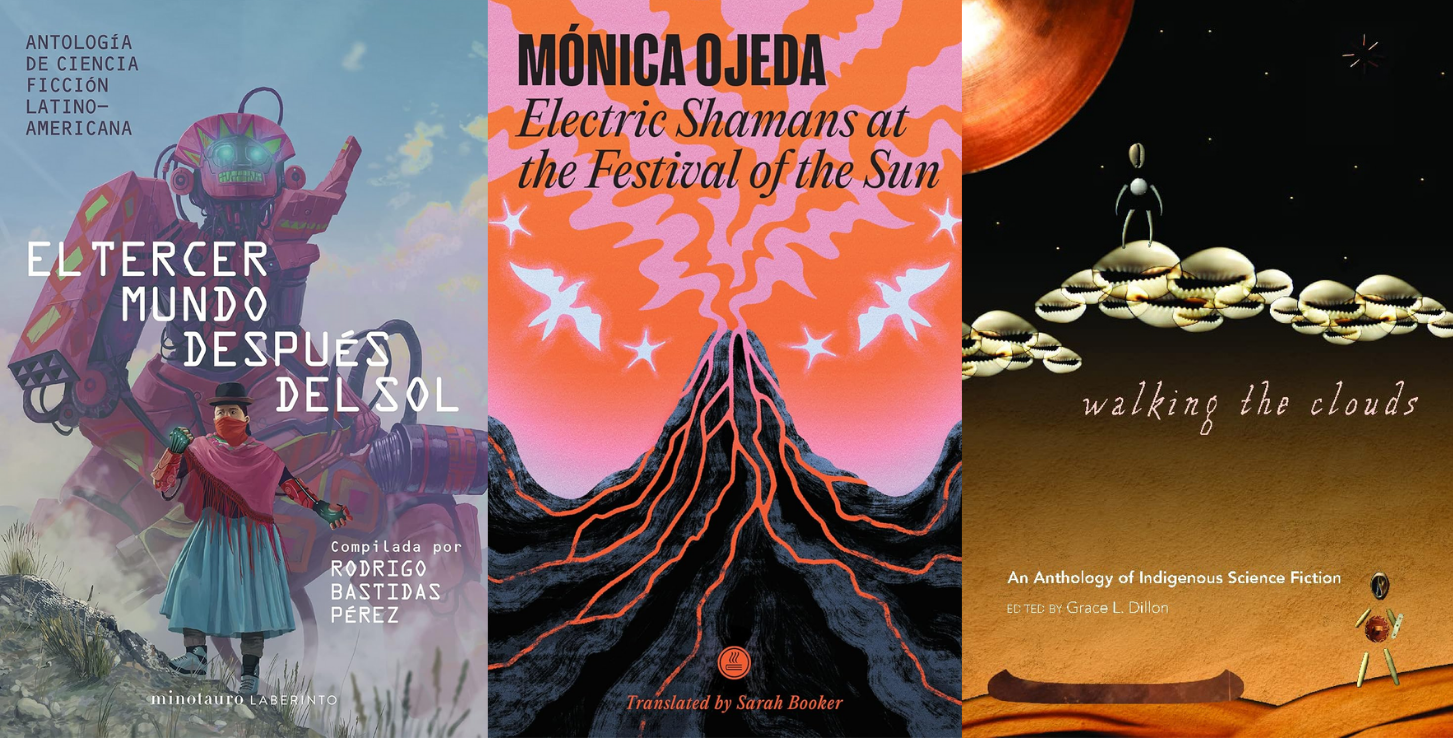
If you wander down the cobblestones of Cartagena you might stumble upon this literary portal - Ábaco Libros y Café - where you can imagine some Carribean writer creating the next Colombian novel. I always buy at least one gem of a book when I am there. Last time it was an illustrated copy of Love in a Time of Cholera and this past summer I picked up this amazing anthology of Indigenous Futures - expressed so beautifully in the image of a Quechua woman standing in front of a giant robot. I couldn’t have expressed it better myself. This is an amazing collective of works, which I am slowly working through, engaging my stilted Spanish in real-time.
Grace L. Dillon is the crafter of the term “Indigenous Futurism(s)” - a cousin term born out of the amazing tradition of Afrofuturism (Mark Derry, 1993). Both exist across time and space (past/present/future) and expressed in the imaginative manifestations of this kind of science fiction and speculative storytelling in the arts, in all forms.
You can read her conversation on “Taking the Fiction Out of Science Fiction: A Conversation About Indigenous Futurisms” with Pedro Neves Marques (2021) as an entry point into her work.
In it she reflects on Indigenous Futurisms as a plurality of Indignized Futures and geographical fluidity of Indigeneity:
“Indigenous Futurisms, in the plural, was a choice that I made after 2012. Until then I was calling it “Indigenous Futurism.” The choice reflects the richness of Indigenous communities globally. I based it on the process and legal struggles that led to the United Nations Declaration on the Rights of Indigenous Peoples, with an s. It took about three decades of struggle to get that letter s in there. The reason that it’s so important is because our nations can cross borders of what are perceived as other nations. My own nations are that way. Bay Mills Nation in the Upper Peninsula of Michigan, in the US, and Garden River First Nation, in Ontario, Canada, belong together, but because of the 49th parallel, it’s Canada on one side and the US on the other. We’re not just one people, we are peoples and our lands can encompass more than one settler nation. So Indigenous futurisms became a political pushing-forward of decolonization.
I am deeply enamored with the work of Mónica Ojeda. In a recent (2023) interview, she discussed the concept of “Andean Gothic” reflecting:
“ I’ve concluded that it has to do with writing the experience of fear with the entire Andes imaginary, its symbols, myths, and history. Every geographic space has its own horrors: fear is geographic, political, historical. The Andean Gothic then, would be an approach to thinking about fear from a specific geography, in this case the Andes mountains.”
She inspires in me the hopefulness that the future-bearers and story-keepers are not some aspiration on the horizon but they are scripting our way into futures - Andean, Indigenized, and in full kinship with all being - today.
The prophecies are already being foretold. Let us all pay attention and listen for them. Let us begin to write them, ourselves.
For a start to her writing, you can read this piece: “Everyone runs away from my heart because it looks like a crocodile” in Spanish Vogue (2024).
Electric Shamans is available in English beginning in Spring/Summer 2026.
Follow her work on Instagram at monaojeda.
…Look for it Monday or Tuesday of next week.
Coming up after that: “Two Colombian Girls: Unbordered Kinship” and “The Wave: Stripping Humanity Through Power.”
I am grateful for the community that joined together on Sunday for the first session of the Rebel Hoja workshop series - a time to be in community, ceremonial practice, and storying our way forward in relationship with Mama Coca alongside other plant and land kin. You can sign up to join any of the future workshops and practice being your own Rebel Hoja here.
This weekend I watched (a good portion of) “The People’s Filibuster” at The Public Theater in Manhattan with a combination of poets, playwrights, actors, and local leaders. It was an example of the power of our stories and memories in times of great change. They invite people to continue the filibuster through their prompts and resources on their digital platform…if you have something on your heart to share in collective creativity and imagination, or you want to share your recitation of one of their collected works recited during the 8-hour event on Saturday, January 31, 2026.
Lance Avery Brown, reading his piece titled “Minnesota We Are Standing Shoulder-to-Shoulder,” spoke this ever-present and prescient reminder:
“The one thing that stays after the chaos is art.”
Comments
Nothing yet. Say the first thing.
Sign in to join the conversation.