
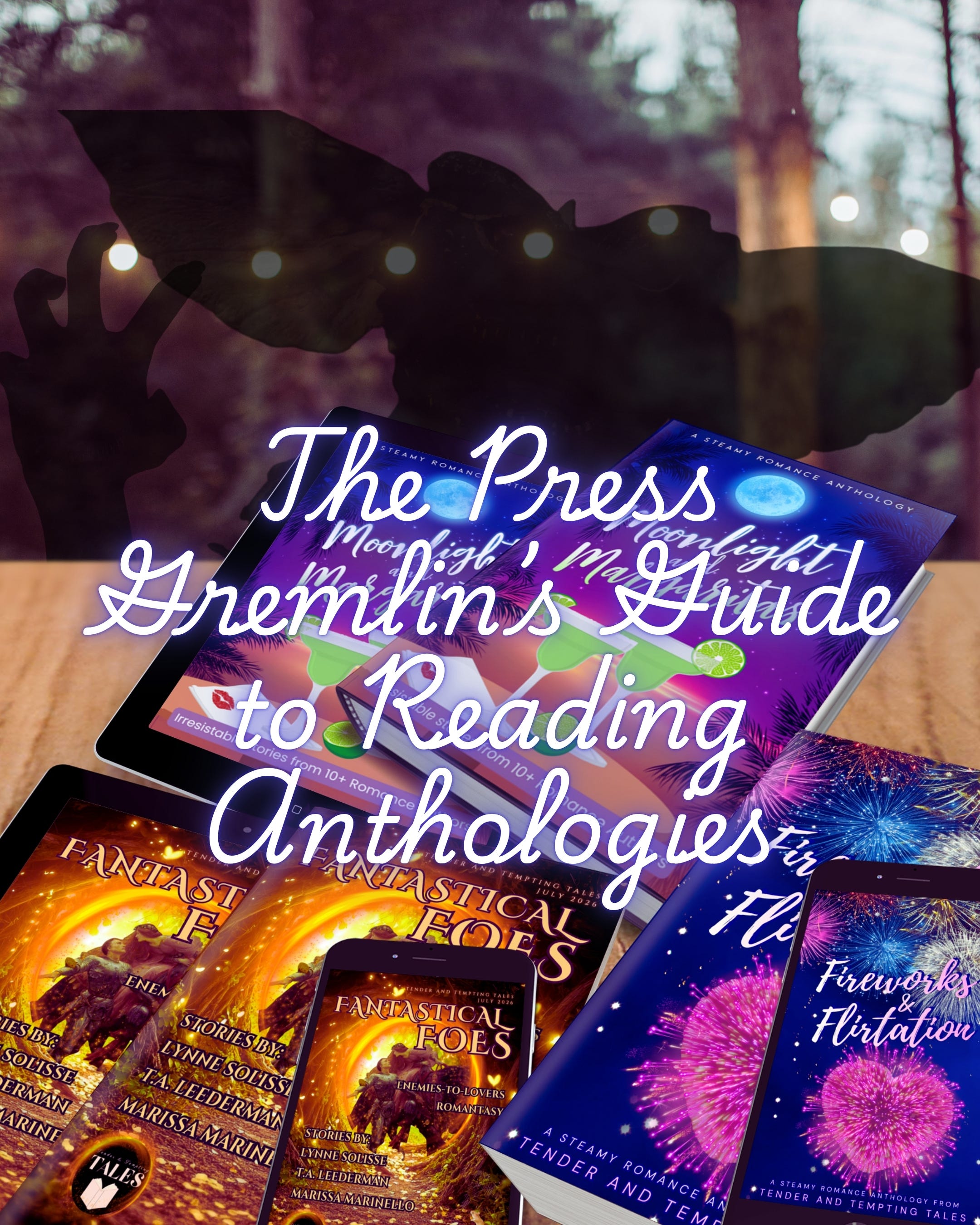
Press Gremlin here. I emerge from the press basement, covered in editing sweat and ink from our upcoming collection, Starlit and Spellbound, to talk to you about how I, Press Gremlin, read and approach anthologies, and how that impacts the way we put them together (and how it doesn’t). I’m also here to authorize you, tender reader, to invite a little chaos into your reading—in order to invite one of the great joys of life and anthologies, which is discovery.
But first, an autobiographical story time.
Part One, in which the press gremlin dishes about the enormous pile of decades-old anthologies beside her desk.
I really like urban fantasy. From about the age of twenty-two and well into my time as a PhD candidate, I read the subgenre with a fierce voracity that current-day me truly marvels to remember. I was commuting via train and bus through LA at the time (woe betide me), and there simply did not exist enough series and reading material to fill the tiresome hours I spent bumping along in sunny Los Angeles. There was a time when I always had at least one Dresden File and one Sookie Stackhouse adventure-in-supe-spice at the bottom of my bag, just in case. I tried several series early in their runs, and experienced untold hopes and disappointments along the way. The Cal Leandros series, October Daye, Iron Druid.... If you had a magic-slinging, injury-prone, grim detective or demon-slaying MC in your arsenal, you could count on me to give you a chance.
Around this time, I owned a lot of anthologies already because, well... I was an English major at a then-very canonical program (UCLA), and I really liked survey courses and wanted to go to grad school. This meant several full shelves of very heavy anthologies in literature, from short stories to poetry to revenge drama, even anthologies of critical theory and literary essays. Some of these things, bible pages and all, could kill a man if you beaned him with it at the right angle. (Hm. Might be a good murder mystery. Jenna, get the Valentines on it!)
So, when I discovered some of my favorite urban fantasy authors had additional adventures for their grim detectives and demon-slaying MCs in anthologies, I eagerly snapped those up and waited for them to appear on bookstore shelves. I would get a collection because Jim Butcher was in it, then discovered another two authors with main characters and worlds I enjoyed, and then I’d know to go grab the first in their series. That these stories were deemed worthy and on-theme enough for someone to curate them alongside a world or character I already liked meant that they were plainly for me.
I discovered several authors both early and late in their series this way, and worlds that I might not have given a chance in series form because the premise didn’t catch my eye or seemed weird. I recall that I had to circle back on Seanan McGuire several times before I got into the October Daye series, partly because I’m just not a huge fae person; I’d rather read about werewolves and ghosts, personally. But she was so into the idea, and she developed it so thoroughly and put such a unique spin on it that I was hooked.
I also discovered some stories, worlds, and authors in anthologies I knew I didn’t want to read, thanks to checking out a short story. That, on its own, was valuable to me. Sometimes the blurb and even the first chapter have compelling language and a great hook, but the story execution just isn’t there, or the author writes female characters in a way I find nauseating, or the author just isn’t into the world building and wants to write some wizard-gunslinging power fantasy. Seeing the author write a full short story can preview how they might proceed in a novel, or at least some of their shortcomings.
One thing my husband and my mother-in-law, who’s an economics professor, have taught me well is the value of an option. To keep it short, the idea is that an option itself—the ability to do something or choose something—is valuable in itself. An anthology provides great option value. You may get the chance to follow an author, story, world, or character you already like. You may get to check out established authors you haven’t bought from before. You may be able to give an author another chance after not liking something else they wrote. You may learn that something—a world, a kind of character, a mode of writing, a tone, a subgenre—really is or isn’t for you, while still having the other 90% of the book to enjoy. You might discover a new author when they’re early in their career and experience the added joy of being an early supporter and watching them grow. You may discover an author you’d considered buying from isn’t your cup of tea. You may discover an author you’d never buy from is actually your jam.
And all the while, you still have the rest of the book. Each story, generally one of ten to fifteen, is an option and a chance to discover.
A novel is, by contrast, a safer option, and I say this as a positive. If you already like the author and the series, if you’re well into the series and know you’ll enjoy the whole page run, that book has a high entertainment value which is virtually assured. It does, however, confirm you in a belief you already had, which is that you like this book and this author; it doesn’t invite you to find more authors and series you may also enjoy. There’s a place and a time for both of these modes of reading, for option value and assured entertainment value, and I’ve personally toggled between them as a commuting reader. I think having both is incredible and very fun.
Part Two, in which the press gremlin reports the chaotic way in which she reads anthologies, and books in general.
I don’t just say in promotional materials that anthologies are perfect for beach totes and the like because it’s useful marketing language. It’s also a real serving suggestion which matches my actual reading patterns. If I’m going to the beach to hang out on a canvas chair or a towel while the kiddo runs around and enjoys sand or collects shells, it’s an anthology I bring along. I can select a story and finish it before I need to start sorting and cleaning shells, or before getting my kiddo to a shower for de-sanding. If I don’t like one story, or it seems too intense for that moment, I can skip to another one.
I particularly like collections with stories of different lengths, so that I can choose something that fits a particular reading moment. Not enough time to read something in the novelette range? I can peruse something in the 2000-4000-word range instead. Urna Semper’s most recent personal collection is like this, and it has indeed received an undue accumulation of beach sand between its pages. When I went to put together my own personal collection recently, I also included short stories in a variety of lengths—everything from flash fiction to a novella, and many lengths in between. While everything in the collection is Starship Valkyrie and sci-fi, I felt that diversity of story lengths and subgenre, such as sci-fi romance, mystery, and space opera, would make it appealing to someone who enjoys anthologies the way I do.
All this is to say that I, as a reader, tend to skip around. When I read our first collection, Moonlight and Margaritas (the only one for which I did not do the copyedit), I moved through it based on whim, curiosity about various authors or premises, and mood. I met Urna Semper at our first FB takeover, then bopped over to read Urna’s story in Margaritas. I had a nice evening on the patio to read, and I chose Jenna’s story at the back of the book, feeling that it was guaranteed to be a solid second-chance romance read. I wasn’t sure how I would feel about enemies-to-lovers, but we had a queer story in the anthology, so I perused “Ship Happens.” In this way, I made my way through the anthology and enjoyed my experience over the summer. I even read part of a story at a margarita bar!
I don’t and never have read anthologies in order, nor do I tend to read them completely; if a collection has multiple authors, there’s usually one or two stories I won’t find appealing and therefore won’t finish (unless it’s one of ours, which I also read while editing). I understand, especially now I’ve done layout, that the order of stories matters immensely for creating a cohesive collection with peaks and valleys of emotion, like a music album or a symphony. Many readers read an anthology the way it was “intended” or, really, crafted to be read. We work hard on layout to give folks this experience if they choose to read from alpha to omega, from soup to nuts, from word one to word the last. I, however, am not one of those people, and I’ve never read anthologies that way. And I don’t think I’m alone in that.
There’s a reason the anthologies I picked up in my twenties had headliners. The editors assumed folks would pick up the book to read the story or stories from the headliners, then give the other stories in that collection a chance thereafter. If I grabbed an anthology to read a Dresden Files or Iron Druid or October Daye or Sookie Stackhouse story, you bet your ass that I read that story first. Whatever came right after it usually got a read as well. Then I started hunting through the book for my next read.
“But Press Gremlin!” I can hear you saying. “That’s not the way the book was intended to be read. Layout gremlins and editors like yourself worked hard to create a nuanced and progressive experience for you, and you totally ignored it! Would you do that with a novel?”
Yes. Yes, I would. And I have.
It’s your book. You buy one of these things, especially a paperback, and it’s yours. Make art out of it. Dogear it. Lend it to friends. Read it in whatever order works for you. Obviously, I hope you read my story in there, but when? That’s up to you. And if? Also up to you.
As far as novels go... I’m pretty liberal on that point as well. Sure, I do think folks who skip prologues, epilogues, and most of the description are missing the whole book, or most of it. If you come to a novel just for dialogue... I mean, I have some great plays to recommend. But it’s still your right to do that, and if it makes the book more enjoyable, then that’s the experience you’re signing up for. Does it make me sad if someone skips huge portions of a book I know to be great? Totally.
But reading out of order? That’s just normal in anthologies, I feel, and sometimes necessary in novels. I definitely skip ahead to make sure characters survive. If a book has multiple POVs (not romance dual POV, but George RR Martin with his kajillion characters), I will go through the book reading one POV, then come back to the beginning and read another, and then another. I don’t care about spoilers, personally. I just found that I didn’t enjoy the book as the author intended it, so I switched things up. I authorize you to do the same. The author isn’t here to chide you. The book police aren’t coming to arrest you.
It’s your book. Read it the way you want. I’m just here to tell you what I do personally, and to validate/authorize/cheer on anyone who needs it.
Part Three, in which the gremlin tells you how we put anthologies together.
Plainly story order isn’t something that matters to me as a reader, but it does matter during layout, because there are many good little bunnies who do read a collection from soup to nuts. And, frankly, we need an order for the stories to go in, and that order should help propel a reader through the text with momentum and enjoyment.
Raconteur Press has written about how they order stories in their anthologies, and we owe much to Cedar Sanderson for laying that out in plain language, as it has impacted how we do story order in anthologies (zines are a different beast). Like Rac, we now try to start with a compelling, strong story from a newcomer (consider “The Grand Finale” in Fireworks and Flirtation). We put strong stories from known entities in slots four and six, and from slot six, we build using strong stories toward the finisher. The finisher is a strong story from someone well-known, who acts as a draw for the anthology. In Fireworks and Flirtation, this was Jenna with her novelette, “A Matter of Time.” It’s also important to consider which is the longest story, and try to pop it in back so it doesn’t dwarf anything after it. Had we put a novelette in slot nine and a short story after it, that shorter story might not have gotten read.
Another consideration we take very seriously for layout is layering, in this case anything that’s not contemporary straight romance (“weirds”) and contemporary straight romance. Contemporary alone typically accounts for half of everything in any given anthology, with weirds making up the other half. In Fireworks and Flirtation, we did a contemporary first and last, to give you an idea, with weirds sitting in slots four and six for nougaty-core strength, and layered throughout the anthology. We also like to put a strong draw—a known author—in slot three, so Annie R McEwen and Suzy Langevin have both been in this slot. We like to tuck newcomers next to known entities, as though shading them beneath the wing of a buddy—like, if you came here for Urna’s story, you might like Miranda’s, right here!
Zine story order is, as I mentioned, a different beast. With three to five stories, as well as several other features, the reader’s experience is carefully considered. I love magazines, and I even acted as an editor for a literary magazine in grad school, and the perusal of a zine is, to me, different from an anthology. There’s more whimsy and discovery, a lot of leafing through, moments of delight, casual flicking of pages, and open-minded browsing. Games, a funny ad, a short article about romance news, events happening around the country to browse, maybe an article. Then time to read a story!
When we considered story order for Paws and Peril, our first zine, I offered two order options to Jenna and the zine’s editor, Rachel. I named these something like, “Nougaty Weird Core” and “Boil the Frog.” The order options and names had a lot to do with where my own story would go. If you’ve read Paws and Peril, you know that “Winter Sting” is fairly weird and one of the most audacious things I’ve ever written; I’m still in awe of Rachel for championing it, as it was so weird that I even wrote her a less-weird alt story just in case. In Nougaty Weird Core, “Winter Sting” would be nestled in the center, so a reader could experience it, then have a nice palate cleanser to finish off reading stories in the zine. In “Boil the Frog,” we would proceed in order of weirdness from Jenna up front, to Marissa second, to me last.
Rachel chose “Boil the Frog.” Or dog, in this case. Rachel is perhaps as weird and audacious an editor as I am a writer, which made for an incredibly fun first zine. Anyways, go read it. That was a good time.
In Fantastical Foes, Parrish had a strong idea of how to order the stories—essentially in order from “most like the main tendency of romantasy” to “most unlike the main tendency of romantasy.” This took us from Marissa up front, writing an ur-romantasy with epic themes and fae, to me with an urban romantasy, and finally to Lynne with a later-in-life magical school reunion romantasy. How I’ll order stories for Sapphics will largely depend on the selection of stories I have and the sorts of experiences I could create, of course. I remember a reader sent me a comment about Paws and Peril—quite smart!—noting that the inclusion of the Author Confessions before “Winter Sting” spoiled an aspect of the story. I had to tell them that this was a choice on my part, losing the element of surprise while gaining something else: allowing readers to opt into something that was fairly audacious, and maybe tempting them to give it a try anyways. I didn’t want to shock anyone that much.
Part Four, in which the gremlin talks about tropes and content warnings.
This leads me to a change we’ve made in how we do our layout. We now include in the cover page for each story a fair bit of information. In many other anthologies, you’ll usually get story name and author. Sometimes you get a blurb. Then it’s story time! With us, we’ve chosen to start including subgenre or category, the blurb, tropes, and any content warnings the writer might have included, or content warnings one of the editors thought we should include. Folks coming here from fantasy or sci-fi might find this absurd, and I don’t blame you! It’s a lot of information, and that might seem like it spoils the stories.
The difference here is in how romance readers approach stories, how romances tend to be marketed, especially the kind of information romance writers often include up front as an enticement. Romance isn’t here to give you whiplash; there’s a comfort to it that makes lots of information appropriate. For instance, all these stories must have an HEA or HFN, as a strong convention of the genre. You know that this story will end well, and that the main couple will end up together. They must have a spicy scene of three chili peppers or higher; you know when you get a collection of stories from us that you’ll get open-door romance in each story.
I also just wanted to help readers sort and choose the experience they’d like to have next, and that’s based on how I read anthologies. To be frank, I wish those urban fantasy anthologies included more information up front for each story. “This urban fantasy includes a stabby FMC, demon-fighting, and trauma” would be nice to know before I start reading at the beach. I just want information to help me sort—not to decide I won’t read something, but to decide when. As a sci-fi romance writer, I also don’t want people reading me because we tricked them into it by not telling them this would be a sci-fi romance. I find readers respond worse to an electric shock than to seeing upfront information and deciding, “thanks, but that’s not for me.” And if someone puts a content warning-worthy element in their story and doesn’t warn people, the electric shock can be pretty huge.
I also find that, honestly, content warnings can act as an enticement for the people who want to read that kind of thing. The folks who see “alien genitals” and are super down for that are self-selecting into reading “Winter Sting.” That’s great, and it’s what I want. If folks see “cheating romance” or “age-gap romance,” and that’s their thing, then we’ve found that story’s readers, while warning the folks who might want to proceed cautiously. Of course, we always hope they’ll give it a chance anyways, but we want them to have the information they need to enjoy the book they’ve bought to the fullest.
Of course, if you don’t care about all that info or want to avoid spoilers, just breeze on past those cover pages with our compliments for your adventurous spirit. We love that too!
This has been a fun frolic chatting about what I love most when reading anthologies and zines, and some of the behind-the-scenes decision-making that goes into what you see when you pick one up. I might do a follow-up about reviewing anthologies and zines as well, as I think this is a challenge for everyone. But until then, this has been your All-Purpose Press Gremlin at Tender and Tempting Tales, signing off!
Are you an author? Don’t forget that our submission call for Sapphics of Saturn is open this month, from August 1st to 31st! Check out the mission briefing here!
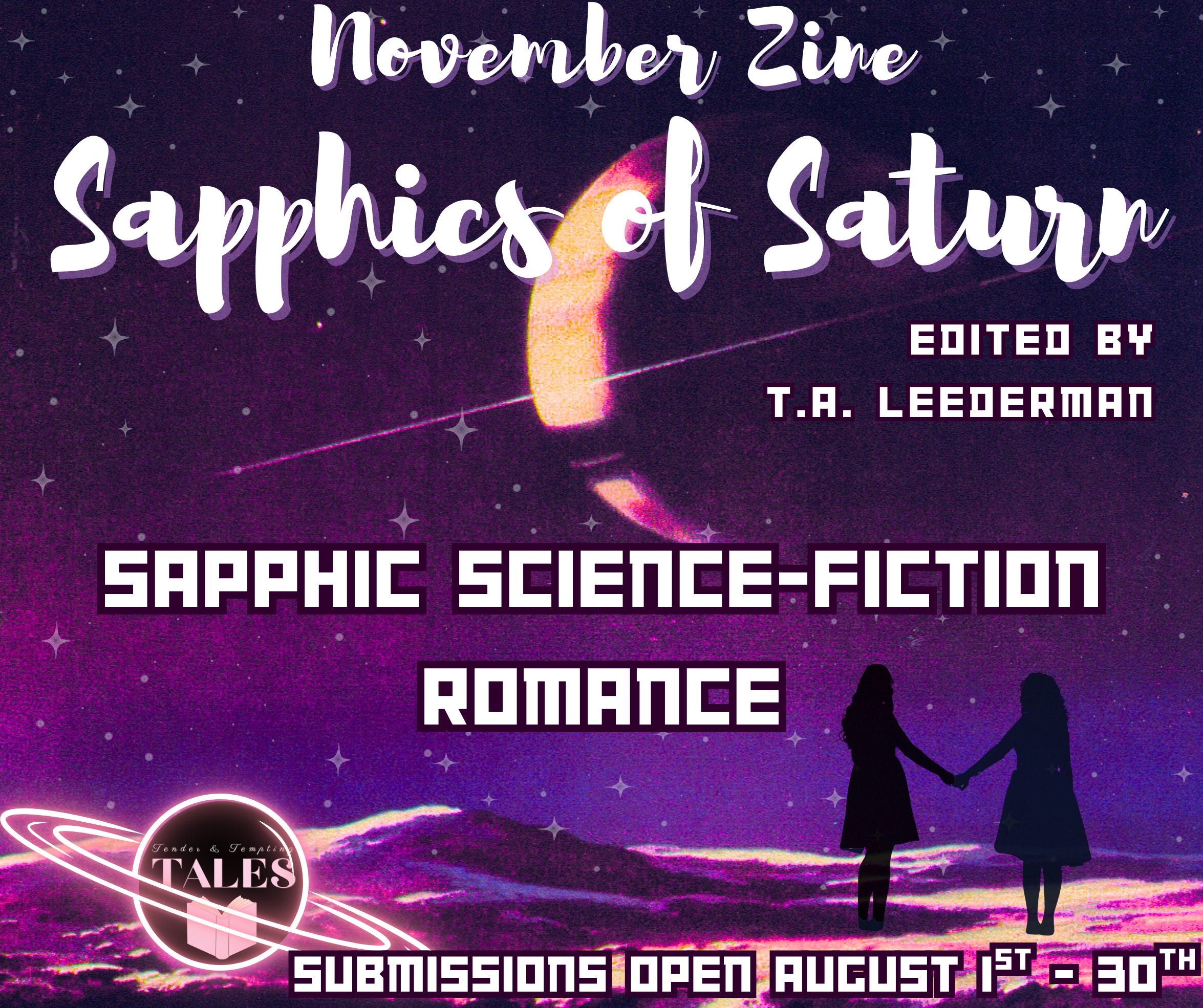
Coming Soon: Our cover reveal for Starlit and Spellbound will be starting soon over on Instagram! Come check us out there and get in on the fun!
Share Tender and Tempting Tales
Prepared by T.A. Leederman for Tender and Tempting Tales. Are you interested in offering a guest post with the press? Check out our page on how you can do just that here.
Comments
Nothing yet. Say the first thing.
Sign in to join the conversation.