
Let me tell you about two recent conversations, one with Michael D. West and the other with Micah Redding. [Don’t confuse Michael with Micah.] These conversations led to a question: should thoughtful Christians play ball with transhumanists?[1]
“This can only end badly,” muttered Michael D. West over lunch a few weeks ago. Although Mike did not mention Prometheus or Frankenstein, I had the feeling that something like their fate was on his mind.
If you do not know this frontier-expanding biogerontologist, let me mention that Michael D. West may go down in history as savant to longevity research breakthroughs such as the telomerase theory of aging plus the isolation of Human Embryonic Stem Cells (hESCs). In addition, he has been a promoter of regenerative medicine, the founder of Geron Corporation and Advanced Cell Technology (ACT), and the author of the book The Immortal Cell (West 2003).

When the first pitches were thrown to start the hESC ball game, Mike umpired laboratories to the sensitive moral issues. Among those issues was the 14-day rule. In embryonic development, nearing the 14th day, the embryo adheres to the uterine wall and gains its identity as an individual. Perhaps even personhood. No disaggregation of the embryo for the purpose of harvesting stem cells is ethically justifiable after this point. I served on the ethical standards committee of the California Institute for Regenerative Medicine (CIRM), and we set the limit at 12 days, a buffer to ensure that no crossing of this threshold would occur in laboratories funded by the state. Mike is upset now. Why? Because scientists today are ignoring such ethical principles.
Today, Mike is worried. He watches transhumanist millionaires and billionaires in Silicon Valley pouring their wealth into longevity research so that they themselves can live forever. Morally vacuous accelerationism! “Ominous.” Does this portend a Promethean or Frankensteinian tragedy just around the corner?
More recently, I played pitcher-batter with Micah Redding on a podcast. He pitched, and I swung. Then I pitched, and Micah swung on AI and transhumanism. To view our dialogue, click here.
Micah, if you have not yet met him, is Executive Director of the Christian Transhumanist Association. Micah criticizes secular transhumanism (H+ or Humanity +) for undervaluing its own religious motivations. And Micah invites faithful Christians to learn from H+ how to press science with technology into both the pursuit of personal holiness and social ethics. Micah writes, the Christian theologian “can provide us with healthy and humble ways to critique transhumanist mistakes, while learning from genuine transhuman discoveries” (Redding, 2025, 243).
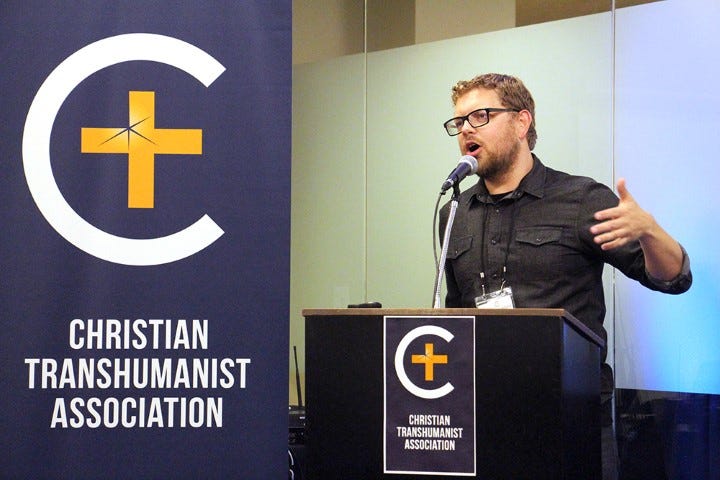
Yes, contends Micah, Christians should play ball with transhumanists. More. Christians, even if they don’t realize it, are already transhumanists of a sort.
Now, does Mike West, the scientist, play on the same ball field as Micah Redding, the theologian? Why is West so downbeat and Redding so upbeat?
Let’s turn to a momentous at-bat on both the transhumanist and theological teams, namely, immortality.
The utopian imagination over recent centuries has envisioned longer lives -- even everlasting lives -- courtesy of technoscientific progress. Longevism within transhumanism raises the batting average on the secular salvation team.
With the term longevism, we point to the science of longevity. Via genetic engineering, transhumanists in white lab coats aim to extend human life so radically that we will not die. Rather, we will live perpetually, forever.
More precisely, everlasting life might come in one of two forms. Radical Life Extension (RLE) would rely upon genetic engineering, reversing the aging process, and regenerating the body’s organs. A radically long life would continue to be an embodied life, replete with all of our wildest aspirations and worst bad habits.
The alternative, curiously, would take the form of disembodied consciousness. Like we transfer a computer program from hardware to hardware, cybernetic immortality (CI) would consist of removing our entire mind and our consciousness from our biological substrate and transferring it to either a machine substrate or to the computer cloud. With no body, we would not die. We would continue to think and think as our consciousness spreads out from Earth and investigates the stars.
Technology is breathtakingly transformative, sings Silicon Valley’s Ray Kurzweil.
“Since this technology will let us merge with the superintelligence we are creating, we will be essentially remaking ourselves. Freed from the enclosure of our skulls, and processing on a substrate millions of times faster than biological tissue, our minds will be empowered to grow exponentially, ultimately expanding our intelligence millions-fold. This is the core of my definition of the Singularity” (Kurzweil 2024, 73-74).
Kurzweil’s Singularity marks the threshold we cross from being human to posthuman, even divine. After the singularity, “an entirely new species of gods will exist,” avers the J. Omar Good Professor of Religion at Juniata College, Donald Braxton (Braxton 2021, 8).
The public theologian is quick to point out that neither RLE nor CI would have any impact on the human propensity to sin. Let alone to kill. In either case, quite to the chagrin of God, who expelled Adam and Eve from the Garden of Eden so they could die and put an end to their sinful state, your and my everlastingness would maintain our fall into sin forever and ever. No technology can provide salvation of the sort the Bible describes. Do transhumanists even think about sin?
Hypercapitalist and apocalyptic transhumanist Peter Thiel gets the assignment. Sorta. Peter Thiel is cited on this matter, saying, “We want you to be able to change your heart and change your mind and change your whole body. And then orthodox Christianity, by the way, the critique orthodox Christianity has of this is that these things don’t go far enough. That transhumanism is just changing your body, but you also need to transform your soul, and you need to transform your whole self” (Coley April 2026, 23).
Let’s try a little systematic theology here. Let’s ask Paul Benedikt Göcke, a professor at the Catholic Theological Faculty of the Ruhr University Bochum and an associate member of the Faculty of Theology and Religion at the University of Oxford. Here is the question: Will we have fulfilled the dream of immortality that is promised in the Christian faith once our bodies are enhanced enough to live for an indefinite span of life?
The answer is quite clearly “No.” Although Christians fully enjoy being alive and, in normal circumstances, seek to lengthen their time in this world in order to do good and to recognize and respond to the grace of God, the transhumanist vision of what often is misleadingly called “immortality” is theologically irrelevant.
First, even an enhanced human body that knows no natural death is not an invulnerable human body and can be killed or destroyed in numerous ways.
Second, our universe has only a finite existence and, according to the second law of thermodynamics, is bound to come to a state in which life is impossible. As a matter of physical necessity, human subjects cannot lead an infinitely long life in this world.
Third, from a Christian point of view it is not the duration of a particular human life that is important but the moral quality of the life led and the human individual’s response to the call of God. A short life can be morally exemplary, and along or an indefinitely long life can be morally horrendous in the eyes of God. The duration of a human life is therefore eschatologically irrelevant” (Göcke 2017, 361).[4]
At the end of the inning, H+ has stolen no bases. That should wipe out any mistaken equivalence between what technoscience can do and what God can do.[2 ]
Technological salvation in the form of immortality seems to strike out when fast pitches are thrown.[3]
Jeffrey Epstein
The first strike was thrown by Mike West, mentioned above. The transhumanists with accumulated capital seeking immortality and perhaps even a posthuman species appear to make up a needy, seedy, and greedy lot. This could only turn out badly.
At the top of many such batting lineups is Jeffrey Epstein. Yes, Epstein is widely known as a sex trafficker. Yet, he was also an aficionado and funder of science, including H+. According to The New York Times and Live Science, Epstein was ready to spend money on eugenics, on genetic alteration to seed an improved human race. He imagined impregnating as many as 20 women at a time at his New Mexico ranch, distributing his DNA for the betterment of our species.]4]
The eugenics movement did end badly. In America, the eugenics movement died because it was both unscientific and racist. In Nazi Germany, the eugenics movement died after so many Jews died in concentration camps. The prospect of creating a posthuman species through genetic engineering horrifies those who know the history of eugenics.
Pope Leo XIV
Strike two is a pitch just hurled from the Vatican pitcher’s mound. Pope Leo XIV’s fastball came with Magnifica Humanitas this past May. The Holy Father fears that transhumanist visions of the perfect human or the posthuman will dehumanize the human we know today. Because you and I are created in the divine image, we already have dignity. H+ threatens to de-dignify us, to turn us into disposable anachronisms on the path to higher evolution. The pope sounds the disarm alarm: disarm AI to prevent this!
“Humanity — in all its grandeur and woundedness — must never be replaced or surpassed. We can embrace the technological progress that alleviates suffering and unlocks new possibilities, provided that we do not abandon the very essence of our humanity, namely the capacity for relationship and love. This leads to a crucial question: if an authentic ‘more than human’ exists, where is it to be found? The Christian faith answers that question by pointing to a fulfilment that does not arise from a technological divinization, but through God’s grace received in Christ” (Magnifica Humanitas, §126).
Disarm AI to prevent transhumanists from replacing us with the posthuman! That’s strike two. What about strike three?
Georgia Coley
Might a pitch to a transgender batter already willing to modify the body get us on base? No. Even here, the human body becomes a home. Trans-woman Georgia Coley, when criticizing transhumanist Peter Thiel, celebrates her body as the temple of the Holy Spirit.
“As a trans woman, I’ve always said that if my body is ‘a temple of the Holy Spirit’ (1Corinthians 6:19), I want it to be one I can worship within. Far from seeing the body as a throwaway object to be thoughtlessly tampered with, I view it as a holy part of myself that I have been invited into communion and co-creation with” (Coley April 2026, 27).
Coley wants to be integrated with her body in intuitive wholeness.
Here we have strike three. Is the transhumanist batter now out?
No, the batter is not out if you belong to the Christian Transhumanist Association (CTA). Here is the CTA mission.
CTA seeks to seeks to draw theological themes on which Christians can agree, and that reflect the interaction Christianity must have with Transhumanism in a manner that will be mutually beneficial. Our distinctive emphasis is on The Image of God, as understood through these lenses:
Or, in Micah Redding’s words…
“Christian transhumanism is a conversation, first of all. This conversation could lead to an emerging theology of technology which frames technology as an outworking of the imago Dei, the divine image at work in the human species. The imago Dei defines the human species, at least in part, as God’s created co-creator. Further, I recommend that we explore how technology can participate in God’s redemptive purposes, to see technology’s profound significance for God’s eschatological future” (Redding 2022, 113).
In our podcast conversation, I asked Micah Redding whether he agrees or disagrees with Pope Leo XIV’s uncompromising defense of Homo sapiens as we are, replete with bodily and even moral imperfections.
In the back of my mind, I was thinking of Villanova’s cornucopian scholar Ilia Delio. Professor Delio just might – dare I say it? – disagree with the Bishop of Rome. Delio sets aside static human essentialism in order to embrace a fluid understanding of Homo sapiens. We Homo sapiens are on our way toward a new stage of evolution. “Having named the wounds of the algorithmic age with real precision,” begins Delio, “the encyclical reaches for a vocabulary inherited largely from Aristotle and Aquinas — fixed natures, rational essence, dignity bestowed — at the very moment our most fertile accounts of reality have moved toward emergence, process, and becoming.” Delio looks forward to “emergence, process, and becoming.”[5]
Delio welcomes the posthuman because the posthuman would de-anthropocentrize the human. “The posthuman challenges the hubris of anthropocentrism by recontextualizing the human person within a wider web of relationships” (Delio, 2025, 339). Might Delio cheer if the transhumanist hits the immortality ball out of the park and sends the now-surpassed human race back down to the minor league?
Here was my pitch. “Micah, should our techies so overhaul humanity that a new, posthuman species replace us and abandon us to the dustbin of extinct species?”
"No," answered Micah. "We should absolutely use technoscience to heal disease, reduce suffering, expand human capacities, and improve well-being along every dimension. But the future has to remain continuous with the human story. We should not lose our connection with our own histories, or those of the generations who came before us. Even in God's eschatological renewal, nothing is left behind. Resurrection means transformation without erasure."
Along with two of my colleagues, Arvin Gouw and Brian Patrick Green, I spent a decade-plus interacting and partnering with our transhumanist friends in the San Francisco Bay Area. A few years ago, the three of us put together an anthology of essays that attempted to sort this out, Religious Transhumanism and its Critics (Gouw, Green, and Ted Peters 2022).
There is a second and newer book worthy of mention: Technologies of the Future Self: An Ethics for Transhuman Flourishing, edited by Georg Theiner at Villanova University and Alcbiades Malapi-Nelson in Toronto. Both Micah and I have written chapters for this up-to-date volume. This collection of essays makes it clear that both transhumanist culture and religious interpretations of transhumanism are diverse. Despite the diversity, our global society needs an ethics of human and posthuman flourishing.
Of particular interest in the first of these two books is the constructive proposal of geneticist-theologian Arvin Gouw, who introduces a New Transhumanist Theology (A. Gouw, 2022). Gouw recommends we put on H+ glasses and then read Holy Scripture through the transhumanist lens. Then Gouw recommends that we formulate familiar doctrines such as creation and redemption in light of human technological creativity. In short, the ambitious innovations of our techie friends provide resources for the advance of the Christian mission – and the mission of other faith communities – to do God’s will on Earth.
Of particular interest in the second of these two books is the volume agenda formulated by Georg Theiner: transhumanism “stands in dire need of a fundamental ethics of (human) transformation”(Theiner and Malapi-Nelson, 2026, 10). Note how ‘human’ is placed within parentheses. Are the proposed ethics of flourishing aimed at the well-being of the human? Or at the posthuman? One reviewer, Ingrid Dunèr, picks up on the issue.
The volume’s central move is to recast transhumanism in terms of ‘flourishing’, drawing on a broad revival of virtue ethics. Yet this immediately generates a productive tension: classical accounts of flourishing presuppose relatively stable conceptions of human nature, while transhumanism calls precisely such stability into question. This tension is not resolved but amplified through the book’s pluralism (Dunèr, 2026, 2).
Both books deal with H+ and multiple forms of religious H+. This raises an important additional question: on which religious or secular tradition should we construct our transformation ethics? The answer is complex, as book reviewer Adam Riggo makes clear.
For a Buddhist, Hindu, Muslim, Jew, Sikh, or follower of many other non-Christian faiths, transhumanism’s Christianity would give it only the partial, perspective-limited validity of that one religion’s perspective….Justifying a belief through a theology is not a genuine universal, but at best a relative universal. So the Christian roots of transhumanism bolster transhumanism’s justification for a Christian, but not for anyone else (Riggio, 2026, 17).
Really? No. This is not the case. The public theologian’s response to Riggio, I think, should go something like this: the discourse clarification articulated by any religious ethicist should be offered to the wider multi-religious discussion regarding the preservation of human dignity and achievement of the common good.
I want to play on the same team with the prodigious scientists and techies who have the can-do ambition to improve human health and wellbeing. Though visions of radical life extension or cybernetic immortality seem to defy the laws of nature as we know them, I applaud our innovators for dreaming big.
Dreaming of hitting the grand slam of immortality is not the problem, in my judgment. The problem derives from proclaiming a soteriology built solely on technoscience.[6][7] This is a problem for three reasons. First, it underestimates the dramatic power of destruction that could be unleashed by human sin. Second, this is also a problem because it bypasses the offer of a loving God to grant us salvation as a gift of grace. Third, we direly need thoughtful ethics, but technoscience alone cannot deliver thoughtful ethics. The world is waiting nervously for AI guidelines and guardrails. Like a runner stranded between first and second base in a rundown, the global public is in a pickle between unregulated accelerationism and untrustworthy governments likely to confiscate new technologies for tyranny.
Perhaps the public theologian should celebrate technoscientific creativity while reminding us that God is the only God. And we do not need an AI-generated apotheosis of our own. As we move into our shared future, I advise public theologians in all faith communities to embrace even the most dramatic technoscientific advances while keeping in mind that they are but tools for use in carrying out God’s commission to make this a better world for all living creatures.
Patheos PT 3296. Why we think money can defeat death (it can’t)
Ted Peters, “Machine Intelligence, Artificial General Intelligence, Super-Intelligence, and Human Dignity” Religions
Ted Peters, “Cybertheology and the Ethical Dimensions of Superintelligence: A Theological Inquiry into Existential Risks,” Khazanah Theologia
Ted Peters, “Christian Transhumanism and Transhumanist Christianity,” Scientia et Fides
Substack H+ 2016. Technological Salvation? Really? Part 1: Can AI and Transhumanism really deliver?
Substack H+ 2017. Technological Salvation? Really? Part 2: Peeking inside Adam Becker’s forecast of AI, Transhumanism, and Mars colonization
Substack H+ 2019. Superintelligence? No, say our AI techies.
Substack H+ 2020. AI Ethics at the Vatican: Jews’ and Christians’ “Joint Statement on AI Ethics”
Substack H+ 2021. Peter Thiel’s Apocalyptic Political Theology. Technological Salvation? Really? Part 3
Patheos H+ 2022. AI and Public Theology
Substack H+ 2023. How can AI make us truly human? Urian Kim on Co-Creativity and Moral Responsibility
Substack H+ 2024 Crustafarian Claw Theology. AI and the Church of Molt.
Substack H+ 1027 TESCREAL. TESCREAL, Transhumanism, and Cybertheology
Substack H+ 2027. Magnifica Humanitas, Science, and Technological Salvation. Really? Part 6
Substack PT 1021. Debating AI, Post-Humanity, and Magnifica Humanitas. Should we confer dignity on the superintelligent posthuman? Episode 1
Substack PT 1022. Debating AI, Post-Humanity, and Arvin Gouw. Should we confer dignity on the superintelligent posthuman? Episode 2
Substack PT 1023. Debating AI, Post-Humanity, and Augustine Pamplany. Should we confer dignity on the superintelligent posthuman? Episode 3
Substack PT 1024. Debating AI, Post-Humanity, and Ilia Delio. Should we confer dignity on the superintelligent posthuman? Episode 4
Substack PT 1025. Debating AI: Rebuttal to Ilia Delio by Michael E Zimmerman. Should we confer dignity on the superintelligent posthuman? Episode 5
Substack PT 1026. Debating AI. Noreen Herzfeld asks: Is Claude Conscious? Should we confer dignity on the superintelligent posthuman? Episode 6
Substack PT 1027. Debating AI, Post-Humanity, and Ahmed Khater. Should we confer dignity on the superintelligent posthuman? Episode 7
▓
Ted Peters (Ph.D., University of Chicago) is a public theologian directing traffic at the intersection of science, religion, and ethics. Peters is an emeritus professor at the Graduate Theological Union, where he co-edits the journal, Theology and Science, on behalf of the Center for Theology and the Natural Sciences, in Berkeley, California, USA. He recently co-edited Astrobiology: Science, Ethics, and Public Policy (Scrivener 2021) as well as Astrotheology: Science and Theology Meet Extraterrestrial Intelligence (Cascade 2018). He edited The Promise and Perils of AI and IA: New Technology Meets Religion, Theology, and Ethics (ATF 2025). He also co-edited Religious Transhumanism and Its Critics (Roman and Littlefield 2022) and The CRISPR Revolution in Science, Ethics, and Religion (Bloomsbury 2025). Soon to be released is a volume of essays, A Handbook on Astrobiology, Astrotheology, and Astroanthropology, co-edited with Carolina Azucena Sanz de la Fuente and Arvin Gouw, with Amsterdam University Press.
See his Patheos blogsite and his website [TedsTimelyTake.com].
▓
[1] We’re now entering cyber theology or digital theology. Digital religion, digital theology, and cyber theology are the terms academics are now using to describe the intersectional interface between artificial intelligence, digital media, religious practice, and, of course, assessment of the underlying cultural momentum. Here, the public theologian puts on the uniform of digital theology to warn us to resist the temptation to follow the breadcrumbs left by one particular idol, namely, technological progress.
[2] When journalist Karen Hao “was embedded with the secretive makers of ChatGPT, she discovered paranoia and religious fervour in their pursuit of superhuman power,” London’s Sunday Times reports. Techie belief in AGI is something akin to a religious fervor, observes Karen Hao herself. She calls it “the ideological pursuit of the machine god” (Hao 2025).
[3] Longevity is a money maker. “The key is to overstate what’s known by blurring the lines between the proven and the speculative,” observes Dhruv Khullar in The New Yorker.
[4] Scott Newman and Ava Berger reported to NPR on the 2006 meeting between Epstein and a selection of the world’s top scientists. Theoretical physicist Lawrence Krauss organized the meeting in the Virgin Islands that included Alan Guth and Stephen Hawking. Young women hanging around seemed out of place. Evidently, Epstein’s ego expanded when rubbing shoulders with reputable scientists.
[6] “Unlike the Christian notion of salvation through Christ’s death and resurrection, salvation through AI is a ‘do it yourself’ project, something we humans might accomplish through our own efforts and agency” (Herzfeld, 2024, 151).
[7] The Transhumanist Manifesto claims that “I am the architect of my existence,” not God. This eliminates any trepidation before the divine, at least according to Simon Young. “Let us have no irrational fears about ‘playing God’” (Young 2006, 49). Oxford’s Celia Deane-Drummond employs the term Hyperhumanism, which is the belief that humanity is in control of its own history and its own evolutionary future. “It would be a mark of intense hubris marked with political overtones of eugenics to expect that humans can control their own evolution” (Deane-Drummond 2009, 285).
Braxton, Donald. 2021. “Religion Promises, but Science Delivers.” The Fourth R: Westar Institute 34:3 3-9.
Coley, Georgia. April 2026. “To be more fully human.” Sojourners 22-27.
Deane-Drummond, Celia. 2009. Christ and Evolution: Wonder and Wisdom. Minneapolis, MN: Fortress Press.
Delio, Ilia. 2026. “Teilhard de Chardin on Technology and Human Evolution.” In Technologies of the Future Self: An Ethics for Transhuman Flourishing, eds., Georg Theiner and Alcibiades Malapi-Nelson, 335-362. New York: Palgrave Macmillan.
Dunèr, Ingrid, 2026. “Review of Georg Theiner and Alcibiades Malepi-Nelson, eds., Technologies of the Future Self: An Ethics of Transhumanist Flourishing.” Postdigital Science and Education, https://doi.org/10.1007/s42438-026-00657-1.
Göcke, Benedikt Paul. 2017. “Christian Cyborgs: A Plea for a Moderate Transhumanism.” Faith and Philosophy 34:3: 347-364; DOI: 10.5840/faithphil201773182.
Gouw, Arvin. 2022. “Epilogue: Introducing a New Transhumanist Theology.” In Religious Transhumanism and Its Critics, eds., Arvin M. Gouw, Brian Patrick Green, and Ted Peters, 409-424. Lanham, MA: Lexington.
Hao, Karen. 2025. Empire of AI. New York: Penguin.
Herzfeld, Noreen. 2024. “The Eschatological Future of Artificial Intelligence: Savior or Apocalypse?” In The Cambridge Companion to Religion and Artificial Intelligence, by eds Beth Singler and Fraser Watts, 148-164. Cambridge, UK: Cambridge University Press.
Kurzweil, Ray. 2024. The Singularity is Nearer. New York: Viking.
Peters, Ted. 2025. The Promise and Peril of AI and IA. Adelaide: ATF;
Pope, Leo XIV. 2026. Magnifica Humanitas, Vatican See.
Redding, Micah. 2026. “Transhumanism as a Secular Vision of Christian Ethics.” In Technologies of the Future Self: An Ethics for Transhuman Flourishing, eds., Georg Theiner and Alcibiades Malapi-Nelson, 221-246. New York: Palgrave Macmillan.
Redding, Micah. 2022. “Why Christian Transhumanism?” In Religious Transhumanism and Its Critics, eds., Arvin M. Gouw, Brian Patrick Green, and Ted Peters, 113-128. Lanham, MA: Lexington.
Riggio, Adam. 2026. “Experiments in New Directions for Humanity and Philosophy— Technologies of the Future Self: An Ethics for Transhuman Flourishing.” Social Epistemology Review and Reply Collective 15:5: 15–23. https://wp.me/p1Bfg0-b7x.
Theiner, Georg, and Alcibiades Malapi-Nelson, Eds. 2026. Technologies of the Future Self: An Ethics of Transhumanist Flourishing. New York: Palgrave Macmillan.
Trothen, Tracy, and Calvin Mercer. 2025. “AI, IA, and Theological Anthropology.” The Promise and Peril of AI and IA: New Technology Meets Religion, Theology, and Ethics. Ed., Ted Peters, 141-162. Adelaide: ATF.
Vatican. 2025. Joint Statement on AI Ethics. Statement, Rome: Vatican.
West, Michael D. 2003. The Immortal Cell: One Scientist’s Quest to Solve the Mystery of Human Aging. New York: Doubleday.
Young, Simon. 2006. Designer Evolution: A Transhumanist Manifesto. Amherst, NY: Prometheus Books.
No posts
Comments
Nothing yet. Say the first thing.
Sign in to join the conversation.