
Systematic theologian Thomas Oord asks, “Do I need to believe in a Devil?” Then he refines the question: “Does a personal, ontological being called the Devil (or some similar name like Satan) actually exist?” Please flag the word ‘exist’ in Oord’s formulation of the question. I’ll get back to this in a moment.
As a thoughtful theologian, Dr. Oord weighs both affirmative and negative options. “If a devil or demons do exist, these spiritual beings would be negative influences in creation….If the devil and demons don’t exist, we can account for unusual and strangely negative behaviors in other ways.” In short, Oord does not need to affirm the existence of evil beings to account for sin and evil.
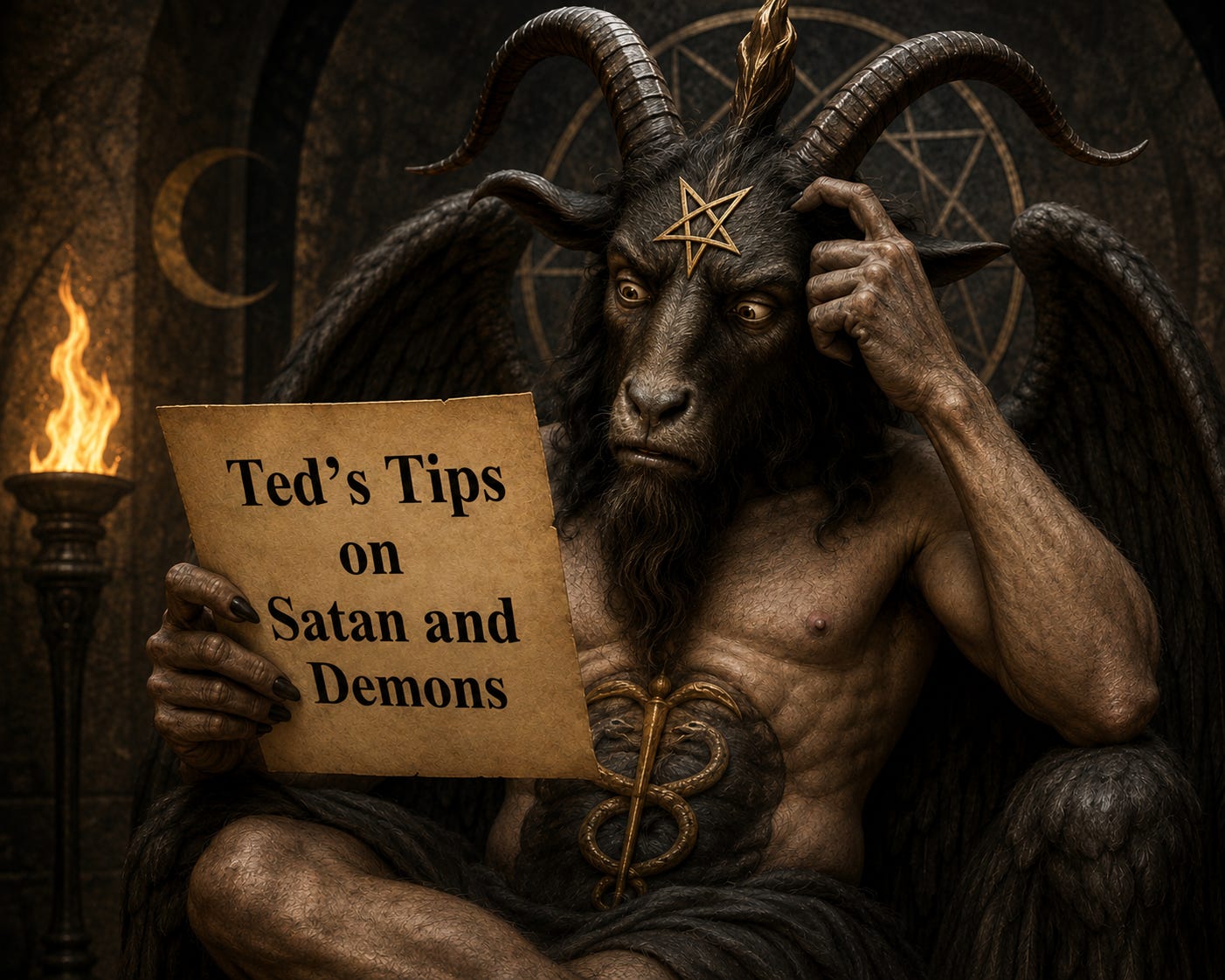
So far, so good. In my own wrestlings with such theological matters, I tend to think that it’s important to stress that Satan does not exist. Satan is real, to be sure. But Satan does not exist. Why? Because Satan is the force that diminishes, dissolves, and destroys what exists. For Satan to exist would be self-contradictory.
In some previous column posts -- “Sin 7: The True Story of Satanic Panic”; “Sin 8: How can Satan Cast out Satan?“; “Sin 9: Ted’s Tips on Satan and Demons” -- I claimed that the public theologian should feel obligated to provide the wider culture with an illuminating theology of Satan and Satanism. A theological interpretation of Satan and demons could be useful to both believers and non-believers. Such a theological interpretation, of course, should be true to Holy Scripture, rationally articulated, and aimed at honoring the common good.
Let me make a point that may be obscured by Thomas Oord’s formulation of the question. A theology of Satan and demons is about evil. It is not about the existence of evil personalities. It is not about supernaturalism or spiritualism. The occult may be fascinating, to be sure. But keep in mind: the subject of Satan and demons is about evil.
With this in mind, let me reiterate my list of seven tips.
I. First, Satan is real; but Satan does not exist. To exist means to stand out (ek=out + stasis = stand) from nonbeing. To stand out of nonbeing means to exist in a specific time and place. Satan does not exist in this sense. Satan is rather the aggressive force of nonbeing within the realm of being. Satan destroys what exists.
Systematic theologian Paul Tillich reminds us that there are two kinds of nonbeing. “Ouk on is the ‘nothing’ which has no relation at all to being; me on is the ‘nothing’ which has a dialectical relation to being”(Tillich 1951-1963, 1:188). The second, me on, is the aggressive nonbeing which destroys what is. Destroying! That’s the province of Satan. Finally, “Satan, the principle of the negative, has no independent reality” (Tillich 1951-1963, 2:171).
Here is the takeaway. Even if we say Satan does not exist as a single person in a specific time and place, it is certainly the case that evil is real. Evil is a Satanic force that destroys what is.
II. Second, Satan is personal; but Satan is not a person. To be a person is to spiritually integrate body and mind around a core self or soul. Satan, in contrast, is the force of disintegration. Satan undermines and destroys the self. Satan destroys personhood. To lose one’s self is to feel zerstreut, disintegrated. If a friend asks you whether you believe Satan is a person, tell that questioner to jump in the lake. Don’t get diverted from the main issue, namely, evil.
The term Paul Tillich uses here is “Self-loss,” a loss of what integrates us as a person. “Self-loss is the loss of one’s determining center, the disintegration of the unity of the person….The horrifying experience of ‘falling to pieces’ gets hold of the person….In extreme cases the complete unreality of one’s world is felt; nothing is left except the awareness of one’s own empty self”(Tillich 1951-1963, 2:61). Satan, as the principle of the negative, delights at this dissolution of the personal self.
The Holy Spirit, in contrast to Satan, provides the power to become a robust self. That gifted power is divine grace. When our very self becomes integrated around the imago Dei, around the image of God that is Jesus Christ, then that self becomes an eternal self. This is what Satan tries to prevent from happening.
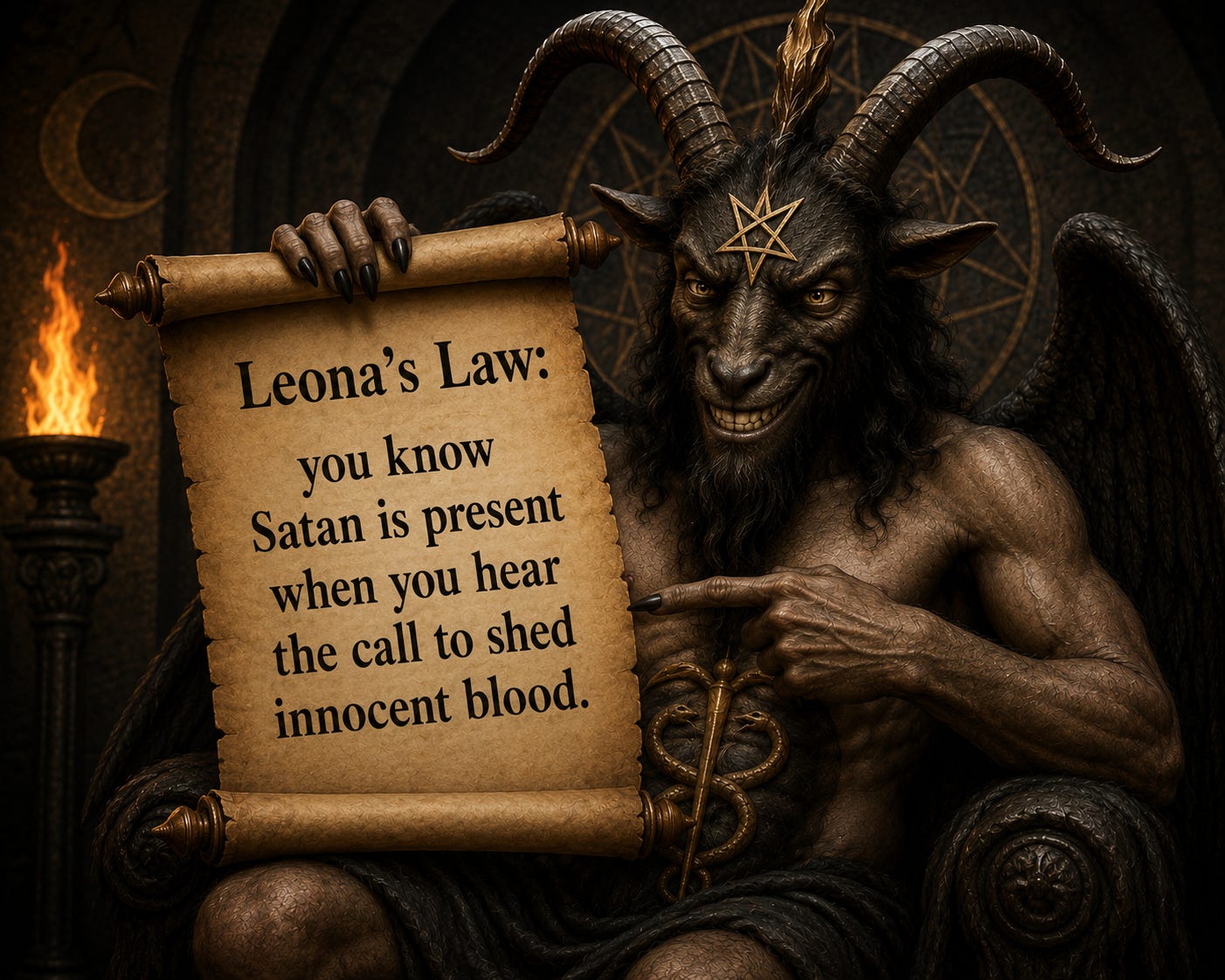
You know Satan is present when you hear the call to shed innocent blood, either figuratively or literally. This is Leona’s Law in the book, The Moon Turns to Blood.
III. Third, look for Satan when you see rapid finger-pointing and hear a vicious volley of accusations. You may not see Satan personally. But you’ll certainly smell the elephant-sized manure Satan leaves behind. As the Prince of Disorder, Satan corrupts community first by pitting all against all in an apparent never-ending war of accusations. But then, the Prince of Order reverses course, pitting all against an individual or a minority. A scapegoat gets selected. Those previously bickering at one another suddenly become united against the scapegoat. Everyone feels a deep defensive bond. In this fashion, Satan makes order out of disorder. Mob order. Satan builds social order on the figurative, if not literal, slaying of the scapegoat.
Here is a biblical example. Jesus was selected as a scapegoat to make peace between Jews and Romans. “That same day Herod and Pilate became friends with each other; before this they had been enemies” (Luke 23:12). Nothing makes stronger friends than a common scapegoat. But, of course, every scapegoat is only temporary. Soon, disorder as a cacophony of accusations breaks out again and again. Satan laughs uproariously at our inability to resist.
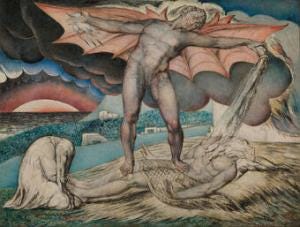
We could think of the crucified Jesus as the last of the scapegoats. Followers of Jesus resist Satan by refusing to participate in scapegoating.
One important message sent to us from Jesus’ cross is this: no more scapegoats! (Heim, 2006) S. Mark Heim contends that “the significance of the cross stands out with particular clarity when seen in the light of a particular aspect of evil, a dynamic of scapegoating violence that encompasses both the individual and society” (Heim 2006, 10). The message from the cross is clear: no more scapegoats!
IV. Fourth, almost all sin is evil performed in the name of the good. To say it another way, hypocrisy is built right into garden-variety sinning. Radical evil designates evil done in the name of evil. But this is very rare. So rare that we’ll not even discuss it here.
Even Satan has a hard time engaging in radical evil. Whenever Satan accuses someone of doing evil, Satan invokes the criterion of the good. That is, Satan appeals to what is good to justify our sin. Please get clear on this subtle point: Satan appeals to what is good when enticing us to engage in evil. You and I rarely pursue evil for its own sake. Rather, we justify our evil by calling it something good. Sin comes pre-shrink-wrapped in hypocrisy.
Evil is always a leach off the good. Never the reverse. Even when Satan tempts us, he tempts us by holding something good in front of us. That’s why Satan and lies come wrapped together in a single package.
Saint Augustine calls evil “the absence of good” or privatio boni. “But although no one can doubt that good and evil are contraries, not only can they exist at the same time, but evil cannot exist without good, or in anything that is not good. Good, however, can exist without evil”(Augustine 1961, 15). No matter how aggressive Satan may attack the good, Satan depends on the good for his very attack. When you and I engage in violence against a person, an animal, or the natural world, we do so in the name of some good so that we feel self-justified in shedding innocent blood.
V. Fifth, sin-talk in church helps us to understand ourselves in the context of God’s grace. Bashing evangelical Christians has become as popular a sport as Pickleball. Too much sin talk! That’s the chief complaint against evangelical churches.
To the contrary, I believe sin-talk helps us understand our own inner motivation, action, and impact. Sin-talk within a community of grace provides an opportunity for personal integration around faith in the forgiving one, Jesus Christ. Without sin-talk, we are unable to dig beneath the hypocritical lie to uncover the truth about ourselves and about God’s grace.
The dialectic of sin ‘n’ grace in the Lutheran distinction between Law and Gospel provides a healthy form of sin-talk that accomplishes two things. First, the Law-Gospel dialectic provides a realistic grasp of our human nature. Second, the Law-Gospel dialectic proclaims the grace of our forgiving God.
Let’s get realistic about the human condition regarding sin. Brian McDonald, following René Girard, identifies the foundational principle of culture as “Satan.” Satan sits on the throne of human culture. Satan tries to define us in terms of lies, lies that make us feel powerful.

In the New Testament, Satan is described as the Prince of the World of Darkness. Satan is “the god of this world has blinded the minds of the unbelievers, to keep them from seeing the light of the gospel of the glory of Christ, who is the image of God” (2nd Cor 4:4). Satan mirrors perfectly Christ’s description of “the Prince of this world” who was moved by envy and was “a liar and a murderer from the first.”
Notice how today’s accusers in the political realm want to get a grip on American history. Each accuser wants to tell the hegemonic story of America’s origin and, hence, American essence in a way that ideologically supports a specific group’s position of cultural power. To own the history is to own cultural capital. Telling lies about our origin to maintain cultural power is one of the ways Satan laughs all the way to the bank.
An indescribable digital chaos of alternative facts, conspiracy theories, acrimonious accusations, and outright lies daily engulfs us. If we would rely solely on our digital worldview for our self-understanding, disorientation, if not disintegration and depression, could be the only result. This is the kingdom of darkness. Its only source of light is the sparkle off Satan’s teeth as he smiles.
By laying down his life to expose and overthrow the kingdom of darkness built on violence and untruth, Jesus Christ introduced the world to another kingdom. This new kingdom is “not of this world.” The fundamental principles of God’s kingdom include repentance for sins instead of the catharsis of scapegoating. They include love of God and neighbor rather than the warfare of accusations and justification for violence.
VI. Sixth, forgiving others protects you from demon possession. The concept of the demonic in Paul Tillich’s systematic theology takes the form of idolatry. The demonic gains power when we treat something penultimate as if it were ultimate. We invite the demonic when we treat the relative as if it were absolute. The most common form of demon possession according to Tillich’s colleague at Union Seminary, Reinhold Niebuhr--perhaps the most renowned public theologian of the last century--is nationalism. “The most striking, contemporary form of it [the demonic] is a religious nationalism in which race and nation assume the eminence of God and demand unconditioned devotion. This absolute claim for something which is not absolute identifies the possessing spirit as demonic” (Niebuhr, 2:111). When nationalism becomes jingoism, people die.
That’s group demonism. What about individual demon possession?
No demon will possess you uninvited. Whew! Relief, huh? Even so, I’m not confident every Bible interpreter gets this point about Satan and demons straight.
How can you invite a demon in? By holding a grudge. By demanding revenge. If you feel wronged by someone and want justice so fiercely that you become twitterpated with paying an eye for an eye or a tooth for a tooth, you’re in effect placing a welcome mat for Satan. If you take Jesus’ advice and forgive as God forgives, no respectable demon will want to hang out with you.
Don’t just take my word for it. Try reading Anton LaVey’s Satanic Bible. The high priest of San Francisco’s Church of Satan was a hedonist. Pleasure is the highest good, hedonists agree. But what is the highest pleasure? Fame? Wealth? Power? No, says the Satanic Bible. Revenge gives a satisfaction that no other pleasure can give. Why? Because in revenge you feel that justice is done, and justice is eternal.
If you pay for a Satanic ritual sacrifice, then the Prince of Darkness will aid you in getting the justice you believe you so justly deserve. With this as the framework, one can easily see why Jesus so emphasized forgiveness rather than revenge.
You have heard that it was said, “An eye for an eye and a tooth for a tooth.” But I say to you, Do not resist an evildoer. But if anyone strikes you on the right cheek, turn the other also; and if anyone wants to sue you and take your coat, give your cloak as well; and if anyone forces you to go one mile, go also the second mile. Give to everyone who begs from you, and do not refuse anyone who wants to borrow from you. (Matthew 5: 37-42)
Satan simply cannot handle forgiving behavior.
VII. Seventh, exorcism in the name of Jesus Christ works anywhere. This is not a topic progressive Christians like. But it’s biblical, theological, and practical. Demons are not pluralists. They know Jesus Christ when the name is pronounced.
I’ve interviewed Christian exorcists. One in Sri Lanka was Edison Mendis. Mendis has expelled demons from Buddhists, Hindus, and atheists. The demons know who Jesus Christ is, even if the one possessed by the demon does not. Mendis explained to me that he would begin each exorcism by discerning whether a demon was actually present or not. He would place his hand firmly on the possessed person’s head and then ask the person to recite the Lord’s Prayer or the Apostles’ Creed. If the victim could not recite such words from memory—Hindus and Buddhists who are unfamiliar with these symbols—he or she could read the words. If a demon were present, this could throw the possessed person into convulsions or induce violent writhing.
Mendis would then ask for the demon’s name. With the name, Mendis would command—“in the name of Jesus Christ”—that the demon depart from the person, the room, the village, and go to a place appointed by God to await judgment. The formerly possessed person would relax, and the face turn serene (Peters, 1993, 257-258).
In modern Western society, demon possession of an individual is rare. Present. But rare.
What is rife in the Modern West is group madness. Group madness comes to us on social media, television news broadcasts, and political rallies. Especially in democracies, mob violence raises its ugly head daily at the verbal political levels in the media and in the neighborhoods. Accusations fly like locusts. The volley of accusations is Satan inciting us to call for the shedding of innocent blood. When society answers that call, Satan is delighted.
Leona Foxx, the protagonist in the espionage novel, The Moon Turns to Blood, has made this her theological mantra: you know Satan is present when you hear the call to shed innocent blood.
On the one hand, we might say that playing accusation volleyball belongs in the category of original sin. We human beings simply can’t help it. Do we have free will in this matter? Allegedly, we’re bound to sin in this fashion. But, I ask: just how does Satanic determinism apply?
Even though sin may be universal in human experience, it is not necessary. No. Sin is not necessary. Deep down, our human nature is what God is calling us to become in Jesus Christ. Deep down beneath the tarnished veneer, we are the imago Dei. Here is theologian Nancey Murphy and mathematician George Ellis.
“We reject the ontology of violence which implies that selfishness and violent coercion are basic to human nature. In its place we develop a theory of human life as created for self-sacrifice and nonviolence. This kenotic ethic--an ethic of self-emptying for the sake of the other--is in turn explained and justified by a correlative theology: the kenotic way of life is objectively the right way of life for all of humankind because it reflects the moral character of God” (Murphy 1996, 17).

To say it another way, each of us has the capacity to say “no” to Satan. Well, “no” is a negative, to be sure. Nevertheless, it might very well be worth a little negativity if we are to turn toward the grace that draws us to God and toward caring human community.
Oh, yes, Saint Augustine and Saint Thomas Aquinas made it clear that God provides the first grace that empowers us to say “no” to all temptation. But that’s beside the point. The point is this: we are capable of saying “no” when we hear Satan’s call to shed innocent blood, either figuratively or literally.
I worry a tad when theologians formulate the issue around the question of Satan’s existence as a supernatural person. This risks misleading us, because Satan is the principle of the person’s disintegration, destruction, and death. Instead, I believe we should formulate our questions around sin and evil.
I am trying to explicate the locus on sin and evil. A careful explication of human sin includes an explication of God’s grace. God’s grace could lead toward holy living that includes, paradoxically, the mandate to sin boldly. The combination lock that opens the door to holy living requires the above seven numbers regarding Satan and demons. If we forgive rather than hold a grudge, no self-respecting demon will have any interest in visiting us. If we lower, if not eliminate, the tone of accusing one another, the opportunity for a mutually respectful human community will appear. We can establish a communal bond on love rather than on scapegoating. Satan might not like this. But God certainly would.
ST2157. SIN 7 The true story of Satanic Panic
ST 2158. SIN 8 How can Satan cast out Satan?
ST 2159. SIN 9 Ted’s Tips on Satan and Demons
ST 2161. SIN 11 Sin-Talk and Grace-Talk
Substack PT 4015 Revenge in the Voice of Satan: Choose Love for America’s Future 7
▓
Meet Ted Peters. For Substack, Ted Peters posts articles and notices in the field of Public Theology. He is a pastor in the Evangelical Lutheran Church in America and an emeritus professor at Pacific Lutheran Theological Seminary and the Graduate Theological Union. His single-volume systematic theology, God—The World’s Future, is now in its 3rd edition. He has also authored God as Trinity plus Sin: Radical Evil in Soul and Society, as well as Sin Boldly: Justifying Faith for Fragile and Broken Souls. In 2023, he published The Voice of Public Theology, with ATF Press. More recently, he has published an edited volume, Promise and Peril of AI and IA: New Technology Meets Religion, Theology, and Ethics (ATF 2025), and, along with Arvin Gouw, an edited collection, The CRISPR Revolution in Science, Religion, and Ethics (Bloomsbury 2025). Soon to be released is a volume of essays, A Handbook on Astrobiology, Astrotheology, and Astroanthropology, co-edited with Carolina Azucena Sanz de la Fuente and Arvin Gouw, with ATF.
See his website: TedsTimelyTake.com and Patheos blog site.
▓
Augustine. 1961. The Enchiridion on Faith, Hope, and Love. Chicago: Henry Regnery, Gateway Edition.
Clark, Fred. January 22 2022. “The Satanic Panic of the 20s.” Patheos Slacktivist
Girard, René. 2001. I See Satan Fall Like Lightning. Maryknoll, NY: Orbis.
Heim, S. Mark. 2006. Saved from Sacrifice: A Theology of the Cross. Grand Rapids, MI: Wm. B. Eerdmans.
Heim, S. Mark. September 5, 2006. “No More Scapegoats.” Christian Century 123:18 22-29.
Murphy, Nancey, and George Ellis. 1996. On the Moral Nature of the Universe: Theology, Cosmology, and Ethics. Minneapolis, MN: Fortress Press.
Niebuhr, Reinhold, 1941-1942. The Nature and Destiny of Man. 2 Volumes: New York: Scribners.
Oord, Thomas. 2026. A Systematic Theology of Love. Volume One: God and Creation. SacraSage Press.
Peters, Ted. 1993. Sin: Radical Evil in Soul and Society. Grand Rapids, MI: Eerdmans.
Peters, Ted. 2015. Sin Boldly! Minneapolis, MN: Fortress Press.
Tillich, Paul. 1951-1963. Systematic Theology. 3 Volumes: Chicago: University of Chicago Press.
Comments
Nothing yet. Say the first thing.
Sign in to join the conversation.