
4:47 a.m. (forty-five minutes before sunrise). Fifty-one degrees, with a west wind at two miles per hour, gusting to five—calm compared with last evening, when the wind snapped branches and heart-rotted trees. Robins singing on the pergola at 4:37 a.m.
Clear overhead. Lightly striated in the east and north. A small cloud clings to the horizon in the valley between Smarts Mountain and Mount Cube. Another, a cottony puff, drifts above the mouth of the White River.
Then, as the sun rises above Moose Mountain, the east gleams like polished gunmetal. Light at first, then deepening to a metallic gray-purple—an evanescent wash that vanishes in moments.
Sprays of goldenrod, the first hint that summer is not eternal, color the edge of the road and the uncut meadow with yellow.
5:04 a.m. red-eyed vireos join robins, singing nonstop in the maples, the oaks, the hemlocks.
5:08 a.m. front-lawn chipping sparrows join in and a hermit thrush, hidden in the hemlock shadows.
5:10 a.m. lone crow across an empty sky, calling
5:12 a.m. goldfinch—many, many—back and forth above the meadow. Song sparrow in the meadow. Both singing, full-throated.
Ten minutes later, an indigo bunting on an electric line, so intensely blue I have to stop and stare.
5:26 a.m., just as the sun crests Moose Mountain, a pheobe decides to sing. Joined by a wood thrush and an eastern towhee. Then, within moments, a blue jay, first of many, and a titmouse, also first of many.
Red-eyed vireo singing on one side of the road, blue-headed vireo on the other. Almost identical songs. Stereophonic but incoordinated speakers (like my college apartment) ... the red-eyed is louder and faster, a ceaseless babble—a terminal outpouring. Blue-headed, more dignified, pauses, considers. Leaves me wanting more, not less.
Total: twenty-nine species. Scarlet tanager, tree-top level, flies over the road; common yellowthroat; swamp sparrow; house sparrow; house finch.
At home: two rose-breasted grosbeak families—males, females, and grown chicks, two each. Black and white and red. A summer highlight, a narcotic intrusion. The comings and goings of hummingbirds at all three feeders and the vine honeysuckles that climb the pergola, bearing dozens of clusters of red, trumpet-shaped flowers.
The juncos fledged four chicks from the potted plant hanging from the pergola, which, for several weeks, made watering a calculated risk.
Yesterday’s pre-dawn encounter: Adolescent bear stands in the road, like a Newfoundland—dark, shaggy, and immense. We stare at each other in the gray light. I keep walking. The bear keeps standing, staring. Tiny eyes in a big head, owl in reverse. Dim light. A pregnant moment. Then the bear turns and steps into the woods, walking back and forth, flat-footed and noisy, before disappearing into the shadows. I hear it, but can no longer see it. I stand for long moments, peering into the dark.
I think of my bird feeders filled to the brim, my raspberry vines laden with fruit, my moldering compost. Should I continue to walk or go home? Defend my deck with a maniacal cry and bluff charge like a dog on a leash? The morning slowly uncurls. Farther up the road, the bear returns, saunters down the bank and into a meadow, through daisies and goldenrod, in no particular hurry. Then it stops and looks back at me, like a driver about to back up, though far more flexible. We consider each other again.
My walk unravels, spectacularly cut short like a dream disturbed. Bear heads downhill, and I home to breakfast on my deck in the company of squirrels.
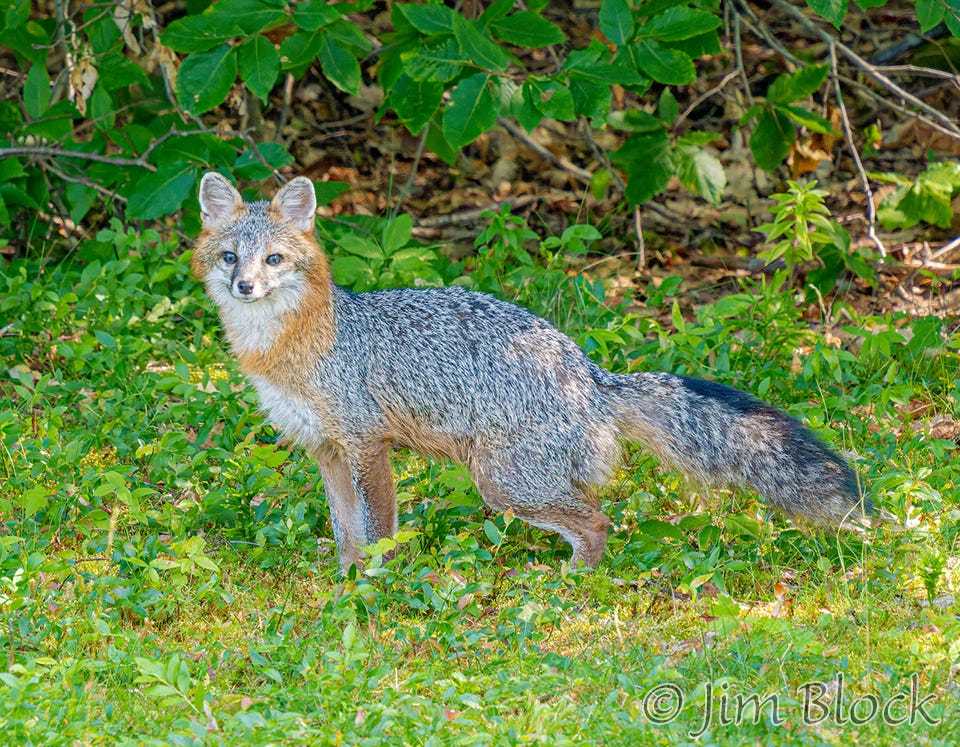
What happens when the light goes out: in the realm of owls, beneath the velvet blanket of night, a hillside stirs awake. A bear is too large to hide, too heavy-footed, too forceful not to leave its signature—rolled stones, shattered stumps, the torn weave of the woods. But gray foxes pass like breath over knuckled roots and through sinuous streambeds. A couple and two kits, one lost, return in tandem to the birthing den after six-week wandering somewhere beyond sight.
There are eight million stories in the dark forest, and a wildlife cam turns the world gently back into scale.
Gray fox videos courtesy of David Pelletier
Gray fox and skunk in the background
Foxes grooming and one kit
Tender greeting
Gray fox in daylight, photograph courtesy of Jim Block
To my subscribers, thank you for joining me on this journey. I appreciate the company. If you’re a paid subscriber to Another Morning in Paradise, thank you. If you’re not, please consider; your financial support helps me create these postings.
As a lifelong naturalist and Yankee fan, I follow a trail blazed by John Burroughs and John Muir, neither of whom paid much attention to baseball. My work has appeared in Houghton Mifflin’s The Best American Sports Writing, Audubon, Sierra, Sports Illustrated, National Wildlife, OnEarth, National Geographic Traveler, National Geographic Books, Yankee, The New York Times, Newsday, The Boston Globe, The Chicago Sun-Times, The Guardian, and The Daily Telegraph, among other publications and anthologies. For twenty-four years, I was a regular commentator on Vermont Public Radio, and occasionally on NPR. I am the author of Backtracking: The Way of a Naturalist (1987), Blood Brook: A Naturalist’s Home Ground (1992), and Liquid Land: A Journey Through the Florida Everglades (2003), among other works of nonfiction. I received the Burroughs Medal in 2004, the highest literary honor awarded to an American nature writer. E. O. Wilson called America’s Snake: The Rise and Fall of the Timber Rattlesnake (2016) a beautifully written book [that] demonstrates just how good nature literature can be.
Beginning on 14 March 2020, the day after I returned home from Costa Rica, at the onset of the pandemic lockdown, I started writing a daily journal—part natural history, part memoir, and part commentary—that appeared here on Substack. Since the 25 August 2021 post, I have edited the 526 entries (deleting, combining, modifying) into a new book, The Promise of Sunrise: Finding Solace in a Broken World, which Green Writers Press published on the vernal equinox of 2025.
From: Seven Days
Ted Levin, Green Writers Press, 400 pages. $21.95.
A pissed-off woodpecker flies in and screams...
When COVID-19 crashed into his life in 2020, naturalist Ted Levin began taking a walk each day at sunrise through the woods and wetlands around his home in Thetford. His walks begat a daily blog and now a lyrical book that brings to life the world of efts and otters, warblers and wrens, chickadees and coyotes. Engaging natural history lessons — loon semen and mammoth bones make an appearance — weave through the daily entries, and slowly the reader also learns the story of the author’s life.
Levin’s writing can be extraordinarily vivid: Coyotes “hurl their voices at the crescent moon”; a bobcat has a face “like a soiled, fraying softball”; chickadees are “four maestros working on a score.” Writing such as this demands to be read as one reads poetry, in small sips, to be fully savored.
—Candace Page.
No posts
Comments
Nothing yet. Say the first thing.
Sign in to join the conversation.